
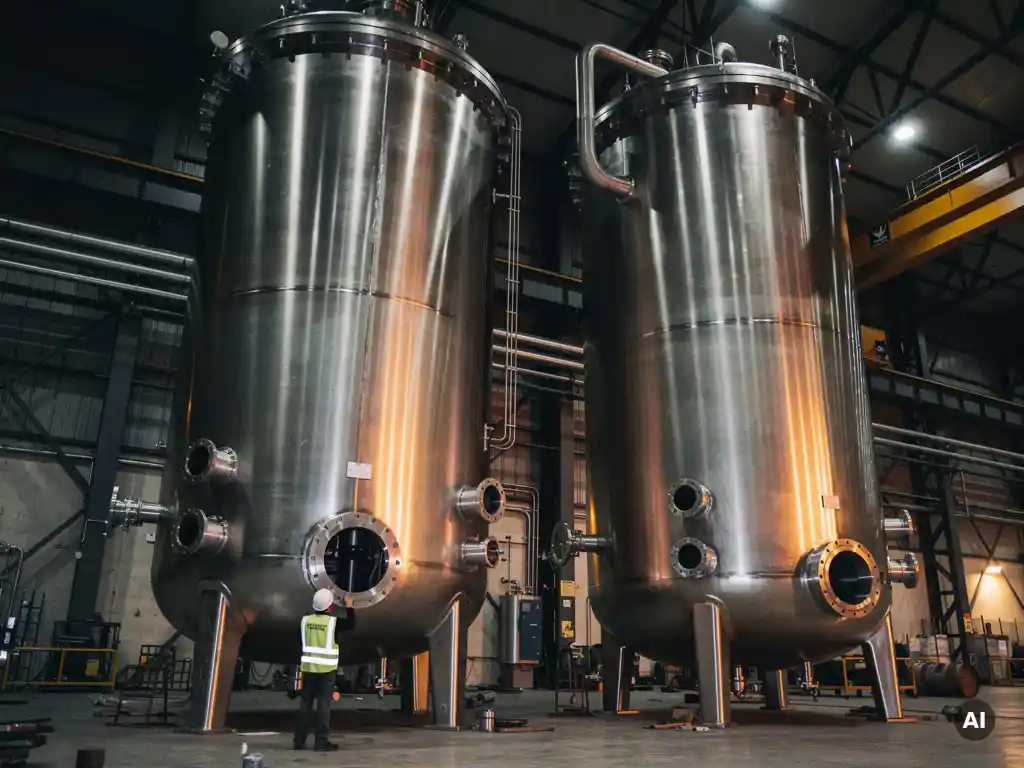
An autoclave and a reactor vessel are both pressure vessels, but they serve fundamentally different purposes. An autoclave is a sealed pressure chamber designed to expose its contents to controlled temperature and pressure conditions, while a reactor vessel is engineered to facilitate and control a specific chemical or physical process, typically involving reactions between substances. The distinction matters enormously when specifying equipment for a project.
In practice, the boundary between the two can blur, and some equipment genuinely functions as both. The sections below work through the key differences in function, design, application, and manufacturing complexity.
How do autoclaves and reactor vessels actually work?
An autoclave works by sealing a load inside a pressure-tight chamber and applying heat and pressure, often using steam or inert gas, to achieve a desired physical or chemical effect on the contents. The autoclave itself is largely passive: it creates the environment, and the material inside responds to it. The vessel does not need to manage a continuous reaction between multiple reagents.
A reactor vessel, by contrast, is designed to actively manage a process in which substances interact, transform, or are converted. This typically means the vessel must accommodate feeds and outlets, internal mixing or heat transfer, catalysts or reaction media, and precise control of process variables throughout the reaction cycle. The vessel is not merely a container but a controlled processing environment.
What design features distinguish an autoclave from a reactor?
The key design difference is that autoclaves prioritise uniform pressure and temperature distribution across the entire chamber volume, while reactor vessels are engineered around the specific chemistry and process dynamics they must support. This produces very different mechanical configurations.
Typical autoclave design features include:
- Large, unobstructed internal volume to accommodate the load
- Heavy-duty closure mechanisms, such as bayonet or segmented ring closures, allowing repeated opening and sealing
- Uniform heating systems, often jacketed walls or internal coils
- Pressure and temperature instrumentation focused on chamber conditions
- Corrosion-resistant lining or cladding where aggressive environments are involved
Reactor vessels, by contrast, are typically designed with multiple nozzles for feeds, vents, and instrumentation, internal components such as agitators, baffles, dip tubes, or catalyst beds, and heat transfer provisions precisely matched to the reaction’s thermal profile. Wall thickness, material selection, and internal geometry are all driven by the specific process chemistry and operating conditions.
What are autoclaves typically used for in industry?
Industrial autoclaves are used wherever a material or product must be subjected to elevated pressure and temperature as a processing step, rather than as part of a continuous chemical reaction. The autoclave provides the controlled environment; the transformation happens to the load itself.
Common industrial autoclave applications include high-pressure leaching of ores in hydrometallurgy, curing of composite materials and rubber products, sterilisation of medical and pharmaceutical goods, bonding and forming of aerospace components, and high-pressure processing in food and specialty chemical production. In hydrometallurgy in particular, industrial autoclaves operate under extremely demanding conditions, combining high pressure, elevated temperature, and highly corrosive process media such as sulfuric acid slurries.
The defining characteristic across all these uses is that the autoclave is cycled: loaded, sealed, pressurised, held, depressurised, and opened. This cyclical mechanical loading has a direct bearing on how the vessel must be designed and fabricated.
What processes require a reactor vessel instead of an autoclave?
A reactor vessel is required when the process involves a controlled chemical transformation between substances, rather than simply exposing a load to pressure and temperature. If the equipment must manage reagent feeds, reaction kinetics, catalyst contact, mixing, or continuous product withdrawal, a reactor is the appropriate equipment type.
Processes that typically require reactor vessels include polymerisation reactions such as polypropylene and polyethylene production, catalytic hydrogenation and hydrocracking, oxidation and nitration reactions in fine chemicals, fermentation at elevated pressure, and many refinery and petrochemical conversion processes. In these applications, the vessel design is inseparable from the process design: nozzle locations, internal geometry, agitator configuration, and heat transfer area are all determined by the chemistry involved.
Can an autoclave also function as a reactor vessel?
Yes, in certain applications an autoclave can function as a reactor vessel, and the two terms are sometimes used interchangeably in specific industries. This occurs when a batch process involves both the controlled environment of an autoclave and a chemical reaction taking place inside the chamber.
Hydrometallurgical pressure oxidation is a clear example: the vessel is called an autoclave, but a chemical reaction, specifically the oxidation of sulphide minerals, takes place inside it under pressure. Similarly, some high-pressure batch synthesis processes in specialty chemicals use autoclave-type vessels fitted with agitators and internal coils, making them functionally equivalent to batch reactors. What distinguishes these from standard autoclaves is the addition of process-specific internals and the need to manage reaction conditions, not just chamber conditions.
Which equipment type is harder to manufacture?
Neither type is inherently harder to manufacture than the other; the manufacturing complexity depends on the specific requirements of each piece of equipment. Both autoclaves and reactor vessels can reach extreme levels of fabrication difficulty depending on size, pressure rating, wall thickness, materials, and internal complexity.
Large industrial autoclaves present significant challenges in terms of sheer scale, closure mechanism precision, and cyclic fatigue resistance. Autoclaves approaching 1,000 tons in weight, as exist in hydrometallurgical applications, demand exceptional manufacturing infrastructure and quality control. Reactor vessels introduce their own complexities through internal components, multiple nozzles, tight dimensional tolerances on agitator clearances, and the need to fabricate in corrosion-resistant or clad materials where process chemistry demands it.
In practice, the most demanding projects in both categories share common fabrication challenges: advanced materials such as titanium, zirconium, Hastelloy, or clad constructions, thick-walled pressure-containing shells, and dimensional requirements that leave no margin for error.
When should a project specify an autoclave versus a reactor vessel?
The specification decision comes down to the nature of the process. If the equipment must create a controlled environment in which a load is processed by exposure to pressure and temperature, and the vessel itself is opened and reloaded in cycles, specify an autoclave. If the equipment must manage a chemical process involving reagent feeds, reactions, mixing, or continuous operation, specify a reactor vessel.
Where the process involves both a chemical reaction and a batch, high-pressure environment, the distinction becomes a design question rather than a terminology question. In those cases, the process requirements should drive the mechanical specification, and the equipment engineer’s role is to translate those requirements into a design that is both process-correct and manufacturable.
Early engagement between the process owner and the equipment manufacturer is valuable precisely because the boundary between these equipment types is not always clear from process requirements alone. The mechanical design implications of classifying equipment one way or the other can be significant.
How Coek supports projects involving autoclaves and reactor vessels
Coek Engineering manufactures custom pressure equipment for technically demanding applications where the distinction between equipment types, materials, and fabrication approach has real consequences. For projects involving either industrial autoclaves or reactor vessels, Coek’s capabilities include:
- Large-scale manufacturing for equipment up to approximately 10 metres in diameter and 1,000 tons in weight
- Advanced materials expertise including titanium, zirconium, Hastelloy, Inconel, and clad constructions
- In-house mechanical engineering to translate process specifications into manufacturable equipment designs
- More than 30 years of experience with clad construction for corrosion-resistant pressure equipment
- Compliance with international standards including PED, ASME, and ISO 9001
Whether a project requires a standalone vessel or a broader integrated equipment scope, Coek works from customer process requirements and converts them into mechanically sound, reliable equipment. Contact Coek to discuss your equipment requirements with a specialist.
Frequently Asked Questions
How do I know if my process requires a standard autoclave, a reactor vessel, or a hybrid of both?
Start by mapping out what the equipment actually needs to do: if it only needs to expose a load to controlled pressure and temperature in batch cycles, a standard autoclave is likely sufficient. If your process involves feeding reagents, managing reaction kinetics, continuous mixing, or withdrawing products during operation, you need a reactor vessel. When both conditions apply — for example, a batch high-pressure chemical synthesis — the process chemistry should drive the mechanical specification, and early involvement of an equipment engineer will help determine the right design approach before costly assumptions are locked in.
What are the most common mistakes engineers make when specifying pressure vessels for a new project?
One of the most frequent mistakes is treating the equipment type as a terminology choice rather than a design decision — calling something an autoclave when it functionally requires reactor internals, or vice versa, can lead to significant rework downstream. Another common error is underspecifying the process chemistry, particularly corrosion conditions, which directly affects material selection and can have a major impact on cost and lead time. Engaging the manufacturer early with full process data — temperature, pressure, fluid composition, cycle frequency, and expected service life — helps avoid both pitfalls.
How does cyclic loading affect the design and long-term reliability of an autoclave?
Every time an autoclave is pressurised and depressurised, the vessel shell and closure components experience mechanical stress cycles. Over thousands of cycles, this can lead to fatigue cracking if the vessel is not designed with cyclic loading in mind from the outset. Key design responses include conservative stress calculations, fatigue analysis per applicable codes (such as ASME VIII Div. 2 or EN 13445), robust closure mechanism design, and regular in-service inspection programs. Operators should also track actual cycle counts against the design fatigue life to plan maintenance and inspection intervals proactively.
What material options are available for highly corrosive autoclave or reactor applications, and how do I choose between them?
For aggressive environments — such as sulfuric acid slurries in hydrometallurgy or halogenated media in fine chemicals — common material solutions include solid corrosion-resistant alloys (titanium, zirconium, Hastelloy, Inconel) or clad constructions where a carbon or low-alloy steel shell is lined with a corrosion-resistant layer. The choice depends on the severity of the corrosive environment, operating temperature, mechanical loading, and budget: solid alloy construction offers maximum corrosion resistance but at higher material cost, while clad construction can deliver equivalent corrosion performance at lower overall cost for large vessels. A manufacturer with in-house clad expertise can model the trade-offs for your specific conditions.
What international standards and codes apply to industrial autoclaves and reactor vessels, and does it matter which one my equipment is built to?
Yes, the applicable code matters significantly — both for regulatory compliance and for the technical rigour of the design. Common standards include ASME Boiler and Pressure Vessel Code (widely used in North America and internationally), the European Pressure Equipment Directive (PED) with harmonised standards such as EN 13445, and various national codes depending on the installation country. The code affects calculation methods, material traceability requirements, inspection and testing protocols, and documentation. When specifying equipment for cross-border projects, confirm which code is required by the end-use jurisdiction early in the project, as switching codes mid-fabrication is costly and time-consuming.
How long does it typically take to manufacture a large custom autoclave or reactor vessel, and what factors affect lead time?
Lead times for large custom pressure vessels vary widely but commonly range from several months to over a year for the most complex or large-scale equipment. The primary drivers of lead time are vessel size and weight, wall thickness (which affects forming and welding time), material availability (specialty alloys and clad plate can have long procurement lead times), the complexity of internal components, and the inspection and certification requirements. Planning procurement and fabrication in parallel with detailed engineering, and engaging the manufacturer before the design is fully frozen, are the most effective ways to compress the overall schedule.
What should I prepare before approaching a pressure vessel manufacturer with a project inquiry?
The more process information you can provide upfront, the more accurate and useful the manufacturer’s technical and commercial response will be. At a minimum, prepare a summary of the process conditions (design pressure and temperature, operating pressure and temperature, fluid composition including any corrosive or hazardous components), the required vessel volume or throughput, the applicable design code and any client or site-specific standards, and a rough project timeline. If internal components such as agitators, heat transfer coils, or catalyst beds are required, include those in the brief. Even preliminary data is valuable — a capable manufacturer can help refine the specification as the process design matures.
Related Articles
- What are the main manufacturing challenges of large shell-and-tube heat exchangers?
- How do you assess the remaining service life of a pressure vessel?
- How does shell-and-tube heat exchanger design differ from reactor vessel design?
- What is clad construction in pressure vessel manufacturing?
- How do you select the right pressure vessel for your process?