
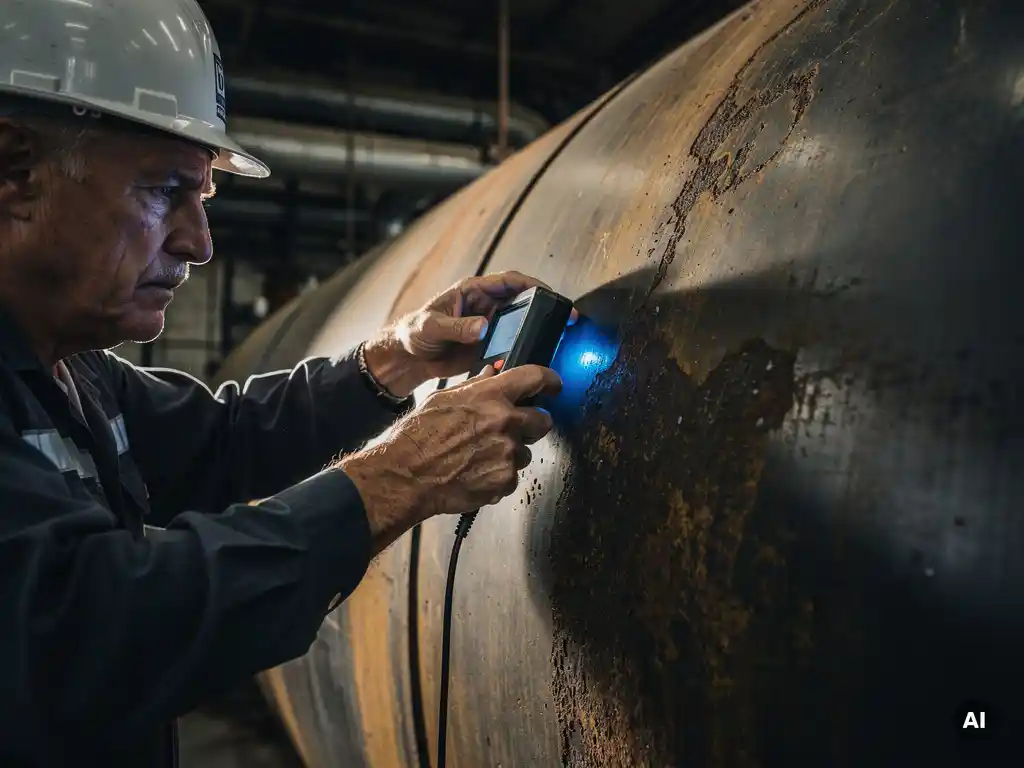
The remaining service life of a pressure vessel is determined by comparing the current condition of the equipment against its original design limits, using inspection data, corrosion rate measurements, and engineering assessment methods such as API 579 fitness-for-service analysis. In practice, this means calculating how much wall thickness or structural integrity remains before the vessel can no longer safely contain its operating pressure. The sections below address the key questions engineers and asset owners face when evaluating pressure vessel integrity and planning for life extension or retirement.
What factors determine how long a pressure vessel can safely operate?
The remaining service life of a pressure vessel depends on the rate at which operating conditions degrade the equipment relative to its original design margins. The primary factors are corrosion rate, wall thickness loss, material condition, weld integrity, operating pressure and temperature history, and the quality of original fabrication. Equipment operating in aggressive chemical environments or at high temperatures will generally reach its limits sooner than equipment in mild service.
Beyond corrosion, other degradation mechanisms include hydrogen embrittlement, stress corrosion cracking, creep at elevated temperatures, fatigue from cyclic loading, and erosion from process fluids. A vessel may have experienced none, one, or several of these mechanisms simultaneously, and each requires a different assessment approach.
The original design corrosion allowance, meaning the extra wall thickness built in at fabrication to accommodate expected material loss over time, is a central reference point. Once that allowance is consumed, the vessel is approaching the boundary of its safe operating envelope.
What is a fitness-for-service (FFS) assessment and when is it required?
A fitness-for-service assessment is a structured engineering evaluation that determines whether a piece of equipment containing flaws, damage, or deterioration can continue to operate safely under defined conditions. The most widely applied international framework is API 579-1/ASME FFS-1, which provides standardised methodologies for assessing a broad range of damage types, including general corrosion, localised metal loss, pitting, cracking, and dents.
An FFS assessment is typically required when routine inspection reveals wall thickness below the minimum required thickness, when cracks or weld defects are detected, when operating conditions have changed beyond the original design envelope, or when a vessel has reached or is approaching its original design life. Regulatory requirements in many jurisdictions also mandate FFS evaluation before a vessel can be returned to service after significant damage is found.
The assessment produces a clear engineering conclusion: the vessel is either fit for continued service as-is, fit with operational restrictions, or requires repair or retirement. This structured outcome is what distinguishes an FFS assessment from a simple inspection report.
How does non-destructive testing (NDT) feed into a remaining life calculation?
Non-destructive testing provides the measured data that any remaining life calculation depends on. Without accurate NDT results, a remaining life estimate is based on assumptions rather than evidence. Ultrasonic thickness measurements, radiographic examination, magnetic particle inspection, phased array ultrasonics, and acoustic emission testing each provide different types of information about the current condition of the vessel wall, welds, and heat-affected zones.
The most directly relevant NDT output for remaining life calculation is wall thickness data collected at multiple measurement points across the vessel shell, heads, and nozzles. When compared against the minimum required thickness calculated from the applicable pressure vessel code, these measurements reveal how much corrosion allowance remains. If multiple inspection intervals have been recorded, the data also allows the actual corrosion rate to be calculated rather than relying on the assumed design rate.
Advanced NDT methods such as phased array ultrasonic testing (PAUT) and time-of-flight diffraction (TOFD) allow detection and sizing of subsurface flaws that would not be visible through conventional methods, enabling a more complete picture of vessel integrity before any remaining life calculation is finalised.
What methods are used to calculate the remaining corrosion allowance?
The remaining corrosion allowance is calculated by subtracting the minimum required wall thickness as defined by the applicable design code from the current measured wall thickness. The result tells you how much additional material can be lost before the vessel can no longer safely contain its design pressure. Dividing this remaining allowance by the measured corrosion rate then gives the estimated remaining service life in years.
Several practical considerations affect the accuracy of this calculation:
- Corrosion rate basis: The rate should ideally be derived from actual inspection history rather than assumed from design data, as real operating conditions often differ from original assumptions.
- Localised versus general corrosion: Pitting or localised thinning requires different treatment than uniform wall loss, and API 579 Level 1 and Level 2 assessments provide specific methods for both.
- Future operating conditions: If process chemistry, temperature, or pressure will change, the projected corrosion rate must be adjusted accordingly.
- Inspection confidence: The measurement grid density and NDT method reliability affect how representative the thickness data is of the actual worst-case condition.
Where corrosion is not uniform, fitness-for-service methods allow engineers to assess whether localised thin areas are acceptable under the actual stress distribution, rather than applying a blanket rejection based on a single low reading.
What’s the difference between remaining life and remaining safe operating period?
Remaining life refers to the total calculated time before a vessel reaches its minimum acceptable wall thickness at the current corrosion rate. The remaining safe operating period is a shorter, practically defined interval that incorporates safety margins, inspection uncertainty, and regulatory requirements. The remaining safe operating period is always equal to or shorter than the remaining life, and it defines when the next inspection or intervention must occur.
This distinction matters because engineers and asset owners do not simply operate a vessel until it reaches its calculated end of life. Instead, they define inspection intervals within the safe operating period so that any acceleration in degradation is detected before the vessel reaches an unsafe condition. Standards such as API 510 and risk-based inspection (RBI) methodologies provide frameworks for setting these intervals based on the probability and consequence of failure.
In practical terms, a vessel might have a calculated remaining life of twelve years but a remaining safe operating period of four years, meaning the next formal inspection is due in four years to confirm the corrosion rate assumption remains valid before authorising continued operation.
When should a pressure vessel be repaired, rerated, or retired?
The decision between repair, rerate, and retirement depends on the nature and extent of the degradation, the technical feasibility and cost of repair, and the future operating requirements. A fitness-for-service assessment typically frames this decision by identifying which options are technically viable.
Repair is appropriate when the degradation is localised and can be addressed through weld overlay, insert plates, sleeve repairs, or controlled grinding within code-accepted limits. The repaired vessel must then be re-inspected and re-evaluated to confirm it meets minimum thickness requirements.
Rerate involves formally reducing the maximum allowable working pressure (MAWP) or changing the operating temperature range so that the vessel remains within its actual remaining structural capability. This is a legitimate life-extension strategy when the process can accommodate the reduced operating window.
Retirement is required when the degradation is too extensive or widespread for repair to be technically or economically justified, when the base material condition is fundamentally compromised, or when the cost of continued inspection and maintenance exceeds the value of continued operation. Regulatory requirements may also mandate retirement once certain thresholds are crossed.
How do advanced materials and clad construction affect remaining life assessment?
Pressure vessels fabricated from advanced corrosion-resistant materials or with clad construction present specific challenges and advantages in remaining life assessment. The assessment methodology must account for the actual material system rather than applying generic carbon steel assumptions.
For solid vessels fabricated from materials such as titanium, zirconium, Hastelloy, or Inconel, corrosion rates in aggressive media are typically much lower than for carbon steel, which can significantly extend the calculated remaining life. However, these materials may be susceptible to specific degradation mechanisms such as crevice corrosion, stress corrosion cracking in certain environments, or sensitisation in heat-affected zones, and the inspection programme must be designed to detect these failure modes specifically.
Clad vessels, which combine a structural carbon steel shell with a corrosion-resistant inner layer, require assessment of both components. The integrity of the cladding bond is critical: disbonding of the clad layer can expose the base material to the process environment, rapidly accelerating degradation of the structural shell. Inspection of clad vessels therefore includes evaluation of the cladding thickness, bond integrity, and any through-clad defects using appropriate NDT methods.
When a clad vessel requires repair, the repair procedure must restore both the structural integrity of the base material and the corrosion resistance of the inner layer, which demands welding expertise and procedure qualification specific to the clad material system.
How Coek supports pressure vessel integrity and life assessment decisions
When inspection findings or an FFS assessment point toward repair, rerate, or replacement, the quality of the original fabrication and the material system significantly influence what options are available. Coek Engineering designs and manufactures custom pressure vessels, reactors, and industrial autoclaves for technically demanding applications where material selection, wall thickness, clad construction, and dimensional precision are critical from the outset.
For asset owners and EPC contractors dealing with complex equipment decisions, Coek’s capabilities are particularly relevant when:
- Replacement equipment involves advanced materials such as titanium, zirconium, Hastelloy, or Inconel
- Clad construction is required to combine structural integrity with corrosion resistance
- Equipment dimensions, wall thickness, or weight exceed the capacity of commodity manufacturers
- Tight dimensional tolerances or complex internal configurations are required
- An integrated equipment scope is needed, combining the vessel with mechanical systems and components
If your assessment has identified that a vessel requires replacement or significant repair beyond what is economically viable, contact Coek Engineering to discuss your technical requirements and fabrication options.
Frequently Asked Questions
How do I know if my pressure vessel qualifies for a life extension rather than immediate retirement?
A vessel is a candidate for life extension if the remaining wall thickness is sufficient to sustain operating pressure with an acceptable safety margin, the base material has not suffered irreversible metallurgical degradation, and the degradation mechanism is well understood and predictable. A formal API 579 fitness-for-service assessment will determine this conclusively by evaluating current condition against code-defined acceptance criteria. If the assessment confirms fitness, a revised inspection interval and any operational restrictions are documented to govern the extended operating period.
What are the most common mistakes engineers make when calculating remaining service life?
The most frequent error is relying on the assumed design corrosion rate rather than calculating the actual rate from real inspection history, which can lead to either overly optimistic or unnecessarily conservative life estimates. Another common mistake is treating localised thinning or pitting the same as general corrosion, when in fact these require separate assessment methods under API 579 Level 1 or Level 2. Finally, engineers sometimes underestimate the impact of inspection uncertainty — a sparse measurement grid may miss the worst-case thinning location, making it essential to ensure NDT coverage is representative of the full vessel surface.
How often should a pressure vessel be inspected to keep remaining life estimates accurate?
Inspection frequency should be set based on the calculated remaining safe operating period, the corrosion rate confidence level, and the consequence of failure — not simply on a fixed calendar schedule. Risk-based inspection (RBI) methodologies, as outlined in API 580 and API 581, provide a structured framework for optimising inspection intervals by weighing probability of failure against potential consequences. As a general rule, the higher the uncertainty in the corrosion rate or the more severe the service environment, the shorter the inspection interval should be to detect any acceleration in degradation before it becomes a safety issue.
Can a pressure vessel's maximum allowable working pressure (MAWP) be increased if the actual wall thickness is greater than originally assumed?
Yes — if inspection confirms that the actual wall thickness is greater than the nominal thickness used in the original design calculation, it may be possible to formally rerate the vessel upward to a higher MAWP. This process, governed by the applicable pressure vessel code (such as ASME Section VIII or PED in Europe), requires a documented engineering calculation, review by a qualified inspector or authorised pressure vessel engineer, and in many jurisdictions, regulatory approval before the revised MAWP can be applied operationally. Any rerate must also account for nozzle ratings, flange pressure classes, and connected piping, not just the shell thickness.
What documentation should be in place before starting a remaining life or fitness-for-service assessment?
A complete assessment requires the original design and fabrication documentation, including the design code, material specifications, original wall thickness and corrosion allowance, weld maps, post-weld heat treatment records, and the original pressure test results. Historical inspection records showing previous thickness measurements, any repairs carried out, and the dates of prior assessments are equally critical for establishing an actual corrosion rate. If this documentation is incomplete or missing — which is common for older vessels — the assessment must start with a more conservative baseline and may require additional NDT to reconstruct the current condition profile.
At what point does it become more cost-effective to replace a pressure vessel than to continue repairing and inspecting it?
The replacement threshold is typically reached when the cumulative cost of repairs, increasingly frequent inspections, and operational restrictions imposed by fitness-for-service conditions exceeds the amortised cost of new equipment over its expected service life. A practical trigger is when repairs are addressing symptoms of widespread degradation rather than isolated defects — for example, when multiple weld overlays or insert plates are needed across the shell, or when the base material condition is compromised by hydrogen damage or stress corrosion cracking. At that point, the risk profile of continued operation also increases, and replacement with correctly specified new equipment often represents the lower-risk and lower-total-cost option.
How does operating temperature affect the remaining life calculation, and what changes if the vessel runs at elevated temperatures?
Operating temperature influences remaining life through two main pathways: it directly affects the corrosion rate (higher temperatures typically accelerate most corrosion mechanisms) and it determines whether time-dependent degradation mechanisms such as creep, high-temperature hydrogen attack, or metallurgical phase changes become relevant. For vessels operating above the creep threshold of the base material — which for carbon steel begins around 370°C — remaining life assessment must incorporate creep damage fraction calculations in addition to corrosion allowance analysis, following methods such as those in API 579 Part 10. If operating temperature has increased beyond the original design basis, the allowable stress values may also be lower at the new temperature, effectively reducing the MAWP and requiring a formal rerate evaluation.
Related Articles
- What documentation is required when delivering certified pressure equipment?
- What dimensional tolerances are required in high-pressure reactor vessels?
- How are large and heavy pressure vessels transported to site?
- What are the most common pressure vessel failures and their causes?
- How do you choose between solid and clad construction for corrosive service?