
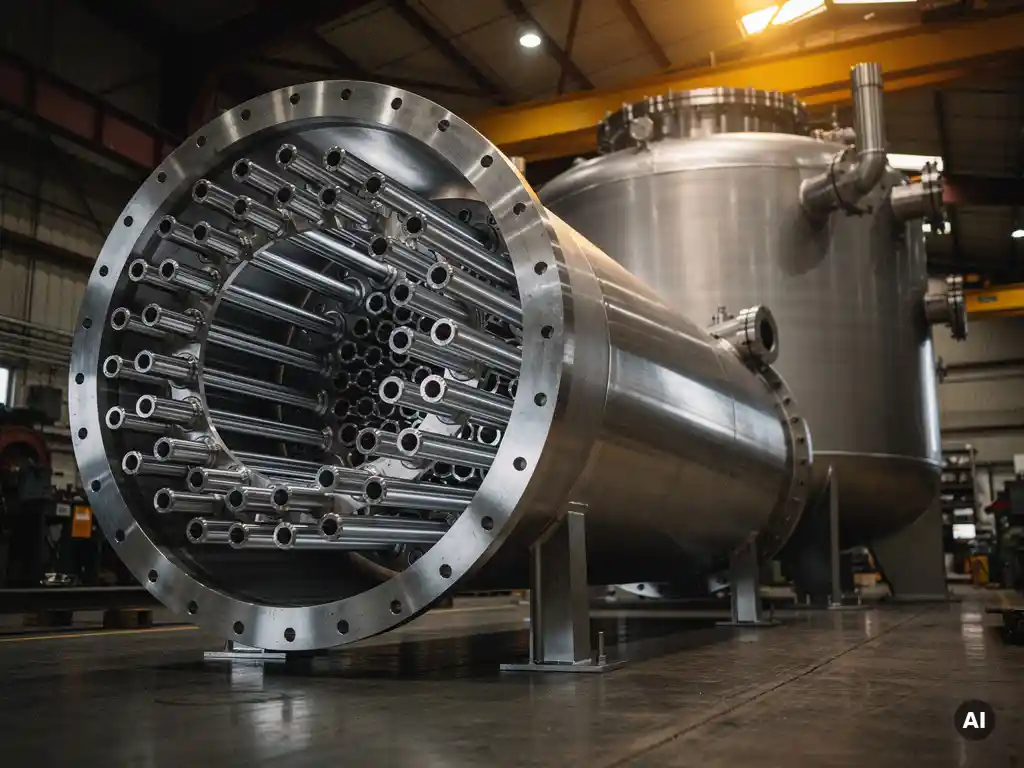
Shell-and-tube heat exchanger design and reactor vessel design differ fundamentally in purpose, internal complexity, and mechanical requirements. A heat exchanger is optimised for controlled thermal transfer between two fluid streams, while a reactor vessel is engineered to contain and support an active chemical process. Although both are classified as pressure equipment, the engineering decisions behind each are driven by entirely different process functions.
The distinction matters most when a project involves equipment that sits at the boundary between the two types, or when a fabricator must handle both within the same scope. The sections below address the most important technical differences engineers and procurement teams encounter when specifying either equipment type.
What are the core mechanical differences between a shell-and-tube heat exchanger and a reactor vessel?
The core mechanical difference is that a shell-and-tube heat exchanger is built around a tube bundle that separates two fluid streams, while a reactor vessel is a contained pressure chamber designed to house a chemical reaction. The heat exchanger’s geometry is governed by heat transfer area and flow path. The reactor’s geometry is governed by process chemistry, residence time, and internal mechanical requirements.
In a shell-and-tube heat exchanger, the tube bundle, tubesheets, baffles, and shell are all sized to maximise thermal performance while managing pressure drop across both the shell side and tube side. The mechanical structure serves the thermal function.
In a reactor vessel, the shell is a pressure boundary first. Everything inside, including internals, nozzles, and support structures, is arranged to support the reaction rather than transfer heat. The two equipment types may look similar from the outside, but their internal logic is entirely different.
How does thermal duty shape heat exchanger design in ways that don’t apply to reactors?
Thermal duty is the primary design driver for a shell-and-tube heat exchanger and determines nearly every major mechanical decision. The required heat transfer rate defines the tube count, tube length, tube diameter, baffle spacing, and shell diameter. None of these parameters exist in reactor vessel design, where the shell geometry responds to process volume and reaction conditions instead.
Heat exchanger designers must balance thermal efficiency against pressure drop, fouling potential, and mechanical integrity simultaneously. Baffle configuration, tube pitch, and flow arrangement all affect how efficiently heat moves between streams. Getting this balance wrong means the exchanger either underperforms thermally or creates excessive pressure drop that disrupts the wider process.
Reactors do involve heat management, particularly in exothermic or endothermic reactions, but heat transfer is typically handled through jacketing, internal coils, or external loop exchangers rather than through the vessel’s primary geometry. The reactor vessel itself is not optimised as a heat transfer surface.
What internal mechanical requirements make reactor vessel design more complex?
Reactor vessel design is generally more mechanically complex than heat exchanger design because the internals must support an active process rather than simply separate two fluid streams. Agitators, drive systems, internal baffles, catalyst supports, distribution trays, and multiple nozzle connections all need to be mechanically integrated into a pressure boundary that must remain structurally sound under demanding operating conditions.
Key internal requirements that add complexity to reactor design include:
- Agitator and drive system integration, including shaft seals, bearing housings, and mechanical seal systems
- Internal support structures for catalyst beds, trays, or packing
- Precise nozzle positioning for feed, product, vent, and instrumentation connections
- Internal coils or jackets for temperature control
- Manway and access requirements for inspection and maintenance
- Dimensional tolerances that affect internal flow distribution and reaction efficiency
Heat exchangers have internals too, but they are largely standardised around the tube bundle and baffle arrangement. Reactor internals are far more application-specific and often require close coordination between process engineers and mechanical fabricators to translate process requirements into manufacturable designs.
How do materials selection and corrosion requirements differ between the two equipment types?
Materials selection for both equipment types is driven by operating conditions, but reactors more frequently require advanced or exotic alloys because the process fluid is often chemically aggressive, reactive, or operates at extreme temperatures. Heat exchangers can also require corrosion-resistant materials, but their selection is typically more straightforward because the fluid streams are often better characterised and less reactive.
In reactor vessels, the combination of elevated temperature, pressure, and aggressive chemistry can demand materials such as titanium, zirconium, Hastelloy, Inconel, or clad constructions that combine a structural carbon steel shell with a corrosion-resistant inner layer. Clad construction is particularly relevant for large reactors where solid exotic alloy construction would be prohibitively heavy or expensive.
Shell-and-tube heat exchangers also use corrosion-resistant materials, particularly for tube bundles handling aggressive fluids. Titanium tubes, for example, are common in applications involving seawater or chlorinated process streams. However, the tube bundle can often be fabricated from a different material than the shell, giving designers flexibility to protect only the surfaces that contact the most aggressive fluid.
The key difference is that reactor vessels more often require a fully corrosion-resistant internal environment across a complex geometry, while heat exchangers allow more targeted material selection based on which side of the tube wall contacts which fluid.
Which design codes and standards govern each equipment type?
Both shell-and-tube heat exchangers and reactor vessels are governed by pressure vessel design codes, but heat exchangers have an additional layer of discipline-specific standards. In most international markets, the primary pressure equipment codes are ASME Section VIII (used globally) and the European Pressure Equipment Directive (PED), which apply to both equipment types.
Heat exchangers are additionally governed by TEMA (Tubular Exchanger Manufacturers Association) standards, which define mechanical design requirements specific to shell-and-tube construction, including tubesheet thickness, baffle spacing, nozzle loads, and bundle removability classifications. TEMA classes R, C, and B reflect different levels of mechanical robustness suited to different service categories.
Reactor vessels follow the same base pressure vessel codes but do not have an equivalent discipline-specific standard like TEMA. Their design is more heavily influenced by process licensor specifications, internal component requirements, and project-specific engineering documents. When a reactor includes rotating equipment such as an agitator, additional mechanical standards for drive systems and seals come into scope.
Both equipment types may also be subject to material-specific standards, non-destructive examination requirements, and third-party inspection hold points depending on the jurisdiction and criticality of the application.
When should a project specify a custom fabricator rather than a standard manufacturer for either equipment type?
A project should specify a custom fabricator when the equipment exceeds the dimensional, material, or mechanical boundaries that standard manufacturers are set up to handle. For both shell-and-tube heat exchangers and reactor vessels, the triggers are similar: unusual size, high wall thickness, advanced or clad materials, tight dimensional tolerances, complex internals, or a combination of requirements that falls outside catalogue or semi-standard production.
Standard heat exchanger manufacturers are well suited to equipment within common size ranges using conventional materials. When a project requires large-diameter shells, thick tubesheets, exotic tube materials, high-pressure ratings, or non-standard bundle configurations, a fabricator with specialist capabilities and in-house mechanical engineering becomes necessary.
For reactor vessels, the case for a custom fabricator is even more frequent. Reactors are rarely standard products. The combination of process-specific geometry, advanced materials, complex internals, and integrated mechanical systems means that most industrial reactors require a fabricator who can work directly from process specifications and translate them into a mechanically sound design.
The decision ultimately comes down to whether the equipment is technically demanding enough that commodity fabrication carries unacceptable risk. In applications where equipment failure, corrosion, or dimensional inaccuracy has serious process or safety consequences, the fabricator’s engineering depth and quality track record matter as much as manufacturing capacity.
How Coek supports shell-and-tube heat exchanger and reactor vessel projects
Coek Engineering manufactures custom pressure equipment for projects where standard fabrication is not sufficient. Whether the requirement is a large-scale industrial vessel or a technically demanding reactor, Coek combines in-house mechanical engineering with specialist fabrication capabilities to deliver equipment that meets process requirements and international standards.
Coek is particularly relevant when a project involves:
- Shell-and-tube heat exchangers requiring advanced materials, large dimensions, or high-pressure ratings
- Reactor vessels with complex internals, clad construction, or integrated mechanical scope
- Equipment fabricated from titanium, zirconium, Hastelloy, Inconel, or other demanding alloys
- Clad constructions combining structural carbon steel with corrosion-resistant inner layers
- Large or heavy equipment that exceeds the capacity of standard manufacturers
- Projects requiring compliance with ASME, PED, or other international pressure equipment standards
If your project involves technically demanding pressure equipment, contact Coek Engineering to discuss your specifications and fabrication requirements.
Frequently Asked Questions
How do I know whether my equipment qualifies as a heat exchanger or a reactor vessel for procurement and coding purposes?
The classification typically depends on whether the equipment’s primary function is thermal transfer between two fluid streams or containment of an active chemical process. If heat transfer is incidental to a reaction taking place inside the vessel, it is generally classified and specified as a reactor. This distinction matters practically because it determines which discipline-specific standards apply, how the equipment is reviewed by inspection authorities, and what fabrication capabilities your supplier needs to demonstrate.
What are the most common mistakes engineers make when specifying a shell-and-tube heat exchanger for the first time?
One of the most frequent mistakes is underspecifying fouling factors, which leads to an exchanger that meets its thermal duty on day one but degrades rapidly in service. Another common error is failing to define the preferred TEMA class upfront, which can result in a design that is either over-engineered for the application or mechanically inadequate for the service environment. Providing complete fluid properties, including viscosity across the operating temperature range, is also critical and often overlooked in early specifications.
What if my reactor vessel needs to handle both a chemical reaction and significant heat transfer — how is that typically designed?
This is a common scenario in batch and continuous process reactors, and it is typically handled by integrating a heating or cooling jacket around the vessel shell, internal coils, or an external recirculation loop with a dedicated heat exchanger. The reactor vessel itself remains designed primarily as a reaction containment vessel, while the heat transfer function is engineered as a separate but integrated mechanical system. The two functions are designed to complement each other without compromising the structural or process integrity of either.
How does clad construction work in practice, and when is it the right choice over solid exotic alloy fabrication?
Clad construction bonds a thin layer of corrosion-resistant alloy, such as titanium, zirconium, or Hastelloy, to a structural carbon steel or low-alloy steel substrate. This gives the vessel a chemically resistant internal surface while keeping the overall weight and cost significantly lower than solid exotic alloy fabrication. It is typically the right choice when the vessel is large enough that solid alloy construction becomes impractical or prohibitively expensive, and when the corrosion challenge is primarily on the process-contact surface rather than throughout the full wall thickness.
What should I look for when evaluating a fabricator's capability to handle complex reactor internals?
Look for evidence that the fabricator has in-house mechanical engineering capability, not just a workshop — they need to be able to interpret process specifications and translate them into manufacturable designs. Ask specifically about experience with agitator integration, shaft seal systems, and catalyst support structures, as these are the areas where coordination between process and mechanical engineering is most critical. References from similar process industries and documented quality records, including weld procedure qualifications and NDE certifications, are also strong indicators of genuine fabrication depth.
Can the same fabricator reliably manufacture both shell-and-tube heat exchangers and reactor vessels, or is specialisation important?
A fabricator who handles both types credibly typically has a broader base of pressure equipment experience, which can be an advantage on projects where the scope includes both equipment types or where the boundary between the two is technically ambiguous. However, the key is whether they have the engineering and workshop capabilities specific to each type — TEMA-compliant tubesheet and bundle fabrication on the heat exchanger side, and complex internal integration and advanced materials experience on the reactor side. Specialisation matters less than demonstrated competence in the specific mechanical challenges your equipment presents.
At what stage of a project should I engage a custom fabricator, and what information do I need to have ready?
Engaging a custom fabricator during the front-end engineering or detailed design phase gives them the opportunity to provide meaningful input on fabricability, materials availability, and dimensional constraints before the design is fully frozen. At minimum, you should have a process datasheet, preliminary sizing, fluid properties, operating and design conditions, and any applicable code or standard requirements ready for the initial discussion. The earlier a specialist fabricator is involved in technically demanding equipment, the more likely the final design will be both process-correct and efficiently manufacturable.
Related Articles
- How does operating temperature affect pressure vessel material selection?
- What is autoclave manufacturing?
- How do you manage thermal expansion in large high-temperature reactor vessels?
- How does post-weld heat treatment affect pressure vessel mechanical properties?
- What causes fatigue cracking in pressure vessels under cyclic loading?