
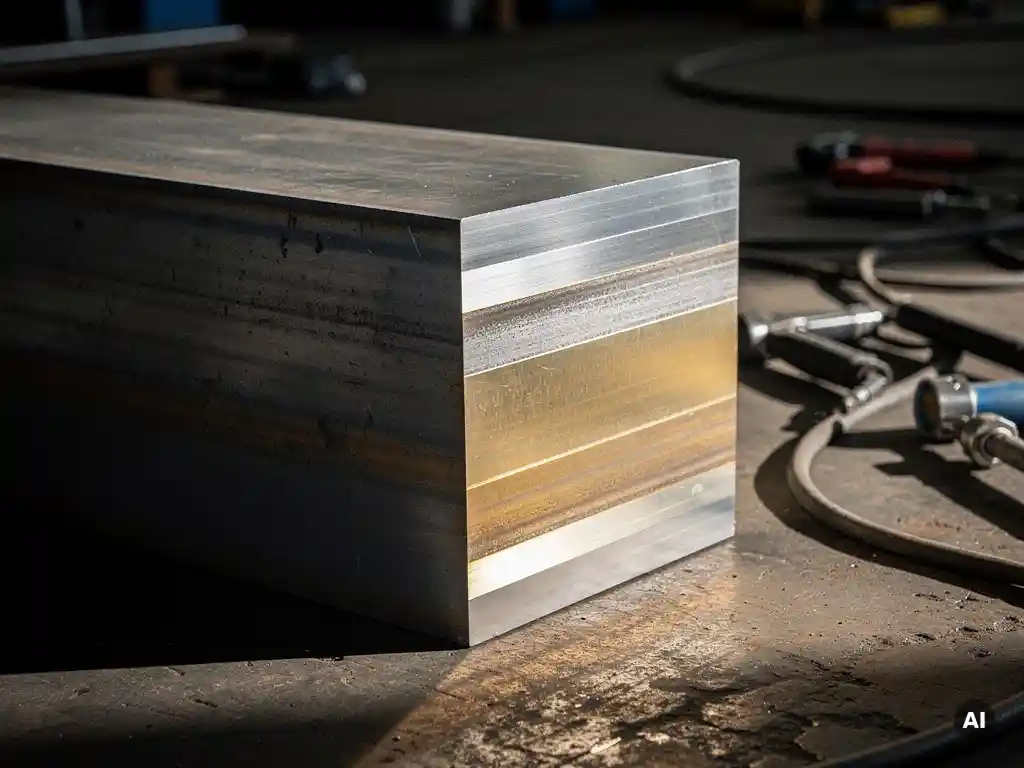
Clad construction in pressure vessel manufacturing is a fabrication method that bonds a thin layer of corrosion-resistant alloy to a structural base material, typically carbon steel or low-alloy steel. The result is a vessel that combines the mechanical strength and cost efficiency of the base material with the corrosion resistance of the alloy layer. This approach is widely used in chemically aggressive or high-temperature process environments where solid alloy construction would be technically unnecessary or economically prohibitive. The sections below address the most common questions engineers and procurement teams ask when specifying or evaluating clad pressure vessels.
What materials are typically used in clad pressure vessel construction?
In clad pressure vessel construction, the base material is almost always carbon steel or low-alloy steel, which provides the structural integrity and pressure-bearing capacity. The cladding layer is a corrosion-resistant alloy selected to match the process environment. Common cladding materials include stainless steel grades, titanium, zirconium, tantalum, Hastelloy, and Inconel, each suited to different chemical and temperature conditions.
The choice of cladding material depends on the specific corrosive media, operating temperature and pressure, and the required service life of the equipment. Titanium and zirconium, for example, are selected for highly aggressive acid environments where stainless steel would corrode too rapidly. Hastelloy and Inconel are used where both high temperatures and chemically active media are present. The cladding layer is typically a few millimetres thick and is not counted as part of the pressure-bearing wall thickness in most design codes, though this varies by standard.
How is cladding bonded to the base material in pressure vessels?
Cladding is bonded to the base material in pressure vessels through one of three primary methods: roll bonding, explosive bonding, or weld overlay cladding. Each method produces a metallurgical or mechanical bond between the two materials, but they differ significantly in how they are applied, the bond quality they achieve, and the applications they suit.
- Roll bonding applies heat and pressure to fuse the cladding and base material together as a composite plate. This is a mill process and produces consistent, uniform clad plate used as the starting material for vessel fabrication.
- Explosive bonding uses a controlled detonation to drive the cladding layer onto the base material at high velocity, creating an exceptionally strong metallurgical bond. It is particularly useful for material combinations that cannot be roll bonded due to incompatible mechanical properties.
- Weld overlay cladding deposits the corrosion-resistant alloy directly onto the base material using a welding process. This method is applied in the fabrication shop and is commonly used for nozzles, weld seams, and areas where clad plate cannot be used directly.
In practice, a clad pressure vessel often combines methods. The shell and heads may be fabricated from roll-bonded or explosively bonded clad plate, while weld overlay cladding is applied at joints, transitions, and penetrations to maintain the continuity of the corrosion-resistant lining.
When should clad construction be chosen over solid alloy vessels?
Clad construction should be chosen over solid alloy vessels when the process requires corrosion resistance but the mechanical loads, pressure rating, or vessel size make a full solid alloy construction economically or technically impractical. For most large vessels, the wall thickness required to meet pressure and structural requirements far exceeds what is needed for corrosion resistance alone, making solid alloy construction costly without adding functional value.
The economic argument for clad steel vessels becomes stronger as vessel size increases. A large reactor or column fabricated entirely from titanium or zirconium would require enormous quantities of expensive material, most of which serves a structural rather than a corrosion-protective function. Clad construction provides the required chemical resistance through a relatively thin alloy layer while keeping the bulk of the wall in lower-cost carbon or low-alloy steel.
Solid alloy construction remains the better choice for small vessels, high-purity applications where contamination from any carbon steel is unacceptable, or situations where the operating conditions are so severe that only the alloy can provide the necessary structural properties at temperature.
What are the main fabrication challenges in clad pressure vessel manufacturing?
The main fabrication challenges in clad pressure vessel manufacturing centre on maintaining the integrity of the bond between the cladding and base material throughout all forming, welding, and heat treatment operations. Any process that degrades the bond, dilutes the cladding composition, or introduces defects at the interface can compromise the corrosion performance of the finished vessel.
Welding is one of the most demanding aspects. Weld joints in clad vessels must be carefully sequenced and designed to avoid dilution of the corrosion-resistant layer by the base material. Incorrect welding procedures can result in a weld deposit that lacks the corrosion resistance of the parent cladding, creating a weak point in the protective barrier. Qualified welding procedures and thorough inspection of weld overlays are therefore critical.
Forming clad plate into shells and heads introduces additional complexity. The differential properties of the two bonded materials must be accounted for during rolling and pressing to avoid delamination or cracking at the interface. Post-weld heat treatment, when required, must be evaluated carefully to ensure it does not adversely affect the cladding material or the bond.
Non-destructive testing of clad vessels requires methods capable of detecting both surface defects in the cladding layer and interface defects between the cladding and the base material. Ultrasonic testing of the bond area is standard practice and must be performed at multiple stages of fabrication.
Which industries and processes most commonly specify clad pressure vessels?
Clad pressure vessels are most commonly specified in industries where process fluids are chemically aggressive, where operating temperatures are elevated, or where contamination of the product by metal ions is unacceptable. The combination of structural carbon steel with a corrosion-resistant inner surface addresses these requirements across a wide range of applications.
Chemical processing is the most established market, covering reactors, columns, and storage vessels handling acids, chlorides, solvents, and other corrosive media. Petrochemical and refining applications frequently specify clad vessels for hydroprocessing, sulphur recovery, and other services involving hydrogen sulphide, sulphuric acid, or similar compounds. Pulp and paper manufacturing uses clad digesters and vessels in contact with cooking liquors. Fertiliser production, mining and hydrometallurgy, and specialty chemical synthesis are further sectors where clad construction is routinely specified.
Large industrial autoclaves used in high-pressure, high-temperature processes also frequently incorporate clad construction, particularly where the process environment would attack unprotected carbon steel. The scale of these vessels often makes solid alloy construction impractical, reinforcing the case for a clad approach.
What standards and codes govern clad pressure vessel fabrication?
Clad pressure vessel fabrication is governed by the same major international codes that apply to pressure vessels generally, with additional requirements specific to clad construction. The two most widely referenced frameworks are the ASME Boiler and Pressure Vessel Code and the European Pressure Equipment Directive, with fabricators typically certified to work under one or both depending on the destination market.
Within the ASME code, Section VIII Division 1 and Division 2 include specific provisions for integrally clad and weld overlay clad vessels. These address how the cladding thickness is treated in design calculations, acceptable bonding methods, examination requirements for the clad interface, and welding procedure qualifications for dissimilar material combinations. ASME Section IX governs the qualification of welding procedures and welders, which is particularly important for the complex dissimilar metal welds found in clad vessel construction.
The European PED framework sets the essential safety requirements, with harmonised standards such as EN 13445 providing the technical rules for unfired pressure vessels, including provisions relevant to clad construction. Project-specific requirements may also reference additional standards for non-destructive examination, material qualification, and post-weld heat treatment.
Compliance with the applicable code is not simply a documentation exercise. It requires qualified fabrication procedures, certified inspection, traceable materials, and documented quality management throughout the manufacturing process.
How Coek supports clad pressure vessel projects
Coek Engineering has more than 30 years of experience fabricating clad pressure vessels for technically demanding industrial applications. The team translates customer process requirements into mechanically sound, manufacturable equipment, selecting and combining cladding methods to suit the material pairing, vessel geometry, and service conditions involved.
Key capabilities relevant to clad vessel projects include:
- Experience with a wide range of cladding materials, including titanium, zirconium, tantalum, Hastelloy, and Inconel
- In-house welding procedure qualification and weld overlay cladding for joints and penetrations
- Large-scale manufacturing capacity, supporting clad vessels up to 10 metres in diameter and approximately 1,000 tons in weight
- Fabrication under ISO 9001, PED, and ASME certification frameworks
- Engineering support to assess constructability and optimise the clad design for manufacturing efficiency
Whether the project involves a large industrial autoclave or a complex reactor vessel in a corrosive service, Coek’s team can work from process specifications to deliver equipment built to the required standard. To discuss your clad vessel requirements, contact the Coek team directly.
Frequently Asked Questions
How do I verify the integrity of the cladding bond after a clad pressure vessel has been delivered?
Post-delivery bond integrity is typically verified through ultrasonic testing (UT) of the clad interface, which can detect delamination or unbonded areas without damaging the vessel. Some operators also conduct a baseline inspection using phased array ultrasonic testing (PAUT) immediately after delivery, establishing a reference condition against which future in-service inspections can be compared. For critical services, this baseline documentation becomes an important part of the vessel’s ongoing inspection and maintenance programme.
What are the most common mistakes made when specifying a clad pressure vessel?
One of the most frequent mistakes is selecting a cladding material based solely on general corrosion resistance without fully accounting for the specific concentration, temperature, and flow conditions of the actual process fluid. Another common error is failing to specify the cladding method — leaving it entirely to the fabricator — which can result in a bonding approach that is not optimally suited to the material pairing or vessel geometry. It is also important to explicitly state whether the cladding layer should be excluded from pressure-bearing thickness calculations, as assumptions here can lead to design non-conformances under the applicable code.
Can a clad pressure vessel be repaired in the field if the cladding is damaged during operation?
Yes, field repair of clad vessels is possible, but it requires careful planning and qualified procedures. Localised damage to the cladding layer is typically repaired using weld overlay cladding, applying the corrosion-resistant alloy to the affected area using a qualified welding procedure that controls dilution and maintains the required alloy composition in the deposit. Any repair work should be followed by non-destructive examination of the repaired zone, and the repair procedure should be reviewed against the original fabrication code to ensure ongoing compliance. Involving the original fabricator or a qualified specialist in planning the repair is strongly advisable.
How does clad construction affect the lead time and overall project schedule compared to solid alloy vessels?
For large vessels, clad construction generally offers a shorter lead time than solid alloy alternatives, primarily because carbon and low-alloy steel base materials are more readily available in the required thicknesses and plate sizes than solid alloy plate. However, sourcing explosively bonded or roll-bonded clad plate in specific material combinations can itself introduce lead time, particularly for less common pairings such as tantalum or zirconium on steel. Early engagement with the fabricator during the engineering phase allows material procurement to be initiated in parallel with design, minimising schedule impact.
What inspection hold points should be included in a clad vessel's inspection and test plan (ITP)?
A well-structured ITP for a clad pressure vessel should include hold points for incoming material verification of both the base material and cladding plate, ultrasonic testing of the clad bond prior to fabrication, dimensional and visual inspection after forming, examination of weld overlay deposits at joints and nozzles, post-weld heat treatment monitoring where applicable, and final hydrostatic or pneumatic pressure testing. The specific examination methods and acceptance criteria at each stage should reference the applicable fabrication code, such as ASME Section VIII or EN 13445, along with any supplementary project or client specifications. Involving a third-party inspection authority at key hold points is common practice for critical service vessels.
Is it possible to apply additional cladding or upgrade the lining of an existing carbon steel vessel rather than replacing it?
In some cases, weld overlay cladding can be applied to the interior of an existing carbon steel vessel to add corrosion protection without full replacement, provided the base material is in sound condition and suitable for the welding process. This approach is sometimes used to extend the service life of vessels where the base steel remains structurally adequate but the process environment has changed or the original surface protection has degraded. A thorough inspection of the existing vessel — including thickness measurements and assessment of any existing corrosion or cracking — is essential before this option is considered, and the work must be carried out under qualified welding procedures with appropriate post-application inspection.
How should dissimilar metal welds at nozzle connections be handled in a clad vessel?
Nozzle connections in clad vessels typically require a transition from the carbon steel base material to the corrosion-resistant alloy at the wetted surface, which involves dissimilar metal welding — one of the more technically demanding aspects of clad vessel fabrication. The standard approach is to use a qualified weld overlay procedure to butter the nozzle bore and flange face with the cladding alloy, ensuring the process fluid contacts only the corrosion-resistant material. Welding procedure qualifications for these joints must address dilution control, preheat requirements, and post-weld examination, all governed by ASME Section IX or the equivalent standard applicable to the project.
Related Articles
- How long does it take to manufacture a custom industrial pressure vessel?
- What dimensional tolerances are required in high-pressure reactor vessels?
- How does operating temperature affect pressure vessel material selection?
- When should an industrial company consider replacing rather than repairing a pressure vessel?
- What is a large capacity autoclave?