
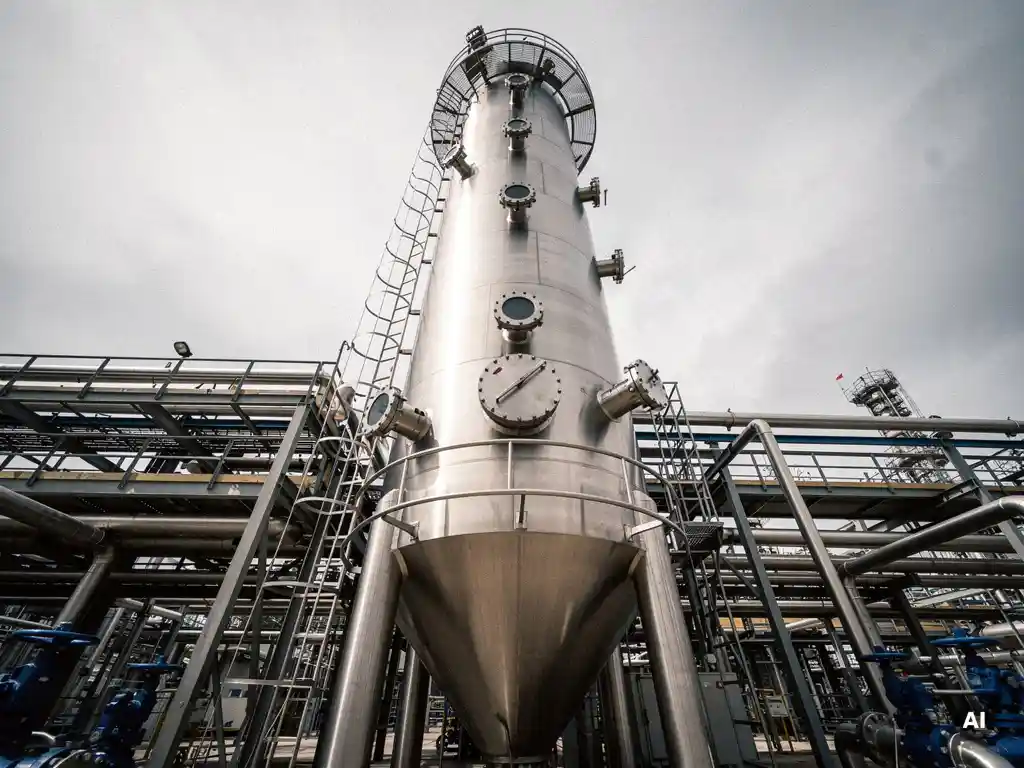
Process columns used in chemical processing fall into several main categories: distillation columns, absorption columns, stripping columns, extraction columns, and rectification columns. Each type is designed to achieve a specific separation or mass-transfer objective. The right column type depends on the nature of the feed mixture, the desired separation, and the operating conditions of the process.
Beyond column type, the choice of internals, materials of construction, and fabrication approach all play a decisive role in whether a column performs reliably over its service life. The sections below answer the most common questions engineers and procurement teams ask when specifying or sourcing a process column.
What are the main types of process columns used in industry?
The main types of process columns are distillation columns, absorption columns, stripping columns, extraction columns, rectification columns, and dehydration columns. Each type performs a distinct separation function based on differences in volatility, solubility, or chemical affinity between components in a mixture.
Here is a brief overview of the most widely used column types in chemical processing:
- Distillation columns separate mixtures by exploiting differences in boiling points between components.
- Absorption columns transfer a gas-phase component into a liquid solvent, removing it from the gas stream.
- Stripping columns perform the reverse of absorption, driving dissolved components out of a liquid and into a gas phase.
- Rectification columns refine a partially separated stream to achieve higher purity, often as a downstream step after initial distillation.
- Extraction columns separate components between two immiscible liquid phases, using solubility differences rather than volatility.
- Dehydration columns remove water from a process stream, often as a preparatory or finishing step in a broader process sequence.
In demanding chemical processes such as purified terephthalic acid (PTA) production, several of these column types operate together within a single plant. Absorber columns, dehydration columns, rectification columns, and recovery columns each handle a specific stage of the overall process, often under corrosive conditions that require advanced materials throughout.
What is the difference between a packed column and a tray column?
A packed column uses a bed of structured or random packing material to create a contact surface between the gas and liquid phases, while a tray column uses a series of horizontal plates fitted with valves, caps, or perforations to achieve staged contact. The fundamental difference lies in how the two phases interact and how separation is achieved across the height of the column.
Packed columns tend to offer lower pressure drop and are often preferred for vacuum applications, smaller-diameter installations, or services involving corrosive media where packing materials can be selected for chemical compatibility. They also lend themselves well to retrofitting when additional separation capacity is needed within an existing shell.
Tray columns are generally preferred for larger-diameter columns, feeds with suspended solids or fouling tendencies, and applications requiring precise liquid hold-up or residence time. Trays also make it easier to add side draws or feed nozzles at specific stages, which is important in complex fractionation sequences.
In practice, the choice between packed and tray internals is driven by the specific process conditions, the diameter of the column, the required number of theoretical stages, and the properties of the process fluids. Many large-scale industrial columns are designed with a combination of both, using trays in sections where fouling or liquid management is critical and packing elsewhere.
How does a distillation column separate chemical mixtures?
A distillation column separates chemical mixtures by repeatedly vaporising and condensing the mixture as it moves through the column. Components with lower boiling points concentrate in the vapour phase and rise toward the top, while heavier, higher-boiling components concentrate in the liquid phase and descend toward the bottom. The result is a lighter overhead product and a heavier bottoms product.
The separation relies on the difference in volatility between components, expressed as the relative volatility. The greater this difference, the fewer theoretical stages are required to achieve the desired separation. When relative volatility is small, the column must be taller, have more trays or packing, and operate at a higher reflux ratio to reach the required product purity.
Heat is supplied at the base of the column through a reboiler, which generates the rising vapour stream. At the top, a condenser cools the overhead vapour, returning part of it as liquid reflux to maintain the driving force for separation. The balance between vapour rising and liquid descending determines the separation efficiency at each stage.
In corrosive chemical environments, the distillation column must be constructed from materials that resist attack by the process fluid across the full range of temperatures encountered from bottom to top. This often means the material selection varies by section, or that clad construction is used to provide corrosion resistance at the wetted surfaces while maintaining structural strength in the shell.
What materials are process columns made from?
Process columns are manufactured from a wide range of materials depending on the operating temperature, pressure, and chemical environment. Carbon steel is used for non-corrosive services, while stainless steel, Hastelloy, titanium, zirconium, and tantalum are specified when the process fluid is aggressive or corrosive. Clad construction, combining a structural carbon steel shell with a corrosion-resistant inner layer, is a common and cost-effective approach for large columns.
The choice of material is driven primarily by the corrosive nature of the process medium. Acetic acid processes, for example, require materials with strong resistance to organic acids, making Hastelloy C22 and zirconium both proven choices. PTA processes involve halide-containing environments at elevated temperatures, where titanium and titanium-clad constructions offer the necessary corrosion resistance combined with structural integrity at scale.
For brine purification applications, zirconium or zirconium-clad columns are used to handle the highly aggressive chlorine chemistry involved. In each case, the material selection is not a generic decision but a process-specific one, informed by the chemical composition of the fluid, temperature, concentration, and the presence of trace contaminants that can accelerate corrosion.
Clad construction deserves particular attention for large-diameter, heavy columns. Explosion cladding bonds a thin corrosion-resistant layer directly to the carbon steel base plate at the metallurgical level, producing a composite material that combines the structural performance of carbon steel with the surface properties of the alloy liner. This approach is widely used in demanding column applications where solid exotic-material construction would be prohibitively expensive or technically impractical at the required dimensions. You can find more detail on the full range of column types and materials used in critical process applications.
What operating conditions determine process column design?
The key operating conditions that determine process column design are operating pressure, temperature range, fluid composition and corrosivity, vapour and liquid flow rates, and required separation efficiency. These parameters together define the column diameter, height, number of theoretical stages, wall thickness, material selection, and internal configuration.
Pressure is one of the most influential design variables. Columns operating under vacuum require careful attention to external pressure stability and buckling resistance, while high-pressure columns demand thicker walls and more robust nozzle and flange designs. Intermediate pressures affect the vapour density and therefore the allowable vapour velocity, which directly determines the column diameter for a given throughput.
Temperature range matters both for material selection and for the mechanical design. Large temperature gradients between startup and operating conditions create thermal expansion stresses that must be accommodated in the support structure and nozzle design. In columns with corrosive media, elevated temperatures typically accelerate corrosion rates, making material selection at the upper end of the temperature range the governing criterion.
Flow rates determine the hydraulic loading on the internals. For tray columns, the vapour and liquid loads must stay within the operating window of the tray design to avoid flooding or weeping. For packed columns, the gas and liquid distribution must be uniform across the cross-section, which becomes increasingly challenging as column diameter increases. Achieving uniform distribution in very large-diameter packed columns is a genuine engineering challenge that influences both internal design and fabrication precision.
When should a process column be custom-fabricated versus standardised?
A process column should be custom-fabricated when its dimensions, operating conditions, material requirements, or internal configuration fall outside what standard equipment can deliver. Standardised columns are appropriate for well-defined, moderate-duty applications with common materials and conventional sizes. Custom fabrication becomes necessary when the column is unusually large, operates under extreme conditions, requires exotic or clad materials, or must integrate complex internals.
- Dimensions exceed standard ranges: Columns exceeding certain diameters or lengths cannot be sourced from catalogue equipment and must be engineered and fabricated specifically for the project.
- Corrosive or aggressive media: When the process fluid demands titanium, zirconium, Hastelloy, or clad construction, the column is inherently a custom item requiring specialist material and welding expertise.
- High or low operating pressure: Extreme pressures require wall thickness calculations, material qualifications, and fabrication procedures that go well beyond standard practice.
- Tight dimensional tolerances: Columns with precision-aligned internals, complex nozzle arrangements, or critical flange face tolerances require controlled fabrication conditions and rigorous inspection.
- Regulatory and code requirements: Projects requiring PED, ASME, or other international pressure equipment certifications need a fabricator with the appropriate quality system and code compliance capability.
- Integrated scope: When the column must be delivered as part of a broader equipment package including associated vessels, heat exchangers, or mechanical components, a custom fabrication approach is necessary to coordinate the full scope.
For commodity applications in non-corrosive services at moderate scale, standardised columns can offer a practical and cost-efficient solution. However, as soon as the process introduces chemical aggression, large scale, or demanding mechanical requirements, the risks of forcing a standard solution typically outweigh any initial cost advantage. Custom fabrication ensures that the column is designed for the actual operating conditions rather than adapted from a generic product.
How Coek Engineering supports demanding process column projects
Coek Engineering designs and manufactures custom process columns for chemically aggressive, large-scale, and technically demanding applications. For projects where standard equipment is insufficient, Coek brings together materials expertise, clad construction experience, and large-scale manufacturing capability to deliver columns built precisely for the process conditions specified.
Key capabilities relevant to complex column projects include:
- Manufacturing of columns up to 80 metres in length, 8 metres in diameter, and 600 to 800 tons in weight, with capacity for even larger equipment
- Extensive experience with titanium, titanium-clad, zirconium, zirconium-clad, and Hastelloy C22 constructions for corrosive process environments
- More than 30 years of clad construction expertise, including explosion-clad combinations of carbon steel with corrosion-resistant inner layers
- In-house mechanical engineering that translates process requirements into manufacturable equipment designs compliant with PED, ASME, and ISO 9001
- Proven references across absorber, dehydration, rectification, recovery, extraction, and DCH column types in demanding chemical applications
If your project involves a process column that goes beyond what standard fabricators can reliably deliver, contact Coek Engineering to discuss your requirements with our technical team.
Frequently Asked Questions
How do I know if my process column needs to be replaced or can simply be retrofitted?
The decision between replacement and retrofitting depends on the condition of the existing shell, whether the current material of construction is still compatible with the process fluid, and whether the required capacity or separation performance has changed significantly. If the shell remains structurally sound and the operating conditions are unchanged, retrofitting with new internals — such as replacing trays with structured packing — can restore or even improve performance at a fraction of the cost of full replacement. However, if corrosion has compromised the shell wall thickness, if the column material is no longer suitable for an updated process chemistry, or if a significant increase in throughput is required, full replacement with a purpose-built custom column is typically the more reliable and cost-effective long-term solution.
What are the most common mistakes made when specifying a process column?
The most frequent specification mistakes include underestimating the corrosivity of the process fluid, selecting materials based on bulk composition alone without accounting for trace contaminants or temperature peaks, and specifying column diameter based on design flow rates without building in adequate turndown capacity. Another common error is treating material selection as a generic decision rather than a process-specific one — for example, assuming stainless steel is sufficient for mildly acidic services when elevated temperatures or chloride contamination can make it wholly inadequate. Engaging your fabricator early in the design phase, before the specification is locked, helps catch these issues before they become costly fabrication or operational problems.
How does clad construction compare to solid exotic-material construction in terms of long-term reliability?
When executed correctly, explosion-clad construction provides corrosion resistance that is metallurgically equivalent to solid exotic-material construction at the wetted surface, because the bond is formed at the material level rather than through adhesives or mechanical fastening. The key to long-term reliability lies in the quality of the cladding bond, the integrity of welds at clad interfaces, and rigorous inspection during fabrication to confirm bond continuity across the full plate area. For large-diameter columns where solid titanium or zirconium construction would be structurally impractical or prohibitively expensive, high-quality clad construction is not a compromise — it is the engineered solution of choice used across decades of demanding industrial service.
What certifications and codes should I require from a process column fabricator?
For columns supplied into European projects, the Pressure Equipment Directive (PED) is the baseline regulatory requirement, and your fabricator should hold the relevant conformity assessment certification for the equipment category. For projects with international or North American scope, ASME Section VIII certification is commonly required, and some projects specify both. Beyond pressure equipment codes, ISO 9001 certification provides assurance that the fabricator operates a documented quality management system covering design, procurement, fabrication, inspection, and testing. For columns in exotic or clad materials, also verify that the fabricator holds the necessary welder and welding procedure qualifications for the specific material combinations specified — this is where compliance gaps most often appear with less experienced manufacturers.
How does column diameter affect the choice of internals and the complexity of fabrication?
As column diameter increases, achieving uniform vapour and liquid distribution across the full cross-section becomes progressively more challenging, particularly for packed columns where maldistribution directly reduces separation efficiency. Large-diameter tray columns require careful attention to tray rigidity, levelness, and downcomer geometry to maintain consistent hydraulic performance across the full tray area. From a fabrication standpoint, larger diameters also introduce greater complexity in shell rolling, weld distortion control, and transport logistics — columns above a certain diameter must often be fabricated in sections and field-assembled or transported via specialist heavy-lift routes. These factors make fabricator selection increasingly critical as column diameter grows beyond conventional ranges.
Can a process column be designed to handle multiple separation duties within a single shell?
Yes, multi-service or divided-wall column configurations allow a single shell to perform what would otherwise require two or more separate columns, by partitioning sections of the column to handle different separation tasks simultaneously. This approach can significantly reduce capital cost, plot space, and energy consumption in the right applications, particularly in refining and petrochemical fractionation. However, divided-wall columns introduce additional design complexity, require precise control of vapour and liquid splits across the partition, and demand higher fabrication precision than conventional single-service columns. They are best evaluated during the early process design phase when the full separation sequence is being optimised, rather than retrofitted into an existing design.
What should I prepare before approaching a fabricator for a custom process column quotation?
At a minimum, you should be able to provide the process fluid composition (including trace components), operating temperature and pressure ranges, required vapour and liquid flow rates, the desired separation duty and target product purities, and any applicable design codes or regulatory requirements. A preliminary process simulation or datasheet from your process licensor is invaluable at this stage, as it allows the fabricator to size the column, select appropriate materials, and identify any fabrication challenges early. Even if your process data is not yet finalised, sharing the available information and flagging the key uncertainties allows an experienced fabricator to flag material or manufacturing constraints that may influence your process design decisions before they become fixed.