
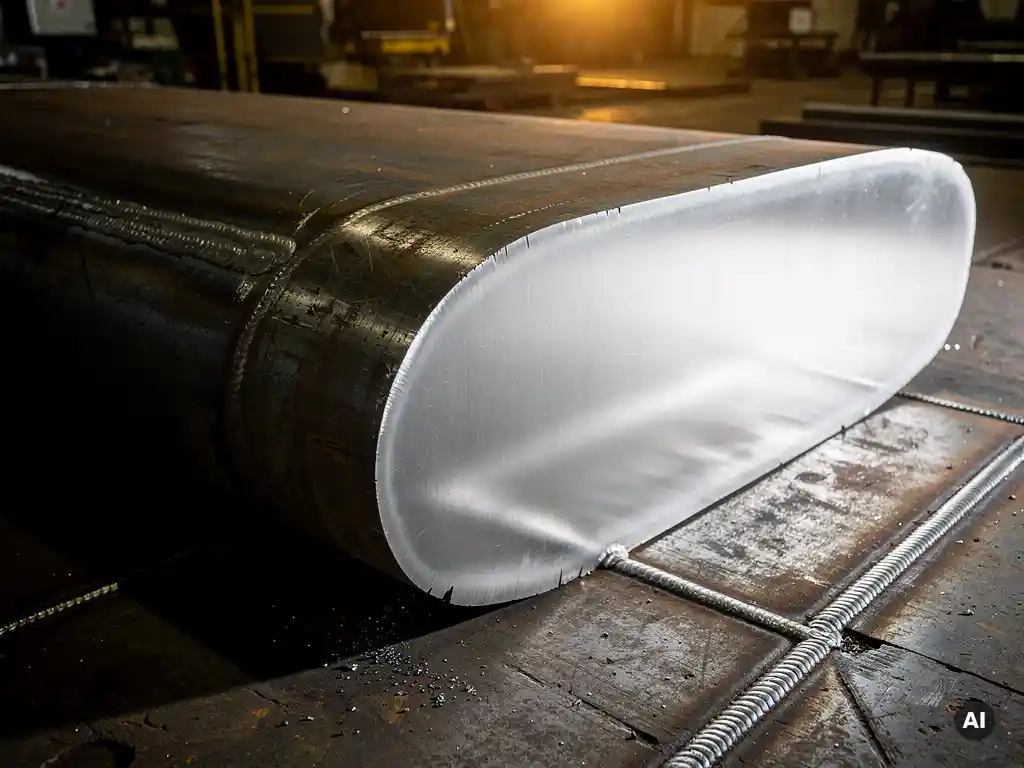
The choice between solid and clad construction depends primarily on wall thickness and the corrosion-resistant alloy involved. When a vessel requires substantial structural thickness, fabricating the entire wall from an expensive alloy becomes disproportionately costly. Clad construction solves this by combining a carbon steel structural shell with a thin corrosion-resistant inner layer, delivering corrosion protection without the material cost of a solid alloy vessel. The sections below unpack the key technical and commercial factors that drive this decision.
What is the difference between solid alloy and clad pressure vessel construction?
A solid alloy pressure vessel is fabricated entirely from a single corrosion-resistant material, such as stainless steel, titanium, or Hastelloy, throughout the full wall thickness. A clad pressure vessel uses carbon steel or low-alloy steel for structural strength, with a thin layer of corrosion-resistant alloy bonded to the process-wetted surface. The structural integrity comes from the base material; the corrosion protection comes from the cladding.
Cladding can be applied through several methods, including explosion bonding, roll bonding, and weld overlay. Each method produces a metallurgical or mechanical bond between the two materials. The result is a composite wall that behaves structurally like carbon steel while presenting a corrosion-resistant surface to the process fluid.
This distinction matters significantly in pressure equipment fabrication because the two approaches involve different engineering assumptions, welding procedures, inspection requirements, and cost structures.
What factors determine whether solid or clad construction is more appropriate?
The most important factors are required wall thickness, the cost of the corrosion-resistant alloy, operating conditions, and the consequences of cladding failure. No single rule applies universally, but the following considerations consistently drive the decision in pressure vessel material selection.
- Wall thickness: Thicker walls amplify the cost difference between solid alloy and clad construction. A thin-walled vessel in stainless steel may be economically straightforward; the same design in a high-cost alloy at 80 mm wall thickness makes clad construction far more attractive.
- Alloy cost: The more expensive the corrosion-resistant material, the stronger the economic case for using it only as a cladding layer rather than throughout the full wall.
- Process fluid aggressiveness: Highly corrosive environments may demand a specific alloy regardless of cost, which shifts the question toward how much of that alloy is structurally necessary.
- Operating pressure and temperature: Elevated pressures require greater structural wall thickness, which increases the cost penalty of solid alloy construction.
- Mechanical loads and design complexity: Complex internal configurations, nozzle arrangements, or agitator loads can complicate clad construction and may favor solid alloy in specific zones.
- Inspection and maintenance philosophy: If the operator requires high confidence in cladding integrity over a long service life, this influences both material selection and inspection strategy.
When does clad construction offer a significant cost advantage over solid alloy?
Clad construction offers its greatest cost advantage when the required wall thickness is large and the corrosion-resistant alloy is expensive. In practical terms, this means vessels operating at elevated pressure, requiring substantial structural thickness, where the process fluid demands a high-cost material such as titanium, zirconium, Hastelloy, or Inconel.
The economics are straightforward: cladding thickness is typically a few millimetres, regardless of how thick the structural wall needs to be. A vessel requiring 100 mm of wall thickness needs only a few millimetres of expensive alloy rather than 100 mm. As vessel size and wall thickness increase, this difference becomes increasingly significant in fabrication cost.
For large-scale equipment, the cost advantage of carbon steel with cladding over a fully solid exotic alloy can be decisive. This is one reason clad construction is well established in refinery, petrochemical, and chemical processing applications where vessels are large, pressures are high, and process fluids are corrosive.
What are the technical limitations and risks of clad construction?
Clad construction introduces risks that solid alloy fabrication does not. The primary concern is bond integrity between the cladding layer and the base material. Disbonding, whether from thermal cycling, mechanical stress, or fabrication defects, can expose the carbon steel substrate to corrosive process fluids, leading to accelerated degradation that may not be immediately visible.
Welding clad materials requires careful procedure qualification. Weld joints must maintain corrosion resistance at the interface, and the transition between cladding and base metal requires specific filler materials and sequencing to prevent dilution that degrades corrosion performance. Poorly executed welds are a common source of premature failure in clad vessels.
Inspection of clad equipment is more demanding than for solid alloy. Ultrasonic testing is typically used to verify bond integrity, but detecting disbonding in service requires systematic monitoring. Operators who underestimate this requirement can face unexpected integrity issues.
Finally, clad construction is not always feasible for every geometry. Complex nozzle configurations, tight internal spaces, and certain joint designs can make reliable cladding application difficult, and in those cases solid alloy construction may be the more practical choice.
Which corrosion-resistant alloys are most commonly used as cladding materials?
The most commonly used cladding alloys in industrial pressure equipment are austenitic stainless steels, nickel alloys, titanium, and zirconium. The selection depends on the specific corrosive environment, temperature, and the nature of the process fluid.
- Austenitic stainless steels (such as 316L and 317L) are the most widely used cladding materials for general corrosive service. They offer good corrosion resistance in a broad range of environments and are relatively straightforward to apply and weld.
- Nickel alloys such as Hastelloy C-276 and Inconel 625 are used where stainless steel is insufficient, particularly in highly oxidizing or reducing environments, concentrated acids, and high-temperature corrosive service.
- Titanium is selected for its exceptional resistance to chloride-containing environments, seawater, and oxidizing acids. It is commonly used as cladding in applications where stainless steel would suffer pitting or crevice corrosion.
- Zirconium offers outstanding resistance to hydrochloric acid and other aggressive inorganic acids, making it the preferred cladding material in certain chemical processing applications.
- Tantalum is used in the most demanding corrosive environments where other alloys are insufficient, though its high cost typically limits it to small areas or lining applications rather than full vessel cladding.
How does the choice between solid and clad affect fabrication complexity and lead time?
Clad construction is generally more complex to fabricate than solid alloy construction and requires specialized expertise. The additional complexity stems from material procurement, bonding method selection, weld procedure qualification, and inspection requirements, all of which can affect lead time.
Clad plate procurement requires coordination between the base material supplier and the cladding process. Explosion-bonded or roll-bonded clad plate must be ordered to specific dimensions and verified before fabrication begins. This adds steps to the procurement timeline that do not exist for solid alloy plate.
During fabrication, welding clad materials requires qualified procedures for each material combination, additional inspection hold points, and careful sequencing of base metal and cladding welds. Fabricators without established experience in clad construction can underestimate these requirements, leading to rework, delays, or quality issues.
For solid alloy construction, fabrication is more straightforward in terms of material consistency, but machining, forming, and welding thick sections of exotic alloys carry their own challenges, particularly for materials such as titanium or zirconium that require controlled welding environments.
What role do international standards play in qualifying clad pressure equipment?
International standards provide the framework for designing, fabricating, inspecting, and certifying clad pressure vessels. Standards such as ASME Section VIII, the European Pressure Equipment Directive (PED), and associated harmonized standards establish requirements for material qualification, weld procedure qualification, non-destructive examination, and documentation, all of which apply specifically to clad construction.
For clad vessels, standards address the extent to which cladding thickness may be credited in pressure design calculations, the requirements for bond integrity testing, and the inspection methods required to verify cladding quality before and after fabrication. These provisions are important because clad construction introduces variables that do not exist in homogeneous solid alloy equipment.
Compliance with these standards is not optional for equipment destined for regulated industrial environments. EPC contractors and technology owners typically specify the applicable code in their equipment specifications, and the fabricator must demonstrate qualification under that code for the specific material combination used.
How Coek supports material selection and fabrication for corrosive service
Coek Engineering has more than 30 years of experience fabricating clad pressure equipment, working with material combinations that include carbon steel with stainless steel, titanium, zirconium, Hastelloy, and other corrosion-resistant alloys. For EPC contractors, technology owners, and industrial end users facing material selection decisions for corrosive service, Coek provides:
- In-house mechanical engineering to translate process requirements into manufacturable clad or solid alloy equipment
- Fabrication capability for large, heavy, and thick-walled vessels where the cost difference between solid and clad construction is most significant
- Qualified welding procedures for demanding material combinations, including exotic alloys requiring controlled fabrication environments
- Compliance with ASME, PED, and other applicable international standards for clad pressure equipment
- Experience with complex vessel geometries where cladding application and joint design require careful engineering judgment
If you are evaluating construction options for a corrosive service application, contact Coek’s engineering team to discuss your process requirements and find the most appropriate fabrication approach.
Frequently Asked Questions
Can cladding be repaired in the field if disbonding or damage is detected during service?
Yes, localized cladding damage can often be repaired in the field using weld overlay techniques, provided the base metal has not been significantly compromised by corrosion. However, field repairs must follow qualified welding procedures for the specific alloy combination and require post-repair inspection, typically ultrasonic testing, to confirm bond integrity. For extensive disbonding, a full engineering assessment is recommended before proceeding with repair rather than replacement.
How thick is a typical cladding layer, and is thicker cladding always better?
Cladding thickness in industrial pressure vessels typically ranges from 2 mm to 6 mm, depending on the alloy and application. Thicker cladding is not always better — beyond a certain point, additional thickness adds cost without meaningful improvement in corrosion performance, since the cladding is not a structural element. The appropriate thickness is determined by corrosion allowance requirements, the bonding method used, and any applicable code provisions for crediting cladding in pressure calculations.
What non-destructive examination methods are used to verify cladding bond integrity before and after fabrication?
Ultrasonic testing (UT) is the primary method for detecting disbonding between the cladding layer and the base metal, both on incoming clad plate and on finished vessels. Shear wave and phased array UT techniques can identify unbonded areas that would not be visible on the surface. Visual examination and liquid penetrant testing (PT) are also used on the cladding surface to detect cracks, pinholes, or weld defects that could compromise corrosion resistance.
Is it possible to combine clad and solid alloy construction within the same vessel?
Yes, hybrid construction is used in practice, particularly for complex vessels where certain zones benefit from solid alloy construction while the bulk of the shell uses clad plate. For example, nozzle necks, flange faces, or areas with complex geometry may be fabricated in solid alloy while the main shell uses clad construction. This approach requires careful engineering at the transition joints to maintain corrosion continuity and structural integrity across the interface.
How does thermal cycling in service affect the long-term integrity of a clad vessel?
Repeated thermal cycling creates differential thermal expansion stresses at the interface between the cladding and base metal, which over time can contribute to disbonding, particularly if the two materials have significantly different coefficients of thermal expansion. This is an important consideration for vessels in cyclic service or those subject to frequent start-up and shutdown. Selecting a compatible material combination and ensuring high-quality initial bonding are the most effective ways to mitigate this risk, along with a systematic in-service inspection program.
What questions should an EPC contractor or end user ask a fabricator when evaluating clad vessel proposals?
Key questions include: What bonding method will be used for the clad plate, and what is the fabricator’s track record with that specific material combination? What welding procedures are already qualified, and what additional qualifications will be required? How will bond integrity be verified at incoming material inspection and after fabrication? Understanding the answers to these questions helps identify whether a fabricator has genuine experience with clad construction or is estimating without established process knowledge, which is a significant project risk.
At what point does solid alloy construction become more economical than clad, despite the higher material cost?
Solid alloy construction can become more competitive when wall thickness is low, the vessel is small, or the geometry is complex enough that reliable cladding application and inspection become disproportionately difficult and costly. For thin-walled vessels in standard stainless steel grades, the fabrication simplicity of solid alloy can offset the material cost difference. The crossover point depends on the specific alloy, vessel size, operating pressure, and fabricator capabilities, which is why a case-by-case cost comparison is always worthwhile before committing to either approach.
Related Articles
- How does pressure cycling affect the design life of industrial pressure vessels?
- What documentation is required when delivering certified pressure equipment?
- Why do some industrial processes require custom-built pressure vessels?
- When does a pressure vessel require thick-wall design?
- What materials are used to manufacture pressure vessels?