
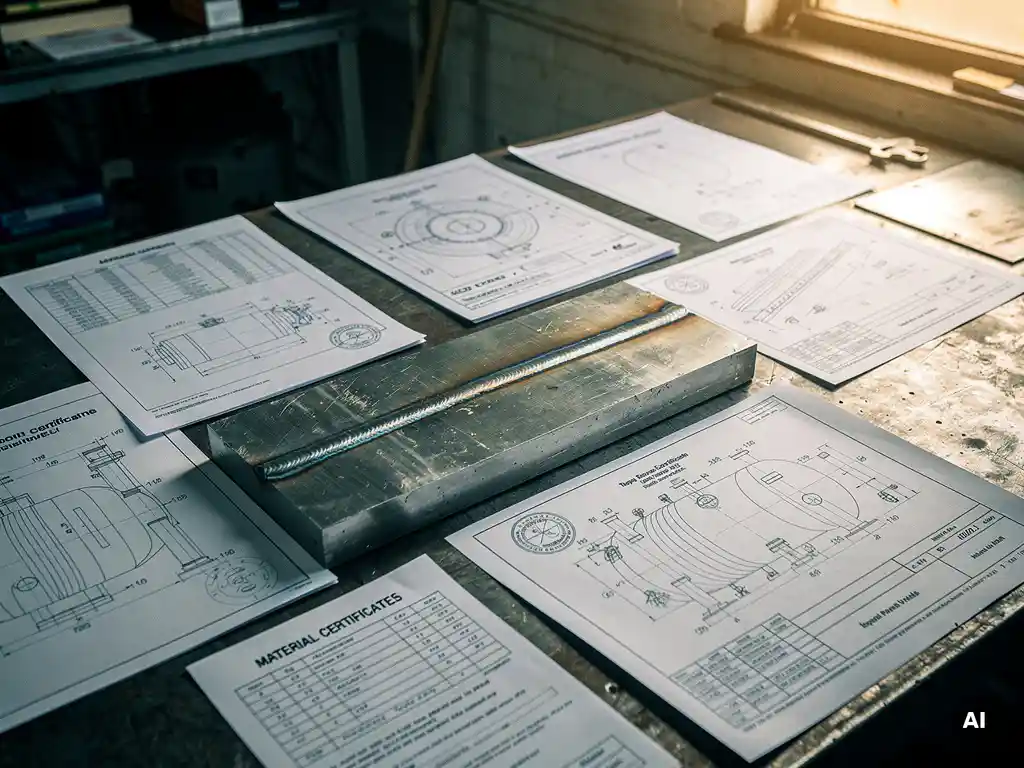
To manufacture a custom pressure vessel, a fabricator needs a complete set of process conditions, mechanical specifications, material requirements, applicable design codes, dimensional constraints, and inspection requirements. The more precisely these inputs are defined upfront, the more accurately the fabricator can engineer and quote the equipment. The sections below break down each category of information in detail.
What documents and drawings are required before fabrication can begin?
Before fabrication can begin on a custom pressure vessel, a manufacturer typically requires a data sheet or specification document covering process conditions, a preliminary or approved mechanical drawing, a material specification, and a reference to the applicable design code. Together, these documents form the technical basis from which engineering and procurement can proceed.
In practice, the level of documentation varies by project stage. At enquiry stage, a well-prepared vessel data sheet and a sketch or reference drawing are usually sufficient for a manufacturer to develop a technical proposal. For order placement and detailed engineering, more complete documentation is expected, including:
- A vessel data sheet with all process conditions filled in
- Mechanical drawings or nozzle orientation sketches
- Material specifications, including any specific grades or certifications
- Client or project specifications governing fabrication, inspection, and documentation
- The applicable design code and any supplementary calculation requirements
- A list of applicable standards, paint or surface treatment specs, and nameplate requirements
Incomplete documentation at the start of a project is one of the most common causes of delays and scope changes during fabrication. Providing as complete a package as possible at enquiry stage allows the manufacturer to flag technical questions early and reduces costly revisions later.
What are the key process conditions a manufacturer needs to know?
The key process conditions a pressure vessel manufacturer needs are design pressure, design temperature, operating pressure, operating temperature, the nature of the process fluid, and any cyclic or transient loading conditions. These parameters directly drive wall thickness calculations, material selection, and nozzle ratings.
Design pressure and temperature are the governing values used in code calculations and must reflect the worst credible combination of conditions the vessel will experience in service, including any upset scenarios. Operating conditions are also useful because they inform fatigue analysis and help the manufacturer understand the realistic duty cycle of the equipment.
The process fluid description is equally critical. A manufacturer needs to know whether the fluid is liquid, gas, or a mixture; whether it is corrosive, toxic, or flammable; and whether it contains solids or abrasive particles. This information determines corrosion allowance, material compatibility, and whether special surface finishes or linings are required.
For vessels subject to pressure cycling, thermal cycling, or other repetitive loading, the number of cycles and the expected range of conditions should be stated explicitly. This allows the manufacturer to determine whether a fatigue analysis is required in addition to standard code calculations.
How does the choice of material affect what information is needed?
Material selection significantly expands the information a manufacturer needs because different materials impose different requirements on design, welding, heat treatment, testing, and traceability. For standard carbon steel vessels, a general material class is often sufficient at enquiry stage. For exotic or corrosion-resistant alloys, considerably more detail is required from the outset.
When a vessel involves materials such as titanium, zirconium, Hastelloy, Inconel, or tantalum, the manufacturer needs to know the specific alloy grade, the required material certifications, any restrictions on welding consumables, and whether post-weld heat treatment is applicable or restricted. Some exotic materials require specialised welding procedures and qualified welders, which affects both planning and lead time.
For clad pressure vessels, where a carbon steel shell carries a corrosion-resistant inner layer, the specification must define both the base material and the cladding material, the cladding method (explosion bonding, weld overlay, or loose lining), the minimum cladding thickness, and the bond quality requirements. The interface between the two materials introduces specific inspection requirements that must be addressed in the quality plan.
Material traceability requirements also vary significantly. Some clients and codes require full material traceability from mill certificate to finished component, which affects documentation scope and must be agreed before fabrication begins.
What dimensional and size constraints must be specified upfront?
Dimensional and size constraints that must be specified upfront include overall vessel length and diameter, nozzle sizes and orientations, flange ratings and facing specifications, support type and location, and any transport or installation restrictions. These parameters define the physical envelope of the equipment and directly affect manufacturability and logistics planning.
Nozzle schedules deserve particular attention. Each nozzle connection should be defined by its nominal size, pressure rating, flange standard, facing type, and orientation relative to a reference point on the vessel. Vague or incomplete nozzle information is a frequent source of rework.
Transport constraints are often overlooked at the design stage but can have a significant impact on how a vessel is designed and fabricated. Maximum transportable diameter, length, and weight vary by route, mode of transport, and destination country. For very large equipment, transport feasibility should be confirmed early, as it may require the vessel to be designed in field-welded sections. Manufacturers with large-scale fabrication capabilities can often produce equipment that smaller shops cannot, but even large manufacturers must work within transport realities.
Which codes and standards govern the information a vessel must comply with?
The design code governing a custom pressure vessel determines the calculation methods, material standards, welding requirements, inspection scope, and documentation that apply throughout fabrication. The most commonly specified codes are the ASME Boiler and Pressure Vessel Code (Section VIII), the European Pressure Equipment Directive (PED) with associated harmonised standards such as EN 13445, and AD Merkblätter for the German market.
The applicable code is usually determined by the country of installation, the end user’s corporate standards, or the requirements of the EPC contractor or technology licensor. It must be stated clearly in the enquiry documents because it affects nearly every aspect of the fabrication process, from the design calculations to the final documentation package.
Beyond the primary design code, a vessel specification may reference additional standards covering welding procedures (such as ASME IX or ISO 15614), non-destructive examination (such as ASME V or EN ISO 17636), material standards, surface treatment, and pressure testing. Where a project involves multiple applicable standards, any conflicts or areas of precedence should be identified and resolved before detailed engineering begins.
What internal equipment details need to be defined for reactors and columns?
For reactors and columns, the internal equipment details that must be defined include the type, quantity, and location of internals such as trays, packing supports, distributors, baffles, agitators, and heating or cooling coils. These elements affect nozzle placement, structural loading, access requirements, and in some cases the overall vessel geometry.
For reactor vessels, the specification should address whether an agitator or mixing system is required, including the drive type, shaft configuration, seal arrangement, and any requirements for the mechanical seal or lubrication system. These mechanical components interact directly with the vessel design and must be coordinated during engineering to avoid conflicts.
For process columns, the number and spacing of trays or packing beds, the type of tray or packing, and the location of feed and draw nozzles are all required inputs. Manway locations and sizes must also be defined to allow access for installation and maintenance of internals.
In both cases, the process licensor or technology owner typically defines the internal configuration as part of their process package. The mechanical manufacturer’s role is to translate those process requirements into a structurally sound, fabricatable vessel design, ensuring that the internals are properly supported, that nozzle loads are accounted for, and that the assembly sequence is practical.
How should inspection, testing, and certification requirements be communicated?
Inspection, testing, and certification requirements should be communicated through a dedicated inspection and test plan (ITP) or by referencing specific clauses in the project specification. At minimum, the enquiry documents should state the required level of non-destructive examination, the type and scope of pressure testing, any third-party inspection involvement, and the documentation package expected at completion.
Non-destructive examination requirements should specify the extent of radiographic or ultrasonic examination of welds, any requirements for hardness testing or ferrite measurement, and whether supplementary methods such as magnetic particle or dye penetrant inspection apply. For clad vessels, bond integrity testing of the cladding interface is a typical additional requirement.
Pressure test requirements should define whether hydrostatic or pneumatic testing is required, the test pressure, the hold duration, and any witness requirements. Some clients or codes require third-party inspection body involvement at defined hold points during fabrication, which must be planned and resourced in advance.
The final documentation package is often underspecified at enquiry stage but can represent a significant scope of work. Typical documentation deliverables include as-built drawings, material traceability records, welding procedure qualifications, welder qualification records, NDE reports, pressure test certificates, and the manufacturer’s data report. Agreeing the documentation scope early prevents disputes and delays at project close-out.
How Coek Engineering supports your pressure vessel enquiry
Coek Engineering works with EPC contractors, technology licensors, and industrial end users to translate process requirements into mechanically sound, manufacturable custom pressure equipment. Whether your project involves standard carbon steel construction or demanding exotic materials, Coek’s in-house engineering team can help define and resolve the technical inputs needed to move from specification to fabrication.
- In-house mechanical engineering capable of working from process data sheets to full fabrication drawings
- Design in accordance with ASME, PED, EN 13445, AD Merkblätter, and TEMA
- Supplementary calculations including FEA, fatigue analysis, and thermal analysis performed in-house
- Extensive experience with solid and clad constructions in titanium, zirconium, Hastelloy, Inconel, tantalum, and other demanding alloys
- Large-scale manufacturing capabilities up to 10 metres in diameter and 1,000 tons in weight
- Dedicated project engineer as a single point of contact from enquiry through delivery
If you are preparing an enquiry or need guidance on what information to include in your specification, contact Coek Engineering to discuss your project requirements directly with our engineering team.
Frequently Asked Questions
What happens if I submit an enquiry with incomplete documentation — can a manufacturer still provide a quote?
Yes, most manufacturers can provide a budgetary or indicative quote based on partial information, but the accuracy of that quote will be limited. Missing data on process conditions, materials, or inspection requirements often leads to significant price adjustments once full documentation is received. To avoid surprises, it’s worth clearly flagging any assumptions made in the enquiry so the manufacturer can highlight where clarification is needed before order placement.
How early in a project should transport and installation constraints be raised with the manufacturer?
Transport and installation constraints should be raised as early as possible — ideally at enquiry stage, before any detailed engineering begins. Vessel diameter, length, and weight limits imposed by road, rail, or sea transport can fundamentally affect the design, including whether the vessel needs to be fabricated in field-weldable sections. Raising these constraints late in the engineering phase can result in costly redesign work and schedule delays.
What is the most common mistake engineers make when specifying design pressure and temperature?
The most common mistake is specifying only normal operating conditions and failing to account for upset or worst-case scenarios, such as pressure spikes during startup, shutdown, or process excursions. Design pressure and temperature must reflect the most severe credible combination of conditions the vessel will ever experience in service. Underspecifying these values can result in a vessel that is technically non-compliant or requires costly re-engineering after the fact.
How do I know which design code applies to my pressure vessel project?
The applicable design code is primarily determined by the country where the vessel will be installed, as local regulations often mandate specific codes — for example, the Pressure Equipment Directive (PED) and EN 13445 are required for vessels installed within the EU, while ASME Section VIII is standard in North America. Your EPC contractor, technology licensor, or local regulatory authority can confirm the applicable code if it is not already defined in your project specification. When in doubt, raise the question with your manufacturer early, as the code choice affects every aspect of the fabrication process.
What is a vessel data sheet and how detailed does it need to be at enquiry stage?
A vessel data sheet is a structured document that captures all key technical parameters for a pressure vessel, including process conditions, materials, design code, dimensional constraints, and inspection requirements — typically on one or two pages. At enquiry stage, it does not need to be fully complete, but the more fields that are filled in, the more accurate and comparable the manufacturer’s proposal will be. At minimum, design pressure, design temperature, fluid service, material class, and applicable code should be populated before sending an enquiry to a fabricator.
Can a manufacturer help select the right material if I only know the process fluid and operating conditions?
Yes, experienced pressure vessel manufacturers with in-house engineering capability can assist with material selection based on process fluid chemistry, temperature, pressure, and corrosion data. However, the final material selection should always be validated by a qualified corrosion or materials engineer familiar with the specific process, as liability for material suitability typically rests with the specifying party. Providing a corrosion allowance recommendation or a reference to your corrosion data early in the enquiry will help the manufacturer propose appropriate options.
How long does the documentation and certification package typically take to compile, and can it delay project handover?
Compiling the final documentation package — including as-built drawings, material traceability records, weld procedure qualifications, NDE reports, and pressure test certificates — can take several weeks after physical fabrication is complete, particularly for complex or heavily inspected vessels. If the documentation scope is not agreed upon early in the project, late additions can cause significant delays to handover and commissioning. Defining the required deliverables in the enquiry documents and reviewing them at order placement is the most effective way to prevent documentation from becoming a critical path issue at project close-out.
Related Articles
- What determines the manufacturing cost of a large industrial pressure vessel?
- Why do some industrial processes require custom-built pressure vessels?
- What is a high pressure autoclave used for in chemical processing?
- What's another name for autoclave?
- How do you manage thermal expansion in large high-temperature reactor vessels?