
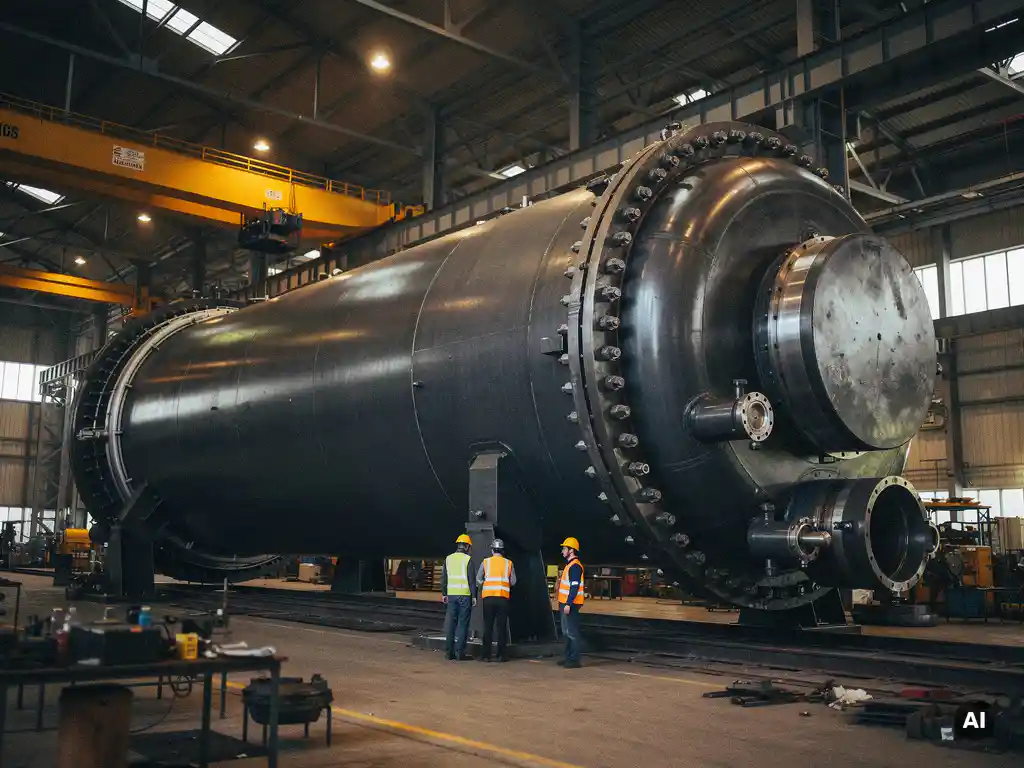
A high-pressure autoclave is used in chemical processing to carry out reactions, treatments, or synthesis steps that require elevated pressure and temperature conditions beyond what open or low-pressure vessels can safely sustain. These are controlled environments where pressure itself is an active process variable, not merely a byproduct. The sections below answer the most common technical questions about how these vessels work, what they are made of, and what governs their design and certification.
What processes actually require a high-pressure autoclave?
Chemical processes that require a high-pressure autoclave are those where the reaction kinetics, phase behaviour, or product quality depend on maintaining pressure significantly above atmospheric levels, often combined with elevated temperatures. Without a sealed, pressure-rated vessel, these reactions either cannot proceed or yield inferior results.
Common industrial autoclave applications in chemical processing include:
- Hydrogenation and hydroprocessing – where hydrogen gas must be dissolved into a liquid phase under pressure to drive catalytic reactions
- Polymerisation reactions – particularly for polymers that require high-pressure environments to control molecular weight and product consistency
- Hydrothermal synthesis – where water at supercritical or near-supercritical conditions acts as a solvent or reaction medium
- Oxidation under pressure – wet air oxidation and similar processes where oxygen partial pressure must be controlled
- Leaching and extraction in hydrometallurgy – dissolving metals from ores using acidic or alkaline solutions under elevated pressure and temperature
- Autoclave curing of composite materials – consolidating fibre-reinforced structures under controlled heat and pressure
What these processes share is that pressure is a deliberate design parameter. The autoclave is not simply a container; it is an active part of the process.
How does a high-pressure autoclave work mechanically?
A high-pressure autoclave works by enclosing a process medium in a sealed, thick-walled vessel capable of withstanding the design pressure and temperature. Pressure is generated either by the process itself, by injecting a pressurised gas, or by heating a liquid above its normal boiling point in a confined space. The vessel maintains these conditions for the duration of the reaction or treatment cycle.
Mechanically, the key components include a cylindrical or spherical shell designed to contain the internal pressure, end closures or heads that seal the vessel, nozzles for process connections, and in many cases an agitator or mixing system to ensure uniform conditions throughout the batch. The closure design is particularly critical in high-pressure autoclaves because it must allow access for loading and unloading while maintaining a reliable pressure seal under operating conditions.
Temperature control is typically achieved through internal coils, external jackets, or both, circulating a heating or cooling medium. Instrumentation monitors pressure, temperature, and other process variables throughout the cycle. Safety systems, including pressure relief devices and interlocks, are integral to the mechanical design.
What materials are used to build chemical processing autoclaves?
The materials used to build a chemical processing autoclave depend primarily on the operating conditions and the chemical nature of the process medium. Carbon steel is sufficient for non-corrosive applications at moderate pressures, but chemically aggressive environments demand far more resistant alloys or protective linings.
For corrosive chemical processes, common material choices include:
- Stainless steel grades – suitable for many aqueous and mildly aggressive environments
- Nickel alloys such as Hastelloy and Inconel – used where strong acids, high temperatures, or oxidising conditions are present
- Titanium and zirconium – selected for highly corrosive media, particularly in hydrometallurgical leaching and certain chemical synthesis applications
- Tantalum – used for extreme corrosion resistance in specialised chemical environments
- Clad construction – a carbon steel structural shell with a corrosion-resistant inner layer, combining mechanical strength with chemical resistance at a more practical weight and cost profile than solid exotic alloys
Material selection is not a secondary consideration. In demanding autoclave applications, the wrong material choice leads to accelerated corrosion, contamination of the process stream, or premature failure of the vessel. The choice between solid exotic alloys and clad construction depends on the severity of the corrosive environment, the required wall thickness, and the overall equipment weight constraints.
What is the difference between an autoclave and a pressure vessel?
An autoclave is a type of pressure vessel, but not all pressure vessels are autoclaves. The key distinction is function: a pressure vessel is a broad category covering any closed container designed to hold fluids or gases at pressures different from ambient. An autoclave is a specific pressure vessel designed for batch processes where the internal environment, pressure, temperature, and sometimes atmosphere, are controlled to achieve a defined outcome.
Practically, autoclaves tend to have more complex features than simple pressure vessels. They typically include openable closures for loading and unloading, internal agitation or mixing systems, heating and cooling provisions, and instrumentation for cycle control. A storage sphere or a simple heat exchanger shell is a pressure vessel. A vessel designed to carry out a hydrogenation reaction in controlled batches, with an agitator, a heating jacket, and a sealable closure, is an autoclave.
In industrial usage, the terms are sometimes used loosely, but when specifying equipment for a chemical process, the distinction matters for design requirements, standards compliance, and fabrication complexity.
What size and pressure ratings are available for industrial autoclaves?
Industrial autoclaves span an exceptionally wide range of sizes and pressure ratings, from laboratory-scale units handling a few litres to large-scale production vessels weighing hundreds of tonnes. The appropriate size and pressure rating depend entirely on the process volume, the required reaction conditions, and the throughput demands of the facility.
In demanding industrial applications, autoclaves can reach diameters of several metres, lengths of tens of metres, and weights approaching or exceeding several hundred tonnes. Operating pressures range from a few bar for some curing applications to several hundred bar for high-pressure synthesis or hydroprocessing. Wall thicknesses increase significantly as design pressure rises, which in turn drives requirements for heavy-section welding, post-weld heat treatment, and precise dimensional control during fabrication.
For projects at the larger end of the scale, the manufacturing facility itself becomes a constraint. Not all fabricators have the lifting capacity, workshop dimensions, or transport logistics to handle very large autoclaves. Equipment approaching 1,000 tonnes requires purpose-built manufacturing infrastructure and careful planning for transport to site.
What standards and certifications apply to high-pressure autoclaves?
High-pressure autoclaves used in chemical processing must comply with recognised pressure equipment standards that govern design, materials, fabrication, inspection, and testing. The applicable standard depends on the country of installation, the operating conditions, and the customer or regulatory requirements.
The most widely referenced standards in industrial autoclave manufacturing include:
- PED (Pressure Equipment Directive) – the European Union framework that sets essential safety requirements for pressure equipment placed on the European market, with harmonised standards such as EN 13445 providing the technical detail
- ASME Boiler and Pressure Vessel Code (BPVC) – the predominant standard in North America and widely accepted internationally, with Section VIII covering unfired pressure vessels and autoclaves
- AD 2000 Merkblätter – a German technical ruleset recognised across parts of Europe for pressure vessel design and fabrication
- National variants and local codes – many countries have their own regulatory frameworks that may reference or supplement the above standards
Beyond design codes, quality management certification such as ISO 9001 is typically required by EPC contractors and industrial end users as a baseline for supplier qualification. For specific applications or markets, additional certifications related to materials traceability, non-destructive examination, and third-party inspection may be required.
Compliance with the relevant standard is not optional. For critical chemical processing equipment operating at high pressures and temperatures, it is a legal and operational requirement that affects every stage from design through to final inspection and commissioning.
How Coek supports demanding autoclave projects
Coek Engineering manufactures custom industrial autoclaves for chemically aggressive, high-pressure, and high-temperature applications where standard fabrication is not sufficient. For projects involving advanced materials, clad construction, large dimensions, or integrated mechanical scope, Coek translates customer and EPC process requirements into mechanically sound, certifiable equipment.
Key capabilities relevant to chemical processing autoclave projects include:
- Manufacturing of autoclaves up to approximately 1,000 tonnes in weight
- Extensive experience with titanium, zirconium, Hastelloy, Inconel, tantalum, and clad constructions
- In-house mechanical engineering to convert process specifications into manufacturable designs
- Compliance with PED, ASME, and other applicable international standards
- Capability to integrate agitators, drive systems, seals, and instrumentation within a single equipment scope
If your project involves a technically demanding autoclave requirement, contact Coek Engineering to discuss your specifications with our engineering team.
Frequently Asked Questions
How do I determine the right pressure rating for my autoclave application?
Start with the maximum operating pressure your process requires, then apply an appropriate design margin as specified by the governing standard (e.g., ASME or EN 13445). The design pressure must account for any pressure surges, relief valve set points, and hydrostatic test requirements. It is strongly advisable to involve a qualified pressure vessel engineer early in the specification phase, as undersizing the design pressure is a critical and costly mistake to correct after fabrication.
What are the most common mistakes made when specifying a chemical processing autoclave?
The most frequent mistakes include underestimating the corrosivity of the process medium, which leads to incorrect material selection, and failing to fully define the operating envelope — including temperature cycling, pressure transients, and cleaning or sterilisation conditions. Another common error is treating the autoclave as a commodity item and issuing a specification that lacks sufficient process detail for the fabricator to make sound engineering decisions. Providing a complete process data sheet, including fluid composition, temperature and pressure ranges, and cycle frequency, is essential for receiving an accurate and safe design.
Can an existing pressure vessel be upgraded or relined to handle more aggressive chemical conditions?
In some cases, yes — vessels can be retrofitted with corrosion-resistant linings or cladding to extend their service life or adapt them to more aggressive media. However, this approach is only viable if the existing shell has sufficient structural integrity and wall thickness to support the modification, and if the geometry is compatible with the lining method. A thorough inspection and engineering assessment must be carried out before any retrofit is considered, and the modified vessel must be recertified to the applicable standard before returning to service.
How long does it typically take to fabricate a large industrial autoclave?
Lead times for large, custom industrial autoclaves vary significantly depending on complexity, material availability, and the fabricator’s current workload, but projects involving exotic alloys, clad construction, or integrated mechanical systems commonly require 12 to 24 months from order placement to delivery. Early engagement with the fabricator during the project’s FEED or detailed engineering phase is critical to securing manufacturing slots and avoiding schedule delays. Material procurement — particularly for specialty alloys like titanium, zirconium, or Hastelloy — is often the longest lead-time item in the fabrication schedule.
What inspection and testing steps should I expect during autoclave fabrication?
A compliant autoclave fabrication programme typically includes material traceability checks, dimensional inspection at key stages, non-destructive examination (NDE) of welds — including radiographic or ultrasonic testing — post-weld heat treatment (PWHT) where required, and a final hydrostatic pressure test at a multiple of the design pressure as specified by the applicable code. For clad vessels, bond integrity between the cladding and base material is also verified. Third-party inspection by a Notified Body (under PED) or an Authorised Inspection Agency (under ASME) is typically required for equipment in the higher pressure and hazard categories.
What is the difference between a batch autoclave and a continuous high-pressure reactor, and when should I choose each?
A batch autoclave processes a defined charge of material through a complete cycle — loading, pressurising, reacting, depressurising, and unloading — before the next batch begins. A continuous high-pressure reactor maintains steady-state conditions with a constant feed and product stream. Batch autoclaves are better suited to low-volume, multi-product, or research-scale operations where flexibility is important, while continuous reactors are preferred for high-throughput, single-product processes where consistency and efficiency are the priority. The choice affects not only vessel design but also instrumentation, control philosophy, and overall plant layout.
How should I approach transport and installation planning for a very large autoclave?
For autoclaves approaching or exceeding several hundred tonnes, transport planning must begin at the design stage, not after fabrication. Key considerations include the maximum transportable dimensions for road, rail, or sea freight; the load-bearing capacity of roads and bridges along the route; and the lifting and rigging infrastructure available at the installation site. In some cases, vessels must be fabricated in sections and assembled on-site, which adds complexity to the welding, inspection, and pressure testing programme. Engaging a specialist heavy-lift and transport contractor alongside the fabricator early in the project is strongly recommended.