
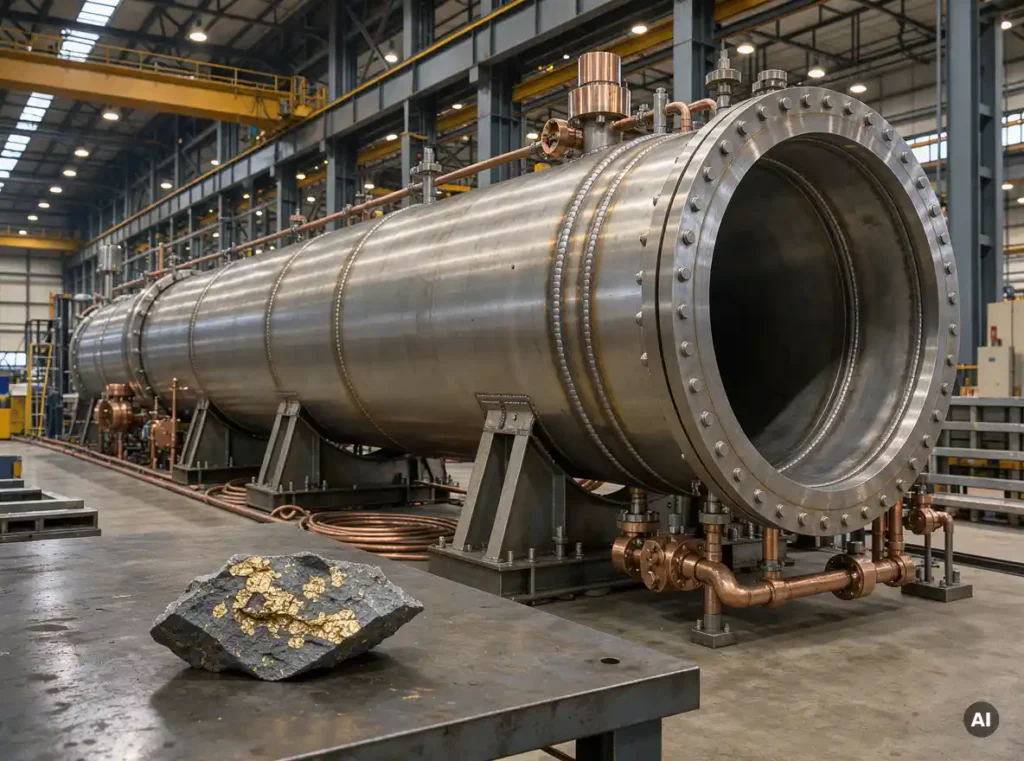
Pressure oxidation is used before gold recovery because some ores lock microscopic gold inside sulfide minerals such as pyrite and arsenopyrite, where cyanide cannot reach it. Heating a slurry with oxygen under pressure destroys the sulfide structure, exposes the gold, and allows conventional cyanide leaching to recover it efficiently.
This pretreatment step is the difference between recovering a small fraction of the gold and recovering most of it. The sections below explain why ores become refractory, what happens chemically in the autoclave, the operating conditions, how the process compares with alternatives, and what to consider when building the equipment.
What makes a gold ore refractory in the first place?
A gold ore is refractory when standard cyanide leaching recovers only a low share of the contained gold. The usual cause is gold that is physically encapsulated in sulfide minerals, chemically bound within their crystal lattice, or blocked by interfering materials such as carbonaceous matter that adsorbs dissolved gold.
In sulfide-hosted deposits, the gold can occur as particles smaller than a few microns, often described as “invisible gold.” Grinding the ore finer does not release it, because the gold sits inside the mineral grain rather than on its surface.
The main causes of refractory behaviour are:
- Sulfide encapsulation: gold locked inside pyrite or arsenopyrite grains
- Solid solution gold: gold atoms held within the sulfide crystal structure
- Preg-robbing carbon: organic carbon that re-adsorbs gold after it dissolves
- Cyanide consumers: reactive sulfides that use up cyanide and oxygen before gold can dissolve
Identifying which mechanism applies is the first step in choosing a pretreatment route, and it is normally confirmed through mineralogical analysis and test work.
What chemical reactions happen inside a pressure oxidation autoclave?
Inside a pressure oxidation autoclave, sulfide minerals react with dissolved oxygen in hot, acidic slurry and convert to sulfate and iron oxides. For pyrite, iron and sulfur oxidize to ferric iron and sulfuric acid. This destroys the mineral matrix and liberates the gold for later cyanide leaching.
The simplified reaction for pyrite is that iron sulfide plus oxygen and water forms ferric iron and sulfate, releasing acid. Arsenopyrite follows a similar path, producing dissolved arsenic that typically precipitates as stable ferric arsenate. This makes the process useful for arsenic-bearing ores, where the arsenic is fixed into a more stable form.
Oxidation of sulfides is strongly exothermic. In many operations, the heat released by the sulfides themselves sustains the reaction temperature, which reduces external energy demand for sulfur-rich feed.
The result is a solid residue with open porosity. Gold that was previously locked away is now accessible, so downstream cyanidation can reach it. When the ore is low in carbonate, acid generated in the autoclave is neutralized before leaching, typically with lime.
What temperature and pressure does pressure oxidation require?
Pressure oxidation typically runs at temperatures of roughly 190 to 230 °C and total pressures of about 2,000 to 3,200 kPa, with oxygen supplied to maintain oxidizing conditions. Exact values depend on ore mineralogy, sulfur content, and the design of the plant.
Pressure serves two purposes. It keeps the slurry liquid above its normal boiling point, and it raises the partial pressure of oxygen so that enough oxygen dissolves to drive the reaction in a practical residence time.
Several factors shape the operating window:
- Sulfide content and reactivity of the feed
- Required degree of sulfide oxidation for acceptable gold recovery
- Slurry density and residence time in the compartments
- Oxygen supply and agitation efficiency
- Heat balance, including cooling to control exothermic reactions
Autoclaves are usually divided into compartments, with agitators ensuring that oxygen is dispersed through the slurry. Operating conditions are always set by the process owner or technology licensor, and the mechanical design of the vessel must then be built around them.
How does pressure oxidation compare with roasting and bio-oxidation?
Pressure oxidation is faster and more tolerant of feed variation than bio-oxidation, and it avoids the gaseous emissions of roasting. Roasting suits some ores and is simpler mechanically, while bio-oxidation has lower equipment pressure demands but slower kinetics. The best choice depends on ore, scale, and environmental constraints.
Each route has distinct strengths:
- Roasting: converts sulfides to oxides at high temperature in air. It handles carbonaceous ores well, but it releases sulfur dioxide and potentially arsenic, which requires gas cleaning.
- Bio-oxidation: uses bacteria in stirred tanks at near-atmospheric pressure. It has relatively low capital cost, but residence times are long and the process is sensitive to temperature, pH, and toxic species.
- Pressure oxidation: offers short residence times and high sulfide oxidation. It captures sulfur as sulfate in solution, but the autoclave demands significant capital and engineering.
For large, high-sulfide, or variable ores, pressure oxidation is often chosen because the high reaction rate supports high throughput in a compact footprint. The trade-off is that the pressure equipment must be reliable under severe conditions.
Why must autoclaves for pressure oxidation be built from special materials?
The slurry inside a POX autoclave is hot, acidic, and often contains chlorides, which rapidly attack ordinary steel. Autoclaves therefore use a carbon steel pressure shell protected by a corrosion-resistant lining, commonly titanium, combined with acid-resistant brick, to survive corrosion and erosion.
Titanium offers excellent resistance to hot sulfuric acid slurries and chloride environments. Using it as a lining or clad layer on a carbon steel shell provides the required corrosion protection while keeping the structural strength and cost efficiency of steel. Titanium grades such as Grade 17 have been used for autoclave linings, and design details have evolved over time to address erosion in service.
Erosion is a particular concern, because abrasive solids move through the vessel at temperature. Careful attention is needed around agitator zones, nozzles, compartment partitions, and internal fittings, where flow disturbance accelerates wear.
Fabrication quality is just as critical as material choice. Autoclaves for gold plants are very large and heavy, with finished weights approaching 1,000 tons for the biggest units, and they carry tight dimensional and weld-quality requirements. A flaw in a liner weld or an overlooked crevice can become a corrosion site that shortens the life of an asset worth tens of millions.
What should be specified when procuring a gold autoclave?
A procurement specification for a gold autoclave should define process conditions, materials of construction, mechanical design code, fabrication and inspection requirements, and logistics. Clear definition at the start prevents redesign, protects the schedule, and ensures the vessel can be manufactured and transported to site.
Key items to define include:
- Process data: design temperature, pressure, slurry composition, chloride level, and acid concentration
- Materials: shell material, lining or cladding type, titanium grade, and brick lining arrangement
- Design code and certification: applicable standards such as PED or ASME, with third-party inspection scope
- Internals: compartment layout, agitator and drive interfaces, nozzles, and wear-protection details
- Fabrication controls: welding procedures, cladding or lining methods, non-destructive testing, and dimensional tolerances
- Transport and installation: maximum shipping dimensions and weight, site access, and lifting plan
Involving the fabricator early is one of the most effective measures. A manufacturer can review the design for manufacturability, flag erosion-prone details, and confirm that dimensions and weights are practical for transport. Equipment of this scale benefits from early alignment between process requirements and mechanical reality, which helps a project avoid late-stage changes.
How Coek helps with pressure oxidation autoclaves
Coek engineers and manufactures custom industrial autoclaves for demanding high-pressure, high-temperature and corrosive duties, including titanium-clad autoclaves for gold pressure oxidation. Coek receives process requirements from customers, EPC contractors, or technology owners and translates them into mechanically sound, manufacturable equipment.
- Titanium-clad autoclaves built with Ti Grade 17 lining, with design details refined over the years to address erosion
- Large-scale fabrication, with gold autoclaves delivered at approximately 960 tons each
- Clad construction experience of more than 30 years, combining carbon steel shells with corrosion-resistant inner layers
- In-house mechanical engineering focused on manufacturability and fabrication efficiency
- Compliance with international standards, including ISO 9001, PED, and ASME certifications
If you are planning a gold pressure oxidation project and want to review your autoclave requirements with a fabrication partner, contact Coek to discuss your specification.
Frequently Asked Questions
How do I know if my gold ore needs pressure oxidation rather than simple cyanide leaching?
Start with mineralogical analysis (such as QEMSCAN or electron microprobe) and a standard bottle-roll cyanidation test on a representative sample. If gold recovery is low (often below 70-80%) and the gold is associated with pyrite or arsenopyrite, the ore is likely refractory. Follow up with pretreatment test work comparing pressure oxidation, roasting, and bio-oxidation before committing to a route.
What sulfur grade makes pressure oxidation economically attractive?
There is no single cutoff, but pressure oxidation is generally most attractive for medium to high sulfide feeds, often from roughly 2-3% sulfide sulfur upward, especially when processed as a flotation concentrate. Higher sulfur improves the autothermal heat balance and reduces external heating, while very low-sulfur ores may not justify the capital cost of an autoclave. A feasibility study should weigh sulfur grade, gold recovery uplift, and throughput.
What happens if the ore contains a lot of carbonate?
Carbonate consumes acid and releases carbon dioxide in the autoclave, which can upset the acid balance and raise oxygen and venting demands. Operators typically pre-acidify the feed in a separate step to destroy carbonates before the slurry enters the vessel. This should be addressed in the process design so the autoclave and gas handling are sized correctly.
Can pressure oxidation handle ores with preg-robbing carbon?
Pressure oxidation does not reliably deactivate organic carbon, so highly carbonaceous ores are often better suited to roasting or require additional steps such as carbon-in-leach with blanking agents. If your ore has both sulfides and carbon, test work should evaluate whether pressure oxidation alone gives acceptable recovery or if a combined flowsheet is needed.
What are the most common operational problems in a POX autoclave?
Frequent issues include erosion and scaling around agitators, nozzles, and compartment partitions, poor oxygen dispersion that lowers oxidation efficiency, and temperature control difficulties with variable sulfur feed. Good feed blending, routine inspections during shutdowns, and robust design of wear-prone details help limit these problems. Early collaboration between the process owner and the fabricator reduces many of them at the design stage.
How long does it take to design and build a large gold autoclave?
Lead times depend on size and complexity, but large titanium-clad autoclaves typically require many months of procurement and fabrication after design approval, since titanium and heavy steel plate must be sourced and certified. Transport and installation add further time, particularly for vessels near 1,000 tons. Engaging a fabricator early in project development helps align the schedule and avoid critical-path delays.
What should I check when evaluating an autoclave fabricator?
Look for proven experience with large clad pressure vessels, relevant certifications (ISO 9001, PED, ASME), documented welding and cladding procedures, and a track record of delivering comparable units. Ask about non-destructive testing capabilities, in-house engineering, and logistics experience for oversized equipment. Reference projects and a factory visit are useful ways to verify quality before placing an order.
Related Articles
- What are the main fabrication challenges of large industrial process columns?
- What determines the manufacturing cost of a large industrial pressure vessel?
- What documentation is required when delivering certified pressure equipment?
- What are the three types of reactors?
- How do you verify the integrity of a clad layer in a pressure vessel after fabrication?