
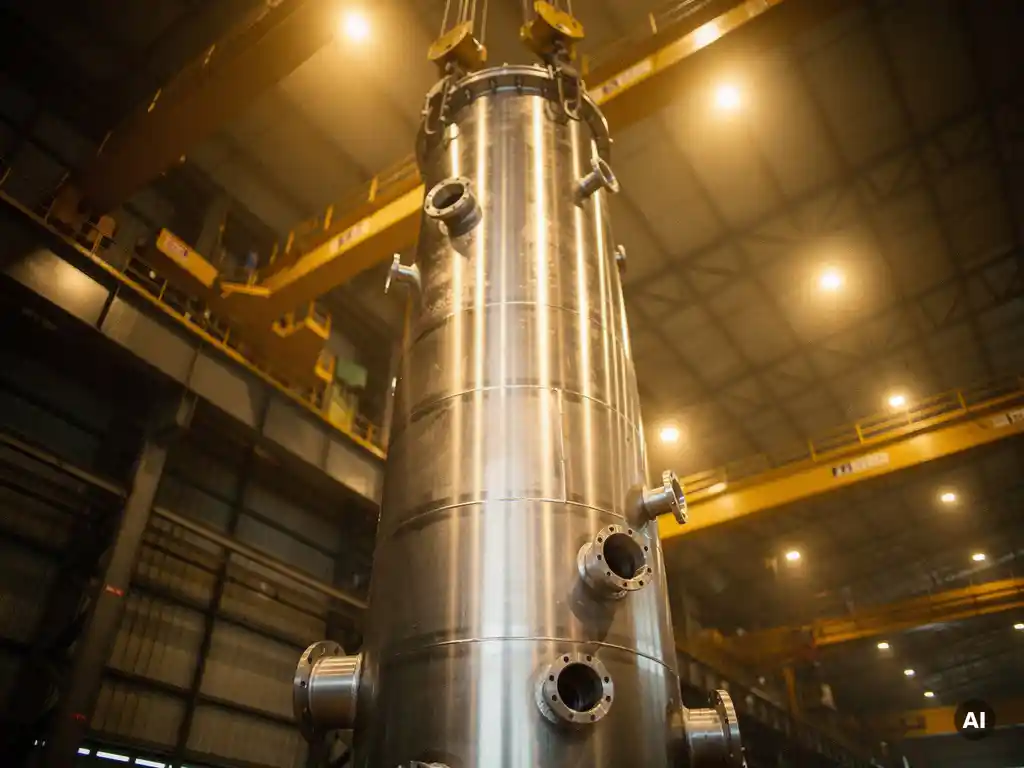
A process column is a vertical pressure vessel used in industrial separation and purification processes. It works by bringing two phases into contact, typically a liquid and a vapour, or two immiscible liquids, so that components transfer from one phase to the other based on differences in volatility, solubility, or chemical affinity. Process columns are found across chemical, petrochemical, pharmaceutical, and refining industries wherever continuous separation at scale is required. The sections below address the most common technical questions about how these columns are designed, what they are made from, and when custom fabrication becomes necessary.
What are the main types of process columns used in industry?
The main types of process columns used in industry are distillation columns, absorption columns, stripping columns, extraction columns, and rectification columns. Each type is defined by the separation mechanism it employs and the phases it brings into contact. The choice of column type is determined by the process chemistry, the components to be separated, and the required purity of the output stream.
- Distillation columns separate mixtures based on differences in boiling point, using heat to generate vapour that rises through the column while liquid flows downward.
- Absorption columns transfer a target component from a gas phase into a liquid solvent flowing counter-currently through the vessel.
- Stripping columns reverse the absorption process, driving dissolved components out of a liquid and into a rising gas or steam stream.
- Extraction columns separate components between two immiscible liquid phases, relying on differences in solubility rather than volatility.
- Rectification columns are a specific form of distillation designed to achieve high-purity separation by combining enriching and stripping sections within a single vessel.
- Dehydration columns remove water from process streams and are commonly used in chemical and polymer production where moisture control is critical.
In demanding chemical processes such as purified terephthalic acid (PTA) production, several of these column types operate within the same plant, each handling a distinct stage of the overall separation sequence.
How does mass transfer happen inside a process column?
Mass transfer inside a process column happens when two phases, typically vapour and liquid, or two liquids, are brought into close contact across a large interfacial area. Differences in concentration or partial pressure between the phases drive components to migrate from the phase where they are more concentrated to the phase where they are less concentrated, until equilibrium is approached. The column’s internal structure is specifically designed to maximise this contact area and the time the phases spend in contact.
In a vapour-liquid column, hot vapour rises from the bottom while cooler liquid flows downward. At each contact point, lighter, more volatile components transfer into the vapour phase and rise toward the top outlet, while heavier components remain in or return to the liquid phase and move toward the bottom. The efficiency of this transfer depends on the interfacial area created, the residence time of the phases, and the degree of turbulence or mixing within the column.
The internal components, whether trays or packing, exist solely to create and renew this contact surface repeatedly across the height of the column. A taller column with more contact stages achieves a sharper separation, which is why process columns in demanding applications can reach lengths of 80 metres or more.
What is the difference between tray columns and packed columns?
The key difference between tray columns and packed columns is how they create contact between the two phases. Tray columns use a series of horizontal perforated or valved plates where vapour bubbles up through liquid held on each tray, creating discrete contact stages. Packed columns use a continuous bed of structured or random packing material that spreads liquid in a thin film across a large surface area as vapour flows upward through the voids.
Tray columns
Tray columns are well suited to large-diameter applications and high liquid flow rates. Each tray acts as an individual equilibrium stage, making it straightforward to design for a defined number of theoretical stages. They are generally easier to inspect, clean, and maintain, and they handle fouling or solids-laden streams better than packed alternatives. Tray columns are common in large-scale distillation and absorption applications in the chemical and petrochemical sectors.
Packed columns
Packed columns offer a lower pressure drop per theoretical stage, which makes them preferable when operating pressure must be minimised, for example, in vacuum distillation or when processing thermally sensitive materials. Structured packing in particular can achieve a high number of theoretical stages within a compact column height. Packed columns are often chosen for smaller diameters, lower liquid loads, or applications where pressure drop is a critical constraint.
In practice, some columns combine both internals, using trays in sections where liquid loads are high and packing in sections where low pressure drop is the priority.
What materials are process columns made from?
Process columns are made from materials selected to withstand the specific combination of temperature, pressure, and chemical environment they will encounter in service. Carbon steel is the standard structural material for non-corrosive or mildly corrosive services. When the process fluid is aggressive, corrosion-resistant alloys or clad constructions are required.
In highly corrosive chemical processes, columns are fabricated from or lined with materials such as:
- Titanium: used in solid or clad form for processes involving oxidising acids and aggressive media, including PTA and chlor-alkali applications.
- Zirconium: selected for processes involving highly aggressive acids such as those found in brine purification, where its corrosion resistance is exceptional.
- Hastelloy C22: applied in acetic acid and other aggressive organic acid environments where nickel-based alloys outperform stainless steel.
- Tantalum: used in extreme corrosion conditions where even titanium or zirconium cannot provide adequate resistance.
- Stainless steel: suitable for moderately corrosive services and widely used across general chemical processing.
Clad construction is a cost-effective approach for large columns where solid exotic alloy construction would be prohibitively expensive. A structural carbon steel shell provides the mechanical strength, while a metallurgically bonded inner layer of titanium, zirconium, or another alloy provides the corrosion resistance. This combination delivers the performance of an exotic material at a significantly lower material cost, and it is particularly relevant for large-diameter, heavy columns where material quantities are substantial.
What design and fabrication standards apply to process columns?
Process columns are designed and fabricated according to recognised international pressure vessel codes that govern wall thickness calculations, allowable stresses, weld quality, inspection requirements, and documentation. The applicable code depends on the country of installation, the client’s specification, and the technology licensor’s requirements.
The most widely applied standards include the ASME Boiler and Pressure Vessel Code (Section VIII), the European Pressure Equipment Directive (PED), and the AD Merkblätter standard used in German-speaking markets. Columns intended for export to multiple regions may need to comply with more than one code simultaneously.
Beyond standard code calculations, demanding column projects often require supplementary analyses. Finite element analysis (FEA) is used to evaluate stress concentrations in complex geometries or nozzle reinforcements. Vibration analysis is particularly relevant for tall, slender columns that may be susceptible to wind-induced oscillation during operation or transport. Fatigue analysis applies where cyclic loading is expected over the column’s service life.
Weld procedures, welder qualifications, non-destructive examination methods, and heat treatment requirements are all defined within the applicable code and the project inspection plan. For columns fabricated from exotic materials such as titanium or zirconium, the welding procedures and quality controls are significantly more stringent than for standard carbon steel construction.
When does a process column require custom fabrication?
A process column requires custom fabrication when its dimensions, operating conditions, materials, or mechanical complexity exceed what standard or catalogue equipment can provide. In practice, most industrial process columns are custom-built to some degree, because the column geometry, nozzle layout, internal configuration, and material specification are all determined by the specific process requirements of the installation.
Custom fabrication becomes particularly critical when one or more of the following conditions apply: the column exceeds standard transport or manufacturing dimensions; the process fluid demands exotic or clad materials; the operating pressure or temperature is at the upper boundary of standard construction; the dimensional tolerances on shell roundness or tray levelness are unusually tight; or the column must be integrated with other mechanical systems as part of a broader equipment scope.
Large columns in PTA plants illustrate this clearly. Columns reaching 80 metres in length, 8 metres in diameter, and 600 to 800 tonnes in weight cannot be sourced from a catalogue. They require a manufacturer with the physical infrastructure to handle such dimensions, the materials expertise to work with titanium clad construction at scale, and the engineering capability to manage the mechanical design from process input through to a manufacturable result.
How Coek Engineering approaches process column fabrication
Coek Engineering designs and manufactures custom process columns for technically demanding chemical and industrial applications. The focus is on projects where standard fabrication is not sufficient, where column size, material requirements, or operating conditions demand a specialist approach.
Key capabilities relevant to process column projects include:
- Manufacturing of columns up to 10 metres in diameter, 100 metres in length, and 1,000 tonnes in weight across facilities in Geel and Genk
- More than 30 years of experience with clad construction, including titanium, zirconium, and Hastelloy clad columns for aggressive chemical environments
- In-house mechanical engineering that translates customer process requirements into mechanically sound, code-compliant, and manufacturable column designs
- Compliance with ASME, PED, and AD Merkblätter standards, with supplementary capabilities in FEA, fatigue, thermal, and vibration analysis
- A proven track record in large-scale PTA columns and acetic acid applications, as well as other corrosion-critical chemical processes
If your project involves a process column with demanding dimensions, aggressive media, exotic materials, or tight fabrication tolerances, contact Coek Engineering to discuss your requirements.
Frequently Asked Questions
How do I know whether my process column needs tray internals or packed internals?
The decision comes down to four key factors: column diameter, liquid load, pressure drop constraints, and fouling tendency. If your column is large-diameter with high liquid throughput, or if the process stream contains suspended solids or fouling components, trays are generally the more practical choice. If minimising pressure drop is critical — for example in vacuum distillation or with thermally sensitive products — or if the column diameter is relatively small, structured packing is usually preferred. In complex processes, it is worth consulting with your mechanical engineer early, as some columns benefit from a hybrid approach using trays in high-liquid-load sections and packing elsewhere.
What are the most common mistakes made when specifying a process column for a new project?
One of the most frequent mistakes is underspecifying the corrosion environment — selecting carbon steel or standard stainless steel for a service that actually requires an exotic alloy or clad construction, which leads to premature failure and costly retrofits. Another common error is failing to account for transport and installation constraints early in the design phase; a column that cannot be shipped in one piece or lifted into position on site creates significant schedule and cost problems. Finally, neglecting to define the required number of theoretical stages from the process simulation before engaging a fabricator often results in a column that cannot achieve the target separation purity.
How is the number of theoretical stages in a process column determined?
The number of theoretical stages is determined through process simulation, typically using software such as Aspen Plus, HYSYS, or equivalent tools, which model the vapour-liquid equilibrium behaviour of the mixture being separated. The simulation calculates how many ideal contact stages are needed to achieve the target separation between the key components, given the specified feed composition, operating pressure, and reflux or solvent ratio. This theoretical stage count is then converted into a physical column height by applying a tray efficiency factor (for tray columns) or a height equivalent to a theoretical plate, known as HETP (for packed columns). The fabricator uses this height, along with the required diameter for the given flow rates, to define the column geometry.
What should I look for when qualifying a fabricator for a large or exotic-material process column?
Beyond general pressure vessel certification, look specifically for demonstrated experience with the material in question — titanium, zirconium, or Hastelloy clad construction each require qualified welding procedures, trained welders, and controlled fabrication environments that not all shops possess. Verify that the fabricator has the physical infrastructure to handle your column’s dimensions, including lifting capacity, plate rolling capability for large diameters, and sufficient workshop floor space. Ask for references from comparable projects in terms of size, material, and industry application, and confirm that the fabricator can support the full engineering scope from mechanical design through code compliance, inspection, and documentation.
What happens if a process column needs to be transported in sections and assembled on site?
When a column exceeds road, rail, or sea transport limits in its assembled form, it is fabricated in field-weld sections — discrete shell sections with prepared weld ends — that are joined on site after erection. This approach requires careful planning at the design stage to position field welds in locations that are accessible for welding and non-destructive examination once the column is vertical. The field weld procedures must meet the same code requirements as shop welds, and post-weld heat treatment, if required by the material or code, must be feasible in the field environment. Coordinating the sequence of internal installation — trays, packing supports, and distributors — around the field assembly sequence adds further complexity that should be addressed in the fabrication plan.
How does clad construction actually work, and is it as reliable as solid exotic alloy construction?
Clad construction bonds a thin layer of corrosion-resistant alloy — such as titanium or zirconium — to a structural carbon steel base plate using explosive bonding, roll bonding, or weld overlay, producing a composite plate that is then formed into the column shell. The bond between the two layers is metallurgical, not mechanical, meaning the cladding does not delaminate under normal service conditions and provides continuous, pinhole-free corrosion protection across the entire wetted surface. When fabricated to the appropriate standards and inspected correctly — including ultrasonic bond integrity testing — clad construction delivers corrosion performance equivalent to solid exotic alloy construction for the wetted surfaces, at a fraction of the material cost for large, heavy columns where the weight of solid alloy would be prohibitive.
What supplementary engineering analyses are typically required for tall, slender process columns, and why do they matter?
Tall, slender columns — generally those with a height-to-diameter ratio above about 15 to 1 — are susceptible to wind-induced vibration, specifically vortex shedding, where alternating wind forces cause the column to oscillate laterally at its natural frequency. A vibration analysis is performed to confirm that the column’s natural frequency is sufficiently separated from the vortex shedding frequency at the design wind speed, and where necessary, helical strakes or tuned mass dampers are added to the design. Finite element analysis is used to evaluate stress concentrations around large nozzles, saddle supports, or geometric discontinuities that simplified code calculations cannot accurately capture. These analyses are not optional add-ons for tall columns — skipping them risks fatigue cracking, structural failure, or regulatory non-compliance over the column’s service life.
Related Articles
- What materials are used in shell-and-tube heat exchanger manufacturing?
- How does nozzle placement affect reactor vessel mechanical performance?
- How do you prevent stress corrosion cracking in pressure vessel materials?
- What are the weight and dimensional limits for road transport of pressure vessels?
- What non-destructive testing methods apply to thick-walled pressure equipment?