
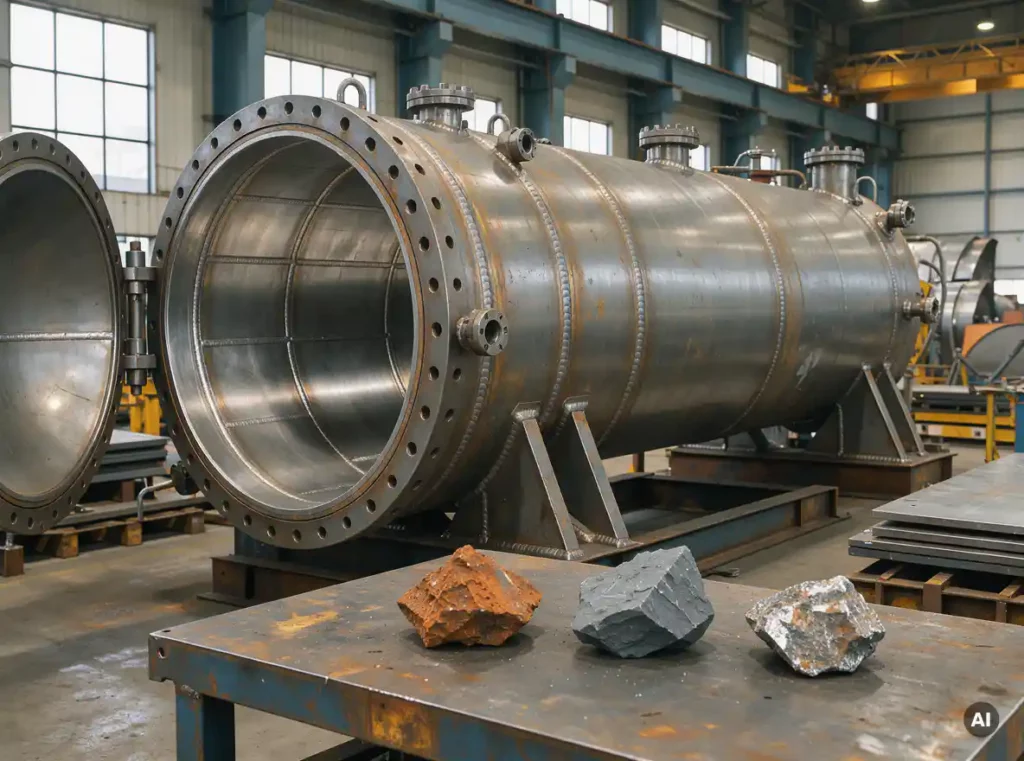
Which ore properties change autoclave operating conditions most?
Sulfide sulfur content, carbonate content, chloride levels, solids density and mineralogy have the greatest influence on autoclave operating conditions. They set how much heat the reaction generates, how much oxygen or acid the process consumes, and how aggressive the slurry becomes toward the vessel lining. The properties that deserve the closest attention are:- Sulfide sulfur: drives oxidation heat, oxygen demand and acid generation.
- Carbonates: consume acid, release carbon dioxide and change the gas phase and pressure balance.
- Chlorides: raise the risk of localised corrosion in many materials.
- Iron and other reactive minerals: influence precipitation, scaling and slurry behaviour.
- Hardness and particle size: affect erosion and abrasion of internals and linings.
How does sulfur content affect autoclave temperature and pressure?
Higher sulfide sulfur content releases more heat during oxidation, which pushes autoclave temperature up and increases the steam and gas load. Since pressure follows both temperature and gas composition, richer ore raises operating pressure unless cooling, venting and feed rate are adjusted to compensate. In a pressure oxidation autoclave, sulfide oxidation is strongly exothermic. At low sulfur levels, the process may need supplemental heating, often through steam. At high sulfur levels, the reaction can generate more heat than the slurry can absorb, so the operator must add cooling, typically by flashing, quench water or reduced feed solids. This creates a practical swing in the thermal duty. A design that handles a mid-range sulfur feed comfortably may run into temperature limits when richer ore arrives. The reverse is also true, and a lean feed may struggle to sustain the reaction without extra energy input. Oxygen demand follows the same pattern. Richer feed needs more oxygen, which affects gas supply, venting and the partial pressures inside each compartment. Pressure ratings, nozzle sizing and relief design all depend on knowing the upper end of this range.Why does variable ore quality cause corrosion and material issues?
Variable ore quality changes the acidity, chloride level and temperature inside the autoclave, and corrosion rates respond sharply to each of them. A lining that performs well on the design feed can degrade faster when the slurry becomes more acidic, hotter or more chloride-rich than expected. Erosion is a second, separate threat. Harder, coarser or denser solids accelerate wear on agitators, baffles, nozzles and the lining itself, particularly near areas of high flow velocity. Erosion can also strip protective surface films and expose fresh metal to corrosion, so the two mechanisms compound each other. For this reason, material selection should consider the worst credible slurry, not the average one. Titanium and titanium alloys are widely used as lining materials in acidic autoclave service, often applied as a clad layer on a carbon steel pressure shell. This design combines structural strength with a corrosion-resistant inner surface. Field experience also shows that design details, such as lining geometry near high-velocity zones, matter as much as the alloy grade in managing erosion.How does ore variability influence autoclave size and compartment design?
Ore variability influences autoclave size because the residence time, oxygen transfer and heat balance must work across the whole feed range. Compartment design then controls how the reaction is staged, letting the vessel handle richer and leaner ore without losing conversion or exceeding temperature limits. Multi-compartment autoclaves divide the slurry path into stages. Each compartment can have its own agitation, oxygen injection and temperature behaviour. This staging gives process teams control over where the heat is released and where cooling or heating is applied. Key design questions include:- What is the longest residence time needed for the most refractory ore in the range?
- What is the maximum heat release per compartment at the richest feed?
- How much oxygen can be delivered and dispersed in each stage?
- Where will the highest erosion occur given slurry velocity and solids content?
What operating margins should be built into an autoclave specification?
An autoclave specification should include margins on design pressure, design temperature, corrosion allowance, oxygen supply, cooling capacity and throughput. The exact values come from the process designer, but the principle is to define the full envelope of ore conditions and add headroom above the worst case. Practical areas to cover in the specification:- Design pressure and temperature: set above the highest expected operating point, including upset conditions.
- Corrosion and erosion allowance: based on the harshest slurry chemistry and solids loading.
- Thermal duty range: both heating for lean ore and cooling for rich ore.
- Future ore changes: deeper or different zones that may not match the early feed.
When should process teams involve the autoclave fabricator early?
Process teams should involve the autoclave fabricator during the concept and front-end design stage, before key dimensions, materials and compartment layouts are fixed. Early input shows whether the specified geometry, wall thickness and lining system can actually be built, transported and inspected. Fabrication constraints often shape the best design. Wall thickness, clad plate availability, welding of lining materials, heat treatment and shipping limits all influence what is practical. Discussing these points early avoids late redesigns and helps align the process envelope with mechanical reality. It is also the right moment to share the full ore variability data. A fabricator can then translate the process requirements into a mechanically sound design, including material options, erosion mitigation details and inspection planning.How Coek helps with ore variability in mining autoclaves
Coek Engineering is a Belgian manufacturer of custom pressure equipment, including large mining autoclaves in titanium-clad construction for pressure oxidation and high-pressure acid leach duty. Coek receives process requirements from customers, EPC contractors and technology owners and turns them into manufacturable mechanical designs. Coek supports projects through:- Titanium-clad autoclave fabrication, with Ti Grade 17 lining experience and design refinements aimed at erosion issues seen in the field.
- In-house mechanical engineering, including code calculations and supplementary analyses such as FEA, fatigue and thermal studies.
- Large-scale manufacturing capability, with autoclave references approaching 1,000 tons.
- Compliance with international standards, including ASME and PED.
Frequently Asked Questions
How do I get started defining the ore variability range for an autoclave specification?
Start by collecting representative samples from every planned pit area, depth and blend scenario, then analyse them for sulfide sulfur, carbonate, chloride, solids density and hardness. Build a table showing the minimum, average and maximum value of each variable, and note which combinations could occur together. Hand this envelope to the process designer and the fabricator so thermal duty, oxygen demand, pressure and material choices are all checked against the extremes, not the average.
What if the ore changes after the autoclave is installed and falls outside the original design envelope?
Short-term, operators can often compensate by blending ore, adjusting feed solids density, changing oxygen flow or altering cooling and heating duty. If the new ore exceeds design pressure, temperature or corrosion limits, a formal engineering review is needed before continuing, since modifying a pressure vessel is difficult and costly. This is why including headroom for deeper or different ore zones in the original specification is usually cheaper than a retrofit.
Is it better to blend ore to a consistent feed or to design the autoclave for a wide range?
Usually both. Blending reduces the swings in sulfur, carbonate and chloride content that the autoclave sees, which makes control easier and protects the lining. However, blending cannot remove all variability, especially over a multi-decade mine life, so the vessel should still be designed for the credible extremes rather than relying on blending alone.
What are common mistakes when specifying an autoclave for variable ore?
The most frequent mistakes are designing around average feed grade, ignoring chloride and carbonate effects, and sizing cooling capacity only for the mid-range sulfur case. Another is treating corrosion and erosion separately when they compound each other. Finally, many teams involve the fabricator too late, after dimensions and materials are fixed, which leads to redesigns or compromises.
How can I tell whether a lean feed or a rich feed is the bigger design risk?
Both matter but in different ways. Rich feed is typically the greater safety and mechanical risk because of higher heat release, oxygen demand, pressure and corrosion severity. Lean feed is mainly an operability and energy risk, since the reaction may need supplemental steam to sustain temperature. Check the design against both ends of the thermal duty range and confirm that heating and cooling systems cover each.
What information should I send a fabricator to get meaningful early feedback?
Share the full ore variability data, the expected operating temperature and pressure range including upset conditions, the slurry chemistry (acidity, chlorides, solids content), the target throughput and the proposed compartment layout. Also include site constraints such as transport routes and lifting limits. With this, a fabricator can comment on wall thickness, lining system, erosion mitigation details, inspection planning and whether the vessel can realistically be built and shipped.
How should erosion be managed if the ore is harder or coarser than expected?
Focus on the high-velocity zones around agitators, baffles, nozzles and compartment transitions, and ask the fabricator about lining geometry refinements in those areas, not just alloy grade. Include an erosion allowance based on the harshest solids loading and particle size, and plan regular inspections so wear trends are caught before they expose the pressure shell. Controlling grind size and solids density upstream also reduces wear.