
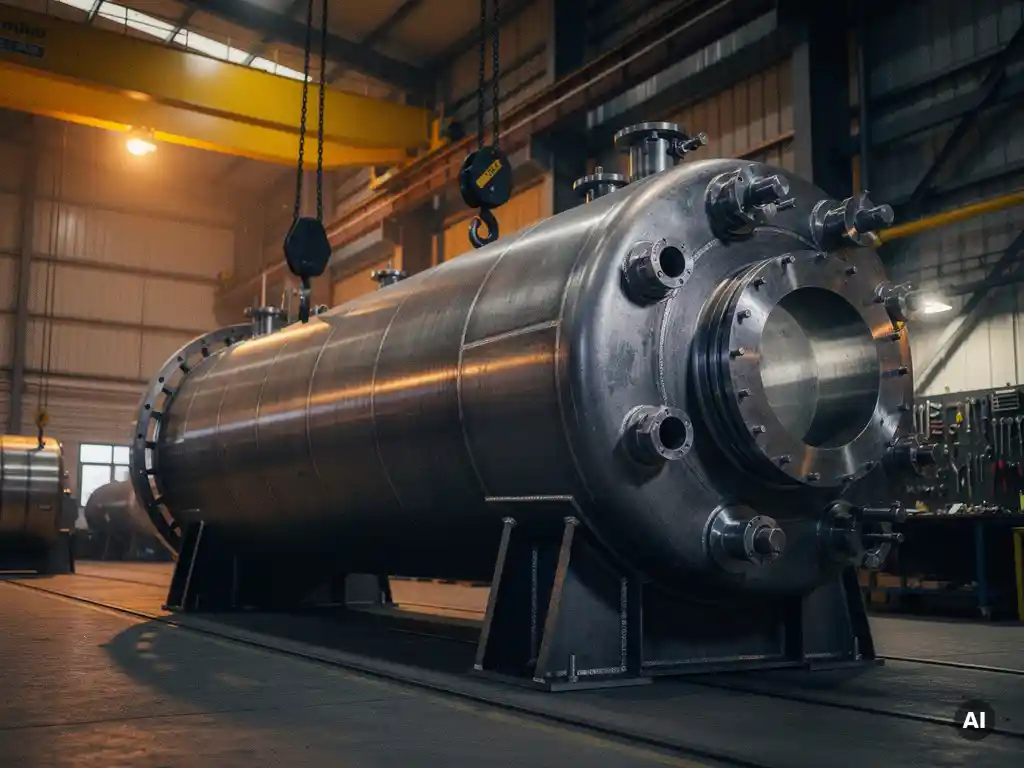
A large capacity autoclave is a heavy-duty pressure vessel designed to process materials or components under precisely controlled combinations of high pressure, elevated temperature, and sometimes specific atmospheric conditions. Unlike general-purpose autoclaves, large capacity units are purpose-built for industrial-scale applications where volume, structural integrity, and operating reliability are critical requirements.
These vessels are engineered to exact process specifications and can range from several metres in diameter to structures approaching or exceeding 100 metres in length, depending on the application. The sections below address the most common technical questions buyers and engineers ask when specifying or sourcing a large industrial autoclave.
How large can an industrial autoclave actually get?
Industrial autoclaves can reach extraordinary dimensions. In demanding applications, vessels can exceed 10 metres in diameter and approach 100 metres in length, with weights nearing 1,000 tonnes. These are not standard catalogue items. Every large-scale autoclave is engineered and fabricated to match a specific process requirement, making dimensional flexibility a core manufacturing challenge.
The practical upper limit of autoclave size is determined by a combination of process requirements, site constraints, transport logistics, and the manufacturing capabilities of the fabricator. Producing a vessel at this scale requires specialised facilities with large overhead cranes, heavy-duty machining equipment, and the structural capacity to support and manoeuvre components weighing hundreds of tonnes during fabrication.
For context, an autoclave approaching 1,000 tonnes represents one of the most demanding fabrication challenges in the pressure equipment sector. Not many manufacturers worldwide can produce equipment at this scale to the required quality and dimensional standards.
What industries use large capacity autoclaves?
Large capacity autoclaves are used across a range of technically demanding industries where high pressure and elevated temperature are required to drive chemical reactions, consolidate materials, or carry out controlled processing at scale. The common denominator is not the industry itself but the severity of the operating conditions and the volume of material being processed.
Industries that regularly require large industrial autoclaves include:
- Composite and aerospace manufacturing: for curing fibre-reinforced polymer components under controlled pressure and temperature
- Chemical and petrochemical processing: for high-pressure reactions, polymerisation, and other demanding chemical processes
- Hydrometallurgy and mining: for pressure oxidation and leaching of ores under aggressive conditions
- Rubber and tyre manufacturing: for vulcanisation processes requiring large internal volumes
- Wood and building materials treatment: for impregnation and preservation under pressure
- Food processing: for large-scale sterilisation under controlled thermal and pressure conditions
In each case, the autoclave must be designed to the specific process conditions of that application, including pressure class, temperature range, internal atmosphere, and compatibility with the materials being processed.
What operating conditions do large autoclaves handle?
Large capacity autoclaves are engineered to withstand combinations of high internal pressure, elevated temperature, and in some cases chemically aggressive environments. Operating pressures can range from a few bar to several hundred bar, and temperatures can extend well beyond 300 degrees Celsius depending on the process. The specific design envelope is always defined by the customer’s process requirements.
Beyond pressure and temperature, the operating environment inside a high-pressure autoclave can involve corrosive media, reactive gases, or abrasive slurries. This means the vessel must be designed not only for mechanical strength but also for long-term resistance to the specific chemical conditions it will encounter throughout its service life.
Thermal cycling, fatigue loading, and the mechanical stresses introduced during pressurisation and depressurisation cycles are also important design considerations. A large autoclave that operates reliably over decades must be engineered with all of these factors accounted for from the outset.
What materials are used to build large capacity autoclaves?
The choice of material for a large capacity autoclave depends directly on the operating conditions it must withstand. Carbon steel is commonly used for the structural shell where operating conditions allow, but many applications require significantly more resistant materials, either throughout the vessel or as an internal protective layer.
For corrosive or chemically demanding environments, advanced alloys and specialty materials are frequently specified. These include:
- Titanium: excellent corrosion resistance in oxidising and chloride-containing environments
- Zirconium: outstanding resistance to acids and highly corrosive media
- Hastelloy and Inconel: high-performance nickel alloys suited to extreme temperatures and aggressive chemical conditions
- Tantalum: used in highly specialised applications where extreme chemical resistance is required
- Clad construction: a carbon steel shell with a corrosion-resistant inner layer, combining structural strength with chemical resistance at lower material cost than a solid alloy vessel
Clad construction is particularly relevant for large autoclaves because producing an entire vessel from a solid exotic alloy at large scale becomes impractical both technically and economically. A well-engineered clad vessel delivers the required corrosion resistance at the internal surface while keeping the overall structure manageable in terms of weight and fabrication complexity.
How is a large capacity autoclave different from a standard pressure vessel?
A large capacity autoclave is a specialised type of pressure vessel, but the two are not interchangeable terms. The key distinction is that an autoclave is designed to process materials or components placed inside it, using pressure, temperature, and sometimes a controlled atmosphere as active processing tools. A standard pressure vessel typically contains or transports a fluid or gas as part of a process, rather than acting as a processing chamber itself.
Autoclaves also tend to require features that are less common in standard pressure vessels. These include large-diameter access openings or end closures to allow loading and unloading, internal fixtures or supports for the materials being processed, and precise control of the internal environment throughout the processing cycle. The mechanical design of the closure system alone represents a significant engineering challenge at large scale.
From a fabrication standpoint, the combination of large diameter, thick walls, heavy closures, and demanding operating conditions places a large autoclave among the most complex items within the broader pressure vessel autoclave category.
What manufacturing capabilities are required to build a large autoclave?
Building a large-scale autoclave demands a manufacturing infrastructure that goes well beyond what is needed for standard pressure equipment. The fabricator must be able to handle extreme dimensions and weights at every stage of production, from raw material receipt through to final inspection and despatch.
Key manufacturing capabilities required include the ability to roll and form heavy plate into large-diameter shell sections, weld thick-walled components to the required quality standards, machine large flanges and closure faces to tight dimensional tolerances, and apply and verify corrosion-resistant cladding across large internal surfaces. Lifting and handling equipment rated for hundreds of tonnes is essential throughout the fabrication process.
In-house mechanical engineering capability is equally important. The fabricator must be able to translate process specifications into a mechanically sound and manufacturable design, accounting for the interaction between pressure loads, thermal effects, nozzle loads, and the specific geometry of the vessel. This engineering work happens before a single plate is cut, and its quality determines the reliability of the finished equipment.
What certifications and standards apply to large capacity autoclaves?
Large industrial autoclaves are subject to the same pressure equipment regulations and standards as other pressure vessels, with the applicable framework depending on where the equipment will be installed and operated. The most widely referenced standards in international projects include the European Pressure Equipment Directive (PED), the ASME Boiler and Pressure Vessel Code, and ISO 9001 for quality management systems.
PED compliance is required for pressure equipment placed on the market within the European Economic Area. ASME certification, and in particular the ASME U-stamp, is commonly required for projects in North America and is also specified on many international projects as a recognised quality benchmark. Beyond these frameworks, specific industries or end users may impose additional requirements related to material traceability, non-destructive examination, or third-party inspection.
Compliance with these standards is not simply a documentation exercise. It requires a quality management system embedded in the fabrication process, qualified welding procedures, certified welders, and systematic inspection at defined stages throughout production. For critical equipment, independent inspection by a notified body or authorised inspection authority is standard practice.
How Coek supports large capacity autoclave projects
Coek Engineering designs and manufactures large capacity autoclaves for technically demanding industrial applications. With facilities in Geel and Genk capable of producing equipment up to 10 metres in diameter and approaching 1,000 tonnes, Coek has the infrastructure to take on autoclave projects that fall outside the scope of most fabricators.
Key capabilities relevant to large autoclave projects include:
- In-house mechanical engineering to translate process specifications into manufacturable equipment
- Advanced materials expertise covering titanium, zirconium, Hastelloy, Inconel, tantalum, and other demanding alloys
- More than 30 years of experience with clad construction for corrosion-resistant applications
- Large-scale fabrication infrastructure for heavy, thick-walled, and dimensionally demanding vessels
- Compliance with PED, ASME, and ISO 9001 requirements
If you are sourcing a large industrial autoclave for a technically demanding application, explore Coek’s industrial autoclave capabilities or contact the Coek team to discuss your project requirements.
Frequently Asked Questions
How long does it typically take to design and fabricate a large capacity autoclave?
Lead times for large capacity autoclaves vary significantly depending on complexity, materials, and the fabricator’s current workload, but projects of this scale commonly require 12 to 24 months from initial specification to delivery. The timeline is driven by the sequential nature of the work: engineering and design must be completed and reviewed before fabrication begins, and procurement of specialty materials such as titanium or zirconium can itself take several months. Engaging your fabricator early in the project lifecycle — ideally at the process design stage — is the most effective way to protect your schedule.
What information do I need to provide when requesting a quote for a large industrial autoclave?
At a minimum, you should be prepared to share your process conditions (design pressure, design temperature, and operating cycle), the internal dimensions required, the media the vessel will be exposed to, and the installation location (which determines the applicable regulatory framework). The more detail you can provide about your process, the more accurately a fabricator can assess material selection, wall thickness, and closure design. Even a preliminary process description is enough to begin a technical conversation — experienced fabricators will help you refine the specification from there.
Can a large autoclave be transported and installed on site, or does it need to be built in place?
Most large autoclaves are fabricated in a controlled workshop environment and then transported to site, which is strongly preferable for quality and inspection purposes. However, transport logistics are a genuine engineering challenge for very large vessels: road, rail, and sea routes all impose dimensional and weight constraints that must be assessed early. In cases where the finished vessel exceeds transportable limits, the autoclave may be fabricated in sections and assembled on site, which introduces additional requirements around field welding, inspection, and pressure testing. Your fabricator should conduct a transport feasibility assessment as part of the early project planning process.
What are the most common mistakes made when specifying a large capacity autoclave?
One of the most frequent errors is under-specifying the operating envelope — designing to nominal conditions rather than the worst-case combination of pressure, temperature, and chemical exposure the vessel may realistically encounter in service. Another common issue is selecting materials based on upfront cost alone without accounting for long-term corrosion performance, which can result in premature vessel degradation and costly remediation. It is also worth ensuring that closure and access requirements are fully defined from the outset, as changes to large-diameter closure designs late in the engineering phase can have significant cost and schedule implications.
How should a large autoclave be maintained to ensure a long and reliable service life?
A structured inspection and maintenance programme is essential for any large pressure vessel operating under demanding conditions. This typically includes periodic internal inspection of the vessel shell and cladding (where applicable), non-destructive examination of welds and high-stress areas, and functional testing of closure mechanisms, seals, and safety systems. The frequency and scope of inspections should be defined in a risk-based inspection plan developed in line with the applicable regulatory requirements and the specific operating history of the vessel. Keeping detailed records of operating cycles, any anomalies, and inspection findings is equally important for tracking the long-term condition of the equipment.
Is clad construction as reliable as a solid alloy vessel for highly corrosive applications?
When properly engineered and fabricated, a clad vessel can deliver equivalent corrosion protection to a solid alloy construction at the internal surface where chemical resistance is actually needed. The critical factors are the quality of the bond between the cladding and the backing material, the integrity of welds at the clad interface, and the thoroughness of inspection during and after fabrication. A fabricator with deep experience in clad construction — including validated procedures for the specific alloy combinations involved — can produce clad autoclaves that perform reliably over decades of service in aggressive chemical environments.
Can an existing large autoclave be modified or uprated to handle more demanding operating conditions?
In principle, yes, but any modification to a pressure vessel that affects its structural integrity or operating envelope must be treated with the same engineering rigour as a new build. This means a formal re-assessment of the vessel’s design, a review of the original material certifications and weld records, and compliance with the applicable pressure equipment regulations for the modification. Whether uprating is technically and economically viable depends heavily on the original design margins, the current condition of the vessel, and the extent of the changes required. An experienced pressure vessel engineer should carry out a feasibility assessment before any modification work is committed to.
Related Articles
- How do you ensure material traceability during pressure vessel manufacturing?
- What is the difference between a solid and a clad pressure vessel?
- How do you size a pressure vessel for a high-pressure application?
- How does operating pressure influence pressure vessel head geometry selection?
- What materials are used to manufacture pressure vessels?