
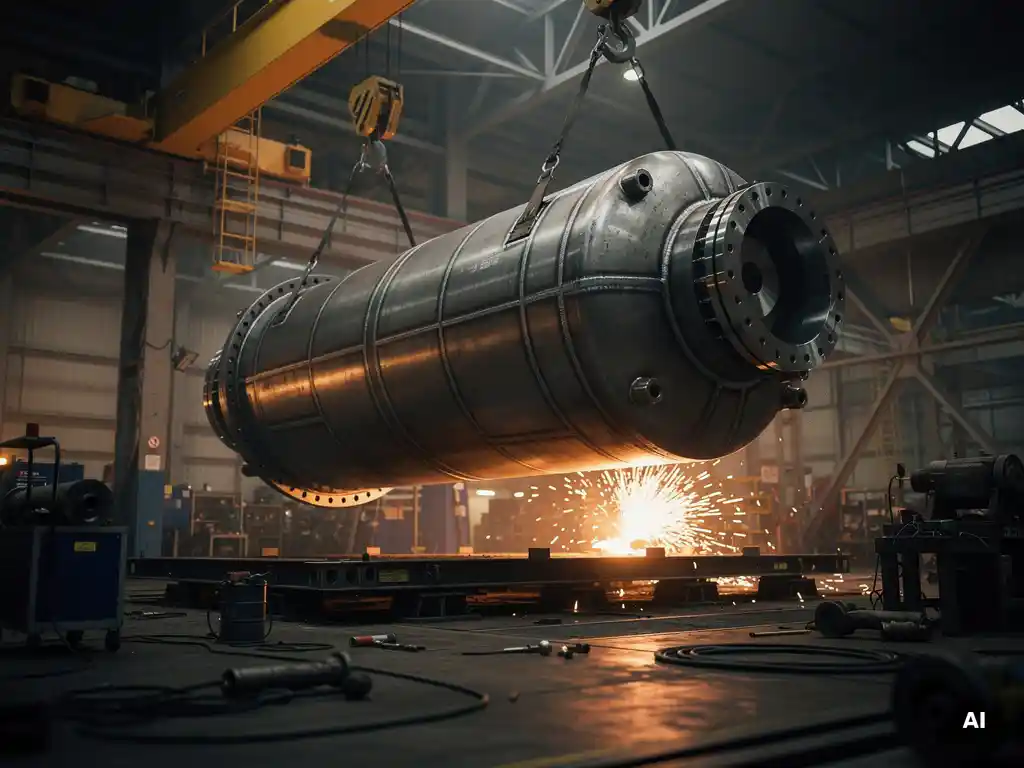
Industrial processes require custom-built pressure vessels when standard, off-the-shelf equipment cannot safely or reliably meet the specific operating conditions of a given application. Factors such as extreme pressure, elevated temperature, corrosive media, unusual dimensions, or demanding material requirements push processes beyond what catalogue vessels are designed to handle. The questions below unpack the most common drivers behind that decision.
What process conditions make a standard pressure vessel inadequate?
A standard pressure vessel becomes inadequate when one or more operating parameters fall outside the design envelope that commodity fabricators build to. These thresholds are not arbitrary – they reflect the limits of standard materials, wall thicknesses, and fabrication methods. When a process exceeds them, a custom-built pressure vessel is not a preference but a technical necessity.
The conditions that most frequently disqualify standard vessels include:
- Extreme operating pressure or temperature – requiring thicker walls, specialised heat treatment, or higher-grade base materials
- Highly corrosive process media – acids, solvents, or reactive chemicals that degrade standard carbon steel
- Unusual dimensions or weight – equipment that exceeds the physical envelope of standard product ranges
- Tight dimensional tolerances – where internal geometry directly affects process performance
- Integrated mechanical requirements – agitators, internal structures, or specialised nozzle configurations that must be engineered as part of the vessel
In practice, many demanding processes combine several of these factors simultaneously, making the case for custom pressure equipment even stronger. A vessel handling a corrosive fluid at high pressure and elevated temperature, for example, requires an engineering approach that addresses all three variables together rather than independently.
How does corrosion resistance drive custom pressure vessel design?
Corrosion resistance is one of the most frequent technical drivers behind custom industrial pressure vessel design. When a process fluid is chemically aggressive, the choice of construction material directly determines whether the vessel will perform safely over its intended service life. Standard carbon steel – the material of most commodity vessels – offers little resistance to acids, halogens, oxidising agents, or many organic solvents.
Designing for corrosion resistance influences the vessel at multiple levels. The base material may need to be replaced entirely with a corrosion-resistant alloy, or the vessel may be built using a clad construction where a corrosion-resistant inner layer is bonded to a structural carbon steel shell. Weld filler materials, heat treatment procedures, and surface finish requirements all follow from the corrosion environment defined by the process.
In highly aggressive environments, materials such as titanium, zirconium, tantalum, Hastelloy, or Inconel may be specified. Each of these materials has distinct fabrication characteristics and requires specialist welding procedures and quality controls. This level of material complexity is well beyond what standard vessel fabrication covers, which is why corrosion-driven projects consistently require custom engineering and manufacturing.
What is clad construction and when is it used in pressure vessels?
Clad construction is a fabrication method in which a corrosion-resistant alloy layer is bonded to a structural carbon steel shell, combining the mechanical strength of carbon steel with the chemical resistance of the cladding material. The result is a vessel that can withstand aggressive process media without requiring the entire structure to be built from expensive alloy material.
This approach is used when solid alloy construction would be technically unnecessary or economically prohibitive. If the structural load is carried by the carbon steel shell and only the process-contact surfaces require corrosion resistance, clad construction delivers the required performance at a more rational material cost. It is particularly relevant for large vessels, where the weight and cost of solid exotic alloy would be very significant.
Clad pressure vessels are more complex to fabricate than single-material vessels. The bond between the cladding and the base material must be consistent and verifiable. Welding at transitions between clad and unclad zones requires careful procedure development. Inspection and testing requirements are more demanding. These factors mean that clad construction is a specialised capability, not a standard fabrication offering.
Why do reactor vessels require more engineering than standard pressure vessels?
Reactor vessels require more engineering than standard pressure vessels because they must do more than contain pressure – they must support and control a chemical or physical process taking place inside. This means the vessel design must account for heat transfer, mixing, reaction kinetics, internal mechanical loads, and process-specific geometry, all within a structure that also meets pressure equipment requirements.
A reactor vessel typically incorporates internal components such as agitators, baffles, coils, distributors, or catalyst support structures. Each of these elements interacts with the vessel shell mechanically and thermally. The nozzle layout, wall thickness, and material selection must accommodate both the process requirements and the mechanical loads imposed by internals and connected systems.
For critical industrial processes, the engineering complexity of a reactor vessel can be substantial. Process requirements received from a technology owner or EPC contractor must be translated into a mechanically sound and manufacturable design – a step that requires genuine mechanical engineering capability, not just fabrication experience. This is a meaningful distinction: equipment engineering and process engineering are separate disciplines, and a vessel fabricator must be able to work from process specifications without owning or developing the underlying process technology.
How does vessel size affect fabrication requirements and manufacturer selection?
Vessel size directly determines which fabrication facilities, lifting equipment, transport logistics, and manufacturing processes are technically feasible. Beyond a certain scale, the number of manufacturers capable of producing a vessel decreases sharply, because large equipment requires purpose-built infrastructure that most fabricators do not have.
As vessel dimensions increase, fabrication challenges multiply. Plate rolling, shell section assembly, and internal welding all become more demanding at large scale. Dimensional control across a long or wide vessel requires rigorous process discipline to maintain tolerances that affect process performance. Heavy lifts within the workshop require appropriate crane capacity. And once fabricated, transport to site may require route surveys, special permits, or sea freight.
For buyers sourcing large custom pressure equipment, manufacturer selection must therefore begin with a realistic assessment of physical capability – not just quality certifications or commercial terms. A fabricator without the physical infrastructure to produce a vessel of the required size cannot compensate with engineering expertise alone.
Which industries most commonly require custom-built pressure equipment?
Custom-built pressure vessels and reactors are most commonly required in industries where process conditions are inherently demanding – high pressures, elevated temperatures, corrosive media, or large throughput volumes that push equipment beyond standard product ranges.
Industries with the highest concentration of custom industrial pressure vessel requirements include:
- Oil and gas processing and refining – where vessels handle hydrocarbons under high pressure and temperature, often with sulphur or other corrosive compounds present
- Chemical and petrochemical production – where aggressive process media, reactor requirements, and large vessel sizes are common
- Specialty chemicals and fine chemicals – where corrosive or reactive media often require exotic alloy or clad construction
- Polymer and plastics manufacturing – where reactor design and integrated mechanical systems are central to the process
- Mining and hydrometallurgy – where large-scale autoclaves operating under high pressure and in acidic environments are required for mineral processing
- Energy and industrial gases – where pressure containment at scale is fundamental to the process
The common denominator across these industries is not the sector itself but the technical complexity and criticality of the equipment. Custom pressure equipment is required wherever standard fabrication cannot meet the combination of size, material, pressure, and process demands that the application imposes.
What certifications and standards apply to custom industrial pressure vessels?
Custom industrial pressure vessels must comply with recognised pressure equipment standards that define design, material, fabrication, inspection, and testing requirements. The applicable standard depends on the country of installation, the project specification, and the requirements of the end user or technology owner.
The most widely referenced standards in international custom pressure vessel fabrication are:
- PED (Pressure Equipment Directive) – the European regulatory framework governing pressure equipment placed on the market within the EU, covering design, materials, and conformity assessment
- ASME Section VIII – the American Society of Mechanical Engineers standard widely used globally for pressure vessel design and fabrication, particularly for projects with US-linked technology or end users
- ISO 9001 – the quality management system standard that underpins consistent fabrication quality and traceability across the manufacturing process
For EPC contractors and technology owners operating internationally, a fabricator’s ability to work to multiple standards simultaneously is practically important. Projects may require PED compliance for European installation while also meeting ASME requirements specified by the technology licensor. Certification alone does not guarantee capability – the fabricator must demonstrate that its engineering and manufacturing processes reliably meet the requirements of each standard in practice.
How Coek supports demanding custom pressure vessel projects
Coek Engineering manufactures custom-built pressure vessels, reactor vessels, and industrial autoclaves for technically demanding applications where standard fabrication is not sufficient. Projects that benefit most from Coek’s capabilities typically involve one or more of the following:
- Large or heavy equipment requiring purpose-built manufacturing infrastructure
- Corrosive process environments requiring exotic alloys or clad construction
- Thick-walled or high-pressure vessel designs with demanding fabrication requirements
- Reactor vessels with complex internals, integrated mechanical systems, or tight tolerances
- Compliance with PED, ASME, or other international pressure equipment standards
Coek works from process requirements provided by EPC contractors, technology owners, or industrial end users, translating those specifications into mechanically sound and manufacturable equipment. If you are evaluating fabrication partners for a technically complex pressure equipment project, contact Coek’s engineering team to discuss your requirements.
Frequently Asked Questions
How long does it typically take to engineer and fabricate a custom pressure vessel?
Lead times for custom pressure vessels vary considerably depending on complexity, material availability, and vessel size, but projects typically range from several months to over a year from order to delivery. Material procurement — particularly for exotic alloys such as titanium, Hastelloy, or Inconel — often drives the critical path, as these materials can have long lead times. Engaging a fabricator early in the project timeline, ideally during the engineering phase, helps avoid schedule pressure and allows material procurement to begin before fabrication drawings are fully complete.
What information do I need to provide to a fabricator to get an accurate quote for a custom pressure vessel?
At minimum, a fabricator needs the process conditions (design pressure, design temperature, fluid composition), the applicable standard or code (such as ASME Section VIII or PED), the required material of construction, and the key dimensional envelope or capacity of the vessel. For reactor vessels, information about internals, nozzle configurations, and mechanical loads from agitators or connected systems is also essential. The more complete the process specification provided upfront, the more accurate and reliable the fabricator’s engineering assessment and commercial offer will be.
What are the most common mistakes companies make when sourcing a custom pressure vessel fabricator?
One of the most frequent mistakes is selecting a fabricator based primarily on price without first verifying that their physical infrastructure, material capabilities, and engineering capacity match the actual project requirements. For large or exotic-material vessels, a fabricator without the right workshop capacity or specialist welding procedures cannot compensate with competitive pricing. Another common error is engaging the fabricator too late in the project timeline, leaving insufficient room for engineering, material procurement, and fabrication within the required schedule.
Can a custom pressure vessel be designed to meet multiple international standards simultaneously, such as both PED and ASME?
Yes, and for international projects this is often a practical necessity. While PED and ASME Section VIII have different structural requirements, an experienced fabricator with genuine multi-standard capability can develop designs and documentation packages that satisfy both simultaneously. This requires the fabricator to hold the relevant certifications and to have engineering and quality processes that are structured around compliance with each standard — not simply familiarity with the documents. Buyers should verify this capability with reference to completed projects, not certifications alone.
How is weld quality verified in custom pressure vessels, and why does it matter more than in standard equipment?
Weld quality in custom pressure vessels is verified through a combination of non-destructive examination (NDE) methods — including radiographic testing (RT), ultrasonic testing (UT), dye penetrant inspection (DPI), and magnetic particle inspection (MPI) — along with hydrostatic or pneumatic pressure testing prior to shipment. The stakes are higher than in standard equipment because custom vessels typically operate at more demanding conditions, use more complex materials, and are often one-of-a-kind items that cannot simply be replaced if a failure occurs in service. For clad vessels or exotic alloy construction, additional weld procedure qualifications and overlay integrity checks are required to ensure the corrosion-resistant layer performs as designed.
What happens if my process conditions change after the vessel has been fabricated — can a custom pressure vessel be modified?
Post-fabrication modifications to pressure vessels are technically possible but must be treated as a formal engineering exercise, not a field modification. Any change to operating pressure, temperature, nozzle configuration, or internal components must be assessed against the original design calculations, and the modified vessel must be re-inspected and re-certified in accordance with the applicable standard. In some cases, the modification may require re-stamping or updated documentation under PED or ASME. Engaging the original fabricator for any modification work is strongly advisable, as they hold the design history, material records, and weld procedure documentation needed to assess and execute changes safely.
At what project stage should a custom pressure vessel fabricator be brought into the engineering process?
Ideally, a fabricator should be engaged during the detailed engineering phase, before equipment datasheets are fully frozen. Early fabricator involvement allows constructability input — such as practical limits on wall thickness, weld joint configurations, or internal geometry — to be incorporated into the design before it becomes costly to change. For projects involving exotic materials, large vessel sizes, or complex internals, early engagement also allows long-lead material procurement to begin in parallel with engineering, which can significantly compress the overall project schedule.
Related Articles
- What safety systems are required for high-pressure industrial autoclaves?
- How long does it take to manufacture a custom industrial pressure vessel?
- How does wall thickness affect pressure vessel structural integrity?
- How do you choose between solid and clad construction for corrosive service?
- What is clad construction in pressure vessel manufacturing?