
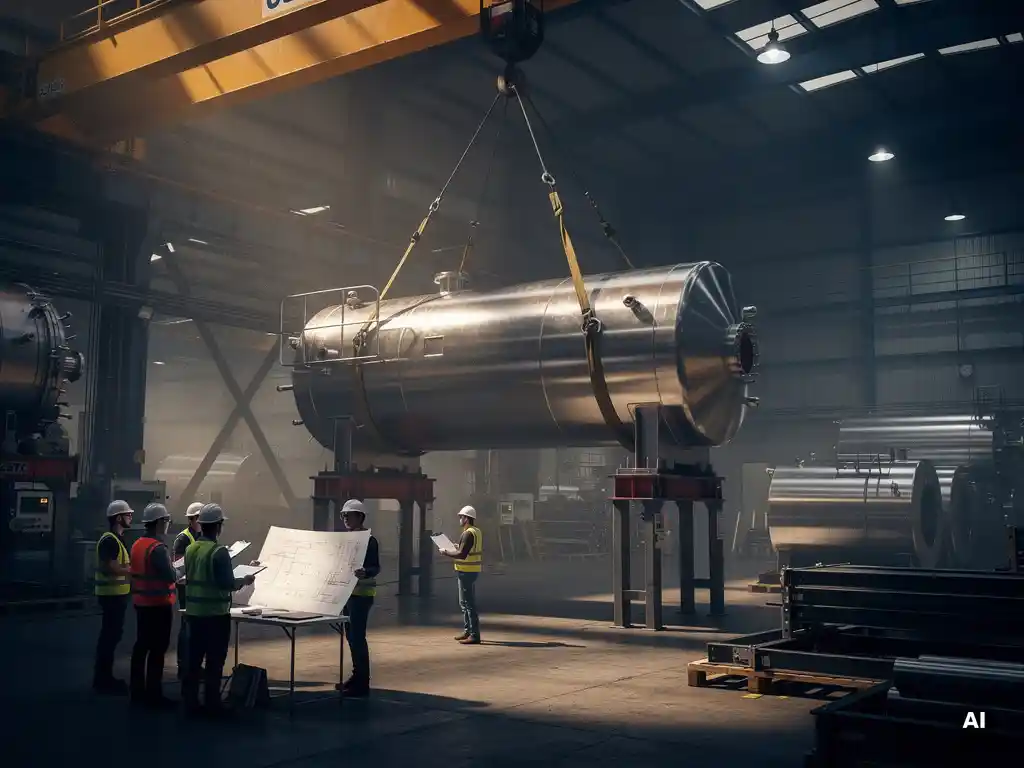
Selecting the right pressure vessel starts with understanding your process conditions: the operating pressure, temperature, fluid chemistry, and any corrosion or mechanical demands your application places on the equipment. These factors together determine which vessel type, material, and construction approach will deliver safe, reliable, and long-term performance. The sections below address the most important technical questions buyers and engineers face when specifying industrial pressure vessels.
What factors determine which pressure vessel type fits your process?
The right pressure vessel type is determined by a combination of operating pressure and temperature, the nature of the process fluid, required internal geometry, and any reaction or heat-transfer functions the vessel must perform. No single factor decides the selection in isolation. Together, these parameters define whether a simple storage vessel, a reactor, a column, or a specialised autoclave is the appropriate solution.
Start with the process function. A vessel that simply holds a pressurised fluid has different structural and material requirements than one that facilitates a chemical reaction, separates phases, or operates under cyclic thermal loading. Internal requirements, such as agitators, baffles, heating coils, or catalyst beds, add mechanical complexity that must be designed into the vessel from the outset.
Operating conditions then set the engineering envelope. High pressures demand thicker walls and more robust weld details. Elevated temperatures affect material selection and may introduce creep or thermal fatigue considerations. Cyclic service, where pressure or temperature fluctuates repeatedly, requires fatigue analysis that would not apply to steady-state operation.
Finally, the process fluid itself is critical. Corrosive media, hydrogen-containing streams, or fluids that embrittle certain alloys all constrain which materials are viable. Getting this combination of factors right at the specification stage avoids costly redesign or premature equipment failure in service.
What are the most common pressure vessel materials and when are they used?
The most common pressure vessel materials are carbon steel, stainless steel, and a range of high-performance alloys. Carbon steel is the baseline choice for non-corrosive service at moderate temperatures and pressures. Stainless steel is selected when corrosion resistance, cleanliness, or elevated-temperature strength is required. High-alloy and exotic materials are specified when the process environment exceeds what carbon or stainless steel can reliably handle.
In practice, material selection follows the severity of the operating environment:
- Carbon steel is widely used for vessels in non-corrosive gas or liquid service, where cost efficiency and weldability are priorities.
- Austenitic stainless steels (such as 316L or 304L) are selected for moderate corrosion resistance, hygienic applications, and cryogenic service.
- Duplex and super-duplex stainless steels offer higher strength and improved resistance to chloride stress corrosion cracking compared to standard austenitic grades.
- Nickel alloys such as Hastelloy and Inconel are used in highly corrosive or high-temperature environments where stainless steel is insufficient.
- Reactive metals such as titanium, zirconium, and tantalum are specified for extremely aggressive chemical environments, including concentrated acids and halogen-containing media.
Material selection is never purely a corrosion decision. Weldability, availability in the required product form, compatibility with the applicable design code, and fabrication cost all influence the final choice. For equipment where a single solid alloy would be prohibitively expensive, clad construction offers a practical alternative.
What is clad construction and when does it outperform solid alloy vessels?
Clad construction is a fabrication approach in which a structural base material, typically carbon steel or low-alloy steel, is bonded to a thin corrosion-resistant inner layer. The base material carries the mechanical load, while the cladding provides chemical resistance. This combination delivers the structural performance of a thick-walled vessel with the corrosion protection of an expensive alloy, at significantly lower material cost than a fully solid alloy construction.
Clad vessels outperform solid alloy alternatives in several situations. When vessel dimensions are large and wall thicknesses are substantial, the material cost of a solid titanium, zirconium, or Hastelloy construction becomes difficult to justify. A clad approach uses the expensive alloy only where it is needed: at the wetted surface in contact with the corrosive process fluid.
The cladding layer is typically applied by roll bonding, explosive bonding, or weld overlay, each suited to different alloy combinations and geometric requirements. The integrity of the bond between base material and cladding is critical and must be verified through non-destructive examination during fabrication.
Clad construction is not always the right answer. For small vessels, thin walls, or applications where contamination from the base material is unacceptable, solid alloy construction may be preferable. The decision requires careful evaluation of process chemistry, vessel geometry, applicable code requirements, and total lifecycle cost.
How do pressure vessel codes and standards affect your equipment specification?
Pressure vessel codes and standards define the minimum design, material, fabrication, inspection, and testing requirements your equipment must meet. The applicable code is determined by the installation country, the operating conditions, and often by the end user or EPC contractor. Specifying the wrong code, or failing to specify one at all, creates regulatory, safety, and contractual risk that is difficult and expensive to resolve after fabrication has begun.
The two most internationally recognised frameworks are the ASME Boiler and Pressure Vessel Code (widely required in North America and many export markets) and the European Pressure Equipment Directive (PED), which applies to equipment placed on the market within the European Union. These are not interchangeable: they differ in design methodology, material qualification, inspection requirements, and documentation.
Beyond the primary design code, additional standards often apply. Welding procedures must be qualified to recognised standards. Non-destructive examination methods and acceptance criteria are prescribed. Material traceability, heat treatment records, and pressure test documentation form part of the mandatory quality record. For equipment destined for regulated industries or specific geographies, additional local requirements may layer on top of the base code.
Engaging your fabricator early in the specification process, before the code selection is finalised, avoids situations where a preferred design approach conflicts with code requirements. A fabricator with multi-code certification can advise on the practical implications of each framework for your specific equipment.
When does vessel size or wall thickness require a specialist fabricator?
Vessel size and wall thickness require a specialist fabricator when the equipment exceeds the dimensional, lifting, or forming capacity of standard workshops, or when the material and welding requirements demand procedures and qualifications that general fabricators do not hold. Large, heavy, or thick-walled vessels are not simply scaled-up versions of standard equipment. They introduce fabrication challenges that require specific infrastructure, tooling, and engineering expertise.
Forming thick plate into cylindrical shells requires rolling equipment with sufficient capacity and control to achieve dimensional accuracy without introducing residual stresses that compromise integrity. Welding thick sections demands qualified multi-pass procedures, pre-heat and post-weld heat treatment capabilities, and inspection methods suited to the joint geometry. Handling vessels of significant weight requires crane capacity and workshop layout that most general fabricators do not possess.
Dimensional accuracy becomes increasingly critical as vessel size grows. Tolerances on roundness, straightness, and nozzle orientation that are straightforward on small equipment become genuine engineering challenges on vessels approaching ten metres in diameter or tens of metres in length. Equipment that will be installed in a process plant with tight positional requirements leaves no margin for fabrication inaccuracies.
For industrial autoclaves and other large-scale pressure equipment, the combination of size, pressure rating, and advanced materials frequently places the work beyond the capability of commodity fabricators. Identifying this early in the project schedule avoids delays caused by rebidding or redesign when an initial fabricator proves unable to meet the technical requirements.
What should you include in a pressure vessel specification to get accurate bids?
An accurate bid for a custom pressure vessel requires a specification that covers operating conditions, design code, materials, internal geometry, nozzle requirements, inspection and testing expectations, and any site or transport constraints. Incomplete specifications lead to assumptions, scope gaps, and bid prices that do not reflect the actual cost of the equipment you need. The more precisely you define requirements upfront, the more comparable and reliable the bids you receive will be.
A well-structured vessel specification typically includes:
- Process and operating data: design pressure, design temperature, operating pressure and temperature, fluid composition and corrosivity, and any cyclic or transient conditions.
- Design code and certification requirements: the applicable code (ASME, PED, or other), inspection class, and any third-party inspection or witness requirements.
- Material requirements: base material and any cladding or lining specification, with reference to relevant material standards.
- Geometry and dimensional requirements: shell diameter, length, orientation, nozzle schedule with sizes and ratings, and any internal components or attachments.
- Fabrication and welding requirements: weld joint efficiency, post-weld heat treatment requirements, and any special welding processes.
- Inspection and testing: non-destructive examination methods, extent of examination, pressure test medium and pressure, and documentation requirements.
- Transport and installation constraints: maximum transport weight and dimensions, lifting requirements, and any site-specific interface conditions.
Providing this level of detail does not limit competition. It ensures that every bidder is pricing the same scope, which makes evaluation straightforward and protects you from discovering scope gaps after contract award.
How Coek helps with pressure vessel selection and specification
Coek Engineering supports EPC contractors, technology owners, and industrial end users at the point where process requirements must be translated into a mechanically sound, manufacturable pressure vessel. The engineering and fabrication capabilities that Coek brings to this process include:
- In-house mechanical engineering to convert process specifications into detailed vessel designs that are both technically compliant and optimised for fabrication
- Advanced materials expertise covering carbon steel, stainless steel, nickel alloys, titanium, zirconium, tantalum, and clad constructions combining these materials
- More than 30 years of experience with clad vessel construction, including complex alloy combinations
- Large-scale manufacturing capacity for equipment up to 10 metres in diameter, 100 metres in length, and approximately 1,000 tons in weight
- Certification and compliance with ASME, PED, and ISO 9001 requirements
- Capability to scope integrated equipment packages that go beyond the vessel itself where the project requires it
If you are working on a project where vessel size, material complexity, wall thickness, or fabrication requirements exceed what standard manufacturers can reliably deliver, contact Coek Engineering to discuss your specification and explore how we can support your project.
Frequently Asked Questions
How do I know if my project requires a fatigue analysis for the pressure vessel?
Fatigue analysis is required when your vessel will experience repeated fluctuations in pressure, temperature, or mechanical loading during normal operation. As a general rule, if your process involves frequent start-up and shutdown cycles, pressure cycling between significantly different levels, or thermal shock, you should raise the question of fatigue with your fabricator at the specification stage. Most design codes, including ASME Section VIII Division 2 and EN 13445, include screening criteria that help determine whether a formal fatigue assessment is mandatory for your specific operating conditions.
What is the difference between design pressure and operating pressure, and why does it matter for vessel specification?
Operating pressure is the actual pressure at which your process runs under normal conditions, while design pressure is the higher value used as the basis for the vessel’s structural calculation — typically set 10% above the maximum allowable operating pressure or by a fixed margin, whichever is greater. This margin accounts for pressure surges, relief valve set points, and process upsets. Specifying the correct design pressure is critical because undersizing it can create a safety risk, while significantly oversizing it adds unnecessary wall thickness, weight, and cost to the vessel.
Can an existing pressure vessel be re-rated to handle higher pressures or temperatures than it was originally designed for?
Re-rating an existing pressure vessel is possible in principle, but it requires a formal engineering review against the original design code and current condition of the equipment. The vessel’s material certifications, weld records, inspection history, and actual wall thickness measurements must all be available and reviewed. In many cases, a hydrostatic or pneumatic re-qualification test is also required. If documentation is incomplete or the vessel has experienced corrosion, erosion, or weld repairs, re-rating may not be achievable without partial reconstruction — at which point replacing the vessel is often the more cost-effective path.
What are the most common mistakes engineers make when specifying pressure vessel materials?
The most frequent mistakes are selecting a material based on corrosion resistance alone without considering weldability, code compliance, or availability in the required product form, and underestimating the risk of localised corrosion mechanisms such as chloride stress corrosion cracking in austenitic stainless steels. Another common error is failing to account for the full range of process fluids the vessel may encounter — including cleaning agents, startup chemicals, or upset conditions — which can be more aggressive than the normal operating fluid. A thorough corrosion review that covers all credible process scenarios, not just steady-state operation, is the safest starting point.
How should I evaluate and compare bids from different pressure vessel fabricators?
Beyond comparing headline prices, evaluate bids on the clarity of scope inclusions and exclusions, the fabricator’s proposed materials and their traceability to recognised standards, the welding and NDE procedures they plan to apply, and their experience with vessels of comparable size, material, and complexity. A significantly lower bid often reflects scope assumptions rather than genuine cost efficiency — request a clarification meeting with any outlier bidder before drawing conclusions. Checking third-party references, visiting the fabrication facility, and confirming code certifications are practical steps that reduce the risk of selecting a fabricator who cannot deliver to the required standard.
What transport and logistics considerations should be factored in early when procuring a large pressure vessel?
Large pressure vessels — particularly those approaching or exceeding standard road transport limits in height, width, or weight — require route surveys, special transport permits, and in some cases escort vehicles or temporary infrastructure modifications. These logistics need to be planned well before fabrication is complete, as they can affect the vessel’s maximum transportable dimensions and therefore its design. If the vessel cannot be transported in one piece, field assembly or on-site welding may be required, which introduces additional code compliance, inspection, and cost considerations that must be built into the project plan from the outset.
Is it possible to specify a pressure vessel for future process flexibility, and how should that be approached?
Yes, designing for future flexibility is a legitimate and often cost-effective strategy, particularly when process scale-up or fluid changes are anticipated within the vessel’s service life. The most practical approaches include specifying a higher design pressure or temperature than currently required, adding extra nozzle connections in the initial build, selecting a more corrosion-resistant material that accommodates a wider range of process fluids, and ensuring the structural design can accommodate additional internal components such as agitators or heating coils. However, each flexibility measure adds upfront cost, so the decision should be based on a realistic assessment of how likely and how soon process changes are expected — not as a general precaution against every conceivable scenario.
Related Articles
- What materials are used in shell-and-tube heat exchanger manufacturing?
- What documentation is required when delivering certified pressure equipment?
- How does operating temperature affect pressure vessel material selection?
- What are the most common pressure vessel failures and their causes?
- What materials are used to manufacture pressure vessels?