
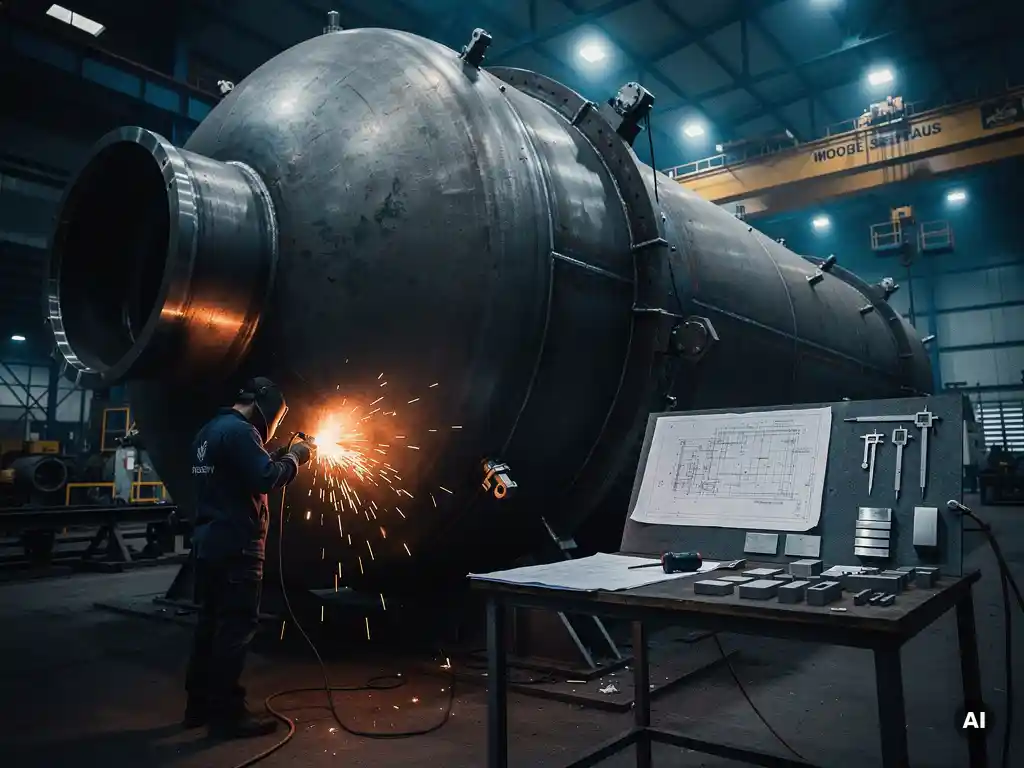
The design life of an industrial autoclave is determined primarily by the interaction of operating pressure, temperature, cyclic loading, material properties, and the applicable design code used during engineering. Most autoclaves are designed for a defined service life, commonly between 20 and 30 years, though the actual lifespan depends on how accurately the original design reflects real operating conditions and how rigorously the equipment is maintained and inspected throughout its service.
For large, high-pressure or corrosive-duty autoclaves, the margin between a long reliable service life and premature degradation often comes down to decisions made at the design and fabrication stage. The sections below address the most important technical questions that engineers and procurement professionals ask when specifying or evaluating autoclave service life.
What engineering parameters most directly limit autoclave service life?
The parameters that most directly limit autoclave service life are operating pressure, operating temperature, the number of pressure cycles, wall thickness, material corrosion allowance, and weld quality. Each of these factors contributes to the rate at which the vessel accumulates mechanical damage or material degradation over time. When any one parameter is underestimated during design, service life is shortened accordingly.
Wall thickness is calculated to withstand design pressure with sufficient margin, but it also determines how much material remains available after years of corrosion or erosion. Corrosion allowance is a deliberate addition to the calculated minimum thickness, and its adequacy depends entirely on the accuracy of the corrosion rate assumed during design.
Temperature affects both the mechanical strength of the base material and the rate of chemical attack on the vessel wall. At elevated temperatures, many steels and alloys lose yield strength, which must be accounted for in the design calculation. If the actual operating temperature consistently exceeds the design temperature, the effective design life is reduced.
How does cyclic fatigue affect the lifespan of a pressure autoclave?
Cyclic fatigue reduces autoclave lifespan by accumulating microscopic damage in the vessel wall and welds each time the equipment is pressurised and depressurised. Over many cycles, this damage can initiate and propagate cracks, particularly at stress concentrations such as nozzle connections, weld toes, and geometric transitions. The autoclave fatigue life is the number of cycles the vessel can safely withstand before this damage becomes critical.
Design codes such as ASME VIII Division 2 and EN 13445 require a formal fatigue analysis when the number of full pressure cycles exceeds defined thresholds. This analysis calculates the cumulative damage fraction across all load cycles and compares it with an allowable limit. Equipment intended for frequent cycling, such as batch-process autoclaves, must be specifically designed with fatigue in mind rather than treated as a static-pressure vessel.
Weld quality has a direct and significant influence on fatigue performance. Weld defects, undercut, or poor profile increase local stress concentration and reduce the number of cycles the joint can sustain. This is one reason why fabrication quality, post-weld heat treatment, and non-destructive examination are not merely compliance steps but genuine contributors to autoclave service life.
What role does material selection play in determining autoclave longevity?
Material selection is one of the most consequential decisions in determining autoclave longevity. The chosen material must retain adequate mechanical strength across the full operating temperature range, resist the specific corrosive media present in the process, and remain compatible with the fabrication processes used during manufacture. A material that performs well in one environment may degrade rapidly in another.
For corrosive-duty autoclaves, the options typically include:
- Solid corrosion-resistant alloys such as titanium, zirconium, Hastelloy, or Inconel, which offer inherent resistance throughout the full wall thickness
- Clad construction, where a carbon steel or low-alloy steel shell provides structural strength and a corrosion-resistant inner layer protects against the process medium
- Lined construction, where a non-metallic or metallic liner is applied inside a structural shell
Clad construction in particular allows designers to combine the cost efficiency of carbon steel for the structural shell with the corrosion resistance of a high-performance alloy at the wetted surface. This approach is well established for demanding autoclave applications and, when executed correctly, delivers service life comparable to solid alloy construction at significantly lower material cost.
How do design codes and standards define autoclave design life?
Design codes such as ASME VIII, EN 13445, and the European Pressure Equipment Directive (PED) define pressure vessel design life through a combination of allowable stress values, corrosion allowances, fatigue analysis requirements, and inspection obligations. The codes do not typically mandate a specific number of years as the design life. Instead, they establish the engineering framework within which the designer specifies a target life and ensures the equipment is adequate for that period.
The designer declares a design life, typically expressed in years and in the number of pressure cycles, and the design calculations must demonstrate that the vessel will remain within safe limits for that declared period. This declared design life then governs the required inspection intervals and the conditions under which the vessel may continue in service.
Compliance with these codes is therefore not a bureaucratic formality. It is the mechanism by which the pressure vessel design life is formally established, documented, and verified throughout the equipment’s operating history.
Can the design life of an autoclave be extended beyond its original specification?
Yes, the design life of an autoclave can often be extended beyond its original specification, but only through a structured engineering assessment that demonstrates the vessel remains fit for continued service. This assessment, sometimes called a fitness-for-service or remaining-life evaluation, examines the current condition of the equipment against the demands of continued operation.
A life extension assessment typically involves reviewing the original design documentation, examining accumulated inspection records, performing additional non-destructive examination to detect any degradation, and recalculating remaining corrosion allowance and fatigue life based on actual operating history. If the assessment identifies areas of concern, targeted repairs or modifications may be required before an extension can be approved.
It is important to recognise that life extension is not always straightforward for autoclaves that have operated in aggressive conditions or experienced a high number of pressure cycles. The accumulated fatigue damage from cyclic loading cannot be reversed by inspection alone. In some cases, the most reliable and cost-effective decision is to replace the equipment rather than extend its life.
What inspection and maintenance practices preserve autoclave service life?
Inspection and maintenance practices preserve autoclave service life by detecting degradation before it reaches a critical level and by ensuring that operating conditions remain within the parameters assumed during design. A structured inspection programme, aligned with the applicable code and the equipment’s risk profile, is the most effective tool available to operators for managing pressure equipment longevity.
Key practices that directly support autoclave service life include:
- Periodic internal and external visual inspection to identify corrosion, erosion, mechanical damage, or changes in surface condition
- Non-destructive examination (NDE) such as ultrasonic thickness measurement, radiographic testing, or phased-array inspection to detect wall thinning or subsurface defects
- Pressure testing at defined intervals to confirm structural integrity
- Review of operating records to verify that actual pressures, temperatures, and cycle counts remain within the design envelope
- Maintenance of sealing systems, nozzles, and closures to prevent localised damage at high-stress or high-wear locations
Consistent documentation of inspection findings over the full service history is essential. This record provides the evidence base for any future fitness-for-service assessment and supports decisions about maintenance, repair, or life extension.
How does autoclave size and wall thickness affect design life calculations?
Autoclave size and wall thickness affect design life calculations in several interconnected ways. Larger-diameter vessels require greater wall thickness to contain the same pressure, which increases the absolute volume of material available to absorb corrosion and erosion over the vessel’s service life. However, greater wall thickness also introduces higher thermal gradients and residual stresses from fabrication, which must be carefully managed to avoid reducing fatigue performance.
For very large autoclaves, the relationship between wall thickness and fatigue life becomes particularly important. Thick-walled vessels experience higher stress gradients through the wall cross-section under cyclic loading, and the fatigue analysis must account for this. Design codes address this through specific calculation methods for thick-walled pressure equipment, but the analysis requires accurate input data and careful engineering judgement.
Manufacturing quality also becomes increasingly critical as size and wall thickness increase. Weld quality, post-weld heat treatment, and dimensional accuracy all influence the stress state of the completed vessel and therefore its fatigue life. For large industrial autoclaves, the fabrication process itself is part of the design life equation.
How Coek supports industrial autoclave design life requirements
Coek Engineering designs and manufactures custom industrial autoclaves for technically demanding applications where service life, operating reliability, and material performance are critical. For clients specifying equipment with defined design life requirements, Coek’s in-house mechanical engineering capability translates process conditions into compliant, manufacturable equipment designed to perform across the full intended service period.
Coek’s capabilities relevant to autoclave design life include:
- Engineering for fatigue-critical and cyclic-duty applications, including formal fatigue analysis in accordance with applicable codes
- Advanced materials expertise covering titanium, zirconium, Hastelloy, Inconel, and clad constructions combining structural steel with corrosion-resistant inner layers
- Large-scale manufacturing for autoclaves up to approximately 10 metres in diameter and approaching 1,000 tons in weight
- Compliance with international standards including ASME, EN 13445, and the PED
- Precision fabrication and weld quality management that directly supports long-term structural integrity
If you are specifying an autoclave for a demanding application and need a fabrication partner with the engineering depth to support your design life requirements, contact Coek Engineering to discuss your project.
Frequently Asked Questions
What is the difference between design life and actual service life for an industrial autoclave?
Design life is the period for which the autoclave is formally engineered and documented to operate safely under specified conditions, typically 20–30 years. Actual service life can be shorter if real operating conditions exceed design assumptions — for example, higher cycle counts, elevated temperatures, or faster-than-expected corrosion rates. Conversely, an autoclave that operates conservatively and is rigorously maintained may remain fit for service beyond its declared design life, provided a formal fitness-for-service assessment confirms this.
How do I know if my autoclave was originally designed with fatigue analysis, and does it matter?
You can determine this by reviewing the original design documentation and the applicable code edition used at the time of fabrication. If the autoclave was designed to ASME VIII Division 1 or an equivalent static-pressure basis without a formal fatigue analysis, it may not have been optimised for cyclic loading — even if it has been subjected to frequent pressurisation cycles in service. This matters significantly: equipment that has accumulated a high number of cycles without a fatigue-based design should be evaluated by a qualified pressure vessel engineer before any life extension is considered.
What are the most common mistakes made when specifying autoclave design life?
The most common mistakes include underestimating the actual number of pressure cycles the process will demand over the equipment’s lifetime, assuming an overly optimistic corrosion rate when defining the corrosion allowance, and failing to account for temperature excursions above the nominal operating point. Another frequent error is treating design code compliance as the sole measure of adequacy without verifying that the declared design conditions genuinely reflect the real process envelope. These gaps between assumed and actual conditions are the primary reason autoclaves degrade faster than their original design life suggests.
At what point in a project should autoclave design life requirements be defined, and who should define them?
Design life requirements should be defined during the process design and equipment specification phase, before fabricator selection or detailed engineering begins. At this stage, the process engineer or project team should establish the target service life in years, the expected number of pressure cycles, the full range of operating temperatures and pressures including upset conditions, and the corrosive media the vessel will contact. These inputs are then passed to the mechanical engineer or fabricator to form the basis of the vessel design. Defining these requirements late in the project often forces compromises in material selection or wall thickness that reduce long-term performance.
Can operating process changes during service reduce an autoclave's remaining design life, and how should this be managed?
Yes, process changes — such as introducing a more corrosive medium, increasing operating pressure or temperature, or significantly increasing cycle frequency — can consume remaining design life faster than the original calculations assumed. Any significant change to operating conditions should trigger a formal engineering review to assess the impact on residual fatigue life, corrosion allowance adequacy, and overall fitness for continued service. Operating an autoclave outside its original design envelope without this review is a common source of premature degradation and an increased risk of pressure equipment failure.
What non-destructive examination (NDE) methods are most effective for monitoring autoclave condition over its service life?
Ultrasonic thickness measurement is the most widely used method for tracking wall thinning due to corrosion or erosion, as it provides direct, quantitative data that can be trended over successive inspections. Phased-array ultrasonic testing (PAUT) is particularly effective for examining welds and detecting subsurface planar defects such as fatigue cracks. For surface-breaking defects at welds or nozzle connections, magnetic particle inspection (MPI) or liquid penetrant testing (PT) are appropriate. The most effective inspection programmes combine multiple methods, targeted at the specific degradation mechanisms and high-stress locations relevant to each autoclave’s design and service history.
Is it more cost-effective to extend an autoclave's design life or replace the equipment when it approaches end of life?
The answer depends on the equipment’s current condition, accumulated fatigue damage, and the cost of the remaining service it needs to provide. Life extension through a fitness-for-service assessment and targeted repairs can be economical when the vessel structure is in good condition and the primary concern is corrosion allowance depletion, which is addressable. However, when a vessel has accumulated significant fatigue damage, experienced weld repairs, or operated in aggressive conditions for its full design life, replacement often delivers greater long-term reliability at lower total cost than repeated life extension assessments and remedial work. A qualified pressure vessel engineer should evaluate both options quantitatively before a decision is made.
Related Articles
- What is the purpose of pressure in an autoclave?
- How does wall thickness affect pressure vessel structural integrity?
- How does operating pressure influence pressure vessel head geometry selection?
- What is clad construction in pressure vessel manufacturing?
- What materials are used to manufacture pressure vessels?