
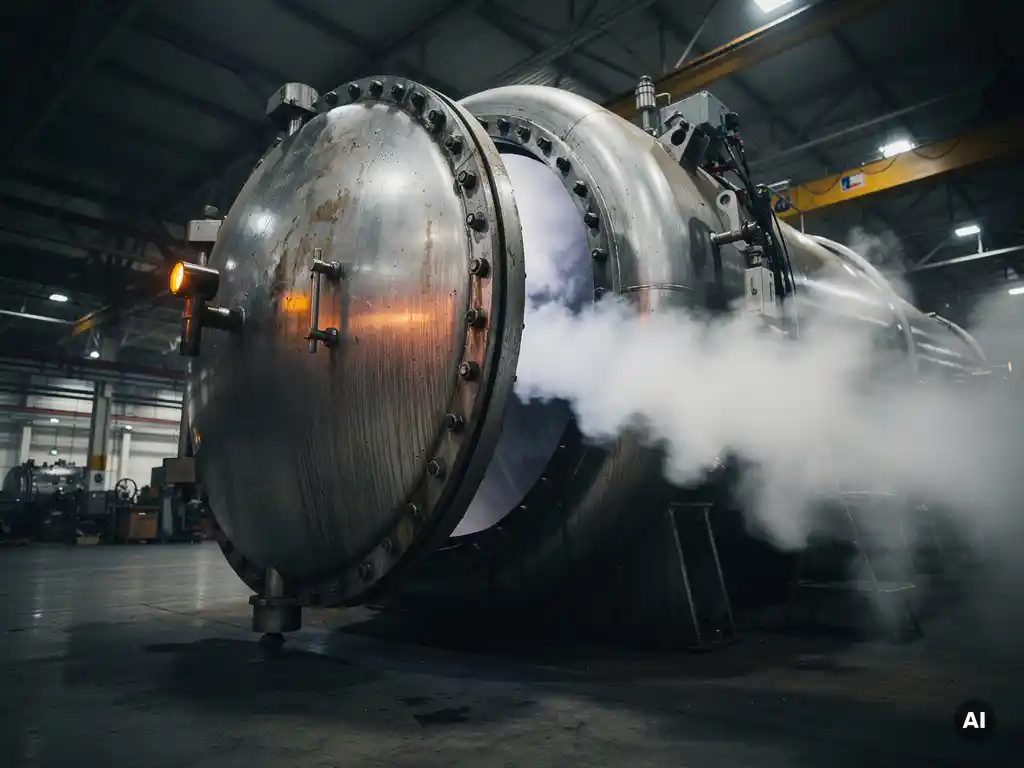
When autoclave pressure is too low, the process conditions inside the vessel fall short of what the reaction or treatment cycle requires, leading to incomplete results, compromised product quality, or outright process failure. Insufficient autoclave operating pressure means the system cannot maintain the temperature, phase state, or chemical environment the process depends on. The sections below examine why this happens, what it means for chemical reactions, how to detect it early, and when to take corrective action.
What are the consequences of insufficient autoclave pressure?
Insufficient autoclave pressure prevents the vessel from sustaining the operating conditions required for a successful process cycle. The most immediate consequence is an incomplete or failed process outcome, but the downstream effects extend well beyond a single batch. The effects of low autoclave pressure can cascade across product quality, equipment integrity, and operational safety.
The most common consequences include:
- Incomplete reactions or treatment cycles: Many high-pressure processes rely on pressure to drive reactions to completion. Below the required threshold, conversion rates drop and product specifications may not be met.
- Phase instability: In processes involving supercritical fluids or controlled liquid-vapour equilibria, pressure loss disrupts the phase state entirely, invalidating the process.
- Contamination risk: If pressure falls below the surrounding environment, the differential can allow ingress of moisture, air, or other contaminants into a sealed vessel.
- Thermal imbalance: Pressure and temperature are interdependent in many autoclave cycles. A pressure drop can cause unexpected temperature shifts that stress both the product and the vessel walls.
- Unplanned shutdowns: Safety systems designed to detect autoclave pressure problems will trip the process, resulting in lost production time and the cost of restarting or scrapping a batch.
In industrial settings, these consequences are rarely isolated. A single pressure excursion below the operating threshold can trigger a chain of downstream problems that take significantly more time and cost to resolve than the original fault.
Why does autoclave pressure drop during a cycle?
Autoclave pressure drops during a cycle when the system loses containment, when the pressurising medium is consumed faster than it is supplied, or when a component fails to maintain the required seal. Understanding the root cause is essential before any corrective action can be effective.
The most frequent causes of pressure loss in industrial autoclaves include leaks at flange connections, valve seats, or instrumentation penetrations. These are often the result of thermal cycling fatigue, inadequate gasket seating, or gradual corrosion of sealing surfaces. In vessels handling aggressive media, corrosion of the inner shell or nozzle areas can create pathways for leakage that are not immediately visible during routine operation.
Process-side causes are equally common. If the reaction inside the vessel consumes a gaseous reactant faster than anticipated, or if a venting sequence is triggered prematurely by a faulty sensor, the vessel will register a pressure drop that appears mechanical but is actually process-driven. Distinguishing between these two root causes is a critical first step in diagnosis.
Finally, thermal losses can indirectly cause pressure drops. If the heating system underperforms and the vessel temperature falls, the vapour pressure of the process fluid drops with it, reducing overall system pressure even without any physical leak.
How does low pressure affect chemical reactions inside an autoclave?
Low autoclave pressure directly impairs chemical reactions by altering the concentration, solubility, and phase behaviour of reactants. Pressure is not merely a containment condition in many industrial processes; it is an active process variable that controls reaction kinetics and equilibrium.
In gas-liquid reactions, pressure keeps dissolved gases in solution. When pressure falls, dissolved gases come out of solution prematurely, reducing the effective concentration of reactants available to the reaction. This is directly analogous to a carbonated liquid losing its dissolved gas when the container is opened. In a chemical process, the equivalent effect means lower yields, slower reaction rates, and inconsistent product quality.
For reactions governed by Le Chatelier’s principle, where equilibrium shifts in response to pressure changes, operating below the design pressure can push the equilibrium in the wrong direction. Reactions that produce fewer moles of gas are favoured at higher pressures. Reducing pressure shifts the equilibrium back toward the reactant side, reducing conversion efficiency.
In hydrothermal and solvothermal processes, where water or a solvent is maintained in a specific phase at elevated pressure and temperature, a pressure drop can cause the solvent to flash to vapour. This abruptly changes the reaction environment, often irreversibly for that batch.
What is the difference between low pressure and pressure fluctuation in an autoclave?
Low autoclave pressure refers to a sustained operating condition below the required setpoint, while pressure fluctuation describes repeated, often rapid, deviations above and below the target value. Both are autoclave pressure problems, but they have different causes, different effects on the process, and require different corrective responses.
Sustained low pressure typically points to a single root cause: a leak, a supply limitation, or a process consumption issue that continuously draws pressure below the operating threshold. The process runs in a degraded state for the duration of the deviation.
Pressure fluctuation, by contrast, often indicates a control system problem, an unstable feed or vent valve, or an intermittent leak that opens and closes with thermal cycling. The process may appear to recover repeatedly, but each oscillation stresses the vessel, its seals, and its internal components. Over time, cyclic pressure loading accelerates fatigue in welds, flanges, and nozzle connections.
From an engineering standpoint, fluctuation can be more damaging than a stable low-pressure condition because it introduces dynamic loading. A vessel designed for a specific operating pressure is also designed with a specific fatigue life in mind. Repeated pressure swings outside the intended range consume that fatigue life faster than steady-state operation, even if peak pressures remain within the design envelope.
How can engineers detect low autoclave pressure before it causes process failure?
Engineers can detect low autoclave pressure before process failure by combining continuous instrumentation, trend monitoring, and structured pre-cycle checks. Early detection depends on treating pressure data as a diagnostic signal rather than simply a pass-or-fail indicator.
A practical detection approach includes the following steps:
- Baseline the pressure profile: Record the expected pressure curve for each cycle type under normal conditions. Any deviation from this baseline, even within alarm limits, is an early warning signal worth investigating.
- Monitor pressure decay rate: During hold phases, a vessel should maintain pressure within a defined tolerance. A measurable decay rate, even a slow one, indicates leakage or consumption that will worsen over time.
- Cross-reference temperature and pressure: Because pressure and temperature are coupled in most autoclave processes, a pressure reading that diverges from the expected temperature-pressure relationship suggests an instrumentation fault or a genuine process anomaly.
- Inspect sealing surfaces before critical cycles: Gaskets, flange faces, and valve seats should be inspected on a defined schedule and before high-value or long-duration cycles where a mid-cycle pressure loss would be particularly costly.
- Use redundant pressure transmitters: A single pressure transmitter can fail or drift without obvious indication. Redundant instrumentation allows cross-checking and reduces the risk of acting on a false reading, in either direction.
Trend analysis over multiple cycles is often more informative than any single measurement. A pressure profile that is gradually shifting, even within acceptable limits, frequently signals a developing mechanical issue before it becomes a failure event.
When should an autoclave vessel be inspected or replaced due to pressure problems?
An industrial autoclave vessel should be inspected whenever pressure problems cannot be attributed to instrumentation, process conditions, or external supply, and whenever corrective maintenance has not resolved a recurring pressure issue. Replacement becomes relevant when inspection reveals damage that cannot be repaired to the original design standard.
Inspection triggers related to pressure performance include repeated pressure decay during hold phases, visible leakage at welds or nozzle connections, evidence of corrosion on sealing surfaces or internal shell areas, and any instance where the vessel has operated significantly outside its design pressure range. Vessels handling corrosive media deserve particular attention because wall thinning and localised corrosion can develop in areas that are not accessible during routine visual checks.
Replacement is warranted when wall thickness measurements fall below the minimum required by the applicable pressure equipment design code, when weld repairs have been made repeatedly to the same location, or when the vessel has accumulated a fatigue history that approaches its calculated design life. In some cases, a vessel may be structurally sound but no longer capable of meeting updated process requirements or revised regulatory standards, which also justifies replacement or a formal re-rating assessment.
The decision to inspect or replace should always be based on documented engineering assessment rather than operational convenience. Continuing to operate a vessel with unresolved pressure problems introduces risk that extends well beyond the immediate process outcome.
How Coek supports projects with demanding autoclave pressure requirements
When autoclave pressure problems point to equipment that has reached the limits of its design, or when a process requires a vessel capable of maintaining precise pressure conditions under demanding operating environments, the solution begins with the equipment itself.
Coek Engineering designs and manufactures custom industrial autoclaves for applications where standard equipment is not sufficient. This includes:
- Large-scale autoclaves for high-pressure and high-temperature processes, with references approaching 1,000 tons
- Advanced materials selection and clad construction for corrosive environments where pressure integrity over the vessel’s full service life is critical
- In-house mechanical engineering to translate process specifications into equipment that is both mechanically sound and manufacturable to the required tolerances
- Compliance with international pressure equipment standards, including PED and ASME
If your project involves autoclave pressure requirements that go beyond what commodity fabrication can reliably deliver, contact Coek Engineering to discuss your specifications.
Frequently Asked Questions
How do I know if my autoclave pressure drop is caused by a mechanical leak or a process-side issue?
The most reliable way to distinguish between the two is to perform a cold pressure test using an inert gas such as nitrogen, with no process media present. If pressure decays during this test, the cause is mechanical — a leak at a flange, valve seat, or weld. If the vessel holds pressure under inert gas but loses pressure during a live cycle, the cause is process-driven, such as faster-than-expected gas consumption or a premature vent trigger. Checking sensor calibration and reviewing the process recipe against actual consumption data are useful next steps in the latter case.
What are the most common mistakes engineers make when troubleshooting autoclave pressure problems?
One of the most frequent mistakes is replacing gaskets or seals without first identifying why they failed — if the underlying cause is a damaged flange face, thermal fatigue, or incompatible materials, the new seal will fail in the same way. Another common error is relying on a single pressure transmitter without cross-referencing it against temperature data or a redundant instrument, which can lead to acting on a false reading. Finally, treating pressure problems as isolated events rather than tracking them across cycles often masks a developing trend that would have been far cheaper to address earlier.
Can autoclave pressure problems permanently damage the vessel, even if the process is stopped quickly?
Yes, depending on the nature and severity of the pressure excursion. A sudden pressure drop that causes a process fluid to flash to vapour can impose thermal shock on the vessel walls and internal components, potentially initiating or propagating cracks in welds or heat-affected zones. Repeated low-pressure cycles that fall outside the design envelope contribute to fatigue damage that accumulates over time, even if no single event appears severe. This is why documenting every pressure excursion — including its magnitude, duration, and operating conditions — is important for any future fitness-for-service assessment.
How often should autoclave sealing components like gaskets and valve seats be replaced as a preventive measure?
Replacement intervals should be based on a combination of manufacturer recommendations, the severity of operating conditions, and your own cycle history rather than a fixed universal schedule. Vessels running at high temperatures, handling aggressive media, or cycling frequently will degrade sealing components faster than those operating under milder conditions. A practical approach is to inspect gaskets and valve seats at every planned maintenance window, replace them whenever there is any sign of deformation, surface damage, or chemical attack, and always replace them before high-value or extended-duration cycles where a mid-cycle failure would be costly.
Is it safe to continue operating an autoclave at reduced pressure if the full design pressure cannot be reached?
Operating at reduced pressure may be technically feasible if the process can tolerate it and the vessel has been formally re-assessed for the new operating conditions, but it is not a decision that should be made informally on the production floor. If the reduced pressure is due to a mechanical issue such as a leak, continuing operation risks worsening the fault and introducing safety hazards. If the intent is to permanently re-rate the vessel to a lower operating pressure, this must be documented through a formal engineering assessment and, where applicable, reviewed against the relevant pressure equipment design code.
What instrumentation upgrades are most effective for improving autoclave pressure monitoring?
Adding redundant pressure transmitters is the single most impactful upgrade, as it eliminates the risk of acting on a drifted or failed instrument and enables cross-validation in real time. Pairing pressure monitoring with temperature data logging and setting up automated cross-reference alarms — where a pressure reading that deviates from the expected temperature-pressure relationship triggers a flag — adds another layer of early detection. For critical processes, integrating pressure trend analysis into a SCADA or data historian system allows engineers to identify gradual shifts across cycles long before they reach alarm thresholds.
When is it worth investing in a custom-designed autoclave rather than trying to modify or repair an existing vessel?
The case for a custom vessel becomes compelling when repeated repairs are failing to resolve the same pressure-related issues, when the process requirements have evolved beyond what the original vessel was designed for, or when wall thickness or fatigue assessments indicate the vessel is approaching the end of its serviceable life. Modifying an existing vessel to meet new pressure or temperature requirements is sometimes possible, but it requires formal re-engineering and re-certification, which can approach or exceed the cost of a purpose-built replacement. A custom-designed autoclave also allows materials selection, geometry, and sealing arrangements to be optimised for the specific process from the outset, reducing the likelihood of recurring pressure problems.