
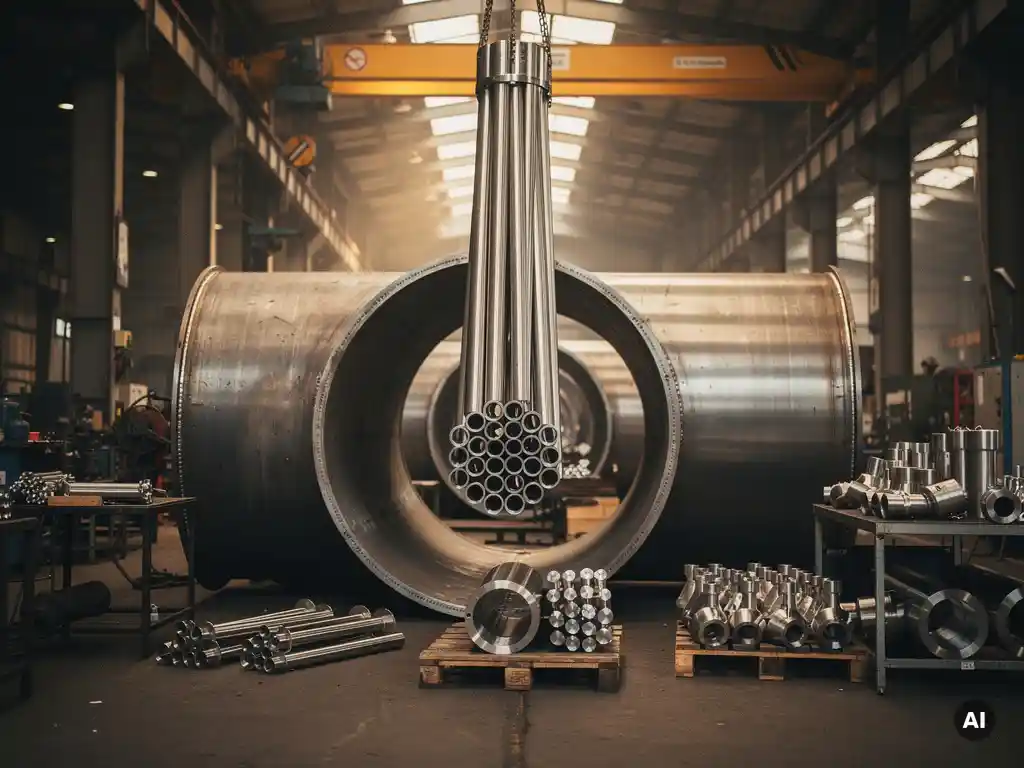
Shell-and-tube heat exchangers are manufactured using a wide range of metals, but the most common choices are carbon steel, stainless steel, and copper alloys for standard applications. When process conditions involve aggressive media, high pressures, or elevated temperatures, engineers turn to exotic alloys such as titanium, Hastelloy, zirconium, and tantalum. Material selection is the single most consequential design decision in shell-and-tube heat exchanger engineering, directly affecting corrosion resistance, thermal performance, fabrication complexity, and long-term reliability. The sections below address the most frequently asked questions about heat exchanger materials in detail.
Which metals are most commonly used in shell-and-tube heat exchangers?
The most commonly used metals in shell-and-tube heat exchangers are carbon steel, stainless steel, and copper alloys. Carbon steel is the workhorse material for non-corrosive services at moderate temperatures and pressures. Stainless steel grades such as 304 and 316 offer improved corrosion resistance for a broader range of process fluids. Copper alloys, including admiralty brass and cupro-nickel, are frequently selected for cooling water services due to their excellent thermal conductivity.
Beyond these conventional choices, duplex and super-duplex stainless steels are increasingly specified where both corrosion resistance and mechanical strength are required simultaneously, for example in offshore or high-chloride environments. Nickel alloys bridge the gap between standard stainless steel and fully exotic materials when neither carbon steel nor conventional austenitic grades provide adequate protection.
The shell, tube bundle, tubesheets, and baffles within a single exchanger do not always share the same material. It is common practice to pair a carbon steel shell with stainless steel or titanium tubes when the tube-side fluid is more corrosive than the shell-side fluid. This combination controls cost while placing the corrosion-resistant material precisely where it is needed.
When are exotic alloys like titanium, Hastelloy, or Inconel required?
Exotic alloys are required in shell-and-tube heat exchangers when process fluids are too corrosive, too hot, or too chemically aggressive for standard stainless steel to survive reliably over the equipment’s intended service life. The decision is driven by the specific combination of temperature, pressure, fluid chemistry, and required operational lifespan rather than by any single factor in isolation.
The following conditions typically trigger the specification of exotic alloys:
- Halide-containing environments: chloride, bromide, and fluoride ions cause stress corrosion cracking in standard austenitic stainless steels; titanium and nickel alloys resist this attack
- Strongly acidic or oxidising media: acetic acid, nitric acid, and similar process streams demand materials such as zirconium or Hastelloy C-276 that remain passive across wide concentration and temperature ranges
- High-temperature services above standard code limits: certain titanium grades, including Ti Grade 9, maintain adequate mechanical properties and corrosion resistance at temperatures where lower grades or stainless steels would be unreliable
- Seawater and brine cooling: titanium Grade 2 and Grade 17 are the preferred tube materials for seawater coolers and brine purification services due to their exceptional resistance to pitting and crevice corrosion
- Biofuel and renewable chemical processes: newer process chemistries often involve aggressive intermediate compounds that require alloys such as Hastelloy or specialised tube materials like Sanicro 35
In purified terephthalic acid (PTA) production, for example, both titanium Grade 2 condensers and titanium Grade 9 preheaters are standard because the process media contain acetic acid and bromide catalysts that would rapidly degrade stainless steel. Similarly, zirconium 702 is specified for heat exchangers in acetic acid production and certain brine purification processes where no other commercially practical material offers comparable resistance.
What is clad construction and how does it affect heat exchanger performance?
Clad construction in shell-and-tube heat exchangers means bonding a thin corrosion-resistant alloy layer to a carbon steel or low-alloy steel base. The carbon steel provides structural strength and keeps wall thickness and weight within practical limits, while the cladding material (typically titanium, zirconium, Hastelloy, or stainless steel) provides the corrosion protection that the process demands. The result is equipment that performs like a solid exotic alloy vessel at significantly lower material cost.
Explosion cladding is the most established bonding method for heat exchanger components. A controlled explosive charge creates a metallurgical bond between the two metals across the entire interface, producing a connection that is mechanically as strong as the base materials themselves. Weld overlay cladding is an alternative for localised areas or geometries where explosion bonding is impractical.
From a performance perspective, clad construction affects heat exchangers in two important ways. First, it allows the designer to specify the exact cladding thickness needed for corrosion allowance without over-engineering the entire wall section in expensive alloy. Second, it enables the fabrication of very large components (tubesheets, shells, and channel heads) that would be prohibitively expensive or technically impossible to produce in solid exotic material at the required dimensions.
The critical quality requirement in clad construction is bond integrity. Any unbonded zone between the cladding and the base metal creates a potential site for under-clad corrosion and can compromise the mechanical properties of the tubesheet or shell. Rigorous non-destructive testing of the bond, combined with controlled welding procedures at clad interfaces, is essential to ensure that the finished component performs as designed throughout its service life.
How does material selection affect heat transfer efficiency?
Material selection affects heat transfer efficiency primarily through thermal conductivity, the rate at which heat moves through the tube wall from one process fluid to the other. Copper alloys offer the highest thermal conductivity among common heat exchanger metals, followed by carbon steel, then stainless steel, and finally exotic alloys such as titanium and zirconium, which have relatively low thermal conductivity values.
In practice, the thermal conductivity of the tube wall is rarely the dominant resistance in a shell-and-tube heat exchanger. The film resistances on the tube-side and shell-side surfaces, along with any fouling layers that develop during operation, typically account for a much larger proportion of the total thermal resistance than the metal wall itself. This means that switching from carbon steel to titanium tubes, for instance, has a far smaller effect on overall heat transfer performance than the fluid velocities, baffle geometry, and surface cleanliness.
Where tube wall conductivity does become meaningful is in applications involving very thin-walled tubes, high fluid velocities on both sides, and clean, low-fouling services. In these cases, the lower conductivity of exotic alloys may require a modest increase in heat transfer area to compensate. Engineers account for this during thermal sizing, and the additional surface area required is generally a straightforward design adjustment rather than a fundamental limitation.
Material selection also influences long-term heat transfer performance through its effect on fouling. A material that resists corrosion and maintains a smooth surface over time will foul more slowly than one that corrodes or roughens in service. Titanium, for example, is well established in seawater cooling applications partly because its passive oxide surface resists biofouling and scaling more effectively than many alternatives, preserving thermal performance over extended operating periods.
What material standards and certifications apply to heat exchanger fabrication?
Shell-and-tube heat exchangers intended for industrial pressure service must comply with recognised design and fabrication codes that specify allowable materials, design rules, inspection requirements, and documentation standards. The applicable code depends on the installation location, the client’s requirements, and the technology licensor’s specifications.
The principal standards governing heat exchanger fabrication are:
- ASME Section VIII: the American Society of Mechanical Engineers Boiler and Pressure Vessel Code, widely used globally and frequently required by EPC contractors and technology licensors regardless of the installation country
- PED (Pressure Equipment Directive): the European Union directive that establishes essential safety requirements for pressure equipment placed on the EU market; compliance is demonstrated through conformity assessment and CE marking
- TEMA standards: the Tubular Exchanger Manufacturers Association standards define mechanical design details specific to shell-and-tube heat exchangers, including tubesheet thickness, baffle spacing, and nozzle reinforcement; TEMA classes R, C, and B reflect different levels of design rigour
- ISO 9001: the international quality management system standard; certification demonstrates that the fabricator operates a documented and audited quality system covering design, procurement, fabrication, inspection, and delivery
Material traceability is a critical element of code compliance. Every plate, tube, forging, and fitting used in a pressure-retaining component must be accompanied by a material test report (MTR) that certifies chemical composition and mechanical properties in accordance with the applicable material standard, for example, ASTM or EN material specifications. For exotic alloys such as titanium, zirconium, or Hastelloy, procurement and verification of certified material is a significant part of the overall project quality plan.
Welding procedures and welder qualifications must be formally qualified in accordance with the applicable code before production welding begins. For dissimilar metal welds, such as those between a clad tubesheet and solid exotic tubes, the qualification requirements are particularly demanding and require careful procedure development and testing.
How do you choose the right material for a shell-and-tube heat exchanger?
Choosing the right material for a shell-and-tube heat exchanger requires a systematic evaluation of the process conditions on both the tube side and the shell side, combined with mechanical, fabrication, and economic considerations. The starting point is always the process: fluid chemistry, temperature, pressure, flow velocity, and the presence of any contaminants or phase changes that could influence corrosion mechanisms.
A structured selection process typically follows this logic. First, identify which fluids contact which surfaces and what corrosion mechanisms are credible: general corrosion, pitting, stress corrosion cracking, erosion-corrosion, or galvanic attack. Second, establish the temperature and pressure envelope, since many alloys have acceptable corrosion resistance at lower temperatures but become unreliable as temperature rises. Third, consider mechanical requirements: wall thickness, tubesheet rigidity, and nozzle loads may impose minimum strength requirements that influence alloy selection. Fourth, evaluate fabricability: some exotic alloys require specialised welding, heat treatment, or forming procedures that not all manufacturers can execute reliably.
Cost enters the analysis after the technically acceptable options have been identified. Solid exotic alloys, clad constructions, and bimetallic tube configurations each offer different cost profiles depending on the required dimensions and quantities. For large tubesheets and shells, clad construction is often the most economical path to achieving the required corrosion resistance without the prohibitive cost and weight of a solid exotic alloy component. For shell-and-tube heat exchangers in highly aggressive services, the material cost premium of an exotic alloy is almost always justified by the reduction in maintenance, replacement, and unplanned downtime costs over the equipment’s service life.
Finally, the applicable fabrication code and the technology licensor’s specifications may constrain the available options. Some licensors have qualified specific material combinations based on their own operational experience and will not accept substitutions without extensive justification. Working within these constraints from the outset of the design process avoids costly late-stage changes.
How Coek approaches material selection for demanding heat exchangers
Coek Engineering specialises in custom shell-and-tube heat exchangers for technically demanding applications where standard materials and commodity fabrication are insufficient. With more than 35 years of focused experience in exotic alloy and clad heat exchanger fabrication, Coek’s capabilities are particularly relevant when a project involves one or more of the following:
- Titanium tube bundles, including Ti Grade 2 and Ti Grade 9, for PTA, brine purification, and high-temperature services
- Zirconium 702 tubes and components for acetic acid, MEG, and aggressive chemical processes
- Hastelloy C-276 and specialised tube materials such as Sanicro 35 for biofuel and corrosive chemical applications
- Explosion-clad tubesheets and shells combining carbon steel structure with corrosion-resistant inner layers
- Large-scale fabrication with equipment up to 10 metres in diameter and approximately 1,000 tons in weight
- Compliance with ASME, PED, and ISO 9001 requirements, with full material traceability and qualified welding procedures
Coek translates customer and EPC process requirements into mechanically sound, manufacturable equipment, handling the full complexity of exotic material procurement, welding qualification, and code compliance in-house. If you are specifying a heat exchanger for a demanding application and need a fabrication partner with demonstrated exotic materials expertise, contact Coek Engineering to discuss your project requirements.
Frequently Asked Questions
How do I know whether clad construction or a solid exotic alloy is the right choice for my heat exchanger?
The decision typically comes down to component size, required alloy thickness, and budget. For large tubesheets, shells, and channel heads, clad construction almost always offers a better cost-to-performance ratio because the carbon steel base carries the structural load while only a thin corrosion-resistant layer is needed at the process interface. Solid exotic alloy components become more competitive for smaller parts, very thin-walled tubes, or situations where bond integrity verification across a large clad interface would be technically difficult to guarantee.
What are the most common material selection mistakes engineers make when specifying shell-and-tube heat exchangers?
The most frequent mistake is selecting material based solely on the bulk fluid chemistry while overlooking localised corrosion mechanisms such as crevice corrosion under gaskets, stress corrosion cracking at welds, or erosion-corrosion at high-velocity inlet zones. Another common error is specifying a material that performs adequately at design temperature but becomes unreliable during start-up, shutdown, or upset conditions when temperatures or concentrations temporarily exceed normal operating ranges. A third pitfall is ignoring galvanic compatibility between dissimilar metals used in the same exchanger, which can accelerate corrosion at contact points.
Can the tube-side and shell-side materials always be selected independently, or are there compatibility constraints?
They can be selected largely independently based on the respective fluid conditions, but galvanic compatibility must be evaluated wherever dissimilar metals are in electrical contact through a common electrolyte. A classic example is pairing titanium tubes with a carbon steel tubesheet: if the tube-to-tubesheet joint is not properly designed and coated, galvanic corrosion can attack the carbon steel at the joint interface. Specifying an isolation coating, a compatible weld overlay on the tubesheet face, or a clad tubesheet with a matching alloy layer eliminates this risk while still allowing each side to be optimised for its own service.
How does fouling factor into long-term material performance, and should it influence my material choice?
Yes, fouling should absolutely influence material selection, particularly for services involving seawater, cooling tower water, or process fluids prone to scaling or biological growth. Materials that maintain a smooth, passive oxide surface — titanium being the prime example — foul more slowly and are easier to clean than materials that corrode or roughen over time, which creates additional sites for deposit adhesion. Selecting a more corrosion-resistant material upfront can reduce cleaning frequency, extend run lengths between shutdowns, and preserve thermal performance over the exchanger’s full service life, often justifying the higher initial cost.
What documentation should I request from a fabricator to verify that the correct materials were actually used?
You should request a full material traceability package for every pressure-retaining component, which includes the original Mill Test Reports (MTRs) certifying chemical composition and mechanical properties, material identification markings traceable to those reports, and the fabricator’s incoming inspection records confirming that received material matches the purchase specification. For exotic alloys such as titanium, zirconium, or Hastelloy, third-party positive material identification (PMI) testing — typically using X-ray fluorescence (XRF) — provides an additional layer of verification and is increasingly required by EPC contractors and end users on critical projects.
How does operating temperature affect the corrosion performance of common heat exchanger alloys, and what thresholds should I be aware of?
Temperature has a profound effect on corrosion rates and failure modes: many alloys that are perfectly stable at ambient or moderate temperatures become susceptible to specific attack mechanisms as temperature rises. For example, standard austenitic stainless steels such as 316L become increasingly vulnerable to chloride stress corrosion cracking above roughly 60°C, while titanium Grade 2 has a practical corrosion resistance limit in certain oxidising acid services around 130–150°C, above which Grade 9 or Grade 12 should be evaluated. Always assess material performance across the full temperature range the exchanger will experience — including transient conditions — rather than only at the steady-state design point.
At what stage of a project should material selection be finalised, and who should be involved in that decision?
Material selection should be substantially resolved during the Front-End Engineering Design (FEED) phase, before detailed mechanical design begins, because late-stage material changes can trigger costly redesigns of tubesheets, nozzles, and welding procedures. The decision should involve the process engineer (who defines fluid conditions and corrosion risk), the mechanical or pressure vessel engineer (who evaluates strength and code compliance), a corrosion or materials specialist for any non-standard service, and the fabricator as early as possible to flag any manufacturability constraints. Engaging the fabricator during FEED — rather than only at the tender stage — often surfaces practical material and construction options that improve both performance and cost.
Related Articles
- What safety systems are required for high-pressure industrial autoclaves?
- What determines the manufacturing cost of a large industrial pressure vessel?
- How does shell-and-tube heat exchanger design differ from reactor vessel design?
- How does wall thickness affect pressure vessel structural integrity?
- How much does an autoclave cost?