
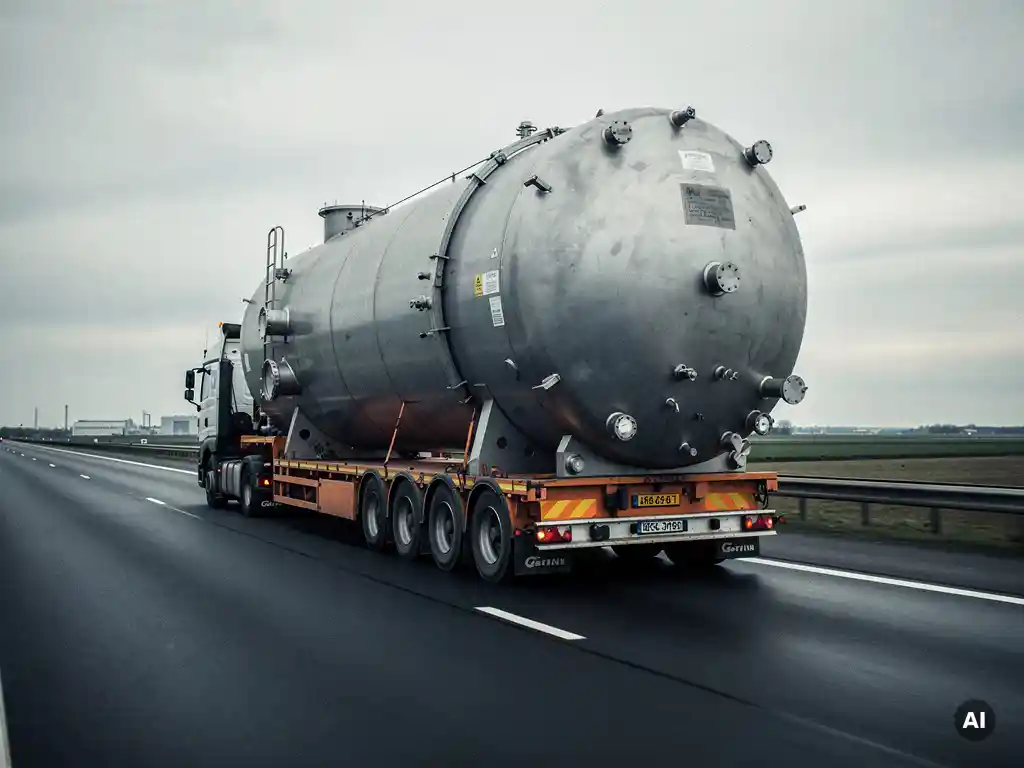
Road transport weight and dimensional limits for pressure vessels depend on the country and route, but as a general rule, loads exceeding roughly 40 to 44 tonnes gross vehicle weight, 2.5 metres in width, 4 metres in height, or around 20 metres in length require special permits and are classified as abnormal or oversized loads. These thresholds vary across jurisdictions, so any specific transport project requires route-by-route assessment. The sections below unpack each dimension, how permits work, and what happens when a vessel exceeds what road transport can accommodate.
What counts as an oversized or overweight load in pressure vessel transport?
A pressure vessel shipment is classified as an oversized or overweight load when it exceeds the standard legal limits set by the road authority of the country or region through which it travels. These limits typically cover gross vehicle weight, axle loads, width, height, and length. Any vessel that pushes beyond one or more of these thresholds triggers the abnormal load regime, which means permits, route surveys, and often escort vehicles.
In practice, most custom-fabricated pressure vessels fall into this category. Even a moderately sized vessel, once loaded onto a multi-axle trailer and secured with transport frames, can exceed standard width or height limits. Reactors, autoclaves, and large columns routinely require abnormal load permits simply due to their geometry, before weight even becomes the primary constraint.
The term abnormal load is used in the UK and much of Europe. In North America, the equivalent terms are oversize load and overdimensional load, sometimes combined with heavy haul when weight is the dominant factor. Regardless of terminology, the principle is the same: the load falls outside what standard road infrastructure and traffic regulations are designed to accommodate without special controls.
What are the standard road transport weight limits for pressure vessels?
Standard road transport weight limits for pressure vessels follow the general vehicle weight regulations of each country. In most of Europe, the maximum gross vehicle weight for a standard articulated truck is 40 to 44 tonnes, depending on the number of axles and national rules. In the United States, the federal limit is 80,000 pounds (approximately 36 tonnes) gross vehicle weight, with individual states able to set their own thresholds.
For pressure vessel transport, the relevant weight figure is the combined weight of the vessel, its transport frame or saddles, and the trailer itself. A vessel weighing 50 tonnes, for example, will require a heavy haul trailer that itself may weigh 20 to 30 tonnes or more, bringing the total well above standard limits even before accounting for the tractor unit.
Axle load limits are equally important. Road infrastructure is designed around maximum loads per axle, typically 10 to 13 tonnes per axle in Europe. Specialist multi-axle trailers distribute the vessel’s weight across a greater number of axles, reducing the load per axle and making heavier vessels transportable on roads that would otherwise be off-limits. This is why the choice of trailer configuration is a critical engineering decision, not merely a logistics one.
What are the maximum width, height, and length limits for transporting a pressure vessel by road?
Standard dimensional limits for road transport vary by country, but common benchmarks are a maximum width of 2.5 metres, a maximum height of 4.0 to 4.3 metres, and a maximum length of around 18 to 25 metres for the overall vehicle combination. Anything beyond these figures requires an abnormal load permit, and the more a vessel exceeds these limits, the more complex the transport arrangement becomes.
- Width: Vessels wider than 2.5 metres almost always require a permit. In many countries, loads wider than 3.0 to 3.5 metres also require escort vehicles. Very wide vessels, exceeding 5 or 6 metres, may only be movable at night or on restricted routes.
- Height: Height is often the most restrictive dimension because it is governed by fixed infrastructure such as bridges, overhead cables, and road signs. A loaded height above 4.0 to 4.3 metres requires a route survey to identify and clear all obstacles.
- Length: Long vessels, such as process columns or large shell-and-tube heat exchangers, can extend well beyond standard vehicle length limits. Lengths above 30 metres typically require special trailer configurations such as extendable or modular trailers and may necessitate traffic management on tight bends.
- Diameter: For cylindrical vessels, the outer diameter is the primary driver of transport width. Vessels with diameters above 3.5 to 4.0 metres present significant road transport challenges in most countries.
How do transport permits work for oversized pressure vessels?
Transport permits for oversized pressure vessels are issued by the relevant road authority in each country or region through which the load will travel. The applicant, typically the transport contractor, submits details of the load dimensions, weight, and proposed route. The authority then assesses whether the route is suitable and what conditions must be met, such as escort vehicles, travel time restrictions, or infrastructure upgrades.
For cross-border shipments, separate permits are required for each country. In Europe, some harmonisation exists through frameworks such as AISCAT agreements and bilateral transport treaties, but there is no single European permit for abnormal loads. This means a vessel transported from a manufacturing facility in Belgium to a site in, say, Poland requires permits from each country along the route.
Key elements of the permit process include a route survey, which identifies low bridges, weak road sections, and tight bends, and a structural assessment of any bridges along the route. For very heavy vessels, the transport contractor may need to commission independent engineering calculations to demonstrate that specific bridges can carry the load. Permits also specify conditions such as maximum travel speeds, required escort vehicle configurations, and notification requirements for police and utility companies.
What happens when a pressure vessel is too large or heavy for road transport?
When a pressure vessel exceeds what road transport can accommodate, even with permits and specialist trailers, the project must turn to alternative transport modes or a different fabrication strategy. The most common alternatives are inland waterway transport, coastal shipping, and rail transport, each with its own dimensional and weight constraints.
Inland waterway and coastal shipping are frequently used for very large vessels, particularly in regions with good waterway access. A vessel that cannot move by road can often be transported by barge to a port or river terminal close to the installation site, with a shorter final road leg using heavy haul equipment.
When no transport route exists at all, the remaining option is modular or field-erected construction. The vessel is either designed in sections that are joined on site, or fabricated entirely at the installation location. This approach is more complex and typically more costly, but it is sometimes the only viable solution for the largest equipment. For projects where transport is known to be a constraint from the outset, the equipment design should account for this early in the engineering phase.
How does vessel design affect road transportability?
Vessel design has a direct and significant impact on road transportability. Decisions made during the mechanical engineering phase, such as overall dimensions, nozzle orientation, insulation thickness, and the placement of lifting and transport trunnions, all influence whether a vessel can be moved by road and at what cost and complexity.
A vessel designed without transport constraints in mind may arrive at the logistics planning stage only to reveal that it cannot leave the fabrication facility by road at all. Proactive design choices that improve transportability include:
- Minimising outer diameter where process requirements allow, keeping the vessel within manageable width limits.
- Optimising nozzle and attachment placement so that protruding components do not add to the effective transport width or height.
- Designing transport trunnions or saddles that allow the vessel to be positioned at the lowest possible height on the trailer.
- Considering section joints early, so that if the vessel must be split for transport, the joint locations are mechanically sound and the field welding scope is manageable.
- Coordinating with the transport contractor during the design phase, not after fabrication, to identify constraints before they become costly problems.
This is one reason why in-house mechanical engineering capability matters. When the engineering team understands both the process requirements and the fabrication and transport realities, design decisions can be made that satisfy all constraints simultaneously rather than optimising for one at the expense of another.
How Coek supports projects with demanding transport requirements
At Coek Engineering, transport considerations are part of the broader engineering conversation, not an afterthought. When fabricating custom pressure vessels for demanding applications, the team works to ensure that dimensional and weight constraints are identified and addressed during the design phase rather than discovered at the point of dispatch.
Coek’s relevance to transport-constrained projects includes:
- In-house mechanical engineering that can account for transport limits when translating process requirements into equipment design
- Experience with large-scale and heavy equipment where transport planning is a standard part of project execution
- Ability to design and fabricate equipment in sections where site assembly is the required solution
- Manufacturing facilities in Geel and Genk with access to road, rail, and waterway logistics options
If your project involves pressure equipment where transport is a known constraint or an open question, contact Coek Engineering to discuss how fabrication and transport requirements can be aligned from the start.
Frequently Asked Questions
How far in advance should transport planning begin for an oversized pressure vessel project?
Transport planning should ideally begin during the front-end engineering phase, before vessel dimensions are finalised. Waiting until fabrication is complete significantly limits your options and can result in costly design modifications, route restrictions, or delays. Engaging a specialist heavy haul contractor early allows transport constraints to feed directly into design decisions, such as maximum allowable diameter or the need for section joints.
What is the difference between a route survey and a structural assessment, and do I need both?
A route survey is a physical or desktop inspection of the proposed transport route that identifies obstacles such as low bridges, overhead cables, weak road surfaces, and tight bends that may be incompatible with the load. A structural assessment goes a step further, involving engineering calculations to verify that specific bridges or road sections can safely carry the combined weight of the vessel, trailer, and tractor unit. For standard abnormal loads, a route survey is typically sufficient, but for very heavy vessels exceeding standard permit thresholds, authorities will often require formal structural assessments for bridges along the route.
What types of specialist trailers are used for transporting heavy pressure vessels, and how do I know which one is right?
The most common trailer types for heavy pressure vessel transport include low-bed or step-frame trailers for height-sensitive loads, extendable trailers for long vessels such as columns and shell-and-tube heat exchangers, and modular or SPMT (Self-Propelled Modular Transporter) configurations for extremely heavy or wide equipment. The right choice depends on the vessel’s weight, diameter, length, and centre of gravity, as well as the route constraints. This selection is an engineering decision that should be made in collaboration with the transport contractor, not left to a last-minute logistics call.
Can a pressure vessel be transported internationally without separate permits for each country?
No — there is currently no single international permit that covers abnormal load transport across multiple countries. Each country along the route requires its own permit application, submitted to the relevant national or regional road authority. In Europe, some bilateral agreements exist that streamline the process between neighbouring countries, but the applications are still handled separately. For cross-border projects, the transport contractor typically manages permit applications for all countries involved, but lead times can vary significantly, and some permits may take several weeks to obtain.
What are the most common mistakes made when planning pressure vessel transport, and how can they be avoided?
The most frequent mistake is treating transport as a logistics issue rather than an engineering one — finalising vessel dimensions without checking whether the result is actually movable by road. Other common errors include underestimating permit lead times for cross-border routes, failing to account for the trailer’s own weight when calculating gross vehicle weight, and not considering nozzle or attachment protrusions that can add significantly to effective transport width or height. These issues are best avoided by involving both the mechanical engineering team and the transport contractor from the early design stages of the project.
At what point does it make more sense to consider field fabrication instead of shop fabrication and transport?
Field fabrication becomes worth evaluating when the vessel’s dimensions exceed what any combination of specialist trailer, permit, and route modification can accommodate, or when the cost and complexity of transport significantly outweighs the quality and schedule advantages of shop fabrication. This is particularly relevant for very large columns, reactors, or storage vessels with diameters above 5 to 6 metres or weights in the hundreds of tonnes. The decision should be made early in the project, as field fabrication has its own engineering, quality assurance, and cost implications that need to be planned for from the outset.
Does insulation or external pipework fitted before transport affect the permit requirements for a pressure vessel?
Yes — any insulation, cladding, external pipework, platforms, or other attachments fitted before transport contribute to the effective transport dimensions and must be included in the permit application. In many cases, it is more practical to transport the bare vessel and complete external fittings on site, particularly if insulation or attachments would push the load into a more restrictive permit category or require additional escort vehicles. This is a design and logistics coordination decision that should be made explicitly, not assumed.