
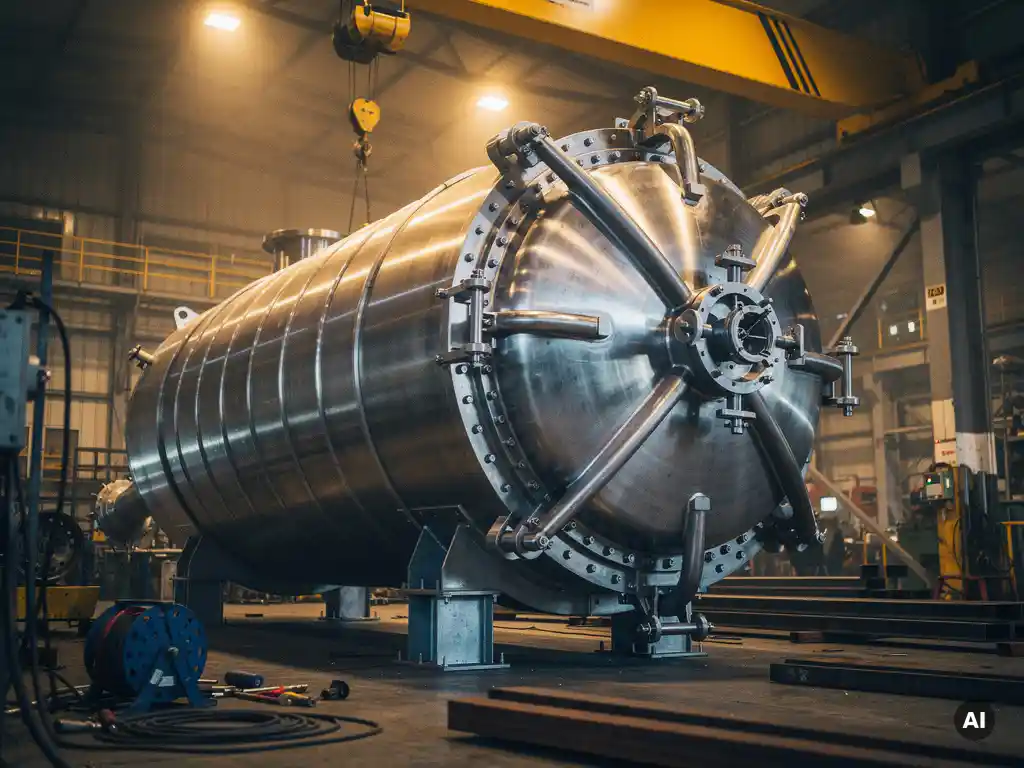
Industrial autoclaves are used to carry out high-pressure, high-temperature processes on materials, components or chemical substances that cannot be processed under normal atmospheric conditions. They are sealed pressure vessels that create a controlled environment where elevated pressure and temperature act together to drive physical or chemical transformations. The specific application varies widely by industry, but the common requirement is a vessel that can safely contain extreme operating conditions over extended cycles.
The questions below unpack how industrial autoclaves work, what conditions they must withstand, and what distinguishes them from standard pressure vessels.
What industries rely on industrial autoclaves?
Industrial autoclaves are used across a broad range of industries wherever a process requires controlled high-pressure or high-temperature conditions. The most established applications include composite materials manufacturing, chemical processing, hydrometallurgy, food and beverage sterilisation, rubber vulcanisation, and wood impregnation. Each industry uses the autoclave principle differently, but all depend on the same fundamental capability: a sealed, pressurised environment that can be precisely controlled.
In aerospace and advanced manufacturing, autoclaves cure fibre-reinforced composite components such as carbon fibre structures, where pressure and heat must be applied uniformly to achieve the required material properties. In hydrometallurgy, high-pressure autoclaves are used to leach metals from ores under conditions that accelerate chemical reactions that would otherwise be too slow or incomplete at atmospheric pressure. In the chemical industry, autoclaves serve as reactors for synthesis processes that require elevated pressure to reach thermodynamic equilibrium or to handle volatile substances safely.
Beyond these established sectors, autoclave technology is increasingly relevant in emerging areas such as advanced battery material processing, specialty chemicals and waste treatment, where process intensification drives demand for robust, high-integrity pressure equipment.
How does an industrial autoclave work?
An industrial autoclave works by sealing a load or process medium inside a pressure-tight vessel and then raising the internal pressure and temperature to the levels required by the process. Pressure is typically generated by introducing steam, an inert gas such as nitrogen, or a process-specific gas. Heat is applied through internal or external heating systems. The combination of pressure and temperature is maintained for a defined cycle duration, after which the vessel is depressurised and cooled in a controlled manner before opening.
The operating cycle is tightly controlled because both the ramp rate and the dwell conditions directly affect the outcome. In composite curing, for example, the pressure consolidates the laminate while the temperature activates the resin matrix. In hydrometallurgical leaching, the elevated pressure keeps the process fluid in a liquid state above its normal boiling point, enabling chemical reactions at temperatures that would otherwise cause uncontrolled evaporation.
Sealing integrity is critical throughout the cycle. Industrial autoclaves use engineered closures, typically bolted flanges or quick-opening mechanisms, designed to maintain a reliable seal under repeated thermal and pressure cycling without degradation.
What are the most demanding autoclave operating conditions?
The most demanding autoclave operating conditions combine high pressure, high temperature and chemically aggressive process media simultaneously. Hydrometallurgical autoclaves used in pressure oxidation of refractory gold or copper ores, for instance, operate at pressures above 30 bar and temperatures exceeding 200 degrees Celsius in the presence of sulphuric acid or other corrosive leachates. These conditions place extreme demands on the vessel shell, internal components and sealing systems.
Other demanding scenarios include:
- Processes involving strong acids or alkalis at elevated temperature, requiring corrosion-resistant alloys or clad construction throughout the vessel interior
- Cyclic loading applications where the vessel undergoes repeated pressurisation and depressurisation, demanding high fatigue resistance in the shell and closures
- Very large autoclaves where achieving uniform temperature and pressure distribution across the full internal volume is a fabrication and engineering challenge
- Processes involving flammable or toxic substances, where containment integrity is a safety-critical requirement with no tolerance for leakage
The combination of these factors is what separates genuinely demanding autoclave projects from more straightforward pressure vessel applications, and why material selection, fabrication quality and engineering rigour are so important.
What is the difference between an industrial autoclave and a standard pressure vessel?
An industrial autoclave is a type of pressure vessel, but it is designed specifically for cyclic operation, closures that can be opened and reloaded, and the simultaneous application of pressure and heat as part of a controlled process. A standard pressure vessel, by contrast, is typically designed for continuous service at defined steady-state conditions, often without the need for repeated access or thermal cycling.
The distinction matters in practice because autoclave design must account for factors that static pressure vessels do not always face. Closures on autoclaves must seal reliably under repeated opening and closing cycles, often under time pressure in production environments. The internal structure must accommodate the load being processed, whether that is composite parts, ore slurry or chemical reactants. Heating and cooling systems must be integrated in a way that achieves uniform conditions throughout the vessel volume.
In terms of pressure vessel codes, autoclaves are governed by the same standards as other pressure vessels, but the engineering requirements around fatigue life, closure design and thermal management are typically more demanding than for a simple static vessel operating at fixed conditions.
What materials are industrial autoclaves made from?
Industrial autoclaves are manufactured from materials selected to match the specific pressure, temperature and corrosion requirements of the process. Carbon steel and low-alloy steels are used for applications where the process medium is not corrosive and operating temperatures are within the range these materials handle reliably. For corrosive environments, the choice of material becomes more complex and more critical.
In applications involving acids, alkalis or other aggressive media, the vessel interior is either constructed from solid corrosion-resistant alloys or built using clad construction, where a carbon steel structural shell is lined with a corrosion-resistant layer. Common cladding materials include stainless steel grades, titanium, zirconium, Hastelloy and other nickel alloys, each selected for its resistance to the specific chemical environment.
Titanium and zirconium are particularly relevant for highly oxidising or reducing acid environments where even high-grade stainless steels would corrode. Hastelloy and Inconel alloys are used where resistance to a combination of high temperature and chemical attack is required. The selection of the right material or material combination is one of the most consequential engineering decisions in autoclave design, directly affecting service life, safety and total cost of ownership.
How large can industrial autoclaves be?
Industrial autoclaves can reach very substantial dimensions, particularly in hydrometallurgical and chemical processing applications where throughput requirements drive vessel size. Large industrial autoclaves can exceed several metres in diameter and tens of metres in length, with total weights that can approach or exceed several hundred tonnes for the vessel alone. The practical upper limit is set by the manufacturing capabilities of the fabricator, transport logistics and site installation constraints.
Size introduces significant engineering and fabrication challenges. A large autoclave must maintain structural integrity across its full shell under internal pressure, resist the thermal stresses generated by heating and cooling cycles, and achieve acceptable dimensional tolerances despite the scale of the structure. Welding quality across large surface areas must be consistent, and non-destructive testing must be thorough enough to provide confidence in the integrity of the completed vessel.
Transport is often a limiting factor in practice. Very large autoclaves may need to be fabricated in sections and assembled on site, or transported via specialised heavy-lift logistics. This requires the fabricator to plan the manufacturing sequence with transport and installation in mind from the earliest engineering stages.
What standards and certifications apply to industrial autoclaves?
Industrial autoclaves are subject to the same pressure equipment standards and regulations as other pressure vessels, with the applicable framework depending on the country of installation and the operating conditions. In Europe, the Pressure Equipment Directive (PED) governs the design, manufacture and conformity assessment of pressure equipment, including autoclaves, above defined pressure and volume thresholds. In North America, the ASME Boiler and Pressure Vessel Code, particularly Section VIII, is the principal standard for pressure vessel design and fabrication.
Beyond the primary design code, autoclaves may also be subject to requirements related to materials traceability, non-destructive examination, pressure testing, documentation and quality management. ISO 9001 certification of the manufacturing facility provides a baseline assurance that quality management processes are in place and consistently applied.
For particularly demanding or novel applications, additional engineering review, third-party inspection and specific documentation requirements may be imposed by the end user, the EPC contractor or the relevant regulatory authority. Compliance with these requirements is not a formality but a substantive part of the engineering and manufacturing process, and it requires the fabricator to maintain robust quality systems throughout the project lifecycle.
How Coek supports demanding autoclave projects
Coek Engineering manufactures custom industrial autoclaves for technically complex and high-value applications where standard equipment is insufficient. The work begins with the customer’s process requirements and translates them into mechanically sound, manufacturable equipment that meets the applicable international standards.
Key capabilities relevant to demanding autoclave projects include:
- Large-scale manufacturing capacity, with equipment up to approximately 10 metres in diameter and weights approaching 1,000 tonnes
- Advanced materials expertise, including titanium, zirconium, Hastelloy, Inconel and other alloys suited to corrosive and high-temperature environments
- More than 30 years of experience with clad construction, combining structural carbon steel with corrosion-resistant inner layers
- In-house mechanical engineering to convert process specifications into fabrication-ready designs
- Compliance with PED, ASME and ISO 9001 requirements
If your project involves an industrial autoclave with demanding operating conditions, large dimensions, advanced materials or complex fabrication requirements, contact Coek Engineering to discuss your specifications.
Frequently Asked Questions
How do I determine the right autoclave size and specification for my process?
Start by defining your process parameters precisely: the required pressure and temperature ranges, the nature of the process medium (including any corrosive or reactive properties), the size and quantity of the load per cycle, and the required throughput. These inputs drive every downstream engineering decision, from vessel dimensions and wall thickness to material selection and heating system design. Working with an experienced autoclave manufacturer at the earliest possible stage allows process requirements to be translated into a technically sound and manufacturable specification before design work begins.
What is clad construction and when is it the right choice over solid alloy construction?
Clad construction uses a structural carbon steel shell lined internally with a corrosion-resistant alloy layer, such as titanium, zirconium or a nickel alloy. It is typically chosen when the process environment demands a high-performance alloy for corrosion resistance, but building the entire vessel from that alloy would be prohibitively expensive or technically unnecessary given that only the interior surfaces are exposed to the aggressive medium. Solid alloy construction is generally reserved for smaller vessels or cases where the wall thickness required for pressure containment is thin enough that the cost premium over clad construction is justified. The choice between the two depends on vessel size, operating conditions, alloy cost and the fabricator’s experience with bonding and testing the cladding interface.
How long does a typical industrial autoclave last, and what affects its service life?
A well-designed and properly maintained industrial autoclave can operate reliably for decades, but service life is highly dependent on the severity of the operating conditions and the quality of the original design and fabrication. The most significant factors affecting longevity are the number and severity of pressure and temperature cycles (fatigue loading), the aggressiveness of the process medium, the quality of welds and closures, and the consistency of maintenance and inspection practices. Autoclaves operating under cyclic or chemically aggressive conditions require a more rigorous inspection regime, including periodic non-destructive examination, to detect any degradation before it becomes a safety or operational concern.
What are the most common causes of autoclave failure or unplanned downtime, and how can they be prevented?
The most frequent sources of unplanned downtime in industrial autoclaves are closure seal failures, corrosion of internal surfaces or nozzles, and fatigue cracking at welds or stress concentration points. Closure seals are a consumable component subject to repeated thermal and mechanical cycling and must be inspected and replaced on a defined schedule rather than run to failure. Corrosion issues are often traceable to an initial material selection that underestimated the aggressiveness of the process medium, or to localised areas such as nozzle connections that were not adequately protected. A structured preventive maintenance programme combined with periodic third-party inspection is the most effective way to identify developing issues before they cause unplanned shutdowns.
Can an existing autoclave be modified or upgraded to handle more demanding conditions?
In some cases, yes, but any modification that affects the pressure boundary, operating conditions or structural integrity of a pressure vessel must be treated as an engineering project in its own right and carried out in compliance with the applicable pressure equipment standards. Upgrading an autoclave to higher pressure or temperature, changing the process medium to something more corrosive, or adding internal components requires a formal engineering review of the existing vessel, potentially including a reassessment of the original design calculations and a new pressure test. Modifications that appear straightforward can have implications for fatigue life, nozzle loads and closure performance that are not immediately obvious, so engaging a qualified pressure vessel engineer before proceeding is essential.
What should I look for when selecting an industrial autoclave manufacturer?
The most important factors are demonstrated experience with autoclaves of comparable complexity and scale, in-house materials expertise relevant to your process conditions, and a quality management system certified to ISO 9001 or equivalent. Compliance with the applicable pressure equipment code — PED in Europe, ASME in North America — is a baseline requirement, but beyond certification, look for a fabricator who can show a track record of successfully completed projects in similar industries and operating conditions. The ability to handle the full scope in-house, from engineering and material procurement through fabrication, testing and documentation, reduces coordination risk and provides clearer accountability throughout the project.
How is transport and on-site installation managed for very large autoclaves?
For autoclaves that exceed road or rail transport limits, the manufacturer must plan the fabrication sequence from the outset with transport and site assembly in mind. This typically means designing the vessel with defined split lines so it can be fabricated in transportable sections and field-assembled on site, with all critical welds completed and tested in the workshop wherever possible. Specialised heavy-lift transport, including abnormal load road permits, barge transport or modular trailer systems, is arranged in coordination with logistics specialists. Site assembly requires a controlled environment and qualified welders working to the same standards as the workshop, with non-destructive examination and a final pressure test carried out on the completed vessel before commissioning.
Related Articles
- How long does it take to manufacture a custom industrial pressure vessel?
- What are the most common pressure vessel failures and their causes?
- How much does an autoclave cost?
- How do you select the right pressure vessel for your process?
- What is the role of a pressure vessel manufacturer in an EPC project?