
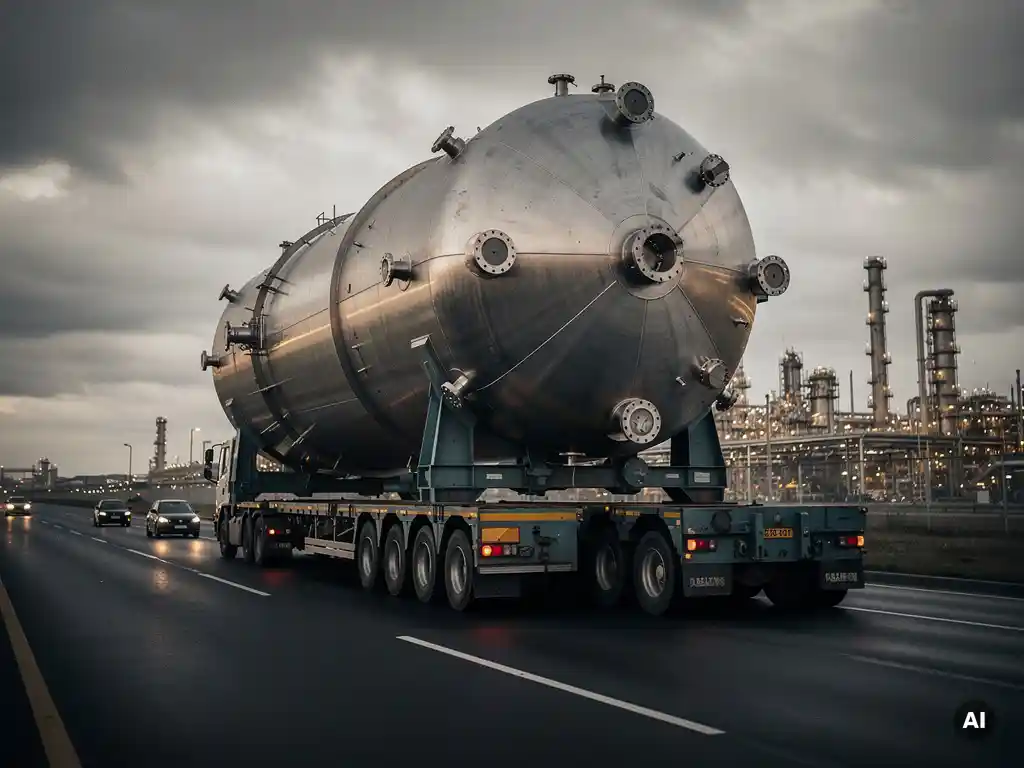
Large and heavy pressure vessels are typically transported by road using self-propelled modular transporters (SPMTs) or heavy-haul trailers, by barge or ship for coastal and river-accessible sites, or by a combination of both. The method depends on vessel size, weight, site location, and available infrastructure. This article unpacks the key questions that arise when planning pressure vessel logistics from fabrication shop to final installation point.
What makes transporting large pressure vessels so challenging?
Transporting large pressure vessels is challenging because these structures often exceed the legal limits for road transport in every dimension simultaneously: length, width, height, and weight. A vessel that is 4 metres in diameter and 40 metres long, for example, cannot simply be loaded onto a standard truck. Every movement requires special permits, route surveys, escort vehicles, and often temporary modifications to roads, bridges, or overhead infrastructure.
The challenge compounds when the vessel is also heavy. Industrial pressure vessels for demanding applications can weigh hundreds of tonnes, and in some cases approach or exceed 1,000 tonnes. At those weights, the load-bearing capacity of roads, bridges, and quaysides becomes a critical constraint that must be assessed before a single wheel turns.
Beyond size and weight, the vessel itself must arrive undamaged. Pressure vessels are precision-fabricated items where dimensional tolerances, weld integrity, and surface condition are critical. Vibration, shock loading, moisture ingress, or mechanical contact during transport can compromise the equipment before it ever enters service.
What transport methods are used for oversized pressure vessels?
The most common transport methods for oversized pressure vessels are road transport using heavy-haul trailers or SPMTs, inland waterway or sea transport by barge or heavy-lift vessel, and rail transport where suitable infrastructure exists. Many projects use a multimodal approach, combining water and road transport to reach the final installation site.
- Self-propelled modular transporters (SPMTs): Hydraulically steered, multi-axle platforms that can be configured to distribute extreme loads across a large number of axles. Widely used for very heavy or oversized vessels where conventional trailers are insufficient.
- Conventional heavy-haul trailers: Used for vessels within the weight and dimensional range that trailers can handle, typically with hydraulic lowbed or extendable trailer configurations.
- Barge and heavy-lift shipping: Preferred for very large or very heavy vessels when the fabrication facility and project site have waterway access. Barges can carry loads that would be impossible to move by road.
- Heavy-lift vessels: Specialised ships equipped with cranes or semi-submersible capability for offshore or remote coastal delivery of extremely large equipment.
- Rail transport: Used in some regions where rail gauge and load limits permit, though less common for the largest vessels due to clearance and weight restrictions.
The selection of transport method is rarely straightforward. It requires a detailed assessment of vessel dimensions and weight, the distance and geography between the fabrication facility and site, and the available infrastructure along the entire route.
How does a pressure vessel get from the fabrication shop to the transport vehicle?
Moving a pressure vessel from inside a fabrication hall to a transport vehicle typically involves heavy lifting using overhead cranes, strand jacks, or hydraulic skidding systems. The vessel is lifted or skidded out of the workshop, lowered onto temporary supports or a load-out platform, and then transferred to the transport vehicle using cranes, SPMTs, or a controlled skidding operation.
For very large vessels, the load-out operation itself is a significant engineering exercise. The floor of the fabrication hall, the load-out apron, and the quayside or road surface must all be assessed for load-bearing capacity. Temporary steel structures or grillage may be needed to distribute the vessel’s weight during the transfer.
When a vessel is too large to be moved horizontally out of the workshop, it may need to be tilted from a horizontal fabrication position to a vertical transport or installation position, a process known as upending. This requires careful rigging engineering and, in some cases, purpose-built tailing frames or hydraulic tailing equipment.
What route planning is required before a heavy vessel moves?
Route planning for heavy pressure vessel transport requires a detailed survey of the entire path from the fabrication facility to the installation site. This includes assessing bridge load ratings, road surface conditions, overhead clearances, turning radii, traffic management requirements, and the availability of police or escort services. In most countries, an abnormal load permit must be obtained before the move can proceed.
Route surveys are typically carried out by specialist transport engineers who physically inspect or use survey data to identify every constraint along the route. Common obstacles include low bridges, weight-restricted roads, roundabouts with insufficient turning radius, overhead power lines, and narrow sections that require temporary road widening or the removal of street furniture.
For international transport, the permitting process becomes more complex because each country has its own regulations for abnormal loads. Coordination between transport contractors, local authorities, and port operators is essential, and lead times for permits can extend the overall project schedule by weeks or months if not planned early.
How is a large pressure vessel protected during transport?
Large pressure vessels are protected during transport through a combination of purpose-built saddles and cradles, protective wrapping or coating of sensitive surfaces, temporary flange covers and nozzle blanks, and careful securing to prevent movement on the transport vehicle. The goal is to prevent mechanical damage, moisture ingress, and surface contamination throughout the journey.
Saddles and cradles are designed to distribute the vessel’s weight evenly and prevent point loading that could deform the shell. For horizontal transport, the vessel typically rests on two or more saddle supports, which are engineered to match the vessel’s geometry and weight distribution.
Sensitive surfaces such as machined flanges, nozzle faces, and internal linings receive additional protection. Flange protectors, foam padding, and shrink-wrap coverings are commonly used. For vessels with corrosion-resistant inner linings or clad surfaces, protecting the internal surface during transport is as important as protecting the external shell.
Seafastening, the process of securing a vessel to a barge or ship deck, is a structural engineering task in its own right. The vessel must be fixed against the dynamic forces of wave motion, and the calculations must account for the worst expected sea conditions along the route.
Who is responsible for coordinating pressure vessel transport?
Responsibility for coordinating pressure vessel transport is typically shared between the fabricator, the project’s EPC contractor or owner, and a specialist heavy-lift and transport contractor. The fabricator is responsible for preparing the vessel for transport, including load-out arrangements and documentation. The EPC or owner manages overall project logistics, while the specialist transport contractor handles permitting, routing, equipment, and execution.
In practice, clear contractual definition of responsibilities is essential. Ambiguity over who is responsible for route surveys, permit costs, or insurance can cause delays and disputes. Transport planning should begin well before vessel completion, because permit lead times, barge availability, and route preparation can all sit on the critical path of a project schedule.
The fabricator’s role does not end at the factory gate. Providing accurate and timely information about vessel weight, centre of gravity, nozzle locations, and lifting attachment points is essential for the transport contractor to design the seafastening, rigging, and saddle arrangements correctly.
How Coek supports the delivery of large and heavy pressure vessels
At Coek Engineering, the logistics of delivering large, heavy pressure equipment to site are a consideration that begins during the engineering and fabrication phase, not after. Vessels are designed and manufactured with transport in mind, including the positioning of lifting lugs, the design of temporary supports, and the documentation needed by transport contractors and permitting authorities.
- Fabrication of pressure vessels, reactors and industrial autoclaves up to approximately 10 metres in diameter and 1,000 tonnes in weight
- Load-out planning and coordination as part of the overall project scope
- Provision of accurate weight, centre of gravity and dimensional data to support transport engineering
- Experience with complex, first-of-a-kind equipment where transport constraints influence design decisions
If you are planning a project that involves the fabrication and delivery of large or technically demanding pressure equipment, contact Coek Engineering to discuss your requirements at an early stage.
Frequently Asked Questions
How far in advance should transport planning begin for a large pressure vessel project?
Transport planning should ideally begin at the same time as the engineering and fabrication phase — not after the vessel is complete. Abnormal load permits can take weeks or months to obtain, barge slots and SPMT equipment have limited availability, and route preparation work such as temporary road strengthening or bridge assessments takes time to commission. Starting early ensures transport constraints do not become a bottleneck on the critical path.
What information does a transport contractor need from the fabricator before planning a heavy vessel move?
A transport contractor typically needs the vessel’s total weight, centre of gravity coordinates, overall dimensions (length, diameter, and any protruding nozzles or attachments), the location and load ratings of lifting lugs or trunnions, and the minimum bend radius or contact points suitable for saddle support. Accurate as-built data is essential — even small discrepancies in weight or centre of gravity can affect seafastening calculations, saddle design, and crane lift plans.
What are the most common mistakes made when planning pressure vessel transport?
The most common mistakes include underestimating permit lead times, failing to account for route constraints early enough to influence fabrication yard selection, and not defining contractual responsibilities clearly between the fabricator, EPC contractor, and transport specialist. Another frequent issue is neglecting to verify bridge and road load ratings until late in the project, which can force costly last-minute route changes or temporary civil works. Early engagement with a specialist heavy transport contractor helps avoid most of these pitfalls.
Can a pressure vessel be transported vertically, and when would that be necessary?
Yes, vertical transport is sometimes used — particularly for tall, narrow vessels such as columns or towers where the horizontal length would make road transport impractical or impossible. Vertical transport requires a specialised trailer configuration, strict overhead clearance management along the entire route, and careful analysis of the vessel’s stability under dynamic transport loads. In some cases, a vessel fabricated horizontally must be upended at the fabrication yard before loading, which is itself a significant rigging and structural engineering operation.
What happens if a vessel is damaged during transport — who is liable?
Liability for transport damage depends on the contractual arrangements in place, but typically the specialist transport contractor carries responsibility for damage that occurs during the move itself, covered by their marine or cargo insurance policy. The fabricator may retain responsibility for damage caused by inadequate load-out preparation or incorrect documentation. It is critical that all parties agree on insurance coverage, inspection protocols at handover points, and the process for documenting vessel condition before and after each transport leg.
Are there vessel designs or features that make transport significantly more difficult?
Yes — certain design features can substantially complicate transport. These include large-diameter nozzles or davit arms that increase the effective transport envelope, asymmetric weight distributions that create challenging centre-of-gravity positions, internal refractory linings that are vulnerable to cracking under vibration or shock, and thin-shell vessels that require additional temporary stiffening to prevent deformation under transport loads. Identifying these features during the design phase allows the engineering team to mitigate transport risks before fabrication begins.
Is it possible to reduce transport costs by partially assembling a vessel on site rather than shipping it complete?
In some cases, yes — splitting a large vessel into transportable sections and completing final assembly or welding on site can reduce transport complexity and cost. However, field welding of pressure vessels introduces additional challenges: it requires qualified welders, post-weld heat treatment capabilities, non-destructive examination, and regulatory inspection at the installation site, all of which add cost and schedule risk. This trade-off should be evaluated carefully on a project-by-project basis, weighing transport savings against the increased complexity and risk of field fabrication.
Related Articles
- How does pressure cycling affect the design life of industrial pressure vessels?
- What international standards apply to pressure vessel design and certification?
- How does operating pressure influence pressure vessel head geometry selection?
- What are the weight and dimensional limits for road transport of pressure vessels?
- What is clad construction in pressure vessel manufacturing?