
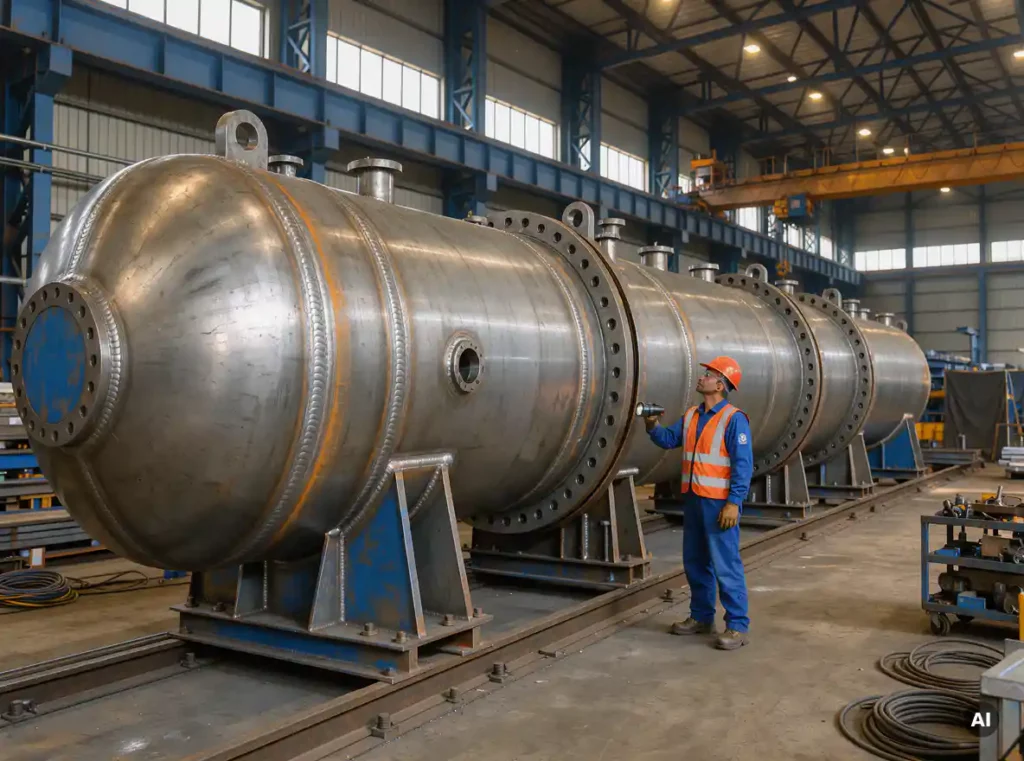
Many mining autoclaves run continuously because slurry flows through them in a steady stream, which keeps throughput high, temperature and pressure stable, and reaction conditions consistent. A batch autoclave must be filled, heated, reacted, cooled and emptied in each cycle. That downtime is difficult to justify at the tonnages of modern gold and nickel plants.
Continuous operation suits high-volume pressure oxidation and high-pressure acid leach duties, where residence time, heat balance and equipment lifetime matter more than flexibility. The sections below explain how continuous autoclaves work, when batch units still win, and what to consider when sourcing them.
How does a continuous autoclave actually process slurry?
A continuous autoclave receives pre-heated slurry at one end, moves it through the vessel while oxygen and, where needed, acid or steam are injected, and discharges the reacted slurry at the other end. Feed and discharge happen at the same time, so the process never stops between cycles.
Inside the vessel, agitators keep solids suspended and disperse oxygen into the liquid phase. The slurry steps from one zone to the next, usually by overflow, so each portion of feed spends a controlled amount of time under reaction conditions. That controlled residence time is what delivers consistent conversion, whether the target is oxidising sulphide minerals in refractory gold ore or leaching nickel and cobalt from laterite.
Upstream, slurry is typically heated and pressurised before entering the vessel. Downstream, flash vessels and cooling equipment reduce pressure and temperature in stages. The autoclave itself is only one part of a pressure circuit, but it is where the most demanding conditions occur.
What makes continuous operation more efficient at mining scale?
Continuous operation is more efficient at mining scale because it removes the idle time between batches, holds conditions steady, and allows heat to be recovered from the process. For large ore tonnages, steady flow produces more consistent output per hour than repeated fill and discharge cycles.
Several factors drive this advantage:
- Higher utilisation: The vessel spends its time reacting, not loading, heating up or draining.
- Stable process conditions: Constant temperature and pressure make control easier and reduce thermal cycling stress on the vessel and its lining.
- Heat integration: Many oxidation reactions are exothermic, and a continuous flow lets that heat be balanced against the cold feed.
- Consistent product quality: Every particle experiences a similar residence time profile, which supports predictable recovery downstream.
- Lower operating effort per tonne: Fewer start-up and shutdown sequences mean less operator intervention.
Fewer pressure and temperature cycles also matter for equipment life. Repeated cycling fatigues welds, linings and nozzles, so a steadily operating vessel is generally easier on its own structure.
When is a batch autoclave still the better choice?
A batch autoclave is still the better choice when volumes are small, feed chemistry changes often, or the process needs precise control over each reaction cycle. Test work, pilot plants and specialty products usually fit batch operation better than a continuous circuit built for steady, high tonnage.
Batch units offer flexibility. Reaction time, temperature and reagents can be adjusted from one cycle to the next, which suits research, variable ore blends or short production campaigns. They also tend to be simpler in their internals, since there is no need to manage flow between zones.
The trade-off is throughput. As soon as a plant needs to treat large, steady tonnages, the cycle time of a batch unit becomes a limitation, and multiplying vessels to compensate adds cost, footprint and operating complexity.
Why are mining autoclaves divided into compartments?
Mining autoclaves are divided into compartments to control residence time, approximate a staged reactor train inside a single vessel, and manage reaction conditions zone by zone. Each compartment typically has its own agitator, so mixing and gas dispersion can be tuned along the length of the autoclave.
Without compartments, a long vessel would behave more like a single mixed volume, allowing fresh slurry to short-circuit toward the outlet. Dividing the vessel with internal baffles or weirs forces slurry through a series of mixed zones, which improves conversion and makes the overall flow pattern more predictable.
Compartments also help with practical control:
- Fresh feed meets the highest reaction demand in the first compartments, where oxygen and heat requirements are greatest.
- Middle compartments continue the reaction while maintaining agitation and gas transfer.
- Final compartments allow the reaction to finish before the slurry is discharged.
The internal partitions and agitator shafts add mechanical complexity to a vessel that is already large, heavy and pressure rated, so they must be designed and fabricated with care.
Which operating conditions drive autoclave material selection?
Material selection is driven mainly by temperature, pressure, acidity, chloride content, oxidising potential and the erosive effect of solids in the slurry. Pressure oxidation and high-pressure acid leach duties combine several of these at once, which is why carbon steel alone cannot be used on the process side.
The usual solution is a pressure-bearing shell in carbon steel with a corrosion-resistant lining on the inside. Titanium is widely used as the lining material for acidic, oxidising slurries because of its corrosion resistance in these environments. Alternatives such as zirconium, Hastelloy or other nickel alloys may be considered where the chemistry calls for them. Titanium Grade 17 has been used as lining material in autoclaves for nickel, cobalt and gold applications.
Erosion deserves as much attention as corrosion. Moving slurry with solids can wear away protective surfaces, particularly around agitators, nozzles and flow transitions. Design details in these areas have been refined over the years in response to erosion experienced in the field. Material choice should therefore be made together with a review of flow velocities, solids loading and internal geometry, not from a corrosion table alone.
What fabrication challenges come with large continuous autoclaves?
Large continuous autoclaves are difficult to fabricate because they combine very large dimensions, heavy wall thicknesses, clad or lined construction and tight tolerances in a single piece of equipment. Individual units can approach 1,000 tons, which affects forming, welding, heat treatment, handling and transport.
The main challenges include:
- Clad and lined construction: Joining a corrosion-resistant layer to a thick carbon steel shell requires controlled procedures, and weld seams in the lining must remain sound and free of contamination.
- Thick-wall welding: High design pressures call for heavy sections, which demand qualified welding processes and careful heat management.
- Dimensional accuracy: Nozzles, internal partitions and agitator mounting points must align across a very large structure.
- Heat treatment of large components: Furnace capacity limits what can be treated as a single piece.
- Logistics: Weight and diameter affect lifting, shop floor layout and transport planning, so these should be considered at the design stage.
Because the vessel is often a long-lead item on a mining project, fabrication planning and design for manufacturability have a direct influence on schedule and on long-term reliability.
How can EPCs and owners reduce risk when sourcing autoclaves?
EPCs and owners reduce sourcing risk by involving the fabricator early, verifying real experience with comparable size and materials, and reviewing design details for erosion, inspectability and manufacturability before ordering. Treating the autoclave as a critical, custom item rather than a catalogue purchase prevents costly problems later.
Practical steps include:
- Checking references for clad or lined vessels of similar weight, diameter and pressure class.
- Confirming applicable code compliance, such as PED or ASME, and the fabricator’s quality system.
- Reviewing how welding, cladding and heat treatment will be controlled and documented.
- Asking how internal details such as partitions, agitator supports and nozzles are designed to limit erosion.
- Agreeing a realistic fabrication, testing and transport plan early in the project.
A fabricator that translates process requirements into mechanically sound, manufacturable equipment can identify risks during design instead of in the workshop, when changes are far more expensive.
How Coek helps with mining autoclave projects
Coek Engineering designs and fabricates custom pressure equipment, including large industrial autoclaves for demanding, corrosive and high-pressure duties. Process requirements come from the customer, EPC or technology owner, and Coek translates them into mechanically compliant, manufacturable equipment.
- Autoclaves for nickel, cobalt and gold applications, with titanium-clad construction and references approaching 1,000 tons
- More than 30 years of experience with clad construction, including titanium, zirconium and nickel alloys
- In-house mechanical engineering, including FEA and other supplementary analyses where required
- Manufacturing capacity for equipment up to 10 metres in diameter, 100 metres in length and approximately 1,000 tons
- ISO 9001, PED and ASME certifications
If you are planning an autoclave project and want to review design, materials or fabrication risks early, contact Coek to discuss your requirements.
Frequently Asked Questions
How do I decide between a continuous and a batch autoclave for my project?
Start with your design throughput, feed variability and project goals. If you expect large, steady tonnages, such as a full-scale pressure oxidation or high-pressure acid leach plant, continuous operation usually wins on utilisation and cost per tonne. If you are still in test work, treating variable feeds or running short campaigns, a batch unit offers the flexibility you need. Many projects use batch autoclaves for pilot testing first and then scale up to a continuous design.
What information should I prepare before approaching a fabricator for a continuous autoclave?
Have the process basics ready: design pressure and temperature, slurry chemistry (acidity, chloride content, solids loading), required residence time and capacity, and the number of compartments and agitators. Add any applicable code requirement (PED, ASME), preferred lining material and known site or transport constraints. The more complete this package is, the earlier the fabricator can flag manufacturability, erosion and logistics risks.
What are the most common mistakes when specifying autoclave materials?
The most common mistake is choosing a lining from a corrosion table alone and ignoring erosion from solids in the slurry. Other pitfalls include underestimating chloride or oxidising potential, and overlooking flow velocities near agitators, nozzles and transitions. Review material choice together with internal geometry and solids loading, and involve both the process licensor and the fabricator in that review.
How can I reduce erosion and wear inside a continuous autoclave?
Focus on design details in high-wear areas: agitator zones, nozzles, partitions and flow transitions. Keep local velocities within what the lining material can tolerate, avoid abrupt geometry changes, and make sure these areas can be inspected and repaired. Learning from field experience with similar vessels helps, so ask the fabricator how their designs have evolved in response to wear seen in operating units.
What should I check to make sure a fabricator can handle a very large clad autoclave?
Ask for references on clad or lined vessels of comparable weight, diameter and pressure class, and confirm their workshop capacity for lifting, welding and heat treating components of that size. Verify certifications such as ISO 9001, PED and ASME, and ask how cladding, weld seams and heat treatment are controlled and documented. In-house mechanical engineering, including FEA, is also a good sign that design and manufacturing are well integrated.
What happens if a continuous autoclave has to be shut down unexpectedly?
An unplanned shutdown means depressurising and cooling the vessel, which causes thermal and pressure cycling. This is one reason continuous units are built for steady operation and why stable running is easier on welds, linings and nozzles. Plan for this with well-defined shutdown and restart procedures, adequate instrumentation, and a maintenance strategy that includes periodic internal inspection after upset events.
How early should the fabricator be involved in an autoclave project?
As early as the design stage, ideally before the specification is frozen. Autoclaves are often long-lead items, and decisions about compartments, nozzle positions, lining details and transport splits strongly affect cost, schedule and reliability. Early involvement lets the fabricator identify problems on paper rather than in the workshop, when changes are far more expensive.
Related Articles
- What is an autoclave and how does it work in industrial processes?
- What is the difference between an autoclave and a reactor vessel?
- What is the difference between ASME and PED pressure vessel certification?
- How do you select the right pressure vessel for your process?
- How do you qualify a new material for use in a pressure vessel design?