
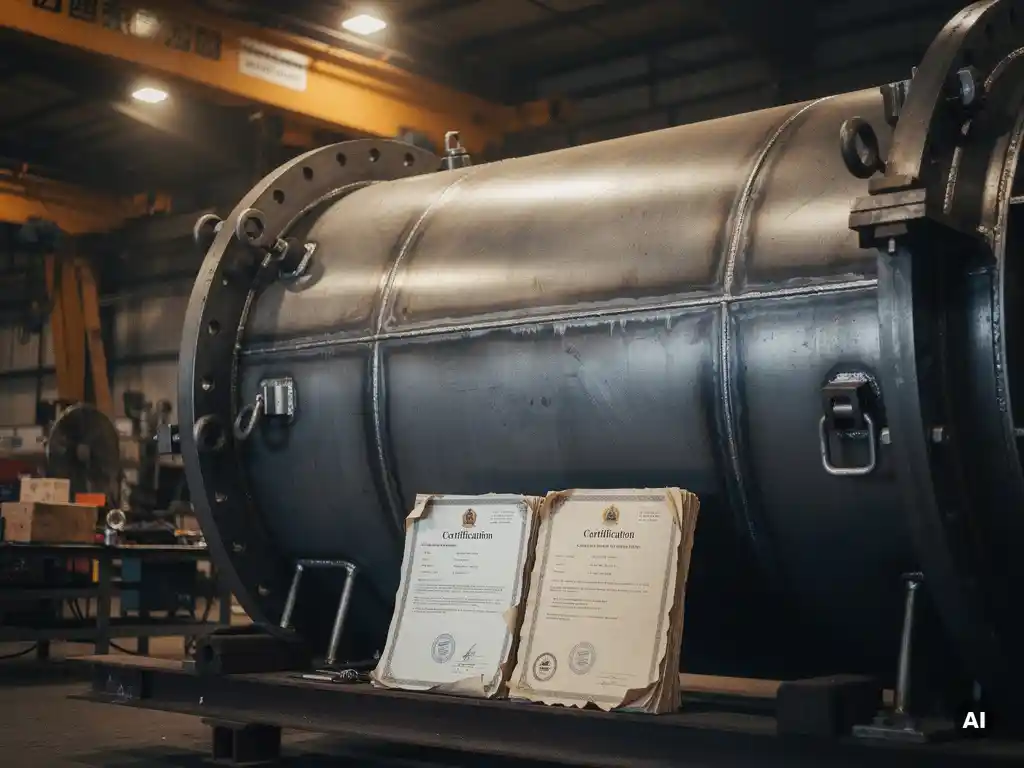
ASME and PED are two distinct pressure vessel certification frameworks that apply in different geographic markets and operate under fundamentally different regulatory philosophies. ASME certification, governed by the ASME Boiler and Pressure Vessel Code, is the standard required in North America, while PED certification applies to equipment placed on the market within the European Union and several associated countries. Understanding which applies to your project, and how each works in practice, is essential for procurement teams, EPC contractors and equipment engineers specifying pressure vessels for international projects.
Which markets require ASME and which require PED?
ASME certification is the dominant requirement in the United States, Canada and a wide range of countries that have adopted ASME standards by reference, including many in the Middle East, Southeast Asia and Latin America. PED certification is mandatory for pressure equipment placed on the market in the European Union and is also recognised in the UK, Norway, Iceland and other countries aligned with EU technical regulations.
The choice is largely determined by where the equipment will be installed and operated, not where it is manufactured. A vessel built in Belgium for a refinery in the United States must meet ASME requirements. Equally, a vessel fabricated in South Korea for a chemical plant in Germany must comply with the Pressure Equipment Directive and carry CE marking.
Some project specifications require compliance with both frameworks simultaneously, particularly for equipment destined for multinational facilities or supplied under EPC contracts spanning multiple jurisdictions. This dual-certification scenario is addressed further below.
How does the ASME design and approval process work?
The ASME design and approval process is a prescriptive, code-driven system in which the manufacturer demonstrates compliance with the detailed requirements of ASME Section VIII, the division of the Boiler and Pressure Vessel Code that governs unfired pressure vessels. The process is centred on the manufacturer holding a valid ASME Certificate of Authorization and using an ASME-authorized Inspection Agency throughout fabrication.
The key stages of the ASME process are:
- Design verification: The vessel is designed in accordance with ASME VIII rules, covering allowable stresses, design pressure and temperature, wall thickness calculations and nozzle reinforcement.
- Authorized Inspector involvement: An Authorized Inspector, employed by an ASME-accredited inspection agency, reviews design documentation, witnesses mandatory tests and monitors fabrication milestones.
- Material traceability: All pressure-retaining materials must be certified to ASME-recognized material specifications, with full traceability maintained throughout fabrication.
- Weld procedure and welder qualification: Welding procedures and welders must be qualified in accordance with ASME Section IX.
- Hydrostatic testing: A hydrostatic pressure test is performed at 1.3 times the maximum allowable working pressure as a standard requirement.
- Stamping and Data Report: Upon successful completion, the vessel receives the ASME U-stamp (or U2 for Division 2) and a Manufacturer’s Data Report is issued.
The ASME system places significant responsibility on the manufacturer to self-certify compliance, with the Authorized Inspector providing independent verification rather than design approval.
How does the PED conformity assessment process work?
The PED conformity assessment process is a risk-based, regulatory framework under European Union law that requires manufacturers to demonstrate that pressure equipment meets the Essential Safety Requirements defined in Directive 2014/68/EU. The specific conformity assessment route depends on the hazard category of the equipment, which is determined by fluid type, pressure, volume and the nature of the contained medium.
Higher-hazard equipment, which includes most industrial pressure vessels, falls into Category III or IV under PED classification. For these categories, a Notified Body, an independent organisation accredited by an EU member state, must be involved in the conformity assessment. The Notified Body reviews design documentation, approves welding procedures, qualifies welders and witnesses pressure tests.
Once conformity is established, the manufacturer issues a Declaration of Conformity and affixes CE marking to the equipment. The CE mark signals that the vessel meets all applicable EU legislative requirements, including those of the PED. Unlike the ASME U-stamp, CE marking is a legal requirement for placing pressure equipment on the EU market, not a voluntary quality indicator.
What are the key technical differences between ASME and PED requirements?
ASME and PED share the same fundamental goal of ensuring pressure equipment safety, but they differ in their technical approaches, material acceptance, design methodology and inspection philosophy.
- Design methodology: ASME VIII Division 1 is largely prescriptive, specifying formulas and rules directly. PED is performance-based, setting essential safety requirements and allowing manufacturers to demonstrate compliance through harmonized European standards such as EN 13445 for unfired pressure vessels.
- Allowable stress values: ASME and European standards use different safety factors and stress bases, which can result in different calculated wall thicknesses for nominally identical design conditions.
- Material specifications: ASME requires materials to be certified to ASME or SA material specifications. PED-compliant equipment typically uses materials certified to EN or equivalent European standards. Cross-referencing is possible but requires careful documentation.
- Impact testing requirements: The two frameworks differ in how they define minimum design metal temperatures and associated impact testing requirements, which can affect material selection for low-temperature applications.
- Weld joint efficiency: ASME applies joint efficiency factors that influence wall thickness calculations depending on the extent of radiographic examination performed. EN 13445 uses a different testing coefficient approach.
- Third-party involvement: ASME uses Authorized Inspectors throughout fabrication. PED uses Notified Bodies for higher-category equipment, with a broader scope that includes design review.
Can a pressure vessel be dual-certified to both ASME and PED?
Yes, a pressure vessel can be dual-certified to both ASME and PED, and this is a well-established practice for equipment destined for international projects or facilities that must comply with both regulatory regimes. Dual certification requires careful planning from the early design stage, as the two frameworks have different, and sometimes conflicting, technical requirements.
In practice, dual certification is achieved by designing the vessel to the more stringent requirement in each area, whether that means using ASME-specified materials that also carry EN certification, selecting the greater calculated wall thickness from each code, or satisfying both the ASME Authorized Inspector and the PED Notified Body inspection programmes simultaneously.
Manufacturers experienced in both frameworks are able to structure their documentation, material procurement and inspection hold points to satisfy both sets of requirements within a single fabrication programme. This avoids the need to manufacture two separate vessels and reduces overall project cost and schedule risk. The additional complexity, however, requires a fabricator with genuine experience in managing parallel certification processes and the documentation discipline that both frameworks demand.
Which certification should be specified for a new pressure vessel project?
The certification to specify is determined primarily by the country of installation and the applicable local regulatory requirements. If the vessel will operate within the European Union or a country that recognises CE marking under the PED, PED certification is legally required. If the installation is in the United States, Canada or a country that mandates ASME compliance, ASME certification applies. Where both apply, dual certification should be specified from the outset.
Beyond geography, project teams should consider the following when specifying certification requirements:
- Client and operator requirements: End users may have internal standards that reference one framework over the other, regardless of local regulations.
- Technology licensor specifications: Process licensors often specify the design code as part of their equipment specifications, particularly for licensed process units.
- Insurance and risk considerations: Some insurers or risk assessors may have preferences for specific certification frameworks in certain industries.
- Fabricator capability: Not all manufacturers hold both ASME and PED authorization. Confirming fabricator certification status early avoids delays during vendor qualification.
Specifying the correct certification framework at the inquiry stage, rather than resolving it during detailed engineering, avoids costly design revisions, material requalification and inspection programme conflicts later in the project.
How Coek supports pressure vessel certification requirements
Coek Engineering holds both ASME and PED certification, enabling the fabrication of custom pressure vessels that comply with either framework or both simultaneously. For EPC contractors, technology owners and industrial end users specifying equipment for technically demanding applications, Coek’s certification capabilities include:
- ASME Section VIII Division 1 and Division 2 fabrication with U-stamp and U2-stamp authorization
- PED conformity assessment under Directive 2014/68/EU, including Notified Body involvement for Category III and IV equipment
- Dual-certification programmes managed within a single fabrication scope, with coordinated documentation and inspection hold points
- In-house mechanical engineering to translate process requirements into code-compliant, manufacturable vessel designs
- Advanced materials capability, including clad construction, titanium, zirconium, Hastelloy and Inconel, under both certification frameworks
If you are specifying pressure equipment for a project that requires ASME, PED or dual certification, contact Coek Engineering to discuss your technical requirements.
Frequently Asked Questions
How long does it typically take to obtain ASME or PED certification for a custom pressure vessel?
Lead times vary depending on vessel complexity, the fabricator’s existing certification status and the availability of Authorized Inspectors or Notified Bodies. For a straightforward vessel built by an already-certified manufacturer, ASME certification is typically completed within the normal fabrication schedule, as the Authorized Inspector is integrated into the production process from the start. PED conformity assessment for Category III or IV equipment can add time if Notified Body design review is required early in the engineering phase, making early engagement with both the fabricator and the Notified Body critical to avoiding schedule delays.
What happens if a pressure vessel is installed in a country without specifying the correct certification upfront?
Installing a pressure vessel that does not carry the required certification for its jurisdiction can result in the equipment being rejected by local authorities, insurers or site operators before it ever enters service. In the EU, placing pressure equipment on the market without CE marking under the PED is a legal violation that can result in enforcement action and mandatory withdrawal of the equipment. In ASME-regulated jurisdictions, a vessel without the appropriate stamp may fail inspection by the local authority having jurisdiction (AHJ), requiring costly field modifications, re-inspection or complete replacement. Addressing certification requirements at the inquiry stage is always significantly less expensive than resolving non-compliance after fabrication.
Can an existing ASME-certified pressure vessel be retroactively certified to PED, or vice versa?
Retroactive dual certification is generally not straightforward and is rarely cost-effective. Each framework requires specific documentation, material traceability records, weld procedure qualifications and inspection hold point records generated during fabrication — many of which cannot be reconstructed after the fact. In some cases, a Notified Body or Authorized Inspector may be able to review existing documentation and perform supplementary testing to establish partial compliance, but this is highly case-specific and depends on the original fabrication records being complete and accessible. The practical recommendation is always to specify dual certification before fabrication begins rather than attempting to add a second certification after the vessel is complete.
Are there specific industries or applications where one certification framework is strongly preferred over the other, even when both are technically permissible?
Yes. In the oil and gas sector, particularly for upstream and midstream applications in the Middle East and North America, ASME is almost universally specified regardless of where the fabricator is located, largely because of its deep integration into industry standards such as those published by API. In European petrochemical and chemical processing facilities, PED compliance is mandatory by law, but EN 13445 is also widely preferred by engineering firms familiar with the European design tradition. Technology licensors for specific process units — such as hydrogen production, ammonia synthesis or ethylene cracking — often mandate a particular design code in their equipment specifications, which can override geographic default choices.
How do material traceability requirements differ between ASME and PED, and why does this matter for procurement?
ASME requires all pressure-retaining materials to be certified to ASME or SA material specifications, with full traceability maintained from the mill certificate through to the finished vessel. PED-compliant fabrication typically uses materials certified to EN or equivalent European standards, and the Notified Body will verify that material documentation meets the requirements of the applicable harmonized standard, such as EN 13445-2. For dual-certified vessels, procurement teams must source materials that carry dual certification — for example, plates certified to both SA-516 and EN 10028 — which narrows the pool of eligible mills and can affect both cost and lead time. Identifying compliant material sources early in the project is essential to avoiding procurement bottlenecks.
What qualifications should a fabricator have to be trusted with a dual-certification pressure vessel project?
A fabricator undertaking dual-certification work should hold a current ASME Certificate of Authorization (typically the U-stamp for Division 1 or U2-stamp for Division 2) and an established working relationship with an accredited PED Notified Body for the relevant equipment categories. Beyond formal certification, look for demonstrated experience managing parallel inspection programmes, a quality management system capable of generating documentation that satisfies both frameworks simultaneously, and in-house engineering capability to resolve the technical conflicts that arise between codes during design. Requesting references from previous dual-certification projects and reviewing the fabricator’s quality manual during vendor qualification are practical ways to assess genuine capability rather than just certification status.
Is CE marking under the PED sufficient for pressure vessel installation in the UK following Brexit?
Following Brexit, the UK has introduced its own conformity marking system — the UKCA mark — which applies to pressure equipment placed on the market in Great Britain (England, Scotland and Wales). Northern Ireland continues to accept CE marking under the PED as part of the Windsor Framework arrangements. As of current regulations, CE-marked pressure equipment can still be accepted in Great Britain under transitional provisions, but project teams specifying equipment for UK installations should confirm the current status of these provisions with their legal or regulatory advisors, as the UK government has updated its position on CE marking acceptance multiple times. For new projects, specifying UKCA marking alongside CE marking — where the fabricator can support it — is the most future-proof approach.
Related Articles
- What dimensional tolerances are required in high-pressure reactor vessels?
- What inspection and testing methods are used to certify pressure vessels?
- What are the most common pressure vessel failures and their causes?
- How do you choose between solid and clad construction for corrosive service?
- What materials are used to manufacture pressure vessels?