
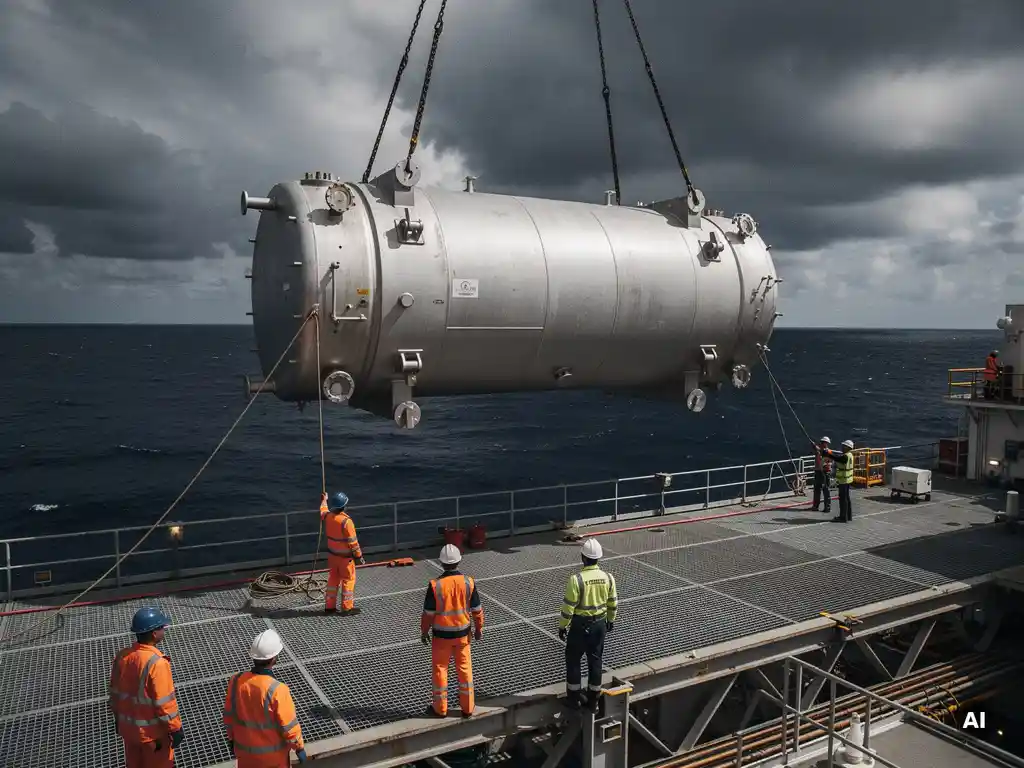
Installing heavy pressure vessels on offshore platforms is significantly more challenging than onshore work due to the combined constraints of limited deck space, restricted crane capacity, dynamic marine loads, and an aggressive corrosive environment. Every phase of the process, from fabrication through transport to final fit-up, carries risks that do not exist in a controlled onshore setting. The sections below address the most critical technical questions engineers and project teams face when planning offshore pressure vessel installation.
Why is lifting and rigging so difficult for heavy pressure vessels offshore?
Lifting and rigging heavy pressure vessels offshore is difficult because marine cranes operate under dynamic conditions, with vessel motion, wind loads, and wave-induced sway all affecting load stability. Unlike onshore lifts performed from fixed ground, offshore crane barges and platform cranes work from floating or compliant structures, which introduces variable load paths and reduces the maximum safe working load.
The geometry of offshore platforms compounds the problem. Deck layouts are congested, structural headroom is limited, and access routes are constrained by pipework, cable trays, and structural members. A pressure vessel that could be walked into position onshore may require a single-crane blind lift offshore, with no room for repositioning if the load swings.
Rigging design must account for the vessel’s centre of gravity, which on complex reactor vessels or shell-and-tube heat exchangers can shift significantly depending on nozzle arrangements and internal components. Trunnion and lug placement must be engineered during fabrication, not added as an afterthought, because offshore lifting loads can be far higher than static weight calculations suggest once dynamic amplification factors are applied.
What structural loads do heavy pressure vessels impose on offshore platforms?
Heavy pressure vessels impose static dead loads, dynamic operational loads, and seismic or wave-induced cyclic loads on offshore platform structures. The structural consequence of installing equipment weighing hundreds of tonnes on a platform designed to strict weight budgets is significant, and vessel weight is only part of the calculation.
Offshore structures must accommodate the following load categories from installed pressure equipment:
- Dead load: the dry weight of the vessel, including shell, heads, nozzles, and any permanently attached internals
- Operating load: vessel weight plus the weight of process fluid at maximum fill
- Wind and wave loads: lateral forces transferred through vessel supports and skirts to the deck structure
- Thermal loads: expansion and contraction forces transmitted through fixed and sliding support points
- Seismic loads: where applicable, horizontal accelerations that create overturning moments at the base
Platform structural engineers must verify that the deck framing, supporting columns, and foundation connections can carry the combined load envelope. Vessel support design, whether saddles, skirts, or lugs, must be coordinated between the vessel manufacturer and the platform structural team to ensure load transfer paths are compatible with the platform’s structural model.
How does marine transport affect pressure vessel integrity before installation?
Marine transport exposes pressure vessels to dynamic accelerations, vibration, humidity, salt spray, and temperature cycling before a single bolt is tightened on the platform. These transit conditions can damage nozzle flanges, deform thin-walled sections, introduce corrosion to machined surfaces, and compromise protective coatings if transport engineering is not treated as a critical project phase.
Heavy vessels transported by heavy-lift vessel or barge must be sea-fastened to resist the six degrees of vessel motion. Sea-fastening loads, particularly in roll and pitch, can produce forces that exceed the vessel’s own weight in certain directions. Temporary supports and sea-fastening structures must be designed using the transport route’s characteristic wave data, not generic assumptions.
Internally, any residual moisture trapped during fabrication or testing can cause corrosion during extended sea passages, particularly in vessels made from carbon steel with corrosion-resistant inner layers. Nitrogen blanketing or desiccant packs are common protective measures, but they require monitoring during transit. Nozzle covers, flange protectors, and instrument connection caps must be robust enough to survive the marine environment for the full voyage duration.
What material and corrosion challenges are unique to offshore pressure equipment?
Offshore pressure equipment faces a dual corrosion threat: external attack from the marine atmosphere and internal attack from the process fluid. The combination demands material selection and surface protection strategies that go well beyond what is required for equivalent onshore equipment operating in the same process service.
External marine corrosion is driven by chloride-laden air and intermittent wetting, which accelerates degradation of carbon steel surfaces, coating systems, and dissimilar metal interfaces. Crevice corrosion at support points, under insulation, and around nozzle penetrations is a persistent concern that must be addressed through both design geometry and material choice.
For process-side corrosion, offshore applications frequently involve sour service conditions, wet CO2, produced water with high chloride content, or combinations of these. These environments can require advanced pressure vessel materials such as duplex stainless steels, nickel alloys, titanium, or clad constructions that combine a structural carbon steel shell with a corrosion-resistant inner layer. Clad construction is particularly relevant offshore because it allows designers to achieve the structural strength needed for large vessels without specifying solid corrosion-resistant alloy throughout, which would be prohibitively heavy and expensive.
Hydrogen-induced cracking and sulphide stress cracking are additional concerns in sour service, governed by NACE MR0175 / ISO 15156, and material procurement, welding procedures, and post-weld heat treatment must all comply with these requirements from the earliest stages of fabrication.
Which international standards govern offshore pressure vessel installation?
Offshore pressure vessel installation is governed by a combination of pressure equipment design codes, offshore structural standards, and regional regulatory requirements. No single standard covers all aspects; project teams must identify the applicable code stack at the outset and ensure that fabrication, inspection, and installation all comply with the correct documents.
The primary standards and frameworks typically involved include:
- ASME VIII Division 1 or Division 2: the most widely recognised pressure vessel design and fabrication codes, specifying design rules, material requirements, welding qualifications, and inspection criteria
- PED (Pressure Equipment Directive) 2014/68/EU: the European regulatory framework for pressure equipment placed on the market in the EU, requiring conformity assessment and CE marking
- ISO 19902 / API RP 2A: offshore structural design standards that govern the platform structure to which vessels are attached
- NACE MR0175 / ISO 15156: material requirements for equipment in sour hydrocarbon service
- Flag state and classification society rules: for floating production units, the relevant classification society (DNV, Lloyd’s Register, Bureau Veritas, or ABS) imposes additional requirements on pressure equipment design, inspection, and documentation
Compliance with this layered framework requires that the vessel manufacturer holds the relevant certifications and that the inspection and documentation package is structured to satisfy all applicable authorities simultaneously. Gaps in certification or documentation discovered during offshore commissioning can cause costly delays.
How do dimensional tolerances affect the fit-up of large pressure vessels on offshore structures?
Dimensional tolerances directly determine whether a large pressure vessel can be connected to its supporting structure, process piping, and instrumentation without costly remedial work offshore. On a platform where access is restricted and modification work is expensive, a vessel that arrives with nozzle positions or support dimensions outside tolerance can delay an entire project.
Offshore platforms are fabricated in modules, often in different yards and different countries, before being integrated. Each module carries its own dimensional tolerances, and the cumulative effect of these tolerances at the interface where a vessel connects to platform piping or structure can be significant. Nozzle orientation, face-to-face dimensions, and support lug positions must be held to the tolerances specified in the piping and structural drawings, not simply to the vessel code’s general fabrication tolerances.
For large vessels, this means that dimensional control during fabrication is not just a quality checkpoint; it is a project risk management activity. Shell roundness, flange face flatness, nozzle projection, and support lug positioning all require controlled measurement at multiple stages during manufacture, with results documented and reviewed against the platform’s as-built survey data before the vessel is shipped.
The consequence of poor dimensional control is not limited to fit-up problems. Forced connections impose stress on nozzles and flanges that was not accounted for in the vessel’s design, potentially compromising the integrity of the pressure boundary. This is why dimensional accuracy in complex, large-scale pressure equipment is treated as a structural and safety requirement, not merely a workmanship standard.
How Coek supports offshore pressure vessel projects
Coek Engineering manufactures custom pressure vessels and related equipment for technically demanding applications where standard fabrication is insufficient. For offshore and marine-related projects, Coek’s capabilities are directly relevant to the challenges described above:
- Large-scale fabrication: equipment up to 10 metres in diameter, 100 metres in length, and approximately 1,000 tonnes, covering the dimensional range of most offshore vessel requirements
- Advanced materials and clad construction: extensive experience with titanium, zirconium, Hastelloy, Inconel, and clad combinations of carbon steel with corrosion-resistant inner layers, suited to sour service and marine corrosion environments
- Precision dimensional control: fabrication processes designed to hold the tight tolerances that offshore fit-up demands across large and complex vessel geometries
- International certifications: ISO 9001, PED, and ASME certifications supporting compliance with the multi-standard regulatory environment typical of offshore projects
- In-house mechanical engineering: translation of process and installation requirements into mechanically sound, manufacturable equipment, coordinated with lifting, transport, and structural interface requirements
If your project involves heavy pressure equipment for an offshore or technically demanding application, contact Coek Engineering to discuss your requirements with our engineering team.
Frequently Asked Questions
How early in a project should lifting and rigging engineering begin for an offshore pressure vessel?
Lifting and rigging engineering should begin during the vessel’s detailed design phase, before fabrication starts. Trunnion and lifting lug positions must be integrated into the vessel’s structural design to handle offshore dynamic amplification factors, which can significantly exceed static weight. Waiting until fabrication is complete to plan the lift is one of the most common and costly mistakes on offshore projects, often requiring expensive retrofits or compromising the vessel’s structural integrity.
What is the typical weight budget process for adding a new pressure vessel to an existing offshore platform?
Adding a pressure vessel to an existing platform requires a formal weight and centre of gravity study, often called a weight control review, conducted by the platform’s structural engineer. The study assesses the vessel’s dead load, operating load, and dynamic loads against the platform’s remaining structural capacity and any weight margins built into the original design. If the platform is near its weight limit, options include structural reinforcement, removing or relocating other equipment, or redesigning the vessel to reduce weight through material optimisation or clad construction.
How do you protect a pressure vessel's internal surfaces during a long sea voyage to an offshore installation site?
The most reliable methods include nitrogen blanketing to displace oxygen and prevent internal corrosion, combined with desiccant packs placed inside the vessel before all nozzles are sealed. All nozzle flanges, instrument connections, and open penetrations must be fitted with robust, weatherproof covers rated for marine exposure, not standard plastic caps. A monitoring plan should also be in place for extended voyages, allowing crew to verify nitrogen pressure or desiccant condition at defined intervals during transit.
What are the most common dimensional fit-up problems found when large pressure vessels arrive offshore, and how can they be avoided?
The most frequent issues are nozzle orientation errors, nozzle projection outside tolerance, and support lug positions that do not match the platform’s as-built survey. These problems typically arise when the vessel is fabricated against design drawings without being checked against the platform’s actual measured dimensions. The solution is to obtain the platform’s as-built survey data before the vessel is shipped and perform a dimensional reconciliation between the vessel’s measured dimensions and the platform interface points, resolving any conflicts while the vessel is still accessible in the fabrication yard.
Can standard onshore pressure vessel manufacturers supply equipment for offshore projects, or is specialist experience required?
While an onshore manufacturer may hold the necessary pressure vessel codes such as ASME VIII or PED, offshore projects impose additional requirements that go beyond standard fabrication competence. These include experience with sour service materials and NACE MR0175 compliance, integrated lifting and sea-fastening engineering, classification society approval processes, and dimensional control programmes aligned with offshore fit-up tolerances. Engaging a manufacturer without this specific experience significantly increases the risk of non-conformances, documentation gaps, and costly delays during offshore commissioning.
What role do classification societies play in offshore pressure vessel projects, and when should they be engaged?
For floating production units such as FPSOs, FLNGs, and semi-submersibles, the relevant classification society (DNV, Lloyd’s Register, Bureau Veritas, or ABS) acts as the technical authority overseeing pressure equipment design, fabrication inspection, and documentation. They should be engaged at the very start of the project, ideally during the design phase, so that their specific requirements are incorporated into the vessel’s design basis and the manufacturer’s inspection and test plan. Late engagement frequently results in design rework, additional inspection hold points, and documentation revisions that delay equipment release.
What is clad construction, and when is it the preferred solution for offshore pressure vessels over solid alloy construction?
Clad construction combines a structural carbon steel shell with a metallurgically bonded or weld-overlaid inner layer of corrosion-resistant alloy such as duplex stainless steel, Inconel, or titanium. It is preferred over solid alloy construction when the vessel must be large enough that building it entirely from an expensive corrosion-resistant alloy would result in prohibitive cost and weight, both critical constraints offshore. Clad vessels deliver the corrosion resistance needed for aggressive process fluids like sour gas or produced water while keeping the overall vessel weight and material cost within the limits that offshore projects demand.
Related Articles
- How do you ensure material traceability during pressure vessel manufacturing?
- What safety systems are required for high-pressure industrial autoclaves?
- What documentation is required when delivering certified pressure equipment?
- How do you verify the integrity of a clad layer in a pressure vessel after fabrication?
- How do you manage thermal expansion in large high-temperature reactor vessels?