
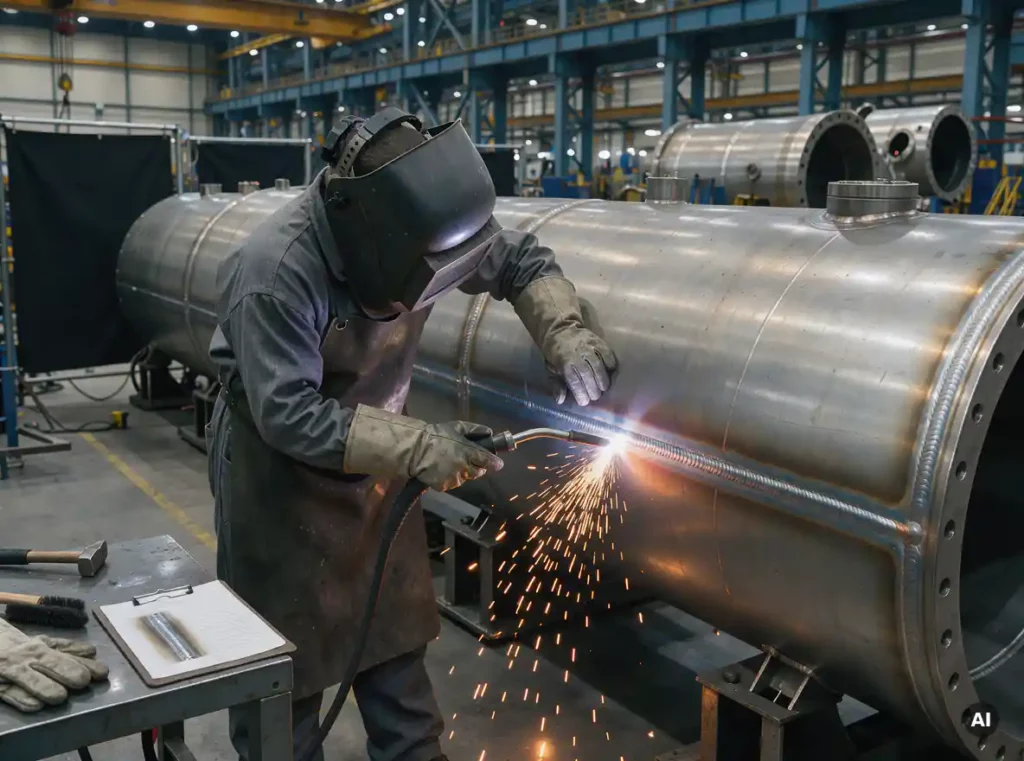
Welding procedure qualifications are important for exotic-metal reactors because they prove, before production starts, that a specific welding method produces joints with the strength, ductility and corrosion resistance the design requires. With titanium, zirconium, tantalum, Hastelloy and Inconel, small deviations can ruin a weld without any visible sign. Qualification removes that risk.
For EPC contractors, technology owners and equipment engineers, a documented procedure qualification is also the foundation of code compliance and long-term reliability. The sections below answer the most common questions buyers ask about it.
What must a welding procedure qualification prove for exotic alloys?
A welding procedure qualification must prove that a defined set of welding variables consistently produces a joint that meets mechanical, metallurgical and corrosion requirements. The test weld is made, examined and tested, and the results are recorded in a Procedure Qualification Record (PQR) that supports the Welding Procedure Specification (WPS).
For standard carbon steel, strength and toughness are usually the main concerns. For exotic alloys, the qualification has to go further. Depending on the material and service, a qualification typically needs to demonstrate:
- Tensile strength and bend ductility that match the base material requirements
- Sound weld metal, confirmed by visual, penetrant and volumetric examination
- Acceptable hardness and microstructure, where the material is sensitive to heat input
- Corrosion performance, where the service environment demands it
- Repeatability within defined ranges for current, travel speed, interpass temperature and shielding
The distinction between the two documents matters. The PQR is the factual record of what was welded and tested. The WPS is the instruction welders follow in production, and it must stay within the limits the PQR supports.
How do titanium and zirconium welds differ from steel welds?
Titanium and zirconium welds differ from steel welds mainly because both metals react aggressively with oxygen, nitrogen and hydrogen at elevated temperatures. Contamination makes the weld brittle and reduces corrosion resistance, so these metals require full inert gas protection and extreme cleanliness. Steel is far more forgiving.
Several practical differences follow from this reactivity:
- Shielding extends beyond the arc. Trailing shields and back purging protect the weld and the cooling heat-affected zone until the metal is cool enough to resist pickup of gases.
- Colour is a diagnostic. A bright silver or light straw weld indicates good protection. Blue, grey or white discolouration signals contamination and usually means rework.
- Cleanliness is part of the procedure. Oils, fingerprints, dust and cross-contamination from steel tooling can compromise a weld, so dedicated tools and controlled fabrication areas are standard practice.
- Filler and base metal grades must match the intent. Titanium grades such as Grade 2 or Grade 17 and zirconium alloys behave differently, so a procedure cannot casually be transferred between them.
Because the failure mode is often invisible at first glance, the qualification has to capture shielding gas purity, flow rates, purge arrangements and cleaning steps as controlled variables.
Which codes govern welding procedure qualification for pressure equipment?
The main codes governing welding procedure qualification for pressure equipment are ASME Section IX for equipment built to ASME rules and the European Pressure Equipment Directive (PED), which relies on harmonised standards such as the EN ISO 15614 series for procedure approval. The applicable code depends on the design code and the installation location.
ASME Section IX defines welding variables, the tests required and the range of qualification. It groups materials by P-number and filler metals by F-number and A-number, which determines how far one qualification can be extended to other materials and thicknesses.
PED and EN standards require welding procedures to be approved by a competent body or a recognised third party for the higher equipment categories. The approval covers the procedure, the welders and the operators, and ties into the manufacturer’s quality system.
Some projects require compliance with both frameworks, plus customer specifications that add further requirements such as extra hardness testing, impact testing or corrosion testing. When that happens, the most demanding requirement usually drives the qualification scope. Buyers should confirm early which code combination applies, because it directly shapes the testing program.
What can go wrong with weld procedures on Hastelloy and Inconel?
On Hastelloy and Inconel, the most common problems are hot cracking, loss of corrosion resistance from excessive heat input and unwanted secondary phases. Nickel alloys tolerate welding well when parameters are controlled, but they are far less forgiving of poor technique or contamination than stainless steel.
The typical failure points include:
- Hot cracking and microfissuring. Nickel alloys have high thermal expansion and low thermal conductivity, and contaminants such as sulphur, lead or phosphorus can trigger cracking during solidification.
- Excessive heat input or interpass temperature. Too much heat can promote precipitation of harmful phases in the weld or heat-affected zone, reducing corrosion resistance exactly where it is needed.
- Incorrect filler selection. Matching or overmatching filler is often required to preserve corrosion performance, and a filler that is acceptable mechanically may still corrode preferentially.
- Surface contamination. Marking paints, lubricants and carbon steel dust can all cause defects or localised corrosion later in service.
- Distortion and restraint. Thick sections welded under restraint can develop stresses that contribute to cracking.
A well-run qualification fixes the heat input window, interpass limits and cleaning requirements so these risks stay controlled across production, not only on the test coupon.
How are clad reactor welds qualified differently?
Clad reactor welds are qualified differently because a single joint involves two materials: a carbon or low-alloy steel backing layer and a corrosion-resistant inner layer. Each layer needs its own procedure, and the interface between them must be restored without mixing the layers in a way that compromises corrosion resistance.
The typical approach is sequential. The structural backing material is welded first with a procedure suited to the steel. The cladding is then restored over the joint, often with a transition or buffer layer and a final corrosion-resistant layer. The key qualification concerns are:
- Dilution control. If iron from the backing steel dilutes the corrosion-resistant layer, the weld surface may not perform like the specified alloy.
- Bond integrity. The cladding bond near the weld must not be damaged by heat, and ultrasonic examination is commonly used to verify it.
- Strip and overlay procedures. Where the clad layer is removed near the joint and rebuilt, the restoration welding needs its own qualification.
- Explosion-clad specifics. Explosion-bonded titanium or zirconium on steel needs particular care because the metals are not weld-compatible, so restoration relies on carefully designed joint details rather than direct fusion.
Because the design details are tied to the cladding system, clad procedure qualifications are rarely interchangeable between projects with different material combinations.
How can buyers verify a fabricator’s welding qualifications?
Buyers can verify a fabricator’s welding qualifications by requesting the WPS and supporting PQR documents, checking welder and operator qualification records and confirming the quality certifications that apply to the project, such as ISO 9001, PED and ASME. Independent inspection review adds further assurance.
A practical verification checklist includes:
- Procedure documents that cover the exact material grades, thickness ranges and joint types in the project
- Records showing the qualification was witnessed or approved by an authorised inspector or notified body
- Welder qualification certificates that are current and relevant to the alloy, not only to steel
- Evidence of experience with the specific material family, such as titanium, zirconium, tantalum or nickel alloys
- A quality plan that links each weld to its procedure, inspection method and acceptance criteria
- Clear traceability of filler metals, shielding gases and base materials
It is also worth asking how the fabricator controls cleanliness and shielding in practice. A strong paper qualification means little if the shop environment cannot support it. A visit to the workshop, or a review of previous test coupons, often reveals more than certificates alone.
Do new qualifications affect project schedule and cost?
Yes, new welding procedure qualifications affect both schedule and cost, because test welds, material, testing and approval take time and resources before production welding can begin. The impact is usually modest compared with the cost of weld failures, rework or repairs in exotic materials.
The main factors that influence the effort are:
- Whether existing qualifications already cover the material, thickness and process
- The cost and lead time of exotic base material and filler for test coupons
- The scope of testing required by the code and customer specification
- Availability of the inspector or notified body for witnessing and approval
The most effective way to protect the schedule is to identify qualification needs during the tender and engineering phase, not after contract award. Early alignment on material grades, joint designs and applicable codes lets qualification run in parallel with design and procurement. Considering lifecycle value, a properly qualified procedure usually costs far less than the downtime and repairs that follow from a weld that fails in service.
How Coek helps with welding procedure qualification for exotic-metal reactors
Coek Engineering fabricates custom reactors in titanium, zirconium, tantalum, Hastelloy and clad constructions, so procedure qualification is part of how every project is prepared. Customer process requirements are translated into mechanically sound, manufacturable equipment, with welding methods defined and qualified before production begins.
- In-house mechanical engineering aligned with ASME, PED and customer specifications
- More than 30 years of experience with clad construction
- Fabrication of thick-walled, heavy and first-of-a-kind equipment up to approximately 10 m in diameter
- ISO 9001, PED and ASME certifications, backed by in-house and independent inspection
- Integrated scope, including agitators, drive systems and seals where required
If you are planning a reactor in exotic or clad materials and want to confirm the welding and qualification approach early, contact our engineering team to discuss your specifications.
Frequently Asked Questions
How do I get started defining welding qualification requirements for a new exotic-metal reactor?
Begin by listing the base material grades, thickness ranges, joint types and the governing design code (ASME, PED or both) in your user requirement specification. Add any service-specific needs, such as corrosion testing or hardness limits, and share them with the fabricator during the tender stage. This lets the fabricator check which existing PQRs apply and which new qualifications must be scheduled in parallel with design and procurement.
Can an existing PQR for one titanium or nickel alloy be used for a different grade?
Only within the limits set by the applicable code. ASME Section IX groups materials by P-number and filler by F-number and A-number, which defines how far a qualification can be extended. Even within those groupings, customer specifications or corrosion requirements may demand a separate qualification, so always have the fabricator and the authorised inspector confirm coverage in writing before relying on an existing PQR.
What should I do if a titanium or zirconium weld shows discolouration during production?
Stop welding and assess the colour: bright silver or light straw is generally acceptable, while blue, grey or white indicates contamination. Discoloured welds typically must be removed and redone, not cosmetically cleaned. Then investigate the root cause, such as purge gas flow, trailing shield coverage, leaks in the purge setup or poor cleaning, and correct it before restarting, documenting the corrective action in the quality records.
Is a qualified welding procedure enough, or do welders also need to be qualified for exotic alloys?
Both are needed. The procedure qualification proves the method works, while welder and operator qualifications prove the individuals can execute it. A welder certified on carbon or stainless steel is not automatically qualified for titanium, zirconium or nickel alloys, so ask for current certificates that are relevant to the specific alloy and process.
Which non-destructive tests are typically specified for exotic-alloy reactor welds in production?
Visual and penetrant testing are almost always applied, and radiographic or ultrasonic examination is added depending on the code, equipment category and joint criticality. For clad reactors, ultrasonic testing is also commonly used to verify cladding bond integrity near welds. Define the extent and acceptance criteria in the quality plan before fabrication begins so there are no disputes later.
What are common mistakes buyers make when reviewing welding documentation?
A frequent mistake is accepting generic procedures that do not cover the project’s exact material grades, thickness ranges or joint designs. Another is checking paperwork without verifying shop practices such as cleanliness controls, dedicated tooling and filler traceability. Reviewing sample test coupons, witnessing a qualification weld or visiting the workshop helps close these gaps.
How can I avoid schedule delays caused by new welding qualifications?
Raise qualification needs during tender and engineering, and order test coupon material and filler early since exotic alloys often have long lead times. Confirm inspector or notified body availability for witnessing, and agree on the code combination and testing scope up front. Running qualification in parallel with detailed design and procurement usually keeps it off the critical path.
Related Articles
- What is the difference between process design and mechanical design for a chemical reactor?
- How do you choose between a fixed tube sheet, U-tube and floating head heat exchanger?
- How do you prevent stress corrosion cracking in pressure vessel materials?
- What factors determine the design life of an industrial autoclave?
- What is clad construction in pressure vessel manufacturing?