
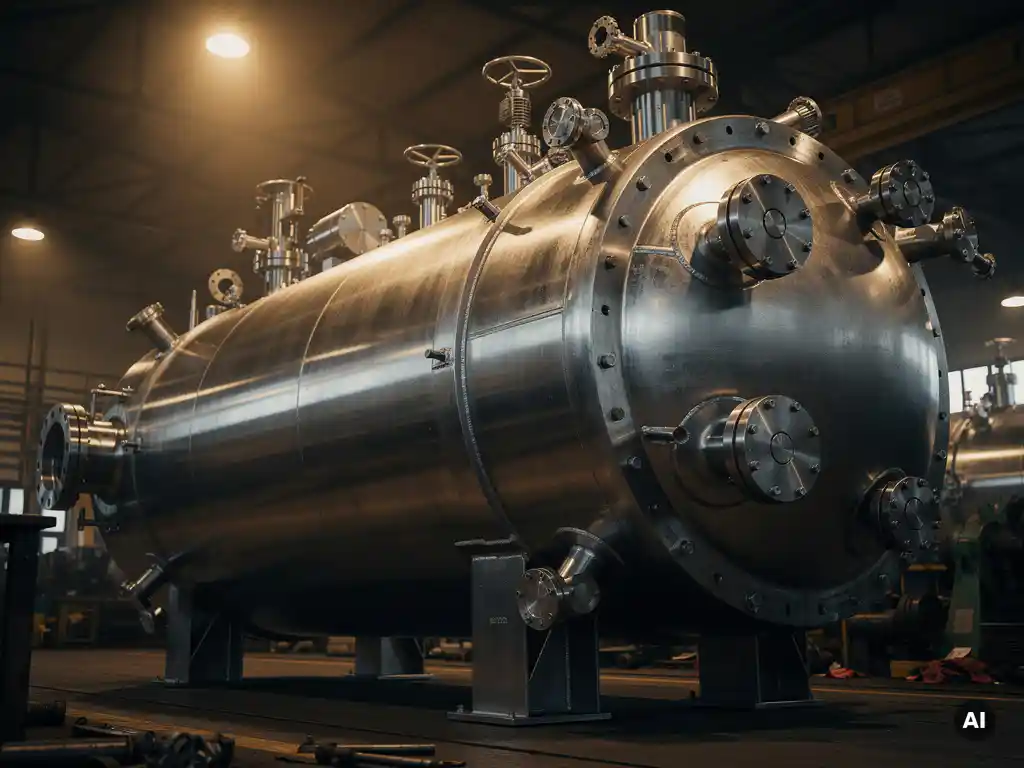
A high-pressure autoclave reactor is a sealed, pressure-rated vessel designed to carry out chemical or physical processes under elevated pressure and temperature, often in combination with reactive media or corrosive substances. Unlike standard pressure vessels that simply contain a medium, an autoclave reactor actively facilitates a controlled reaction inside the vessel. These units are used across a wide range of technically demanding industries where conventional open or low-pressure equipment cannot achieve the required process conditions.
The sections below address the most common technical questions about high-pressure autoclave reactors, from how they work to the engineering challenges involved in building them.
How does a high-pressure autoclave reactor actually work?
A high-pressure autoclave reactor works by creating a sealed, controlled environment in which temperature, pressure and chemical conditions can be precisely maintained throughout a reaction cycle. The vessel is charged with reactants, sealed, and then brought to the required operating conditions using internal or external heating, pressurisation systems and, in many cases, agitation to ensure uniform mixing.
The core principle is containment combined with control. Because the vessel is fully sealed, pressure builds as temperature increases or as gases are introduced, enabling reactions that would not occur at atmospheric conditions. Internal components such as agitators, baffles, dip tubes or heating coils are often integrated to support the specific process requirements.
Once the reaction is complete, the vessel is depressurised and cooled in a controlled sequence before the product is discharged. This cycle-based operation distinguishes autoclave reactors from continuous-flow reactors, though some autoclave designs support semi-continuous processes.
What industries use high-pressure autoclave reactors?
High-pressure autoclave reactors are used in any industry where reactions or processes require elevated pressure, high temperature or chemically aggressive conditions that cannot be handled in standard open equipment. Common application areas include chemical processing, polymer production, hydrometallurgy, specialty materials manufacturing and pharmaceutical synthesis.
Industries that regularly rely on industrial autoclaves and autoclave reactors include:
- Chemical and petrochemical processing, for reactions requiring high-pressure hydrogen, elevated temperatures or corrosive reagents
- Polymer and plastics manufacturing, including polymerisation processes for materials such as polypropylene
- Hydrometallurgy and mining, for pressure oxidation and leaching of ores in aggressive acidic or alkaline environments
- Specialty materials and composites, for curing, bonding or densification processes under controlled pressure
- Pharmaceutical and fine chemical production, for synthesis routes that require precise pressure and temperature control
- Research and pilot-scale development, where process conditions need to be replicated at controlled scale before full production
The common denominator across these industries is the need for reliable containment of aggressive or high-energy process conditions, which places significant demands on both the design and the fabrication quality of the equipment.
What’s the difference between an autoclave reactor and a standard pressure vessel?
The key difference between an autoclave reactor and a standard pressure vessel is function. A standard pressure vessel stores or transports a pressurised medium, while an autoclave reactor is engineered to actively support and control a process or reaction occurring inside it. This functional difference drives significant differences in design complexity, internal configuration and materials selection.
A standard pressure vessel is primarily a containment structure. An autoclave reactor, by contrast, typically incorporates internal mechanical systems such as agitators, drive assemblies, heating or cooling coils, baffles and instrumentation penetrations. These elements must be designed to operate reliably under the same demanding conditions as the vessel shell itself.
Autoclave reactors also tend to operate across a wider range of temperatures and pressures within a single cycle, and they frequently handle corrosive or reactive media that demand advanced materials or clad construction. The result is a considerably more complex piece of equipment from both an engineering and a fabrication standpoint.
What materials are used to build high-pressure autoclave reactors?
The materials used to build a high-pressure autoclave reactor depend on the operating pressure, temperature and the chemical nature of the process media. Carbon steel is used where conditions permit, but many autoclave reactor applications involve corrosive substances that require corrosion-resistant alloys or clad construction to ensure long-term integrity.
Commonly specified materials include:
- Carbon steel, for structural integrity in less corrosive applications
- Stainless steel, for moderate corrosion resistance and cleanliness requirements
- Titanium, for highly corrosive environments, particularly in hydrometallurgy and chemical processing
- Zirconium, for extreme chemical resistance in aggressive acid environments
- Hastelloy and Inconel, nickel-based alloys suited to high-temperature and highly corrosive conditions
- Tantalum, for exceptional resistance to specific aggressive media
- Clad construction, a carbon steel shell with a corrosion-resistant inner layer, combining structural strength with chemical resistance at a reduced material cost
Clad construction is particularly relevant for large autoclave reactors where a solid exotic alloy construction would be prohibitively heavy or expensive. Selecting the right material combination requires a thorough understanding of the process chemistry, operating cycles and long-term corrosion mechanisms.
How large can a high-pressure autoclave reactor be?
High-pressure autoclave reactors can reach very substantial dimensions in demanding industrial applications. Vessel diameter, length and total weight are all determined by the process volume required, and for large-scale industrial processes, these figures can be considerable. In the most demanding projects, autoclave vessels can approach 1,000 tons in weight.
Manufacturing equipment at this scale requires purpose-built facilities, heavy lifting equipment, specialised welding capabilities and the ability to transport oversized loads. Not all pressure equipment manufacturers have the infrastructure to fabricate at this size, which is why large-scale autoclave projects are typically directed to a small number of specialist manufacturers.
The physical scale of the vessel also amplifies engineering challenges. Thick-walled construction at large diameters introduces complex residual stress behaviour, welding constraints and dimensional tolerance requirements that demand experienced mechanical engineering and quality control throughout fabrication.
What are the main design and engineering challenges for autoclave reactors?
Designing and engineering a high-pressure autoclave reactor involves solving a combination of structural, materials and mechanical challenges simultaneously. No single factor dominates; the difficulty lies in integrating all requirements into a vessel that is safe, manufacturable and fit for its intended service life.
Key engineering challenges include managing wall thickness in large-diameter vessels, where the combination of high pressure and large size results in very thick shells that require careful control of welding procedures, heat treatment and post-weld inspection. Ensuring dimensional accuracy across long or heavy vessels adds further complexity.
Internal mechanical systems, particularly agitators and drive assemblies, must be designed to operate reliably under the same elevated pressure and temperature conditions as the vessel itself. Sealing systems at shaft penetrations are a critical design point, as any failure represents both a safety and a process integrity risk.
Corrosion management is another central challenge. When the process medium is aggressive, the engineer must select materials or cladding systems that provide adequate resistance across the full range of operating conditions, including startup, shutdown and any upset scenarios. For clad vessels, the bond integrity between the base material and the corrosion-resistant layer must be verified and maintained throughout fabrication.
Finally, compliance with applicable pressure equipment standards and the documentation requirements of international certification bodies adds a layer of engineering and quality management work that must be planned from the earliest design stages.
What certifications and standards apply to high-pressure autoclave reactors?
High-pressure autoclave reactors are subject to pressure equipment regulations and design codes that vary by region and application. The applicable standard is determined by where the equipment will be installed and operated, and in some cases by the requirements of the technology owner or EPC contractor specifying the equipment.
The most widely referenced standards include:
- PED (Pressure Equipment Directive), the European Union regulatory framework governing the design, manufacture and conformity assessment of pressure equipment placed on the EU market
- ASME Boiler and Pressure Vessel Code (BPVC), the American standard, widely specified internationally for pressure vessels and reactors, particularly in projects involving US technology owners or EPC contractors
- ISO 9001, the quality management system standard, which underpins the documented quality processes required throughout design, fabrication and inspection
- National standards and local regulations, many countries have their own pressure equipment regulations that must be met in addition to or instead of the above
Compliance with these standards requires documented design calculations, material traceability, qualified welding procedures, non-destructive examination and, in most cases, third-party inspection by a notified body or authorised inspection authority. The certification process must be planned from the outset, as it influences design decisions, material selection and fabrication sequencing.
How Coek supports high-pressure autoclave reactor projects
Coek Engineering manufactures custom industrial autoclaves and autoclave reactors for technically demanding applications where standard fabrication is not sufficient. Projects handled by Coek typically involve one or more of the following:
- Large dimensions, high vessel weight or thick-walled construction
- Advanced or exotic materials including titanium, zirconium, Hastelloy, Inconel and tantalum
- Clad construction combining structural carbon steel with a corrosion-resistant inner layer
- Integrated mechanical scope including agitators, drive systems, seals and instrumentation
- Compliance with PED, ASME and ISO 9001 certification requirements
- In-house mechanical engineering to translate process requirements into manufacturable equipment
Coek works with EPC contractors, technology owners and industrial end users who need a fabrication partner capable of handling the full complexity of a critical autoclave reactor project. To discuss your specific requirements, contact the Coek team directly.
Frequently Asked Questions
How do I determine the right operating pressure and temperature ratings for my autoclave reactor?
The operating pressure and temperature ratings must be derived from your specific process chemistry, reaction kinetics and safety margins — not selected arbitrarily. The starting point is a thorough process definition, including maximum expected pressures, temperature peaks during exothermic reactions and any pressure excursions during upset conditions. A qualified mechanical engineering team will then apply the relevant design code (such as ASME BPVC or PED) to translate those process parameters into certified design ratings, wall thicknesses and material specifications.
What is clad construction and when should I specify it over solid alloy construction?
Clad construction uses a structural carbon steel shell as the load-bearing base, with a bonded inner layer of a corrosion-resistant alloy such as titanium, zirconium or Hastelloy providing the chemical resistance. It is typically the preferred choice when the vessel is large enough that fabricating the entire shell from a solid exotic alloy would result in prohibitive weight, cost or fabrication difficulty. For smaller vessels or applications with extreme chemical severity across all surfaces, solid alloy construction may be more appropriate — the right choice depends on vessel size, process chemistry and total lifecycle cost.
What are the most common mistakes made when specifying an autoclave reactor for a new process?
One of the most frequent mistakes is under-specifying the process conditions by only accounting for steady-state operation and overlooking startup, shutdown and upset scenarios, which can expose the vessel to more aggressive conditions than the design accounts for. Another common error is selecting materials based on cost alone without fully evaluating long-term corrosion behaviour under the actual process chemistry. Engaging your fabricator’s engineering team early in the specification process — before design is frozen — helps avoid costly changes later and ensures the vessel is correctly sized, rated and materialised from the outset.
How long does it typically take to design and fabricate a custom high-pressure autoclave reactor?
Lead times for custom high-pressure autoclave reactors vary significantly depending on vessel complexity, size, material availability and certification requirements, but industrial-scale projects commonly range from several months to over a year from order placement to delivery. Large vessels requiring exotic alloys or clad construction, integrated mechanical systems and full ASME or PED certification tend to sit at the longer end of that range. Early engagement with your fabricator is critical, as material procurement — particularly for exotic alloys — and third-party inspection scheduling can drive the overall timeline.
Can an existing autoclave reactor be modified or re-rated for a different process or higher operating conditions?
In principle, yes — but any modification or re-rating of a pressure vessel must be treated as a full engineering exercise, not a straightforward upgrade. The original design calculations must be reviewed against the proposed new conditions, and the existing materials, welds and internal components must be assessed for suitability. Depending on the extent of the changes and the applicable certification standard, new calculations, additional inspection, re-testing and updated certification documentation may all be required before the vessel can be legally and safely returned to service.
What inspection and non-destructive examination (NDE) methods are typically used during autoclave reactor fabrication?
The NDE methods applied during fabrication depend on the applicable design code, the materials used and the criticality of the welds, but commonly include radiographic testing (RT) or ultrasonic testing (UT) of pressure-containing welds, dye penetrant testing (PT) or magnetic particle testing (MT) for surface defect detection, and ultrasonic bond testing for clad construction to verify layer integrity. Hydrostatic pressure testing is typically the final verification step before the vessel is released for service. All examination results must be documented and reviewed by a qualified inspector, and in most cases witnessed or audited by a notified body or authorised inspection authority.
How should I evaluate and select a fabricator for a critical autoclave reactor project?
Beyond price, the key criteria for selecting a fabricator for a critical autoclave reactor are demonstrated experience with comparable vessel complexity, in-house engineering capability, certified welding procedures for the specified materials, and a track record of delivering under the required certification standard — whether ASME, PED or both. It is worth asking for references from similar projects and assessing whether the fabricator has the physical infrastructure — crane capacity, workshop size, heat treatment facilities — to handle your vessel’s dimensions and weight. For highly complex projects, a fabricator who can manage the full scope from engineering through to certified delivery reduces interface risk considerably.
Related Articles
- What are the sizes of autoclaves available?
- How do you size a pressure vessel for a high-pressure application?
- How do you prevent stress corrosion cracking in pressure vessel materials?
- How do you verify the integrity of a clad layer in a pressure vessel after fabrication?
- What non-destructive testing methods apply to thick-walled pressure equipment?