
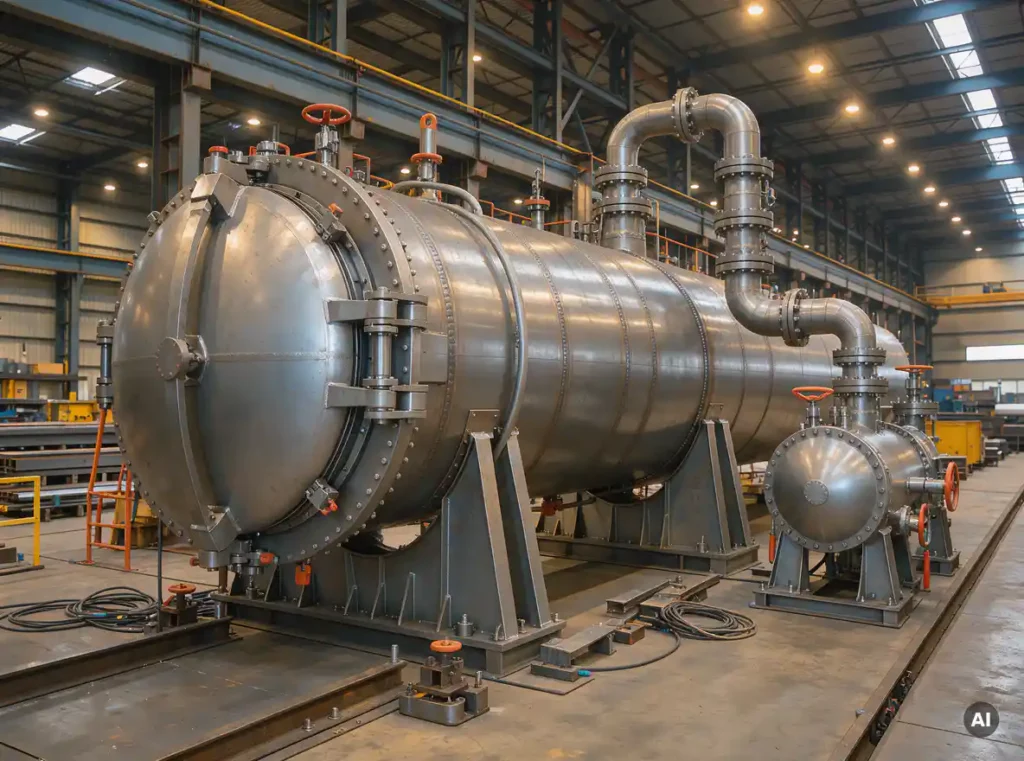
What happens to slurry during autoclave pressure letdown?
During pressure letdown, hot slurry leaves the autoclave at high pressure and is rapidly depressurized, usually through letdown valves, chokes or flash vessels. As pressure falls, part of the liquid flashes into steam, which sharply increases velocity and turbulence in the stream that carries abrasive solids. This is the root of most letdown problems. Before the pressure drop, the slurry is a dense, hot, acidic liquid carrying fine solids. After it, the stream is a two-phase mixture of steam, liquid and particles moving at much higher speed. Velocity rises, local turbulence increases, and the temperature and acidity that the autoclave was built to contain are still present. Three effects combine in the letdown path:- Flashing: steam generation expands the volume of the stream and accelerates it.
- Solids impact: particles travel faster and strike surfaces at higher energy.
- Chemical attack: hot acidic liquor continues to remove protective oxide films from metal surfaces.
Where do letdown systems erode and corrode first?
Letdown systems usually wear first at the points where velocity and turbulence peak: the valve trim and seats, the piping immediately downstream of the valve, bends and the inlet zone of the flash vessel. Corrosion typically accelerates there because erosion strips away the protective film that normally limits attack. The most common high-wear locations include:- Letdown valve or choke trim, where the pressure drop is concentrated
- The first section of pipe after the valve, where the flashing jet is least stable
- Elbows and reducers that change flow direction
- The flash vessel inlet, impingement plates and the wall opposite the inlet nozzle
How does autoclave discharge design affect letdown performance?
Autoclave discharge design affects letdown performance because it sets the starting conditions for the entire downstream train: slurry velocity, flow stability, solids distribution and the amount of disturbance entering the first valve. A poorly shaped discharge nozzle or uneven outflow carries into the letdown line as turbulence and unpredictable wear. Several discharge details deserve attention at the design stage:- Nozzle size and orientation: they influence exit velocity and how cleanly the stream enters the piping.
- Internal approach geometry: abrupt changes inside the vessel can create swirl or dead zones that feed uneven flow to the discharge.
- Distance and routing to the first letdown stage: short, smooth runs with minimal direction changes reduce impingement points.
- Staged pressure reduction: spreading the drop across several stages lowers peak velocity at any single point.
Which materials suit autoclave and letdown components?
Suitable materials depend on the slurry chemistry, temperature and erosion duty, and the autoclave and letdown components often need different solutions. Titanium and titanium-clad construction are widely used for autoclave shells in HPAL and POX, while letdown trim often needs harder, more erosion-resistant materials chosen for the local conditions. Autoclaves in acidic mining service are commonly built as carbon steel pressure shells with a corrosion-resistant lining. Titanium grades such as Ti Grade 17 have been used as lining material in nickel, cobalt and gold autoclaves. This combination provides structural strength from the steel and corrosion protection from the titanium at a more practical cost than a solid exotic alloy shell. Letdown components face a different problem. The dominant mechanism is usually erosion combined with corrosion, so material selection weighs hardness, toughness and corrosion behavior together. Ceramic, hardened or specially coated trim options are often considered alongside corrosion-resistant alloys. Two points keep material choices sound:- Choose materials for the actual slurry and velocity, not only for static corrosion data.
- Check compatibility at the interfaces, where dissimilar materials meet, flange faces are lined or cladding transitions occur.
How does fabrication quality influence discharge system reliability?
Fabrication quality influences discharge system reliability because the discharge nozzle, lining joints and weld transitions are where flow disturbance, crevices and stress concentrate. Smooth weld profiles, accurate nozzle alignment, sound cladding bonds and controlled dimensions help the design perform as calculated rather than failing at its weakest detail. In a high-velocity abrasive stream, small imperfections matter. A weld bead that protrudes slightly into the flow, a misaligned flange or a poorly finished lining joint can create a local turbulence point. Erosion then concentrates there and a localized failure develops long before the rest of the system is worn. Fabrication factors that matter most in discharge zones include:- Weld quality and internal surface finish at nozzles and lining seams
- Bonding integrity of clad or lined surfaces, especially around openings
- Dimensional accuracy of nozzle positions and flange faces
- Controlled fit-up so lined components match without forced alignment
When should the autoclave and letdown scope be combined?
The autoclave and letdown scope should be combined whenever the discharge conditions are severe, the materials are demanding or the interface between the vessel and the first letdown stage carries significant risk. Combining scope gives one party responsibility for compatibility, rather than leaving gaps between separate suppliers. Combining scope is especially valuable in these situations:- High solids content or highly abrasive slurry
- Large pressure drops that produce heavy flashing
- Exotic or clad materials where interface details are critical
- Projects where the schedule leaves little room for rework after commissioning
How Coek helps with autoclave and letdown engineering
Coek designs and fabricates custom mining autoclaves for demanding HPAL and POX duty, with the mechanical engineering and fabrication expertise needed to treat the discharge zone as part of the whole. Process requirements come from the customer, EPC contractor or technology owner, and Coek translates them into mechanically sound, manufacturable equipment. Relevant support includes:- Titanium and titanium-clad autoclave construction, with experience from large autoclaves approaching 1,000 tons
- Mechanical design to ASME and other international codes, with FEA and other supplementary analyses where needed
- Design details developed to address erosion experienced in the field
- Precision fabrication of thick-walled, heavy and clad equipment
- Integrated equipment scope where related mechanical components belong with the vessel
Frequently Asked Questions
How do I get started with reviewing the autoclave discharge and letdown interface on a new project?
Start by assembling a shared design basis that lists slurry solids content, particle size and hardness, temperature, acidity, flow rate and the pressure drop required. Then hold a joint review between the autoclave designer, letdown valve supplier and the EPC or technology owner to agree on velocity limits, nozzle details and who owns the transition. Doing this at the early engineering stage is far cheaper than redesigning after commissioning.
What are the early warning signs that a letdown system is eroding faster than expected?
Common signs include a drifting valve position needed to hold the same pressure or flow, increasing noise or vibration downstream of the valve, and unexplained changes in flash vessel pressure or temperature. Ultrasonic thickness readings on the first pipe section, elbows and the flash vessel inlet zone will confirm wall loss before a leak occurs. Trending these measurements at each shutdown helps you predict replacement intervals rather than react to failures.
Can I just use a more corrosion-resistant alloy to solve letdown wear?
Not usually, because the dominant mechanism is combined erosion and corrosion rather than corrosion alone. A highly corrosion-resistant alloy can still lose its protective film under high-velocity particle impact and wear quickly. Effective solutions balance material hardness and toughness with design changes such as staged pressure reduction, smoother routing and lower peak velocities.
How does staged pressure reduction help, and how many stages are needed?
Splitting the pressure drop across several stages lowers the velocity and flashing intensity at any single point, which spreads wear over more components and makes each easier to protect or replace. The right number of stages depends on the total pressure drop, solids loading and slurry abrasiveness, so it should be determined by a process and mechanical review rather than a fixed rule. Higher solids and larger drops generally justify more stages.
What should I check at the interfaces between dissimilar materials in the discharge zone?
Look at flange faces, lined or clad transitions, gasket details and weld joints where titanium or other lined surfaces meet different materials. These locations can form crevices, create galvanic concerns or introduce small steps that disturb flow and focus erosion. Confirm material compatibility, smooth internal transitions and inspection access for each interface during design review.
What if the autoclave and letdown equipment come from different suppliers?
Separate packages can work if you manage the interface deliberately. Define shared design data, agreed velocity and pressure limits, clear responsibility for the nozzle-to-first-stage transition, and a joint review of drawings before fabrication. If severe slurry, large pressure drops or exotic materials are involved, consider consolidating the scope to reduce risk.
What inspection and maintenance practices extend the life of the discharge and letdown train?
Plan regular thickness surveys at known high-wear locations such as valve trim, the first downstream pipe section, elbows and the flash vessel inlet. Keep spare trim and wear parts on site, and design the layout so that these components can be accessed and replaced quickly. Recording wear rates against operating conditions also helps you refine replacement schedules and feed lessons back into future designs.
Related Articles
- How long does it take to manufacture a custom industrial pressure vessel?
- How does shell-and-tube heat exchanger design differ from reactor vessel design?
- What are the risks of hydrogen embrittlement in high-pressure reactor vessels?
- What factors determine the design life of an industrial autoclave?
- What is the difference between a reactor vessel and a pressure vessel?