
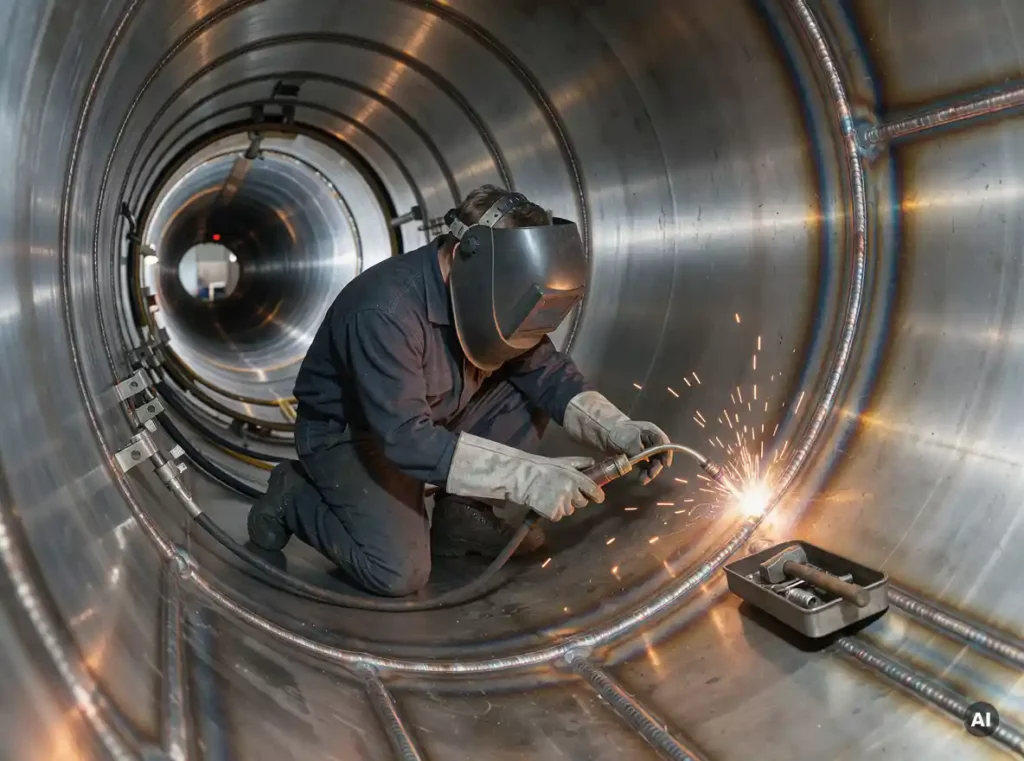
Internal partitions in a titanium-clad autoclave are attached by welding titanium pads or stiffener plates onto the clad lining, with the loads carried through a structural support system anchored to the carbon steel shell. They are never welded straight onto the carbon steel behind the cladding. This keeps the corrosion barrier continuous and the shell intact.
The right method depends on partition size, slurry load, agitation forces and thermal movement. The sections below cover the main questions engineers and buyers ask about this detail.
Why can’t partitions be welded directly to carbon steel?
Partitions cannot be welded directly to the carbon steel shell because that would require cutting through the titanium lining, which breaks the corrosion barrier and exposes carbon steel to hot, acidic slurry. Titanium and carbon steel are also metallurgically incompatible, so a direct weld between the two produces brittle intermetallic phases and cracking.
In HPAL and pressure oxidation service, the carbon steel shell provides strength while the thin titanium layer, such as Grade 17 or Grade 1 or 2 clad, provides all of the corrosion resistance. Any penetration of that layer creates a path for acid to reach the steel. Even a small defect can lead to crevice attack, bond separation and, in the worst case, loss of pressure integrity.
For this reason, every attachment must be designed so that titanium meets titanium on the process side, and structural load is handled away from the liner.
What methods attach partitions inside a clad autoclave?
The most common method is welding titanium attachment pads or lugs to the clad surface, then bolting or welding the partition to those pads. Where loads are higher, designers use pass-through supports with titanium sleeves or covers, so structural steel connects to the shell but remains fully sealed from the process.
Typical approaches include:
- Surface pads on the cladding: titanium plates seal welded to the lining, carrying lightly loaded partitions or baffle brackets.
- Backed attachments: carbon steel pads or studs welded to the shell before cladding, with the titanium lining formed and welded around them.
- Sleeved penetrations: structural members that pass through the lining, protected by titanium sleeves and cover caps.
- Bolted partition connections: removable titanium partitions fixed to welded pads, allowing replacement of worn sections.
Selection depends on load, access for inspection and how often the internals are expected to be replaced.
How are partition loads transferred to the vessel shell?
Partition loads move from the partition into titanium attachment pads, then through the cladding bond into the carbon steel shell, or through dedicated structural supports that bear directly on the shell. Designers must limit the shear and peel stress placed on the bond itself, because the clad layer is not a structural member.
Loads that matter include the hydrostatic pressure difference between compartments, slurry flow forces, agitator-induced vibration and thermal differences during start-up and shutdown. In a large horizontal autoclave, these forces act continuously and cyclically.
Good practice spreads the load over wide pads with generous radii, avoiding sharp corners that concentrate stress. Where loads exceed what the bond can carry, supports transfer force into the steel directly, and the titanium acts only as a sealing skin. This is also why clad thickness, bond quality and local reinforcement should be reviewed together during design.
How are titanium attachment welds made and protected?
Titanium attachment welds are made with gas tungsten arc welding under full inert gas shielding, using matching filler metal and strict cleanliness. Titanium absorbs oxygen, nitrogen and hydrogen when hot, which makes welds brittle, so shielding must cover the weld pool, the cooling bead and the back side of the joint.
The usual sequence follows a clear order:
- Clean and degrease the joint area, removing all carbon steel dust and contamination.
- Fit the pad or partition to the clad surface with tight, consistent gaps.
- Set up trailing shields and back purging to protect the hot metal.
- Weld with controlled heat input, using qualified procedures and welders.
- Inspect the weld colour, since bright silver or light straw indicates good shielding, while blue or grey signals contamination.
Welding near the clad interface also needs controlled heat input, because excess heat can damage the bond layer beneath the lining.
How is the cladding bond checked after welding?
The cladding bond is checked after welding with ultrasonic testing, which detects disbonds beneath and around the attachment area. Weld surfaces are also examined by visual inspection and dye penetrant testing, and some projects add a tracer or vacuum test on seal welds to confirm tightness.
Ultrasonic inspection is usually performed before and after attachment welding, so any new disbond can be linked to the work just completed. Acceptance limits for unbonded areas are set by the applicable code and the project specification, and they are tighter near nozzles, attachments and weld seams.
Records should show the scanned areas, the equipment used and the results. When a disbond appears, repair procedures must be agreed before work continues, because grinding or reheating the area without a plan can make the defect larger.
What fabrication challenges affect large autoclave internals?
The main challenges are dimensional accuracy over long lengths, cleanliness during titanium welding, and managing distortion and thermal movement. In vessels weighing several hundred tons, even small alignment errors can prevent partitions from fitting or leave gaps that cause flow bypass between compartments.
Several factors make this work demanding:
- Shell tolerances: out-of-roundness and straightness over a long horizontal vessel affect pad positions and partition alignment.
- Controlled environment: titanium welding needs clean, shielded work areas, which is hard inside a large vessel.
- Access: welders and inspectors often work in confined internal spaces with limited ventilation and lighting.
- Erosion exposure: slurry flow can wear partitions and attachment details, so design changes are sometimes needed to improve service life.
Planning the sequence of cladding, attachment welding, inspection and pressure testing early reduces rework significantly.
What should buyers specify for autoclave partition attachments?
Buyers should specify the attachment method, titanium grade, design loads, inspection requirements and acceptance criteria for the cladding bond. Stating these items clearly in the purchase specification prevents later disputes and ensures the manufacturer designs for the real operating conditions rather than assumptions.
A useful specification includes:
- Titanium grade for the lining, pads and partitions
- Design pressure differentials across each partition
- Expected slurry velocity, solids content and erosion allowances
- Welding procedure and welder qualification requirements
- Ultrasonic bond testing scope and acceptance limits
- Whether partitions must be removable for maintenance
- Applicable codes such as PED or ASME
Early discussion between the technology owner, EPC contractor and fabricator also helps align the process layout with what can actually be built and inspected.
How Coek helps with titanium-clad autoclave internals
Coek Engineering is a Belgian manufacturer of custom pressure equipment, with more than 30 years of experience in clad construction and a track record in titanium-clad autoclaves for nickel, cobalt and gold applications. Autoclaves delivered range up to roughly 960 tons, built in Geel and Genk, with PED, ASME and ISO 9001 certifications.
For partition and internal attachment details, Coek can support projects with:
- Mechanical engineering that turns customer process requirements into buildable attachment designs
- Titanium welding and cladding expertise on large, thick-walled shells
- Design refinements informed by field experience with erosion in titanium-lined autoclaves
- Controlled inspection of the cladding bond throughout fabrication
If you are planning a new autoclave or reviewing internal details, explore our industrial autoclaves or contact our engineering team to discuss your requirements.
Frequently Asked Questions
How do I get started with designing partition attachments for a new titanium-clad autoclave?
Start by defining the process data that drives the mechanical design: pressure differentials across each partition, slurry velocity and solids content, operating temperature range, and whether partitions must be removable. Share this early with your fabricator and EPC contractor so they can propose an attachment method (surface pads, backed attachments or sleeved penetrations) that can actually be built and inspected. A joint design review before the purchase specification is finalised usually prevents costly changes later.
What happens if a disbond is found in the cladding after attaching a pad or partition?
Stop work in that area and map the extent of the disbond with ultrasonic testing before doing anything else. Compare it against the acceptance limits in the code and project specification, which are stricter near attachments and weld seams. If it is out of tolerance, a repair procedure must be agreed and qualified first, because grinding or reheating without a plan can enlarge the defect.
Can titanium partitions be repaired or replaced in service without cutting into the shell?
Yes, if the design anticipates it. Bolted partitions fixed to welded titanium pads can be unbolted and replaced without disturbing the cladding, while welded partitions usually require cutting out and re-welding the affected section. Because erosion tends to wear partitions faster than the liner, specifying removable or replaceable sections at the design stage can significantly reduce future downtime.
What are the most common mistakes when welding titanium attachments inside a clad vessel?
The most frequent errors are inadequate inert gas shielding (especially back purging and trailing shields), cross-contamination from carbon steel dust or grinding debris, and excessive heat input near the clad interface. Poor fit-up with inconsistent gaps and welding in drafty or poorly controlled internal spaces also cause problems. Weld colour is a quick check: blue or grey discolouration signals contamination and the weld should be rejected and reworked.
How can erosion at partitions and attachment points be reduced?
Design measures include rounding pad edges and corners, avoiding abrupt flow obstructions, adding wear allowances to partition thickness, and adjusting opening geometry to limit local slurry velocity. Feedback from operating titanium-lined autoclaves is valuable here, since wear patterns often point to specific details that can be improved. Regular internal inspections during shutdowns help confirm whether the design changes are working.
What inspection documentation should I request from the fabricator for partition attachments?
Ask for welding procedure specifications and welder qualification records, ultrasonic bond scan maps from before and after attachment welding, and dye penetrant and visual inspection reports. If seal welds were tracer or vacuum tested, request those results as well. Complete traceability of titanium materials and filler metal, along with records of any repairs, gives you a solid baseline for future in-service inspections.
Does the choice of code (PED or ASME) affect how partitions are attached?
Both codes allow the same basic attachment philosophy, but they differ in how clad thickness is treated in strength calculations, in bond testing requirements and in documentation. The applicable code also influences acceptance limits for unbonded areas and the scope of non-destructive testing. Confirm the governing code in your specification early so the attachment design, inspection plan and pressure test requirements are aligned from the start.