
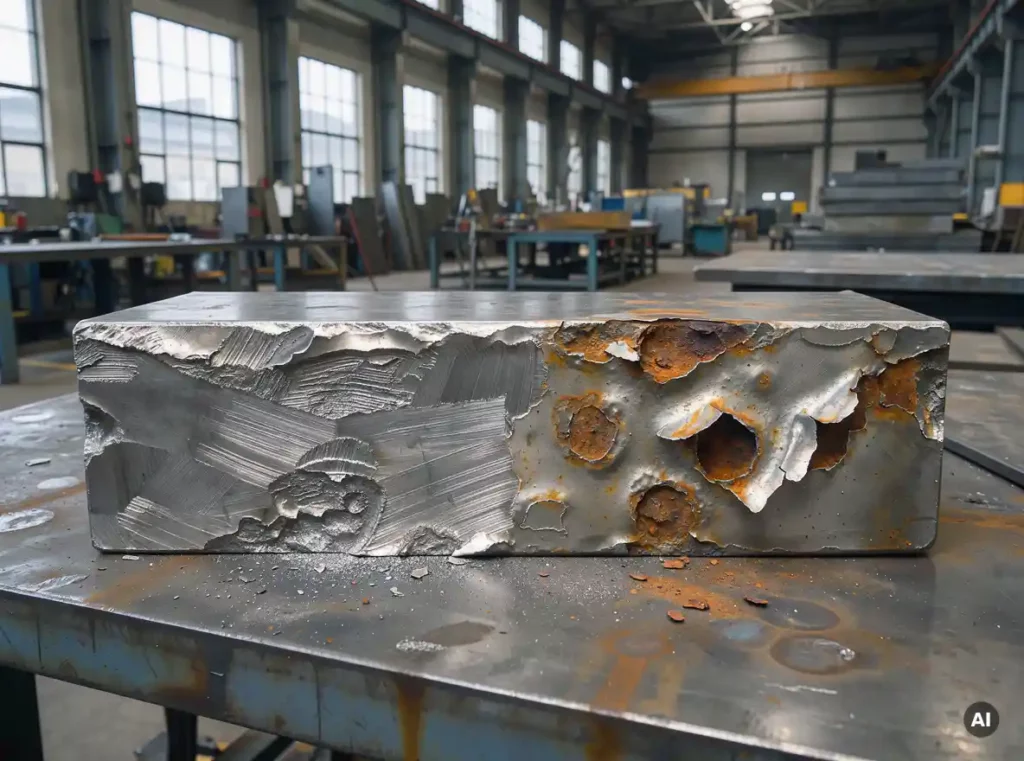
Erosion is the mechanical removal of material by moving solids, slurry or fluid impact, while corrosion is the chemical or electrochemical degradation of the metal by the process liquor. In a hydrometallurgical autoclave, the two mechanisms attack the same surfaces, so their combined effect is often worse than either alone.
The distinction matters because each demands a different remedy: corrosion is managed mainly through material selection, erosion mainly through design and flow control. The sections below explain how the two interact, where they strike, how to tell them apart and how to protect equipment against both.
Why do erosion and corrosion often occur together in autoclaves?
Erosion and corrosion occur together because slurry flow strips away the protective surface film that corrosion-resistant metals depend on. Once that film is removed, the exposed metal corrodes faster, and the damaged surface becomes rougher and more vulnerable to further erosion. This feedback loop is called erosion-corrosion.
Many corrosion-resistant alloys, including titanium, rely on a thin, stable oxide layer rather than being chemically inert. In a high-pressure acid leaching autoclave, hot acidic slurry carries abrasive particles at velocity. When those particles strike a surface repeatedly, the oxide film cannot always re-form quickly enough to keep the metal protected.
Pure corrosion would be slow on a well-chosen alloy, and pure erosion would be modest on a hard, smooth surface. The combination is what drives most unplanned wear in pressure leaching service.
Where inside an autoclave does each type of damage concentrate?
Erosion concentrates wherever flow velocity, turbulence or particle impact is highest, such as agitator zones, nozzles, slurry inlets and discharge areas. Corrosion is more evenly distributed but intensifies at crevices, weld zones, vapor space transitions and stagnant areas where chemistry can concentrate.
Typical hot spots in a pressure leaching autoclave include:
- Feed and discharge nozzles: high-velocity slurry changes direction and accelerates here.
- Agitator surroundings: impeller tip speeds create intense local turbulence against shell and baffles.
- Compartment partitions and weirs: slurry cascades across these and impacts surfaces.
- Steam and oxygen injection points: jets of gas or steam can cause localized impingement.
- Vapor space and liquid line: shifting conditions here can favor corrosion over erosion.
Corrosion tends to appear in more places but at a slower rate, while erosion creates sharply localized damage that can penetrate a lining quickly.
How can you tell erosion damage from corrosion damage?
Erosion leaves smooth, directional marks such as grooves, scallops, waves or polished thinning that follow the flow path. Corrosion produces more irregular surfaces, including pitting, general roughening, discoloration, scale or crevice attack that does not align with flow direction.
A practical visual guide uses the following checks:
- Look at the pattern. Damage that follows flow lines, points downstream or clusters around obstructions suggests erosion.
- Examine the texture. Smooth, burnished or horseshoe-shaped wear points to erosion. Rough pits, undercutting or surface films point to corrosion.
- Check the location. Wear at weld seams, crevices or under deposits suggests a chemical mechanism.
- Measure thickness loss. Localized, rapid thinning is typical of erosion, while uniform loss across large areas indicates corrosion.
- Confirm with analysis. Thickness gauging, metallography or surface analysis separates the mechanisms where visual inspection is ambiguous.
In practice both mechanisms often overlap, so a root cause assessment should consider them together rather than assuming one explanation.
Which materials resist erosion, corrosion, or both?
No single material is best at everything. Titanium alloys offer excellent corrosion resistance in oxidizing acidic media, hard overlays and ceramic or brick linings improve erosion resistance, and carbon steel provides structural strength but needs protection. Material choice should match the dominant damage mechanism and the process chemistry.
Commonly considered options include:
- Titanium grades: widely used as lining material in nickel, cobalt and gold autoclaves because of strong resistance to hot, acidic, chloride-containing liquors. Ti Grade 17 has been applied as lining material in autoclaves for these applications.
- Zirconium, tantalum, Hastelloy and Inconel: chosen for specific chemistries where titanium may not be the best fit.
- Carbon steel: suitable as the pressure-retaining base, but not as a wetted surface in aggressive leach liquor.
- Protective linings or overlays: used in some designs to add wear resistance in the most exposed zones.
A corrosion-resistant metal that is soft or thin may still lose out to erosion, so wear resistance and chemical resistance have to be assessed together. Final selection depends on the customer’s process conditions, which technology owners and EPC contractors define.
How does clad construction protect an autoclave shell?
Clad construction bonds a thin corrosion-resistant layer, such as titanium, to a thick carbon steel base. The steel carries the pressure load, while the cladding shields it from the process liquor. This delivers corrosion protection comparable to a solid exotic alloy vessel at a much lower material cost.
For large autoclaves, building the entire shell in solid titanium would be impractical and expensive. Cladding resolves this by separating the two functions: structure and chemical protection. Explosion cladding is one established method for achieving a strong metallurgical bond between dissimilar metals.
The cladding is also the sacrificial surface exposed to erosion, which makes its thickness, bond quality and weld integrity critical. Defects at seams, nozzles or transitions can become starting points for localized attack, so fabrication precision directly affects service life.
What design choices reduce erosion and corrosion in autoclaves?
The most effective design choices control flow velocity, remove sharp changes of direction, protect high-impact zones and eliminate crevices. Because erosion is largely a flow-related problem, geometry and internals matter as much as the alloy. Design details have been refined over the years specifically to address erosion issues seen in the field.
Key design measures include:
- Smooth transitions: generous radii at nozzles and partitions reduce turbulence and impact angles.
- Controlled velocities: sizing nozzles and flow paths to limit slurry speed at critical points.
- Impact protection: adding replaceable wear plates or reinforced lining where jets strike surfaces.
- Weld quality and layout: placing welds away from high-wear zones and ensuring clean, complete fusion in the cladding.
- Crevice avoidance: eliminating gaps where aggressive liquor can stagnate.
- Accessible internals: designing for inspection and repair so wear can be addressed early.
These details are most effective when the vessel is designed with fabrication in mind, so the intended geometry and weld quality can actually be achieved in manufacture.
How often should autoclave internals be inspected?
Inspection frequency has no universal value, because wear rates depend on slurry abrasiveness, velocity, temperature and chemistry. The practical approach is to inspect at every planned shutdown, focus on known hot spots, and use measured wear rates to set the next interval rather than a fixed calendar.
A sound inspection program usually includes:
- A baseline survey after commissioning to record initial lining and cladding condition.
- Thickness measurements at high-impact zones at each shutdown.
- Visual checks of welds, nozzles, partitions and agitator surroundings.
- Trend tracking so that wear rates can predict remaining life and plan repairs.
- Prompt investigation of any unexpected change in wear pattern.
Shortening the interval is sensible when process conditions change, such as higher solids content or altered feed chemistry. Inspection results should feed back into design updates and maintenance planning.
How Coek helps with erosion and corrosion in autoclaves
Coek Engineering designs and manufactures custom industrial autoclaves for demanding high-pressure, high-temperature and corrosive environments, with references approaching 1,000 tons. Coek receives process requirements from customers, EPC contractors or technology owners and translates them into mechanically sound, manufacturable equipment.
- Titanium-clad autoclaves: supplied for nickel, cobalt and gold applications, including Ti Grade 17 lining, with design details refined over the years to address field erosion issues.
- Advanced materials expertise: experience with titanium, zirconium, tantalum, Hastelloy and Inconel.
- Clad construction experience: more than 30 years of working with carbon steel combined with corrosion-resistant inner layers.
- Large-scale fabrication: equipment up to roughly 10 metres in diameter and 1,000 tons.
- Standards compliance: ISO 9001, PED and ASME certifications.
If you are specifying a new autoclave or reviewing wear on an existing design, contact our engineering team to discuss your requirements.
Frequently Asked Questions
Where should I start if I suspect erosion-corrosion is damaging my existing autoclave?
Start with a documented inspection at the next planned shutdown, focusing on known hot spots such as nozzles, agitator surroundings, partitions and discharge areas. Record thickness measurements, photograph wear patterns and compare them against any baseline survey. Then pair the findings with process data (solids content, velocity, temperature, chemistry) so a root cause assessment can consider erosion and corrosion together rather than assuming one mechanism.
Can I fix localized erosion damage in a titanium lining without replacing the whole lining?
Often yes, provided the damage is localized and the underlying lining and bond are still sound. Typical repairs include welding patch plates or replaceable wear plates over the affected area, using titanium welding procedures with proper inert gas shielding. Repairs should be carried out by qualified personnel with titanium experience, and the repair area should be inspected afterward, since poor weld quality can create new starting points for attack.
What if my process conditions change, such as higher solids content or a different feed chemistry?
Treat it as a trigger to re-evaluate the design and shorten your inspection interval. Higher solids loading increases particle impact and erosion, while changes in acidity, chloride level or oxidizing potential can affect how well a protective oxide film holds up. Share the new conditions with your equipment supplier and technology owner so they can confirm that nozzle velocities, wear protection and material grades are still appropriate.
What are the most common mistakes when trying to control autoclave wear?
A frequent mistake is selecting material based on corrosion resistance alone and overlooking erosion in high-velocity zones. Others include placing welds in high-wear areas, leaving crevices where liquor can stagnate, skipping a baseline inspection after commissioning, and relying on a fixed calendar interval instead of measured wear rates. Addressing both mechanisms at the design stage is far cheaper than fixing them after startup.
How do I decide between a solid alloy vessel and a clad construction?
For large pressure vessels, clad construction is usually the more practical choice because carbon steel carries the pressure load while a thin layer such as titanium handles corrosion, at a much lower material cost. Solid alloy may make sense for small components or very specific chemistries. Evaluate vessel size, pressure and temperature rating, process chemistry and fabrication capability together, and confirm the supplier has proven cladding and weld experience.
Which inspection methods are best for tracking wear over time?
Ultrasonic thickness gauging at fixed, marked locations is the most common way to build a reliable wear trend, supported by detailed visual inspection of welds, nozzles and partitions. Where the cause of damage is unclear, metallography or surface analysis can distinguish erosion from corrosion. Recording measurements at the same points every shutdown lets you calculate wear rates and predict remaining life.
What information should I prepare before discussing a new autoclave design with a manufacturer?
Gather your design pressure and temperature, slurry composition and solids percentage, particle size and abrasiveness, acid and chloride concentrations, oxygen or steam injection details, and expected throughput. If you work through an EPC contractor or technology owner, ask for their process data package as well. The more complete the process conditions, the better the manufacturer can select materials and refine design details to limit erosion and corrosion.
Related Articles
- What are the differences between laboratory autoclaves and industrial autoclaves?
- What is the difference between a solid and a clad pressure vessel?
- What are the main types of industrial autoclaves used in manufacturing?
- What international standards apply to pressure vessel design and certification?
- What factors determine the design life of an industrial autoclave?