
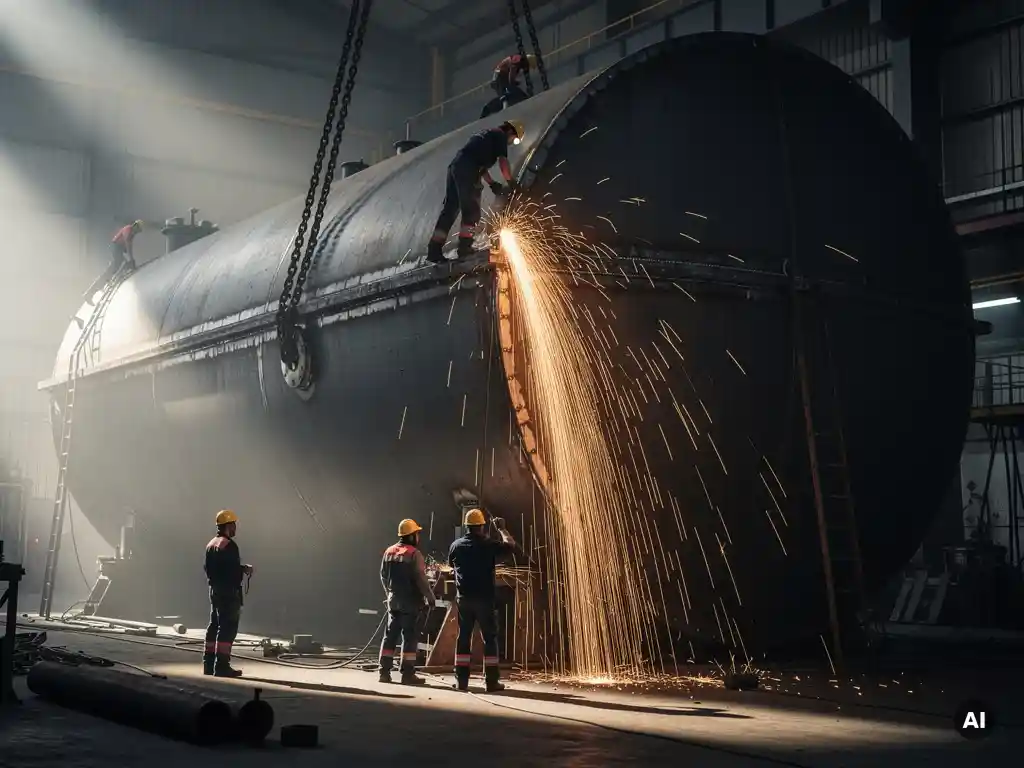
The manufacturing cost of a large industrial pressure vessel is determined primarily by material selection, wall thickness, vessel size, design complexity, and the certification requirements that apply to the project. These factors do not operate in isolation: they interact, and a change in one often drives costs in several others. The sections below break down each cost driver in detail, giving buyers and engineers a clearer basis for understanding quotes and making informed sourcing decisions.
How does material selection affect pressure vessel cost?
Material selection is one of the most significant cost variables in custom pressure vessel fabrication. The base material drives raw material expenditure, influences welding procedures, determines heat treatment requirements, and affects the time and skill required at every stage of production. Choosing the wrong material can compromise equipment integrity; choosing an unnecessarily premium material inflates cost without benefit.
Carbon steel remains the most cost-effective structural material for pressure vessels operating in non-corrosive or mildly corrosive environments. Once process conditions involve aggressive media (acids, halogens, oxidising compounds), engineers must consider corrosion-resistant alloys. Materials such as titanium, zirconium, tantalum, Hastelloy and Inconel offer exceptional resistance but come at a substantial price premium over carbon steel, both in raw material cost and in the specialised fabrication techniques they require.
The key cost drivers linked to material selection include:
- Raw material price: Exotic alloys can cost many times more per kilogram than carbon steel, and this multiplies directly with vessel weight.
- Weldability and procedure qualification: Titanium, zirconium and nickel alloys require qualified welders, controlled environments and specific consumables, all of which add cost.
- Heat treatment requirements: Some materials and weld combinations require post-weld heat treatment (PWHT), which demands furnace time and careful process control.
- Non-destructive examination (NDE) scope: Exotic materials often carry stricter NDE requirements, increasing inspection hours and cost.
- Forming and machining complexity: Work-hardening behaviour and surface sensitivity of certain alloys require specialised tooling and slower processing speeds.
Where solid exotic construction is cost-prohibitive, clad construction (bonding a corrosion-resistant inner layer to a carbon steel structural shell) can deliver comparable corrosion performance at a lower total material cost. The cost trade-off between solid and clad construction is explored further below.
Why does wall thickness drive up fabrication costs so significantly?
Wall thickness has a compounding effect on pressure vessel cost. Greater thickness means more raw material, heavier plate, more difficult forming, more weld passes, longer heat treatment cycles, and more extensive inspection. Each of these adds cost independently, and they accumulate quickly on thick-walled equipment.
Forming thick plate (rolling it into cylindrical shells) requires higher-capacity equipment and multiple passes. Weld joints in thick walls require more filler material, more time, and more inter-pass temperature control to avoid defects. Volumetric examination of thick welds by ultrasonic testing is more complex and time-consuming than on thin-walled sections.
Post-weld heat treatment is another major cost factor for thick-walled vessels. Large furnaces, extended soaking times, and controlled cooling rates all add fabrication hours and energy cost. For very thick or very heavy vessels, the furnace capacity of the manufacturer becomes a limiting factor: not all fabricators can accommodate the dimensions required.
Wall thickness is ultimately dictated by design pressure, vessel diameter, material properties, and applicable code requirements. Optimising wall thickness through rigorous engineering (using finite element analysis (FEA) where appropriate) can sometimes reduce material requirements without compromising safety margins.
What role do vessel size and weight play in manufacturing price?
Vessel size and weight affect manufacturing cost directly and indirectly. Larger, heavier vessels require more raw material, more fabrication time, larger handling equipment, and specialised transport logistics. They also limit the number of manufacturers capable of producing them, which affects market pricing dynamics.
Manufacturing a pressure vessel approaching 10 metres in diameter or several hundred tonnes in weight demands production facilities with overhead crane capacity, large rolling and forming equipment, furnaces capable of accommodating the full vessel, and sufficient floor space to manage the equipment through all production stages. Fabricators without these capabilities simply cannot take on such projects, which means buyers sourcing very large custom pressure vessels are working within a narrower pool of qualified manufacturers.
Transport is a cost that buyers sometimes underestimate at the quotation stage. Oversized and overweight loads require specialist haulage, route surveys, permits and in some cases temporary infrastructure modifications. For export projects, heavy-lift shipping and port handling add further cost. These logistics factors should be factored into total project cost from the outset, not treated as a late addition.
Larger vessels also involve longer production schedules, which affects project financing and cash flow. Understanding the relationship between vessel size, manufacturing lead time and delivery milestones is essential when planning a project timeline.
How do design complexity and internal components affect the total cost?
Design complexity is a significant cost driver that is sometimes overlooked when buyers focus primarily on material and size. A vessel with straightforward geometry and no internal components is far less expensive to fabricate than one with complex nozzle arrangements, internal trays, agitators, baffles, heating coils or other integrated mechanical systems.
Internal components add engineering hours, additional fabrication steps, more weld joints to inspect, and assembly complexity. Agitators, drive systems and mechanical seals, as found in reactor vessels, require precise dimensional tolerances and careful alignment. Each additional component is also a potential source of fabrication error or field performance issue, which is why engineering rigour at the design stage matters.
Nozzle orientation and reinforcement, manway locations, support saddle design and the interface between the vessel and its foundation all require careful engineering attention. First-of-a-kind equipment (vessels built to a new process design without an established fabrication precedent) typically involves more engineering iterations, closer collaboration between the buyer’s process team and the manufacturer’s mechanical engineers, and more conservative quality assurance measures. All of these add cost compared to repeat-build equipment.
Which codes, certifications, and inspection requirements add to fabrication cost?
Compliance with international pressure vessel codes and third-party inspection requirements adds measurable cost to fabrication, but it is a non-negotiable element of manufacturing equipment for critical industrial applications. The applicable code (whether ASME, PED, AD Merkblätter or another standard) defines the minimum design, material, welding, testing and documentation requirements that the vessel must meet.
The main cost contributors within the certification and inspection scope include:
- Code-compliant design calculations: Engineering time to produce calculations in accordance with the applicable standard, including supplementary analyses such as FEA, fatigue analysis or thermal analysis where required.
- Material traceability and certification: Code-compliant material procurement requires certified mill test reports and full traceability documentation throughout fabrication.
- Welding procedure qualification (WPS/PQR): Qualifying welding procedures to the applicable code involves test welds, destructive testing and documentation (particularly significant for exotic materials or unusual joint configurations).
- Non-destructive examination: Radiographic, ultrasonic, magnetic particle and liquid penetrant testing add inspection hours and, in some cases, require third-party NDE contractors.
- Pressure testing: Hydrostatic or pneumatic pressure testing to the required test pressure, with witnessed inspection, is a mandatory step in most codes.
- Third-party inspection and witnessing: Many projects require an independent inspection body (a notified body under PED, or an authorised inspection agency under ASME) to witness key fabrication stages and certify the final vessel.
Buyers sourcing custom pressure vessels for international projects should confirm which code applies at the installation site, whether the manufacturer holds the relevant certification, and how the inspection scope is allocated between the manufacturer’s internal QA and external third-party inspection.
What’s the difference in cost between a standard and a clad pressure vessel?
A clad pressure vessel uses a structural outer shell (typically carbon steel) bonded to a thinner corrosion-resistant inner layer, such as titanium, zirconium, stainless steel or Hastelloy. Compared to a solid exotic-alloy vessel, clad construction typically reduces total material cost significantly, because the expensive corrosion-resistant material is used only where it is needed: at the process-wetted surface.
The cost saving from clad construction depends on the specific material combination, vessel size and wall thickness. For large vessels where the corrosion-resistant layer would otherwise account for a large volume of expensive alloy, the saving can be substantial. The structural integrity of the vessel is provided by the carbon steel base, while the inner layer handles the corrosion challenge. Explosion bonding is one established method for producing clad plate with a metallurgical bond between the two layers.
Clad construction does introduce its own fabrication considerations. The bond integrity must be verified, weld overlay or strip lining at joints requires qualified procedures, and quality control of the clad interface adds inspection steps. Fabricators with deep experience in clad equipment can manage these requirements efficiently; those without it may underestimate the complexity and introduce risk.
For buyers, the decision between solid and clad construction should be driven by a total cost analysis that considers raw material, fabrication complexity, inspection requirements and expected service life, not simply the upfront material price difference.
How should buyers evaluate quotes from different pressure vessel manufacturers?
Evaluating quotes for custom pressure vessels requires looking beyond the headline price. Two quotes for nominally the same vessel can differ significantly in scope, technical assumptions, material specifications, inspection coverage and delivery risk. A lower quote is not always a lower total project cost.
Key areas to examine when comparing quotes include the completeness of the technical scope, the materials specified and their certification basis, the welding and NDE procedures proposed, the inspection plan and third-party involvement, the manufacturer’s demonstrated capability for the specific equipment type, and the delivery schedule with milestone commitments.
Buyers should also assess whether the manufacturer has genuine in-house mechanical engineering capability. A fabricator who can translate process requirements into a mechanically sound and manufacturable design, and who can flag constructability issues early, reduces the risk of costly design revisions later in the project. This is particularly important for complex, first-of-a-kind or large-scale equipment where fabrication surprises carry significant schedule and cost consequences.
References for comparable equipment, the manufacturer’s quality certifications, and their track record with the relevant international codes are all meaningful indicators of capability. Visiting the production facility before awarding a contract for high-value or technically demanding equipment is a step that experienced procurement teams rarely skip.
How Coek Engineering approaches pressure vessel cost and complexity
Coek Engineering specialises in custom pressure vessels for technically demanding applications: equipment that involves large dimensions, thick walls, advanced materials, clad construction or complex internal requirements. As a manufacturer rather than a commodity fabricator, Coek’s value lies in translating demanding process requirements into mechanically sound, manufacturable equipment while maintaining full compliance with the applicable international standards.
Relevant capabilities for buyers evaluating complex pressure vessel projects include:
- Manufacturing equipment up to 10 metres in diameter, 100 metres in length and approximately 1,000 tonnes in weight
- More than 30 years of experience with explosion-clad construction across a range of material combinations
- In-house expertise with titanium, zirconium, tantalum, Hastelloy, Inconel and other demanding materials
- In-house mechanical engineering, including FEA, fatigue analysis and thermal analysis
- Compliance with ASME, PED, AD Merkblätter and TEMA standards
- Two production facilities in Belgium with large-scale furnace and handling capacity
If you are sourcing a custom pressure vessel for a technically demanding application and want to discuss your project requirements, contact Coek Engineering to speak with an engineer.
Frequently Asked Questions
How early in a project should we involve a pressure vessel manufacturer to keep costs under control?
Engaging a qualified manufacturer at the front-end engineering stage — before design is frozen — is one of the most effective ways to avoid costly revisions later. A manufacturer with in-house mechanical engineering capability can flag constructability issues, suggest material or geometry optimisations, and align the design with their specific production capabilities from the outset. Waiting until detailed design is complete before approaching fabricators often means absorbing the cost of changes that could have been avoided with earlier collaboration.
What are the most common mistakes buyers make that lead to unexpected cost increases during fabrication?
The most frequent pitfalls include underspecifying the technical scope at the quotation stage, failing to confirm which certification code applies at the installation site, and treating transport and logistics as an afterthought rather than a project cost from day one. Another common mistake is selecting a fabricator based on headline price without verifying that their facility has the crane capacity, furnace size, and material expertise required for the specific equipment. These gaps tend to surface mid-project, when correcting them is most expensive.
Is it possible to reduce pressure vessel cost without compromising safety or performance?
Yes, but it requires rigorous engineering rather than simply specifying cheaper materials or thinner walls. Using finite element analysis (FEA) to optimise wall thickness, evaluating clad construction as an alternative to solid exotic alloys, and standardising nozzle orientations or flange ratings where process conditions allow can all reduce cost without affecting integrity. The key is making these decisions at the design stage with a clear understanding of the process conditions, applicable code requirements, and the fabrication implications of each choice.
How does the choice of applicable code (ASME vs. PED vs. AD Merkblätter) affect fabrication cost?
Each code carries its own design calculation methodology, material acceptance criteria, welding qualification requirements, and inspection scope, and these differences translate into real cost variations. For example, ASME Section VIII Division 2 allows more optimised designs than Division 1 but requires more extensive engineering analysis, which can reduce material cost while increasing engineering hours. Specifying the wrong code — or failing to confirm the code required by the end-user’s local authority — can result in costly rework or recertification. Buyers should confirm the applicable code with the installation site’s regulatory authority before issuing enquiries to manufacturers.
What questions should we ask a manufacturer to verify they genuinely have experience with exotic alloys like titanium or zirconium?
Ask for a list of comparable vessels they have fabricated in the specific alloy, including the client, application, dimensions, and year of delivery. Request details of their welding procedure qualifications (WPS/PQR) for the material in question and ask whether welding is performed by in-house qualified welders or subcontracted. It is also worth asking about their controlled welding environment for reactive metals — titanium and zirconium welding requires inert gas shielding and contamination controls that not all fabricators have in place. References from previous clients for similar equipment are the most reliable indicator of genuine capability.
How does explosion-clad construction compare to weld overlay in terms of cost and performance?
Explosion cladding produces a full-area metallurgical bond between the base material and the corrosion-resistant layer across the entire plate surface, offering consistent bond integrity and a well-defined, inspectable interface. Weld overlay applies the corrosion-resistant layer by depositing weld metal, which is more flexible for complex geometries and local repairs but is slower and more labour-intensive for covering large surface areas. For large vessels where significant surface coverage is required, explosion-clad plate is generally more cost-effective; weld overlay is typically used at nozzles, weld joints, and areas where clad plate cannot be applied directly.
What documentation should we expect to receive at the end of fabrication, and why does it matter for total project cost?
A properly documented pressure vessel should be delivered with a full data book including certified material test reports, welding procedure qualifications and welder qualification records, NDE reports, heat treatment records, dimensional inspection reports, pressure test certificates, and the code-required nameplate or marking documentation. This documentation is not just a regulatory formality — it is essential for insurance purposes, future inspection and maintenance planning, and any modifications or re-rating the vessel may undergo during its service life. Gaps in documentation can create significant costs and delays when equipment is inspected by local authorities or when the vessel changes hands.
Related Articles
- What materials are used in shell-and-tube heat exchanger manufacturing?
- What safety systems are required for high-pressure industrial autoclaves?
- What dimensional tolerances are required in high-pressure reactor vessels?
- What international standards apply to pressure vessel design and certification?
- What is the difference between ASME and PED pressure vessel certification?