
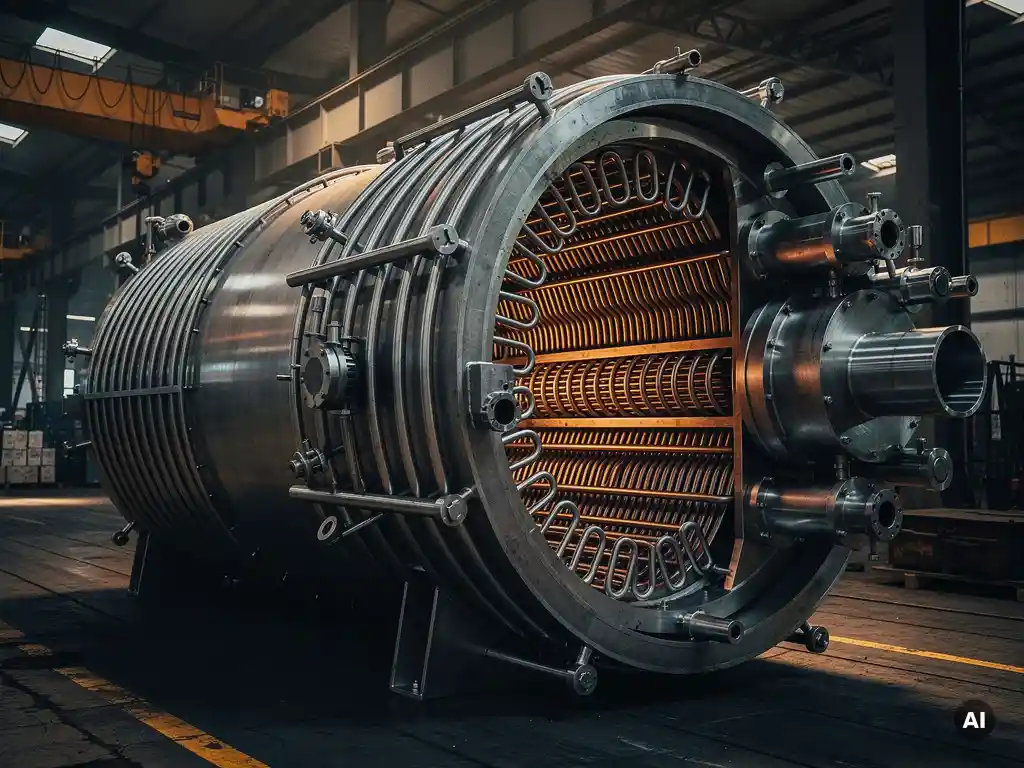
What types of heating systems are used in industrial autoclaves?
Industrial autoclaves are heated using external jackets, internal coils, direct steam injection, or electrical resistance elements, depending on the process requirements. Each method transfers thermal energy differently and imposes distinct structural and material demands on the autoclave vessel. The choice is driven by operating temperature, pressure, fluid compatibility, and the need for temperature uniformity across the vessel.
External heating jackets are among the most common approaches for large autoclaves. A jacket surrounds part or all of the vessel shell, circulating a heating medium such as steam, hot oil, or pressurised hot water. This method keeps the heating medium entirely separate from the process fluid, which is critical when contamination must be avoided.
Internal heating coils offer an alternative where the heating medium runs through tubes submerged in the process fluid. This approach delivers efficient heat transfer but introduces internal components that must withstand the same corrosive and pressure conditions as the vessel itself. Material selection for the coils therefore becomes a separate engineering challenge.
Direct steam injection is used in specific applications where introducing steam into the process is acceptable or even beneficial. It is simpler mechanically but limits flexibility since the steam becomes part of the process medium.
Electrical heating elements are more common in smaller autoclaves or in applications where precise, localised temperature control is required and other heat transfer media are impractical.
How does jacket design affect autoclave wall thickness and structural integrity?
Jacket design directly influences the wall thickness of an industrial autoclave because the outer shell must carry both the internal process pressure and the mechanical loads introduced by the jacket attachment. A poorly integrated jacket creates stress concentrations at weld seams and nozzle connections, which can compromise the long-term structural integrity of the vessel.
The most common jacket configurations each create different structural conditions:
- Full enclosure jackets wrap the entire cylindrical shell and introduce uniform hoop stress, but require careful analysis of differential thermal expansion between the jacket and the vessel wall.
- Half-pipe jackets are welded directly to the outer vessel surface in a helical or straight pattern. They allow higher jacket pressures but introduce localised bending stresses at each weld toe, which must be evaluated through detailed stress analysis.
- Dimple or embossed jackets distribute pressure over a large bonded surface area and are suited to lower jacket pressures, but the bonding pattern affects how loads are transferred into the vessel wall.
For large autoclaves, the interaction between jacket pressure, process pressure, and operating temperature must be assessed simultaneously. Finite element analysis is frequently used to verify that stress levels at jacket attachment points remain within code-allowable limits across the full range of operating and transient conditions. When the vessel uses clad construction, the analysis must also account for the different mechanical properties of the base material and the corrosion-resistant layer.
Why do heating and cooling requirements influence autoclave material selection?
Heating and cooling requirements influence autoclave material selection because the thermal environment determines which materials can maintain their mechanical properties, resist corrosion, and survive repeated thermal cycling over the equipment’s service life. A material that performs well at ambient temperature may become susceptible to stress corrosion cracking, embrittlement, or accelerated corrosion when exposed to elevated temperatures in combination with aggressive process media.
Temperature amplifies the corrosive effect of most process fluids. In high-pressure acid leaching autoclaves, for example, the combination of elevated temperature and acidic slurry demands a lining material that resists both chemical attack and erosion. Titanium Grade 17 has been used in such applications because of its resistance to hot acidic media, but the specific grade and construction method must be matched to the precise operating conditions.
Thermal cycling also introduces fatigue considerations. Autoclaves that undergo frequent start-up and shutdown cycles experience repeated expansion and contraction. At weld joints and material transitions, this cycling generates fatigue stresses that accumulate over time. Materials with mismatched thermal expansion coefficients, such as those used in clad construction, require careful design at interfaces to prevent delamination or cracking.
Where heating or cooling is applied through a jacket, the jacket material must also be compatible with the heating medium and must not introduce galvanic corrosion risks at the interface with the vessel shell. These interactions are evaluated during the material selection phase, well before fabrication begins.
How are rapid cooling requirements handled in large-scale autoclave design?
Rapid cooling in large industrial autoclaves is achieved through dedicated cooling coils, switchable jacket circuits, or quench nozzle systems that introduce cooling water or another medium directly into the vessel. The engineering challenge is not simply delivering cooling capacity but doing so in a way that avoids thermal shock, which can introduce severe transient stresses in thick-walled vessels.
In large autoclaves, wall thickness can be substantial, and the temperature gradient between the inner surface and the outer wall during rapid cooling can generate significant thermal stresses. These stresses must be evaluated during the design phase, particularly at nozzle connections, head-to-shell junctions, and any locations where geometry changes abruptly.
Cooling rate limits are often specified in the operating procedures and are reflected in the design through fatigue analysis. The number of allowable thermal cycles at a given cooling rate becomes part of the design basis, not simply an operational consideration. For autoclaves intended for long service lives with frequent cycling, this analysis directly influences wall thickness, nozzle reinforcement, and the choice of weld geometry.
Where the vessel uses a corrosion-resistant lining, rapid cooling introduces an additional concern: differential contraction between the lining and the base material. If the bond between layers is not maintained through proper design and fabrication, delamination can occur over time, compromising both the corrosion barrier and the structural integrity of the vessel.
What role does thermal uniformity play in autoclave process performance?
Thermal uniformity across an industrial autoclave directly affects process consistency, product quality, and equipment reliability. Uneven temperature distribution creates hot spots that accelerate localised corrosion, promote unwanted side reactions, and reduce the predictability of the process outcome. In pressure oxidation and leaching applications, temperature gradients can affect reaction kinetics and extraction efficiency.
Achieving thermal uniformity in a large autoclave is a mechanical engineering challenge as much as a process one. The placement, geometry, and flow distribution of heating and cooling elements must be designed to deliver consistent temperature across the full vessel volume. Internal agitation, where present, supports uniformity by promoting fluid mixing, but the heating system itself must be capable of supplying heat evenly rather than relying entirely on agitation to compensate for an uneven distribution.
Jacket segmentation is one approach used to improve uniformity. By dividing the jacket into independently controlled zones, operators can adjust heat input along the vessel length to compensate for temperature gradients that develop during operation. This adds mechanical complexity but gives greater process control, which is particularly valuable in continuous processes where stable temperature profiles are critical to consistent output.
Thermal analysis during the design phase, using tools such as computational fluid dynamics or finite element thermal modelling, allows engineers to predict temperature distribution before the autoclave is built. This analysis informs decisions about jacket layout, nozzle placement, and insulation strategy, reducing the risk of discovering uniformity problems after commissioning.
How do pressure and temperature interact in autoclave system design?
Pressure and temperature interact in autoclave system design because both variables simultaneously stress the vessel wall, and their combined effect is always more demanding than either factor considered alone. As temperature rises, the allowable stress of most structural materials decreases, meaning a vessel designed for high-temperature operation must use greater wall thickness or higher-grade materials to carry the same pressure safely.
This interaction is codified in international pressure vessel standards such as ASME and AD Merkblätter, which provide allowable stress values as a function of temperature for each material. Designers work within these code limits to establish the minimum required wall thickness at the most severe combination of pressure and temperature the vessel will encounter, including transient conditions during start-up, shutdown, and any upset scenarios.
The interaction also affects the selection of sealing systems, fasteners, and flanged connections. Bolted flange joints that are tight at ambient temperature may lose clamping force at elevated temperature as the bolt material relaxes under sustained stress, a phenomenon known as creep. Gasket selection and bolt preload must account for this behaviour to maintain leak-tight integrity throughout the operating cycle.
For autoclaves that also handle corrosive media, the pressure-temperature envelope further constrains material selection. Some corrosion-resistant alloys have adequate strength at moderate temperatures but lose mechanical properties rapidly above certain thresholds. The design must therefore identify the most restrictive combination of requirements and ensure that every component, not just the vessel shell, is specified accordingly. You can find more detailed information about the full range of autoclave design considerations on the Coek product pages.
How Coek approaches industrial autoclave heating and cooling design
Coek Engineering designs and manufactures large-scale industrial autoclaves for demanding applications where heating and cooling requirements are among the most technically complex aspects of the project. The engineering team translates customer process requirements into mechanically sound, manufacturable equipment, addressing thermal, structural, and materials challenges as an integrated design problem.
Key capabilities relevant to autoclave thermal system design include:
- In-house mechanical engineering covering jacket design, thermal analysis, fatigue assessment, and FEA for complex loading conditions
- Advanced materials expertise including titanium, Hastelloy, Inconel, and clad constructions suited to high-temperature corrosive environments
- Large-scale manufacturing capacity for autoclaves up to approximately 1,000 tons, with demonstrated references in nickel, cobalt, and gold extraction
- Compliance with ASME, AD Merkblätter, and other international codes governing pressure-temperature design
- Experience with clad autoclave construction where the base structure and the corrosion-resistant lining must perform reliably through repeated thermal cycles
If you are specifying a large autoclave and need a fabrication partner with the engineering depth to handle complex thermal and structural requirements, contact Coek Engineering to discuss your project.
Frequently Asked Questions
How do I know which heating method is right for my autoclave application?
The best starting point is a clear definition of your process requirements: operating temperature and pressure, the nature of the process fluid, contamination sensitivity, and how frequently the vessel will cycle between conditions. From there, an experienced autoclave engineer can map those requirements against the available heating methods — jacket, coil, direct injection, or electrical — and identify which approach delivers the necessary heat transfer performance without introducing unacceptable structural or materials complications. For complex or high-pressure applications, this selection should happen at the earliest stage of the design process, not after the vessel geometry has already been fixed.
What are the most common mistakes made when specifying thermal systems for large industrial autoclaves?
One of the most frequent mistakes is treating heating and cooling as an add-on rather than a core structural input, which leads to jacket designs that create stress concentrations or material combinations that are incompatible over the long term. Another common error is underestimating the impact of thermal cycling on fatigue life, particularly at weld joints and material transitions in clad vessels. Specifying cooling rates without performing a formal fatigue analysis is a related problem — what seems like a conservative operating procedure can still accumulate damage faster than the design anticipates if the thermal cycle count is high.
Can an existing autoclave be retrofitted with a different heating or cooling system?
Retrofitting is possible in some cases, but it requires a thorough engineering assessment of the existing vessel before any modifications are made. Adding or changing a jacket, for example, introduces new weld attachments and mechanical loads onto a shell that was originally designed without them, which may require reinforcement or impose new operating limits. The feasibility depends heavily on the original design margins, the current condition of the vessel, and the scope of the thermal change being considered. Any retrofit that affects pressure-bearing components must also be re-evaluated against the applicable pressure vessel code.
How does insulation strategy interact with the heating and cooling system design?
Insulation directly affects how much energy the heating system must supply to maintain process temperature, how quickly the vessel loses heat during cooling phases, and how the outer surface of the jacket behaves thermally. Poor insulation design can create unexpected temperature gradients along the vessel shell, which may undermine the uniformity that the jacket or coil layout was designed to achieve. Insulation thickness and placement should therefore be determined alongside the thermal system design, not as a separate afterthought, particularly for large vessels where heat losses across an uninsulated surface area can be substantial.
What process control infrastructure is typically needed to manage heating and cooling in a large autoclave?
Large autoclaves with segmented jackets or multiple heating and cooling circuits require a control architecture that can manage each zone independently while maintaining safe pressure-temperature relationships across the whole vessel. This typically involves a combination of temperature sensors positioned at multiple points along the vessel, automated control valves on the heating and cooling circuits, and interlocks that prevent cooling rates or heating ramp rates from exceeding the design limits established during fatigue analysis. For continuous processes, the control system must also handle the transition between heating and cooling modes smoothly to avoid thermal shock events that could compromise vessel integrity over time.
How does the choice of heating system affect long-term maintenance requirements?
Internal heating coils, for example, are exposed to the same aggressive process environment as the vessel interior, which means they are subject to corrosion, erosion, and fouling — and they are also more difficult to inspect and replace than external jacket systems. Half-pipe and dimple jackets, while external, have weld toes that should be periodically inspected for fatigue cracking, particularly on vessels with high cycle counts. The maintenance burden of each heating approach should be factored into the total cost of ownership calculation during the specification phase, alongside capital cost and thermal performance.
At what project stage should thermal system design be integrated into the overall autoclave engineering scope?
Thermal system design should be integrated from the very beginning of the engineering scope — ideally during the concept and pre-FEED stages — because the decisions made about heating and cooling method have cascading effects on vessel geometry, wall thickness, material selection, nozzle layout, and structural analysis. Introducing or changing a thermal system concept late in the design process typically requires revisiting earlier calculations and can result in costly redesign work. Engaging a fabricator with in-house thermal and structural engineering capability early in the project is the most effective way to ensure these decisions are made in a coordinated and technically sound manner.
Related Articles
- How do you size a pressure vessel for a high-pressure application?
- How does nozzle placement affect reactor vessel mechanical performance?
- What are the design challenges of a large autoclave for composite manufacturing?
- How do you select an autoclave manufacturer for a critical industrial project?
- What is a large capacity autoclave?