
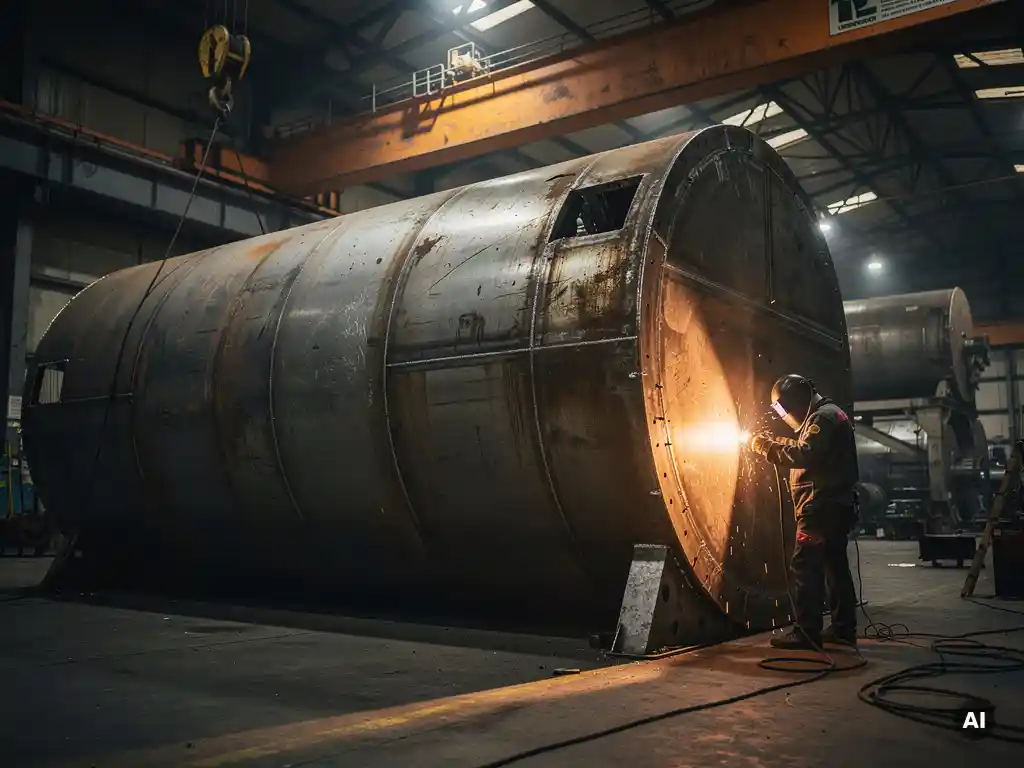
Manufacturing large industrial autoclaves is exceptionally difficult because it combines extreme operating conditions with massive physical scale. These vessels must contain high pressures and temperatures while resisting aggressive corrosive media, often using advanced materials that are inherently difficult to fabricate. The sections below address the most critical engineering and manufacturing challenges in detail.
Why are large industrial autoclaves so difficult to engineer?
Large industrial autoclaves are difficult to engineer because they must simultaneously satisfy multiple demanding requirements: structural integrity under high pressure, resistance to corrosive process media, dimensional precision at enormous scale, and compliance with stringent international standards. Each of these requirements is challenging in isolation. Combining them in a single vessel creates compounding complexity that conventional fabrication methods cannot address.
At the core of the challenge is scale. An industrial autoclave approaching 1,000 tons in weight is not simply a scaled-up version of a smaller vessel. Every engineering decision, from material selection to joint design, must account for the physical realities of working at that size. Thermal gradients during heat treatment, weld shrinkage across long seams, and dimensional tolerances that must be maintained over tens of metres all become significantly harder to control as dimensions increase.
The operating environment adds further complexity. Many large autoclaves are used in processes such as High Pressure Acid Leaching or pressure oxidation, where the combination of elevated temperature, high pressure, and highly acidic or oxidising media would rapidly degrade standard carbon steel. The vessel design must therefore integrate corrosion-resistant materials without sacrificing structural performance, which directly influences every subsequent fabrication decision.
What materials are used in large industrial autoclave construction?
Large autoclaves are typically constructed using a carbon steel structural shell combined with a corrosion-resistant inner layer, most commonly titanium. The carbon steel provides the mechanical strength needed to contain high operating pressures, while the inner lining protects the vessel from aggressive process media. In some applications, solid titanium or other exotic alloys are used where the process environment demands it throughout the full wall thickness.
The most widely used lining material for autoclaves in hydrometallurgical applications is titanium, particularly Ti Grade 17. This grade offers excellent resistance to the oxidising, acidic conditions found in processes such as pressure oxidation for gold extraction and High Pressure Acid Leaching for nickel and cobalt recovery. Over years of fabricating titanium-clad autoclaves, design details have been refined specifically to address erosion patterns commonly observed during long-term field operation.
The combination of carbon steel and titanium in a clad construction requires explosion bonding or other proven bonding techniques to create a metallurgically sound interface between the two materials. This interface must maintain its integrity across the full range of thermal cycling experienced in service. Material selection also affects weldability, heat treatment requirements, and the qualification of welding procedures, all of which must be resolved before fabrication begins.
How does wall thickness affect autoclave fabrication?
Wall thickness in large autoclaves directly affects nearly every stage of fabrication. Thicker shells require more powerful forming equipment to achieve the correct geometry, generate greater heat during welding, and demand more precise control of post-weld heat treatment to relieve residual stresses. As wall thickness increases, the risk of through-thickness defects and the difficulty of non-destructive examination also increase significantly.
Forming thick steel plate into cylindrical shell sections requires equipment capable of applying very high forces while maintaining dimensional accuracy. Deviations in roundness or straightness that would be acceptable in a lighter vessel become structurally significant in a thick-walled autoclave operating under high pressure. Each shell section must meet tight geometric tolerances before assembly can proceed.
Post-weld heat treatment of thick-walled sections presents particular logistical and technical challenges. The entire vessel, or large sub-assemblies, must be heated uniformly to specified temperatures and held for defined periods to reduce residual weld stresses. For an autoclave approaching 1,000 tons, this requires large furnace capacity and careful thermal management to avoid introducing new distortions or thermal gradients during the treatment cycle.
What welding challenges are specific to large autoclave manufacturing?
Welding large autoclaves presents challenges that go well beyond standard pressure vessel fabrication. The combination of dissimilar materials in clad construction, the length and number of weld seams, the thickness of the base material, and the need for full traceability and qualification of every weld procedure create a demanding environment where welding quality directly determines the vessel’s long-term integrity.
In titanium-clad autoclaves, the weld at the interface between the titanium lining and the carbon steel shell requires particular care. Titanium is highly sensitive to contamination at elevated temperatures, meaning that welding must be performed under controlled conditions with adequate shielding to prevent oxidation. Any contamination of the titanium weld zone can compromise corrosion resistance in precisely the areas most exposed to the process environment.
The sheer number of weld metres in a large autoclave is also a significant factor. Long longitudinal and circumferential seams must be completed with consistent quality throughout. Weld parameters, consumables, and operator qualifications must remain consistent across the entire production period, which can span many months for a complex vessel. Every weld is subject to non-destructive examination, and any indication of a defect requires investigation, repair, and re-examination, adding time and cost to the programme.
How are large autoclaves tested and certified before delivery?
Large autoclaves undergo a structured sequence of inspections and tests before leaving the fabrication facility. This typically includes dimensional verification, non-destructive examination of all welds, hydrostatic pressure testing, and review of material documentation and weld records. The specific requirements depend on the applicable design code and any additional requirements specified by the client or the relevant inspection authority.
Key stages in the testing and certification process include:
- Non-destructive examination: Radiographic, ultrasonic, and other examination methods are applied to welds to detect internal or surface defects that would not be visible to the naked eye.
- Hydrostatic pressure testing: The completed vessel is filled with water and pressurised to a defined test pressure, typically above the design pressure, to verify structural integrity before any process fluid is introduced.
- Dimensional and geometric verification: Shell roundness, nozzle orientations, flange face flatness, and overall length are measured and documented against the engineering drawings.
- Material traceability: All materials used in the vessel are traceable through mill certificates and heat numbers, ensuring that every component meets the specified material standard.
- Weld procedure and welder qualification records: These demonstrate that all welding was performed by qualified personnel using approved procedures.
Compliance with recognised standards such as the European Pressure Equipment Directive, ASME codes, or equivalent national regulations is typically a contractual requirement. Third-party inspection by a notified body or authorised inspection authority is standard practice for vessels of this class.
What transport and installation constraints affect autoclave design?
Transport and installation constraints are genuine design inputs for large autoclaves, not afterthoughts. A vessel weighing several hundred tons and measuring many metres in diameter cannot be moved by conventional means, and the route from the fabrication facility to the installation site, as well as the lifting and setting arrangements at site, must be considered during the engineering phase.
Road transport imposes strict limits on width, height, and axle loading. Vessels that exceed road transport limits must be shipped by sea and transported overland using specialist heavy-lift equipment, which requires detailed route surveys and coordination with local authorities. In some cases, the maximum transportable diameter or length determines how the vessel is sectioned for transport and whether field assembly is required.
Where autoclaves must be assembled or welded at site, the fabrication scope must be designed to accommodate this. Field weld joints must be accessible, the joint design must be suitable for the welding equipment and conditions available on site, and the inspection and testing programme must be adapted to what can realistically be performed in the field. These constraints influence the design of nozzles, support structures, and lifting attachments from the earliest stages of engineering.
How Coek Engineering approaches large autoclave manufacturing
Coek Engineering has built a substantial track record in the fabrication of large, technically demanding autoclaves for hydrometallurgical and other critical applications. The combination of in-house mechanical engineering, advanced materials expertise, and large-scale manufacturing infrastructure allows Coek to address the full range of challenges described above within a single, controlled production environment.
Key aspects of Coek’s approach include:
- More than 30 years of experience with clad construction, including titanium-clad autoclaves for pressure oxidation and High Pressure Acid Leaching applications
- Manufacturing capacity for vessels up to 10 metres in diameter and approximately 1,000 tons in weight across two production facilities in Belgium
- In-house forming, welding, heat treatment, and machining, maintaining full control over every critical fabrication step
- Established design refinements for titanium-clad autoclaves that address erosion challenges observed in long-term field operation
- Compliance with ISO 9001, PED, ASME, and other applicable international standards
Coek receives process requirements from EPC contractors, technology owners, and industrial end users and translates these into mechanically sound, manufacturable equipment. If you are evaluating fabrication partners for a large or technically complex autoclave project, contact Coek Engineering to discuss your requirements.
Frequently Asked Questions
How long does it typically take to fabricate a large industrial autoclave from order to delivery?
Lead times for large industrial autoclaves vary considerably depending on vessel size, material complexity, and the extent of field assembly required, but projects of this scale typically span 18 to 36 months from contract award to delivery. The timeline is driven by long lead times for specialty materials such as titanium-clad plate, the duration of multi-pass welding programmes, and the sequential nature of inspection and testing milestones. Early engagement with a fabricator during the project’s engineering phase is strongly recommended to secure manufacturing slots and align the production schedule with site readiness.
What is the difference between explosion-bonded cladding and weld overlay, and which is better for autoclaves?
Explosion bonding produces a metallurgical bond between the titanium lining and the carbon steel shell across the full plate surface before fabrication begins, resulting in a consistent, well-characterised interface that can be inspected and tested as a raw material. Weld overlay, by contrast, deposits corrosion-resistant material onto the base steel weld pass by pass, which is more practical for localised areas such as nozzle bores but is generally not used for large shell surfaces due to cost and quality control challenges. For large hydrometallurgical autoclaves, explosion-bonded clad plate is the established industry preference because it provides predictable mechanical and corrosion performance across the entire vessel interior.
What are the most common failure modes in large autoclaves during service, and how are they mitigated during design?
The most frequently observed service issues in large autoclaves include lining erosion at high-velocity flow zones, crevice corrosion at poorly designed lining terminations, and fatigue cracking at stress concentrations such as nozzle attachments. These failure modes are well understood by experienced fabricators and are addressed through targeted design refinements: erosion-resistant lining geometry at agitator and inlet zones, carefully detailed lining edge terminations that eliminate crevices, and full-penetration nozzle welds with controlled transition geometry. Selecting a fabricator with documented field feedback from operating autoclaves is one of the most effective ways to ensure these lessons are incorporated into a new vessel’s design.
Can an existing autoclave be relined or repaired, or does it need to be replaced entirely?
Titanium linings in large autoclaves can often be repaired or replaced in sections without requiring full vessel replacement, provided the structural carbon steel shell remains within acceptable condition. The feasibility of relining depends on the extent of lining degradation, the condition of the explosion-bonded interface, and whether the shell itself has experienced any corrosion or mechanical damage. A thorough inspection programme, including ultrasonic testing of the clad interface and shell thickness measurements, is the starting point for any relining assessment, and the repair scope should be engineered using the same weld qualification and inspection standards applied to the original fabrication.
How do I evaluate whether a fabricator has the genuine capability to build a large, titanium-clad autoclave?
Key indicators of genuine capability include in-house forming and heat treatment equipment rated for the required shell thickness and vessel weight, documented experience with explosion-bonded clad materials and titanium welding under controlled atmospheres, and a verifiable track record of completed autoclaves in comparable service — not just general pressure vessel fabrication. Requesting a facility audit, reviewing weld procedure qualifications specific to titanium-clad construction, and speaking directly with references from previous hydrometallurgical autoclave projects will give a much clearer picture than reviewing brochures alone. Fabricators who have delivered vessels into long-term operation will also be able to demonstrate how field performance data has influenced their current design standards.
What information does a fabricator need from the client or EPC contractor to begin engineering a large autoclave?
At a minimum, the fabricator requires the process design basis — operating pressure and temperature, process fluid composition and pH, design life, and applicable design code — along with any site-specific constraints such as transport route limitations, installation method, and available lifting capacity. Agitator and nozzle configurations, required inspection access provisions, and insulation or refractory interface details are also needed early in the engineering process. The more completely this information is defined at the outset, the more accurately the fabricator can develop the vessel design, produce a meaningful cost estimate, and commit to a realistic delivery schedule.
Are there alternatives to titanium lining for autoclaves used in acidic, high-pressure processes?
Alternatives to titanium lining do exist and have been used in specific applications: brick lining with acid-resistant mortars provides good corrosion resistance in some sulphuric acid environments, and certain nickel-based alloys or duplex stainless steels are used where the process chemistry is less oxidising. However, for the highly oxidising, acidic conditions typical of pressure oxidation and High Pressure Acid Leaching, titanium — particularly Ti Grade 17 — remains the material of choice because no other commercially available lining material offers a comparable combination of corrosion resistance, mechanical properties, and long-term field reliability at the required operating conditions. Any alternative material should be evaluated against actual process chemistry data and, where possible, validated by operating experience in comparable service.
Related Articles
- How does the filled weight of a mining autoclave affect its support requirements?
- What are the biggest fabrication challenges for thick-walled pressure vessels?
- What non-destructive testing methods apply to thick-walled pressure equipment?
- How do tight manufacturing tolerances affect pressure vessel assembly and sealing?
- How does post-weld heat treatment affect pressure vessel mechanical properties?