
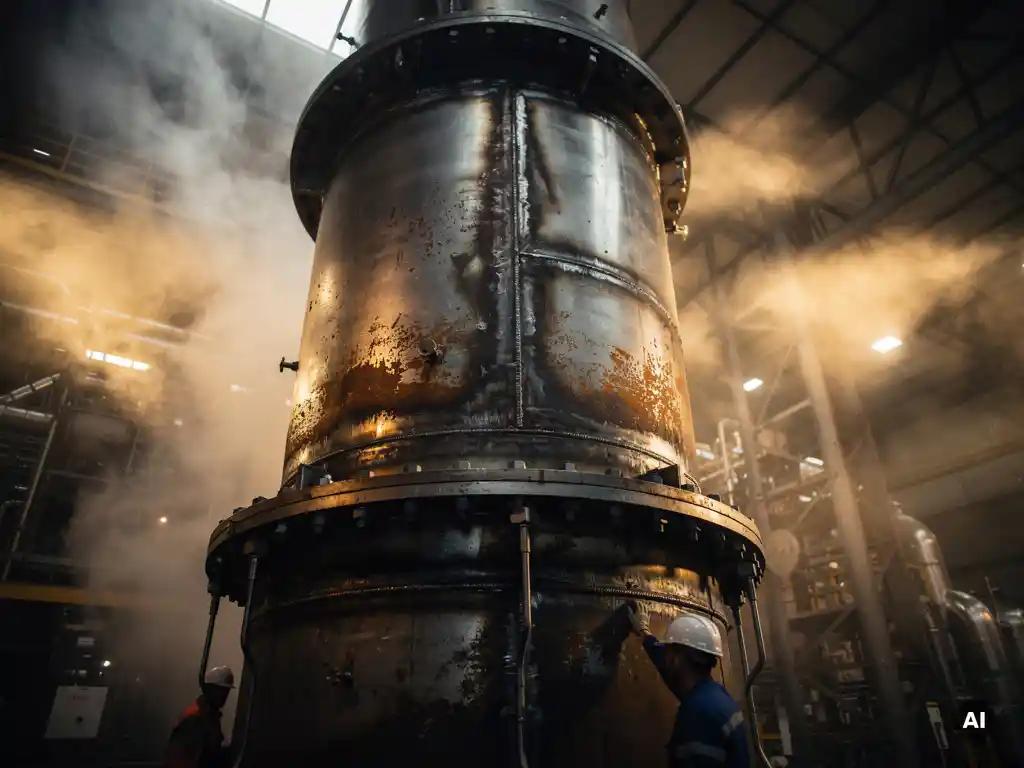
Pressure, temperature and corrosion are the three primary drivers of material selection in process columns, and they rarely act in isolation. The combination of these operating conditions determines which alloys, grades and construction methods are mechanically sound, chemically compatible and manufacturable for a given application. The questions below unpack each factor in detail and explain how they interact in practice.
Which materials are most commonly used in process columns?
The most commonly used materials in process columns are carbon steel, stainless steel, titanium, zirconium, Hastelloy alloys and clad constructions that combine a structural base metal with a corrosion-resistant inner layer. The right choice depends on the specific combination of operating pressure, temperature and the chemical aggressiveness of the process media.
Carbon steel remains the default structural material for columns operating in non-corrosive or mildly corrosive environments where pressure and temperature conditions are within standard design limits. It offers excellent mechanical strength and weldability at relatively low cost.
Where process media are chemically aggressive, engineers move toward higher-performance alloys:
- Titanium (Grade 1, 2, 9, 12, 17): Outstanding corrosion resistance in oxidising acids, chloride-rich environments and many organic acid processes. Widely used in purified terephthalic acid (PTA) and similar applications.
- Zirconium: Exceptional resistance to hydrochloric acid, sulphuric acid and other aggressive inorganic media. Used in brine purification and acetic acid processes.
- Hastelloy C22 and C276: Nickel-based alloys offering broad corrosion resistance across both oxidising and reducing environments. Applied in acetic acid production and biofuel processes, among others.
- Stainless steel (austenitic and duplex grades): Common in moderately corrosive services where higher alloy cost is not yet justified.
Clad constructions, where a carbon steel shell is bonded to a corrosion-resistant liner, are also widely applied when full solid alloy construction would be structurally unnecessary or economically prohibitive. More on that distinction appears in the section on clad versus solid alloy below.
How does operating pressure influence column wall thickness and material grade?
Operating pressure directly governs the minimum required wall thickness of a process column through pressure vessel design codes such as ASME or AD Merkblätter. Higher internal pressure demands thicker walls or higher-strength material grades, and in some cases both. The relationship is not linear once you account for material allowable stresses, weld joint efficiencies and corrosion allowances.
At elevated pressures, engineers face a trade-off between wall thickness and material grade. A higher-strength alloy can achieve the required pressure containment with a thinner wall, which reduces weight and can simplify fabrication. However, higher-strength grades may impose stricter welding requirements, tighter heat-treatment specifications and reduced ductility, all of which have downstream fabrication consequences.
For very large-diameter columns operating at elevated pressures, wall thickness can reach values that make exotic solid alloys impractical or uneconomical. This is one of the primary engineering drivers toward clad construction: the carbon steel shell carries the mechanical load dictated by pressure, while the corrosion-resistant liner handles the chemical environment. The structural and chemical requirements are addressed by different materials working together.
Supplementary calculations such as finite element analysis (FEA) are often required beyond standard code calculations when pressure loading interacts with complex geometries, nozzle reinforcements or non-uniform wall sections. These analyses ensure that local stress concentrations remain within acceptable limits under the full range of operating conditions.
How does temperature affect the mechanical properties of column materials?
Temperature affects process column materials in two critical ways: it alters the allowable mechanical stress that design codes permit, and it can trigger metallurgical changes that permanently reduce material performance. Both effects must be accounted for in the design phase, not just at ambient conditions.
As temperature rises, most metals lose yield strength and creep resistance. Design codes reflect this by reducing the allowable stress values at elevated temperatures, which means a column designed for high-temperature service must use thicker walls or higher-grade materials compared with an equivalent column at ambient conditions. At the other extreme, very low operating temperatures can cause certain steels to become brittle, requiring impact-tested or low-temperature grades.
For titanium alloys specifically, operating above standard code temperature limits is technically possible but requires verified material data and engineering justification. Industry experience with titanium in high-temperature applications such as PTA processing has led to the development of dedicated material and fabrication specifications that address both elevated-temperature performance and the risk of fabrication-related cracking during tube expansion and welding.
Temperature also interacts with corrosion rates. Many corrosion mechanisms accelerate significantly with increasing temperature, meaning that a material that performs adequately at moderate temperatures may experience rapid degradation at process temperatures. This interaction between thermal and chemical conditions is one of the reasons that material selection cannot be evaluated on a single variable alone.
What corrosion mechanisms most commonly dictate material selection in process columns?
The corrosion mechanisms that most commonly drive material selection in process columns are uniform acid corrosion, chloride-induced pitting and stress corrosion cracking, crevice corrosion, and erosion-corrosion in high-velocity or slurry-containing streams. Identifying the dominant mechanism for a specific process is the essential first step before any material can be specified.
Uniform acid corrosion occurs when process media such as acetic acid, hydrochloric acid or sulphuric acid attack the column wall at a broadly consistent rate. The solution is selecting an alloy with demonstrated resistance to that specific acid at the relevant concentration and temperature. Zirconium, for example, offers exceptional resistance to hydrochloric acid across a wide concentration range, which is why it appears in brine purification columns. Hastelloy C22 is selected where both oxidising and reducing acid conditions alternate within the same process.
Chloride stress corrosion cracking (SCC) is a particular concern for austenitic stainless steels in chloride-containing environments at elevated temperatures. Standard 304 or 316 stainless steel can crack under stress in the presence of even moderate chloride concentrations if temperatures are high enough. Titanium, duplex stainless steels and nickel alloys offer significantly better resistance to chloride SCC.
Erosion-corrosion combines mechanical wear from high-velocity flow or entrained solids with chemical attack, and it can cause localised material loss far exceeding what either mechanism would produce alone. This is particularly relevant in columns handling slurries or two-phase flows. Material selection must account for both hardness and corrosion resistance, and design features such as flow velocity limits and wear-resistant liners may be required alongside material grade selection.
When is clad construction a better choice than solid alloy for a process column?
Clad construction is the better choice when a column requires corrosion resistance that only an expensive alloy can provide, but the mechanical loads from pressure and weight demand a wall thickness that makes solid alloy construction structurally unnecessary or economically unjustifiable. Clad design separates the structural function from the corrosion protection function, assigning each to the most appropriate material.
In a clad column, carbon steel provides the structural shell that resists internal pressure and carries the column’s weight. A corrosion-resistant liner, typically bonded by explosion welding, weld overlay or roll bonding, protects the inner surface from the process media. This approach allows the use of premium alloys such as titanium, zirconium or Hastelloy where they are genuinely needed, without paying for solid alloy wall sections that serve no additional corrosion function.
Clad construction is particularly well suited to large-diameter, heavy columns where solid exotic alloy would be both technically challenging and cost-prohibitive. Columns used in PTA applications, for instance, can reach 80 metres in length, 8 metres in diameter and 600 to 800 tonnes in weight. At those dimensions, titanium-clad construction with a carbon steel shell is the engineered solution that balances corrosion performance, structural integrity and practical manufacturability.
Solid alloy construction remains preferable when wall thicknesses are thin enough that the cost premium is acceptable, when the process media contact the external surface as well, or when the bonding integrity of a clad interface cannot be reliably assured under the specific operating conditions. The decision requires engineering judgement based on the full combination of process conditions, not a simple cost comparison.
Detailed information on process column construction methods is available for projects where this distinction matters at the specification stage.
How do pressure, temperature and corrosion interact when selecting column materials?
Pressure, temperature and corrosion interact in ways that make material selection for process columns a genuinely multi-variable engineering problem. No single condition can be evaluated in isolation, because each factor modifies the severity and consequences of the others. The combination of all three operating conditions defines the true design envelope.
A practical illustration: a column operating at moderate pressure and moderate temperature in a chloride-rich acid service may require a higher-grade alloy than a column at significantly higher pressure and temperature in a clean, non-corrosive service. The corrosive environment elevates the risk beyond what pressure and temperature alone would suggest. Conversely, an aggressive medium that a given alloy handles well at ambient temperature may cause rapid corrosion at elevated process temperatures where corrosion kinetics accelerate.
Temperature also affects the mechanical allowable stresses used in pressure design calculations, which means that a column sized for a given pressure at ambient conditions must be redesigned with thicker walls or a higher material grade if the operating temperature rises significantly. The interaction runs in both directions: the material grade chosen for corrosion resistance may have different strength characteristics at operating temperature than at ambient, changing the wall thickness calculation.
For this reason, the design process for demanding pressure equipment typically involves simultaneous evaluation of all three variables rather than sequential optimisation of each. Supplementary analyses such as thermal analysis, FEA and corrosion rate modelling support the standard code calculations and help ensure that the chosen material performs reliably across the full range of operating conditions, including start-up, shutdown and upset scenarios.
What role do fabrication constraints play in final material selection?
Fabrication constraints play a significant role in final material selection because not every alloy that is chemically or mechanically ideal can be reliably manufactured into a large, complex column. Weldability, formability, heat treatment requirements and available material dimensions all influence whether a material choice is practically achievable at the required scale and quality level.
Titanium, for example, requires welding under inert gas shielding to prevent atmospheric contamination and embrittlement. Zirconium demands similarly controlled welding conditions. Hastelloy alloys present challenges related to hot cracking sensitivity and the need for carefully controlled interpass temperatures. Each of these constraints adds process complexity and requires demonstrated fabrication expertise, not just material knowledge.
For clad constructions, the bonding method, whether explosion welding, weld overlay or another technique, must be validated for the specific base and cladding material combination. The integrity of the bond under operating conditions, including thermal cycling and pressure fluctuations, must be confirmed through non-destructive examination and, where required, mechanical testing of the clad interface.
At large column dimensions, material availability also becomes a constraint. Not all alloy grades are commercially available in the plate thicknesses, widths and lengths required for very large-diameter columns. This can influence the choice between grades or between solid and clad construction before any other engineering consideration is applied.
Designing for manufacturability, where the material selection and mechanical design are developed with fabrication practicality in mind from the outset, reduces the risk of late-stage design changes and helps ensure that the final equipment meets both process requirements and quality standards reliably.
How Coek supports material selection for complex process columns
Coek Engineering translates demanding process requirements into mechanically sound, manufacturable column designs. With more than 30 years of experience in clad construction and extensive expertise in advanced materials, Coek is positioned for column projects where standard fabrication approaches are insufficient. Key capabilities relevant to material selection include:
- Fabrication in titanium (multiple grades), zirconium, Hastelloy C22 and C276, stainless steel and carbon steel, in solid and clad configurations
- Large-scale manufacturing for columns up to 80 metres in length and 8 metres in diameter, with weights reaching 600 to 800 tonnes
- In-house mechanical engineering including FEA, thermal analysis and fatigue analysis to support material and design decisions
- Design and fabrication in accordance with ASME, AD Merkblätter, PED and other international standards
- Proven track record in chemically demanding applications including PTA, acetic acid, brine purification and related processes
If your project involves a process column with demanding pressure, temperature or corrosion requirements, contact Coek Engineering to discuss how your process specifications can be translated into a reliable, manufacturable design. Reach out via the Coek contact page to start the conversation.
Frequently Asked Questions
How do I know when my process conditions are too demanding for carbon steel, and it's time to consider a higher-grade alloy?
Carbon steel becomes insufficient when any one of three thresholds is crossed: the process media are chemically aggressive enough to exceed acceptable corrosion rates, operating temperatures reduce allowable stresses to the point where wall thickness becomes impractical, or chloride or acid concentrations create a credible risk of stress corrosion cracking. A practical first step is to calculate the expected corrosion rate for your specific medium, concentration and temperature combination and compare it against your design life and available corrosion allowance. If the numbers don’t balance, or if SCC is a credible failure mode, it’s time to evaluate alloys such as duplex stainless steel, titanium or nickel-based alloys.
What are the most common mistakes engineers make when specifying materials for process columns?
The most frequent mistake is evaluating each operating variable — pressure, temperature and corrosion — in isolation rather than as a combined design envelope. A material that performs well under your corrosion conditions at ambient temperature may degrade rapidly once process temperatures are factored in, because corrosion kinetics accelerate with heat. A second common error is selecting a material based on general industry reputation rather than verified performance data at the specific concentration, temperature and phase conditions of the actual process. Always validate material choices against documented corrosion data for your exact service conditions, not just the broad chemical family.
How should upset conditions, start-up and shutdown scenarios factor into material selection?
Upset conditions, start-up and shutdown cycles frequently expose column materials to conditions outside the steady-state design envelope — including temperature spikes, concentration excursions and pressure transients — and these scenarios must be explicitly considered during material selection. A material that is stable under normal operating conditions may experience accelerated corrosion or mechanical fatigue during repeated thermal cycling or exposure to off-spec process chemistry. The practical approach is to define the full operating envelope, including credible worst-case scenarios, before finalising the material specification, and to confirm that the chosen alloy and any clad bond interface can withstand that broader range reliably.
Is it possible to change the material of an existing column during a revamp or capacity expansion, and what are the key considerations?
Upgrading the material of an existing column during a revamp is possible but involves more complexity than a greenfield design. The structural shell may be reusable if it meets revised pressure and temperature calculations, but the corrosion-resistant lining or internal components often need full replacement to meet new process conditions. Key considerations include whether the existing shell wall thickness is adequate under revised code calculations, whether the new material is compatible with existing nozzles and weld joints, and whether the fabricator has the expertise to execute the modification — particularly if exotic alloys or clad interfaces are involved. A full engineering review, including FEA where geometry is complex, is advisable before committing to a revamp strategy.
How do international design codes such as ASME and AD Merkblätter differ in their approach to material selection for pressure columns?
Both ASME and AD Merkblätter govern the structural design of pressure equipment, but they differ in how they define allowable stresses, material qualification requirements and the scope of accepted materials. ASME Section VIII, for example, publishes allowable stress tables for a broad range of alloys at various temperatures, while AD Merkblätter follows a comparable but separately developed European framework with its own material approvals. In practice, the code applicable to your project is typically determined by the plant location, the end client’s requirements or the jurisdiction of the notified body. Where a specific alloy or fabrication method is not fully covered by standard code tables — as can occur with titanium at elevated temperatures — supplementary engineering justification and verified material data are required under both frameworks.
What non-destructive examination (NDE) methods are typically used to verify the integrity of clad constructions before a column enters service?
The integrity of a clad bond is typically verified using ultrasonic testing (UT), which can detect disbonding or voids at the interface between the base metal and the corrosion-resistant liner across large surface areas. Shear wave and phased array UT techniques are commonly applied depending on the cladding thickness and geometry. For weld overlay cladding, dye penetrant testing or liquid penetrant inspection of the overlay surface is used to identify surface-breaking defects. In addition to NDE, mechanical testing of sample clad specimens — including shear strength and bend tests — is often required to confirm that the bond meets the applicable code and project specification before the column is released for service.
At what project stage should material selection be finalised, and who should be involved in that decision?
Material selection should be substantially resolved during the front-end engineering design (FEED) phase, before detailed mechanical design and procurement begin, because late-stage material changes can cascade into significant rework of wall thickness calculations, nozzle designs and fabrication planning. The decision should involve process engineers who define the operating envelope, corrosion or materials engineers who evaluate chemical compatibility, mechanical engineers who assess structural implications, and ideally the fabricator — particularly for exotic alloys or large clad columns where manufacturability is a genuine constraint. Engaging a fabricator with relevant material expertise early in the design process reduces the risk of specifying a material combination that is technically sound on paper but difficult or impossible to manufacture reliably at the required scale.
Related Articles
- How do you ensure material traceability during pressure vessel manufacturing?
- What welding methods are used in pressure vessel fabrication?
- What is the difference between ASME and PED pressure vessel certification?
- What are the risks of hydrogen embrittlement in high-pressure reactor vessels?
- How do you select an autoclave manufacturer for a critical industrial project?