
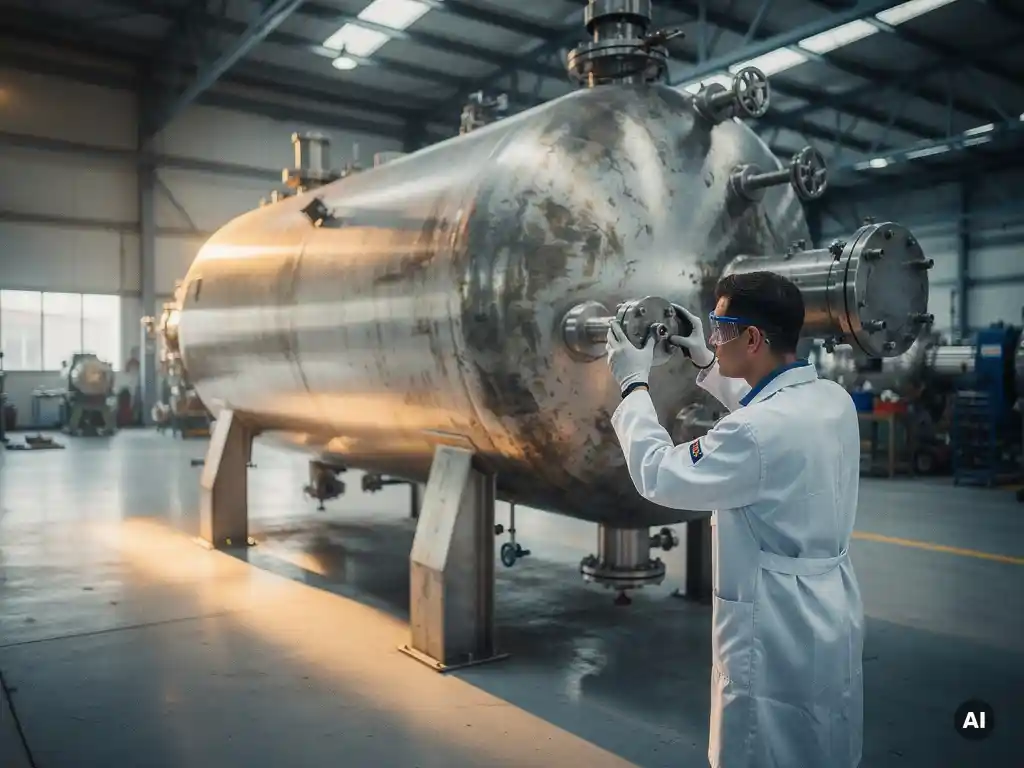
Used autoclaves are purchased primarily by manufacturers, research institutions, universities, aerospace companies, composite fabricators and industrial processors looking to reduce capital expenditure on pressure equipment. The second-hand autoclave market attracts buyers across a wide range of sectors, from food processing and medical sterilisation to advanced materials and chemical processing. This article answers the most common questions buyers ask before entering that market.
What industries purchase used autoclaves?
Used autoclaves are bought across a broad range of industries. The most active buyers include aerospace and composite manufacturers, pharmaceutical and biotech companies, food processing operations, research laboratories, rubber and tyre producers, wood treatment facilities and chemical processors. Each sector uses autoclaves differently, but all share a need for controlled high-pressure and high-temperature environments.
In aerospace and advanced composites, autoclaves cure carbon fibre and other composite materials under precise pressure and temperature conditions. These systems are often large and expensive when new, making the second-hand market attractive for smaller manufacturers or those scaling up production.
Pharmaceutical and medical device companies use autoclaves primarily for sterilisation. Research institutions and universities frequently buy used laboratory autoclaves to equip facilities at lower cost. In food processing, autoclaves are used for the preservation and sterilisation of packaged goods. Wood treatment operations use them for pressure impregnation of timber with preservatives.
Why do buyers choose used autoclaves over new ones?
The primary reason buyers choose used autoclaves is cost reduction. A new industrial autoclave, particularly a large or custom-built unit, represents a significant capital investment. A used or refurbished autoclave can deliver the same core function at a fraction of the price, which is especially attractive for smaller operations, pilot projects or applications where the equipment will not run at full capacity.
Faster availability is another key driver. Custom-built autoclaves can have lead times measured in months or longer depending on complexity, size and materials. A used autoclave already exists and can often be delivered, installed and commissioned far more quickly.
Some buyers also choose used equipment when their process requirements are well within the capabilities of older machines. If the application is not technically demanding and the equipment does not need to meet cutting-edge specifications, a proven older unit may be entirely sufficient.
What are the risks of buying a used industrial autoclave?
Buying a used industrial autoclave carries real technical and financial risks. The most serious concern is the unknown service history of the vessel. Pressure equipment that has operated under demanding conditions may have accumulated fatigue, corrosion, weld degradation or mechanical wear that is not visible during a routine inspection. Without full documentation, buyers are effectively taking on unknown liability.
- Missing or incomplete documentation: Pressure vessels require design calculations, material certificates, inspection records and certification history. Without these, re-certification may be impossible or costly.
- Corrosion and material degradation: Internal surfaces, welds and nozzles may have deteriorated depending on the media previously processed.
- Non-compliance with current standards: Older equipment may not meet current pressure equipment directives or local regulatory requirements, requiring expensive modifications.
- Incompatibility with your process: A vessel built for one application may not be suitable for another without significant engineering changes.
- Hidden repair history: Previous repairs, especially to welds or pressure boundaries, may not be fully documented or may not meet current code requirements.
The cost of bringing a used autoclave into compliance can sometimes approach or exceed the cost of ordering new equipment, particularly for large or complex vessels.
Where do buyers find used autoclaves for sale?
Used autoclaves are available through several channels. Industrial equipment dealers and surplus equipment brokers are the most common sources, offering used and refurbished pressure equipment from decommissioned plants and facility upgrades. Online industrial marketplaces also list used autoclaves, ranging from small laboratory units to large-scale industrial systems.
Auction houses that specialise in industrial and process equipment regularly sell autoclaves as part of plant liquidations or asset disposals. Direct purchases from companies that are decommissioning equipment are another route, sometimes offering better documentation and provenance than broker sales.
Industry networks, trade associations and engineering forums can also surface equipment that never reaches the open market. For buyers with very specific technical requirements, working with a specialist broker who understands pressure equipment is generally more reliable than searching general resale platforms.
What should buyers inspect before purchasing a used autoclave?
Before purchasing a used autoclave, buyers should conduct a thorough technical assessment covering documentation, physical condition and compliance status. Skipping this step is one of the most common and costly mistakes in the second-hand equipment market.
- Request full documentation: Original design drawings, material certificates, welding records, inspection reports and pressure test records should all be available.
- Verify certification and code compliance: Confirm whether the vessel was built to a recognised standard such as PED, ASME or equivalent, and whether that certification is still valid and transferable.
- Commission an independent inspection: A qualified pressure vessel inspector or notified body should examine the vessel, including internal surfaces, nozzles, welds and any mechanical components such as door seals, locking mechanisms and heating systems.
- Assess the service history: Understand what media the autoclave processed, what pressures and temperatures it operated at, and how many cycles it has completed.
- Evaluate compatibility with your process: Confirm that the vessel dimensions, pressure rating, temperature range, material construction and available connections match your process requirements.
- Estimate refurbishment costs: Factor in the likely cost of any repairs, seal replacements, control system upgrades and re-certification before comparing the total cost against new equipment.
When does buying used make sense versus ordering a custom autoclave?
Buying a used autoclave makes sense when the application is straightforward, the process requirements fall well within the capabilities of available second-hand equipment, and the documentation and certification history are complete. It is most appropriate for standard sterilisation applications, laboratory use, pilot-scale testing or situations where budget constraints are the primary driver and technical risk can be managed.
Ordering a custom industrial autoclave becomes the better choice when the application involves unusual dimensions, high pressures, elevated temperatures, corrosive media, demanding materials or tight dimensional tolerances. In these cases, a used vessel is unlikely to meet the exact technical requirements, and the cost of modifying it may exceed the value gained.
Custom equipment also offers full documentation from day one, compliance with current standards, a known service history and the ability to integrate process-specific features. For critical applications where equipment failure carries significant operational, safety or financial consequences, the certainty that comes with purpose-built equipment is often worth the higher initial investment and longer lead time.
As a general rule: if the used autoclave fits your process precisely, comes with complete documentation and passes independent inspection, it can represent genuine value. If any of those conditions are uncertain, the risk profile shifts significantly towards ordering new.
How Coek can help when used equipment is not enough
When process requirements exceed what the second-hand market can reliably offer, Coek Engineering designs and manufactures custom industrial autoclaves built to exact specifications. Relevant capabilities include:
- Large-scale manufacturing up to approximately 10 metres in diameter and approaching 1,000 tons
- Advanced materials expertise including titanium, zirconium, Hastelloy, Inconel and clad constructions
- In-house mechanical engineering to translate process requirements into manufacturable equipment
- Compliance with international standards including PED and ASME
- Experience with thick-walled, high-pressure and dimensionally demanding vessels
If your application involves conditions that a used autoclave cannot reliably meet, contact Coek Engineering to discuss your technical requirements.
Frequently Asked Questions
How do I verify whether a used autoclave's certification is transferable to my facility?
Certification transferability depends on the original certifying body, the applicable standard (such as PED or ASME), and the regulations in your country or region. You should contact the original notified body or an approved inspection authority in your jurisdiction before purchasing, as they can confirm whether the existing certification can be carried over or whether a full re-certification inspection will be required. In many cases, the seller should be able to provide a certificate of conformity and the original design dossier, both of which are essential for any re-certification process.
What refurbishment work is typically needed on a used autoclave before it can be put back into service?
The most common refurbishment requirements include replacement of door seals and gaskets, reconditioning or upgrading of control systems and instrumentation, surface treatment of internal vessel walls, and inspection or replacement of safety valves and pressure relief devices. Depending on the age and condition of the unit, heating elements, insulation, piping connections and locking mechanisms may also need attention. Always obtain a detailed refurbishment quote from a qualified pressure equipment specialist before finalising your purchase decision, as these costs can vary significantly and should be factored into your total cost of ownership calculation.
Can a used autoclave originally built for one industry be adapted for a different application?
In some cases, yes — but it requires careful engineering assessment. The critical factors are whether the vessel’s material of construction is compatible with your process media, whether the pressure and temperature ratings are appropriate, and whether the internal geometry suits your load configuration. For example, an autoclave previously used for wood treatment may not be suitable for pharmaceutical sterilisation without significant modifications to materials, controls and validation requirements. Always involve a qualified pressure vessel engineer before assuming cross-application compatibility.
What questions should I ask a used autoclave seller or broker before making an offer?
Key questions include: What was the autoclave’s original application and what media did it process? Is the full documentation package available, including design drawings, material certificates, weld records and inspection history? Has the vessel undergone any repairs, and if so, are those repairs documented and code-compliant? What is the current certification status, and when was the last formal inspection carried out? Asking these questions upfront will quickly reveal whether a listing is worth pursuing further or whether the documentation gaps make the risk unacceptable.
Are there size limitations I should be aware of when searching the used autoclave market?
The used market tends to have a reasonable supply of small to mid-sized autoclaves, particularly laboratory units and standard industrial vessels. However, very large autoclaves — such as those used in aerospace composite manufacturing — are far less frequently available second-hand, and when they do appear, they often come with complex logistics, installation and re-certification challenges. If your process requires a vessel above a certain diameter or with highly specific dimensional requirements, the second-hand market may simply not have a viable match, making a custom-built solution the more practical path.
How long does it typically take to get a used autoclave operational compared to ordering a new one?
A used autoclave can often be delivered and installed within weeks, compared to months or longer for a custom-built unit — but this timeline assumes the vessel passes inspection, requires minimal refurbishment and does not need extensive re-certification work. If significant repairs, compliance upgrades or control system replacements are needed, the timeline advantage can erode quickly. It is worth mapping out a realistic commissioning schedule for any used unit before assuming it will be faster than ordering new.
What is the role of an independent inspector, and is hiring one really necessary for a used autoclave purchase?
An independent pressure vessel inspector — typically a qualified engineer or representative from a notified body — provides an objective assessment of the vessel’s structural integrity, compliance status and fitness for purpose. While it is technically possible to purchase used equipment without one, skipping this step is one of the highest-risk decisions a buyer can make. The cost of an independent inspection is modest relative to the purchase price of any industrial autoclave, and the findings can either confirm the value of the purchase or reveal issues that would make the acquisition financially damaging. For any vessel intended for industrial or regulated use, independent inspection should be treated as non-negotiable.
Related Articles
- How does pressure cycling affect the design life of industrial pressure vessels?
- What is a batch reactor?
- How do you size a pressure vessel for a high-pressure application?
- How does nozzle placement affect reactor vessel mechanical performance?
- What causes fatigue cracking in pressure vessels under cyclic loading?