
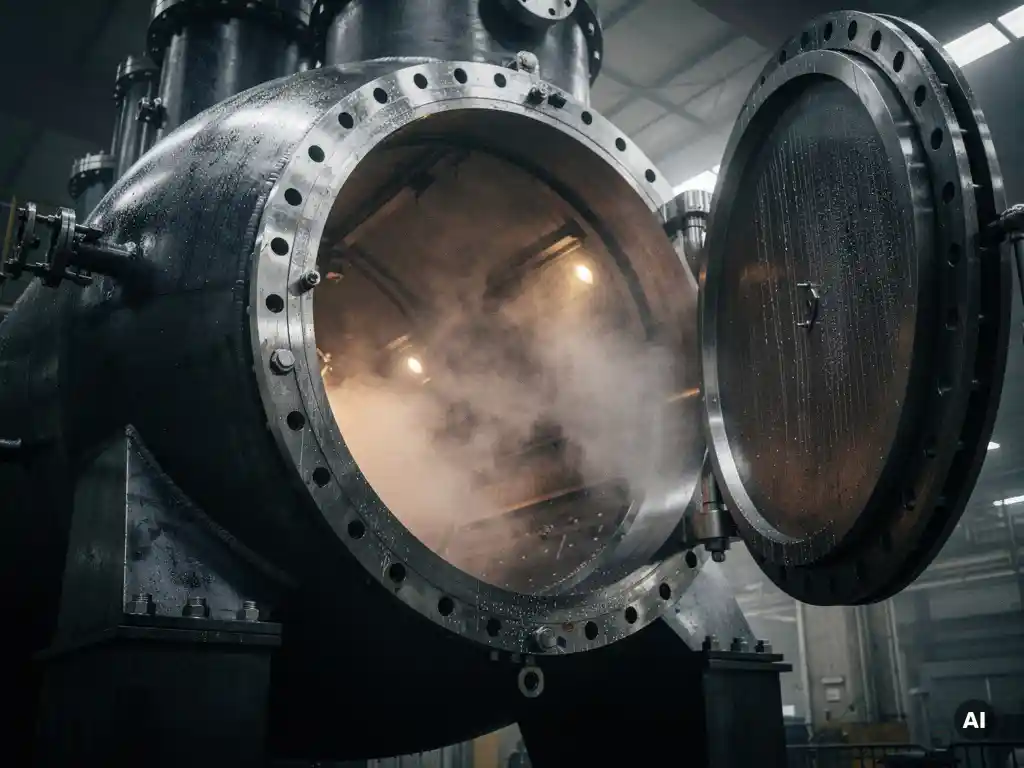
Pressure in an autoclave raises the boiling point of water, allowing steam to reach temperatures far above 100°C. This elevated temperature drives faster, more complete heat transfer into materials, enabling sterilization, curing, chemical reactions, and other processes that ambient-pressure heating simply cannot achieve. The sections below unpack exactly how autoclave pressure works and why it matters across industrial applications.
How does pressure actually change what happens inside an autoclave?
Pressure inside an autoclave raises the boiling point of water, which allows steam to exist at much higher temperatures than it would under normal atmospheric conditions. This superheated steam carries significantly more thermal energy and penetrates materials more effectively than dry heat or low-pressure steam. The result is faster, more uniform heat transfer throughout the entire load.
At sea level, water boils at 100°C. Seal that water inside a pressurized vessel and the boiling point rises in direct proportion to the pressure applied. Steam generated under these conditions is denser, hotter, and more energetic. When it contacts a cooler surface, it condenses and releases a large quantity of latent heat, transferring energy rapidly and evenly into the material.
This mechanism is the foundation of how autoclave pressure works. It is not simply about applying force. The pressure creates the conditions for steam to function as a far more powerful heat-transfer medium than it could ever be at atmospheric pressure.
What temperature and pressure levels do industrial autoclaves operate at?
Industrial autoclave operating pressure and temperature vary widely depending on the application. Sterilization autoclaves typically operate at around 121°C to 134°C, corresponding to pressures of roughly 1 to 3 bar gauge. Industrial process autoclaves for composite curing, chemical synthesis, or hydrometallurgical operations can operate at substantially higher pressures, reaching tens or even hundreds of bar, with temperatures exceeding 200°C to 300°C or more.
The relationship between pressure and temperature follows steam tables and thermodynamic laws. Each application requires a specific combination of both. A composite aerospace component cured in an autoclave, for example, requires precise pressure to consolidate the laminate while temperature drives the resin cure chemistry. A hydrometallurgical autoclave leaching refractory ore operates under entirely different conditions, with aggressive chemistry and high pressure working together to dissolve target minerals.
Industrial autoclaves are therefore engineered around the specific process requirements of the application, not built to a single universal specification. The operating envelope defines the mechanical design, the wall thickness, the material selection, and the safety systems required.
Why can’t heat alone achieve what pressurized autoclaves do?
Heat alone, without pressure, cannot raise steam temperature above 100°C at atmospheric conditions. This limits both the speed and completeness of heat transfer. Pressurized steam carries more energy per unit volume, condenses more aggressively on contact with cooler materials, and penetrates porous or dense loads far more effectively than dry heat or unpressurized steam can.
For sterilization, this distinction is critical. Dry heat sterilization requires much higher temperatures and longer exposure times to achieve the same microbial kill as pressurized steam, because steam’s latent heat of condensation delivers energy directly and rapidly into biological material. Without pressure, you cannot generate the steam conditions needed.
For industrial curing processes, pressure serves an additional mechanical function. In composite manufacturing, for instance, pressure compresses the laminate layers and removes voids, producing a denser, stronger finished part. Heat alone would cure the resin but leave structural defects that pressure eliminates.
In chemical and hydrometallurgical processes, elevated pressure suppresses the vaporization of reactants and solvents, keeps reagents in contact with the substrate, and accelerates reaction kinetics in ways that atmospheric heating cannot replicate. Pressure and temperature together create the reaction environment; neither alone is sufficient.
How does pressure affect cycle time and process efficiency?
Higher autoclave pressure enables higher steam temperatures, which accelerates heat transfer and reduces the time required to reach and hold the target process conditions. Shorter cycle times directly improve throughput and reduce energy consumption per unit processed. Pressure also improves temperature uniformity across the load, which reduces the risk of under-processing in dense or complex geometries.
In sterilization applications, operating at 134°C rather than 121°C can reduce holding time from around 15 minutes to approximately 3 minutes for equivalent sterility assurance. This is a direct consequence of the higher thermal energy delivered by steam at elevated pressure.
For industrial curing or chemical processes, cycle efficiency depends on how quickly the autoclave can reach setpoint conditions, how uniformly it maintains them, and how reliably it can be cycled repeatedly. A well-engineered autoclave with optimized pressure control, heating systems, and internal circulation minimizes variation between cycles and maximizes productive uptime.
What materials and processes specifically require autoclave pressure?
Several categories of materials and industrial processes depend specifically on autoclave pressure to achieve the required outcome:
- Sterilization of medical devices and pharmaceutical equipment – pressurized steam sterilization is the reference method for heat-stable items because it reliably destroys resistant microbial spores
- Composite and advanced material curing – aerospace, defense, and high-performance structural components made from carbon fibre or glass fibre reinforced polymers require simultaneous heat and pressure to consolidate the laminate
- Hydrometallurgical pressure oxidation – refractory gold ores and other mineral concentrates are processed under high-pressure, high-temperature oxidizing conditions to liberate target metals
- Rubber vulcanization – certain rubber and elastomer products are cured under pressure to achieve the required cross-link density and dimensional stability
- Wood and timber treatment – pressure impregnation forces preservatives deep into timber structures that surface application cannot reach
- Chemical synthesis under pressure – reactions that require suppression of volatile components, high dissolved gas concentrations, or elevated reaction kinetics at temperatures above the atmospheric boiling point of the solvent
The common factor across all these applications is that pressure is not incidental. It is a functional process variable that determines whether the outcome is achievable at all.
What happens if autoclave pressure is too high or too low?
Incorrect autoclave pressure in either direction produces process failures. If pressure is too low, steam temperature falls below the required setpoint, heat transfer slows, and the process outcome is compromised. In sterilization, this means inadequate microbial kill. In curing, it means voids, delamination, or incomplete resin cure. In chemical processes, it means reduced reaction conversion or incomplete extraction.
If pressure is too high, the risks shift toward the equipment and the process integrity. Overpressure beyond design limits creates structural risk for the vessel itself. Within the process, excessive pressure can alter reaction selectivity, damage sensitive materials, or cause mechanical distortion of the load. For autoclaves handling corrosive or reactive media, overpressure also increases the severity of any containment failure.
This is why autoclave pressure control systems, safety relief devices, and vessel design are closely integrated. The operating pressure window is defined by the process requirements on one side and the mechanical design limits on the other. A well-designed industrial autoclave maintains pressure within tight tolerances throughout the cycle, with safety systems that prevent exceedance of design limits under any credible operating scenario.
How Coek supports demanding industrial autoclave applications
Coek Engineering designs and manufactures custom industrial autoclaves for technically demanding applications where standard equipment is insufficient. Our capabilities are particularly relevant when the process requires:
- Large dimensions, high operating weight, or thick-walled construction driven by high design pressure
- Advanced or corrosion-resistant materials, including clad construction with corrosion-resistant inner layers
- Precise mechanical engineering to translate process specifications into a manufacturable, compliant vessel
- Compliance with international standards including PED and ASME
- Integrated equipment scope combining the autoclave with related mechanical systems
Coek works from customer process requirements and converts them into mechanically sound, manufacturable equipment. If you are sourcing a high-pressure autoclave for a technically demanding application, contact our engineering team to discuss your requirements.
Frequently Asked Questions
How do I determine the right operating pressure for my specific autoclave application?
Start by defining the process outcome you need to achieve — whether that is a specific sterility assurance level, a target resin cure state, or a required reaction conversion rate — and work backwards to the temperature and pressure conditions that deliver it. Steam tables and thermodynamic data will map the pressure-temperature relationship for steam-based processes, while material or chemistry suppliers typically specify the required cure or reaction conditions for their products. Engaging an autoclave manufacturer early in this process is strongly recommended, as they can translate process specifications into a defined operating envelope and a compliant vessel design.
What are the most common mistakes made when specifying an industrial autoclave?
The most frequent mistake is specifying the autoclave around equipment constraints rather than process requirements — for example, selecting a standard vessel and then trying to adapt the process to fit it. Other common errors include underestimating the wall thickness and material requirements driven by high design pressure, failing to account for corrosive process media when selecting construction materials, and overlooking the importance of pressure uniformity and temperature distribution across the full load volume. Each of these errors typically results in either a process that underperforms or a vessel that requires costly redesign.
Can an autoclave be used for multiple different processes or materials, or does each application require a dedicated vessel?
In principle, a single autoclave can handle multiple applications if their operating envelopes overlap — meaning the pressure, temperature, media compatibility, and cycle requirements are compatible. In practice, however, industrial autoclaves are usually dedicated to a specific process because the vessel design, internal configuration, sealing systems, and control logic are optimized for that application. Switching between chemically aggressive and non-aggressive processes, for instance, raises contamination and material compatibility concerns that are difficult to manage in a shared vessel.
What safety systems are typically required on a high-pressure industrial autoclave?
At minimum, industrial autoclaves require pressure relief devices — typically safety relief valves or rupture discs — sized to prevent the vessel from exceeding its maximum allowable working pressure under any credible overpressure scenario. Beyond that, high-pressure autoclaves typically incorporate pressure and temperature instrumentation with independent high-limit shutdown systems, interlocked closure mechanisms that prevent opening under pressure, and in many cases automated control systems that manage the pressurization and depressurization cycle. The specific safety system requirements are governed by the applicable pressure vessel standards — such as PED in Europe or ASME in North America — as well as the nature of the process media and the installation environment.
How does autoclave size affect pressure performance and process uniformity?
As autoclave volume increases, maintaining uniform pressure and temperature distribution across the entire load becomes more challenging. Larger vessels require more powerful heating systems, more carefully designed internal gas or steam circulation, and more sophisticated control systems to ensure that every point in the load reaches and holds the required conditions simultaneously. Poor uniformity in a large autoclave means some portions of the load may be over-processed while others are under-processed — a critical problem in both sterilization and composite curing. This is why large-format industrial autoclaves typically incorporate forced circulation systems and multiple monitoring points rather than relying on passive heat distribution.
What materials of construction should I consider for autoclaves handling corrosive process media?
For corrosive applications — such as hydrometallurgical pressure oxidation or chemical synthesis involving aggressive acids or oxidizing agents — standard carbon steel construction is generally insufficient. Common solutions include stainless steel (with grade selection depending on the specific chemistry), titanium, or clad construction where a corrosion-resistant alloy is bonded to a structural carbon steel shell. The choice depends on the specific media, concentration, temperature, and pressure, and should be validated against published corrosion data or materials testing. Clad construction is often the most cost-effective approach for large vessels where solid alloy construction would be prohibitively expensive.
What international standards govern the design and certification of industrial pressure autoclaves?
The two most widely referenced standards are the European Pressure Equipment Directive (PED, 2014/68/EU) and the ASME Boiler and Pressure Vessel Code (ASME BPVC), particularly Section VIII for unfired pressure vessels. PED applies to equipment placed on the market within the European Economic Area, while ASME is the dominant standard in North America and is also accepted in many other markets. Both frameworks set requirements for design, materials, fabrication, inspection, and testing, and require third-party conformity assessment for higher-risk pressure classes. If your autoclave will be installed or operated across multiple jurisdictions, it is important to clarify which standards apply before finalizing the design specification.
Related Articles
- What are the main manufacturing challenges of large shell-and-tube heat exchangers?
- How long does it take to manufacture a custom industrial pressure vessel?
- When should an industrial company consider replacing rather than repairing a pressure vessel?
- What international standards apply to pressure vessel design and certification?
- What is the difference between ASME and PED pressure vessel certification?