
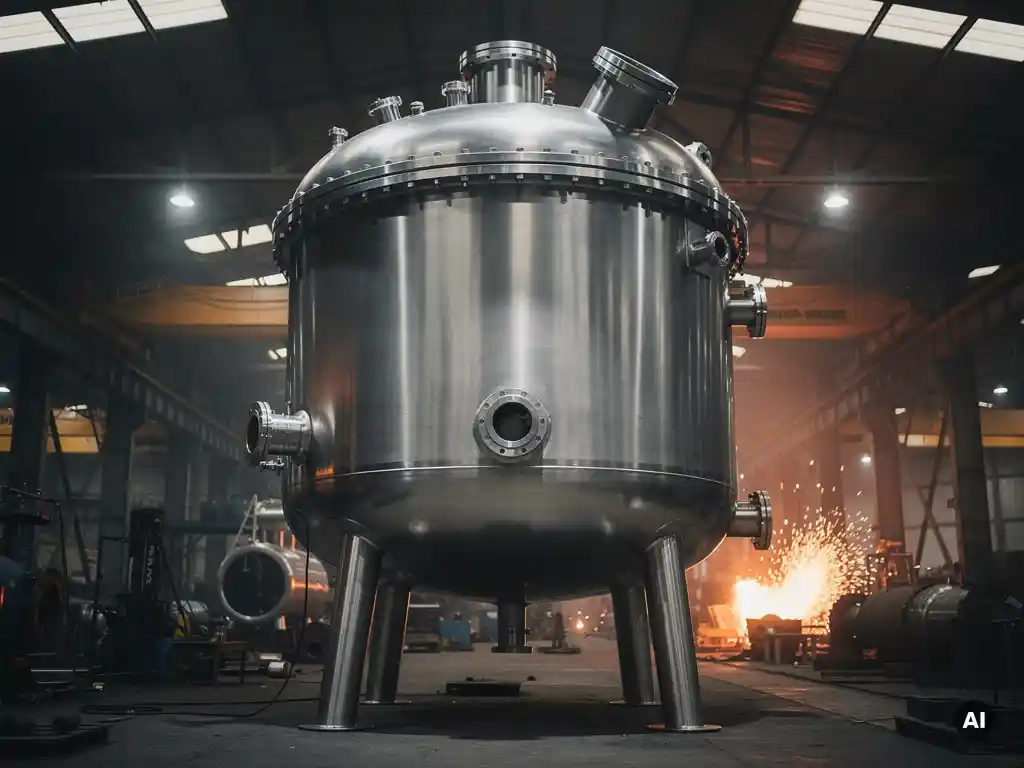
A batch reactor is a closed vessel in which reactants are loaded, allowed to react over a defined period of time, and then discharged as product before the next cycle begins. Unlike continuous systems, nothing enters or leaves the reactor during the reaction itself. Batch reactors are widely used across chemical, pharmaceutical, food processing and specialty materials industries where flexibility, small volumes or precise reaction control are required. The sections below address the most common questions about batch reactor working principles, types, design and selection.
How does a batch reactor work?
A batch reactor works by charging all reactants into a vessel at the start of a cycle, allowing the reaction to proceed under controlled conditions of temperature, pressure and agitation, and then emptying the vessel once the desired conversion or product quality is reached. The entire reaction takes place in a single, closed environment with no continuous feed or withdrawal during processing.
The operating sequence typically follows these steps:
- Charging: reactants, solvents and catalysts are loaded into the vessel
- Conditioning: the vessel is brought to the required temperature and pressure
- Reaction: the mixture reacts for a predetermined time under controlled conditions
- Sampling or monitoring: operators verify conversion or product quality
- Discharge: the product is removed and the vessel is cleaned for the next batch
Agitation plays a central role in most batch reactors. Mechanical agitators ensure uniform temperature distribution, prevent local hot spots and keep solid catalysts or suspended materials in contact with the reactant phase. Heating or cooling jackets, internal coils or external heat exchangers regulate temperature throughout the cycle.
What are the main types of batch reactors?
The main types of batch reactors are the simple stirred tank batch reactor, the jacketed batch reactor, the autoclave reactor and the semi-batch reactor. Each type is suited to different reaction conditions, scale and process requirements.
- Stirred tank batch reactor: the most common configuration, featuring a cylindrical vessel with a mechanical agitator. Used for liquid-phase reactions at moderate temperatures and pressures.
- Jacketed batch reactor: a stirred tank with an outer jacket through which heating or cooling fluid circulates, enabling precise thermal control throughout the reaction cycle.
- Autoclave reactor: a heavy-walled, sealed vessel designed for reactions at elevated pressure and temperature. Autoclaves are used in high-pressure hydrogenation, polymerization and hydrothermal synthesis. Large-scale industrial autoclaves can reach considerable size and weight for demanding applications.
- Semi-batch reactor: a hybrid configuration in which one or more reactants are added gradually during the reaction while the vessel is not continuously discharged. This allows better control over exothermic reactions or selectivity.
The choice between these types depends on the reaction chemistry, required pressure and temperature range, scale and the degree of thermal control needed.
What is the difference between a batch reactor and a continuous reactor?
The key difference between a batch reactor and a continuous reactor is how material flows through the system. In a batch reactor, reactants are processed as discrete, isolated charges with no flow during the reaction. In a continuous reactor, reactants flow in and products flow out simultaneously without interruption.
Batch reactors offer greater flexibility. The same vessel can be used for different products or formulations simply by changing the charge composition, reaction time or operating conditions. This makes batch processing particularly well suited to specialty chemicals, pharmaceuticals and any situation where product variety or small production volumes matter more than throughput efficiency.
Continuous reactors, by contrast, are optimized for high-volume, single-product processes where steady-state operation reduces energy consumption per unit of product and minimizes downtime. They are common in large-scale petrochemical, fertilizer and commodity chemical production.
The practical trade-off is between flexibility and throughput. Batch reactors carry higher labor and cleaning costs per unit of production, while continuous reactors require higher capital investment and are less adaptable to product changes.
What industries and processes use batch reactors?
Batch reactors are used across a broad range of industries wherever flexibility, small-to-medium production volumes or demanding reaction conditions require a controlled, closed processing environment. Pharmaceutical manufacturing, specialty chemicals, food and beverage processing, polymer production and advanced materials synthesis are among the most common application areas.
In pharmaceutical production, batch reactors are standard because regulatory requirements demand full traceability of each production run and formulations change frequently. In specialty chemicals, the ability to switch between products without major equipment changes makes batch processing economically attractive. Polymer and resin manufacturers use batch reactors for controlled polymerization reactions, and hydrothermal or high-pressure synthesis processes in advanced materials rely on autoclave-type batch reactors for the extreme conditions required.
Batch reactors also appear in food processing for fermentation, extraction and heat treatment, as well as in mining and hydrometallurgy for pressure leaching and mineral dissolution at elevated temperatures.
What design factors determine batch reactor performance?
Batch reactor performance is determined by vessel geometry, agitation design, heat transfer capability, pressure rating and materials of construction. Each factor influences how uniformly and efficiently the reaction proceeds, and how safely the vessel handles the operating conditions.
Vessel geometry affects mixing efficiency and residence time distribution. The ratio of vessel diameter to height, the position and type of agitator, and the number and placement of baffles all influence how well the contents are mixed. Poor mixing leads to temperature gradients, incomplete conversion or selectivity problems.
Heat transfer is often the limiting factor in batch reactor design. Exothermic reactions can generate heat faster than a jacket alone can remove it, which is why internal coils, reflux condensers or external heat exchangers are added to supplement jacket cooling. The heat transfer area relative to vessel volume decreases as scale increases, making thermal management more challenging in large reactors.
Pressure rating and wall thickness are determined by the maximum operating pressure, temperature and the mechanical properties of the selected material. For high-pressure applications, thick-walled construction and precise dimensional tolerances are essential for both safety and long service life.
What materials are batch reactors made from?
Batch reactors are manufactured from a wide range of materials depending on the process chemistry, operating temperature and pressure, and required corrosion resistance. Carbon steel is used for non-corrosive applications at moderate conditions, while stainless steel grades are standard for most chemical and pharmaceutical processes.
When the process involves aggressive acids, halogens, oxidizing agents or other highly corrosive media, advanced alloys or clad construction become necessary. Materials such as Hastelloy, Inconel, titanium and zirconium offer corrosion resistance that carbon or stainless steel cannot provide in these environments. Clad construction, where a carbon steel structural shell is lined with a corrosion-resistant inner layer, is a practical and cost-effective approach for large vessels where solid exotic alloy construction would be prohibitively expensive.
The selection of materials directly affects fabrication complexity, welding requirements, inspection protocols and the certifications required for the finished equipment. Reactors handling toxic or flammable media under pressure must meet strict material and fabrication standards, including relevant pressure equipment directives and codes such as PED or ASME.
When should you choose a batch reactor over other options?
A batch reactor is the right choice when production volumes are low-to-medium, when multiple products share the same equipment, when reaction time must be precisely controlled or when the chemistry involves hazardous, sensitive or complex multi-step reactions that are difficult to manage in a continuous system.
If a process requires frequent product changeovers, strict batch traceability or the flexibility to adjust reaction conditions between runs, batch processing is generally more practical and economical than building dedicated continuous capacity. Batch reactors are also preferred when reactions are inherently slow, when solid or heterogeneous phases are involved, or when the process is still being developed and may change over time.
Continuous processing becomes preferable when production volumes are large, when reaction times are short, or when steady-state operation can deliver meaningful energy and cost savings per unit of output. For many industrial processes, the decision is not absolute and a semi-batch configuration may offer a practical middle ground.
How Coek supports custom batch reactor projects
Coek Engineering designs and manufactures custom reactor vessels for technically demanding batch processes, including applications that require advanced materials, thick-walled construction, clad design or large-scale fabrication. For projects where standard equipment is insufficient, Coek translates process specifications into mechanically sound, manufacturable reactor vessels that comply with the required international standards.
Relevant capabilities for batch reactor projects include:
- Custom reactor fabrication in solid and clad construction, including corrosion-resistant alloys such as titanium, Hastelloy and Inconel
- Manufacturing of large-scale, high-pressure autoclave-type reactors for demanding conditions
- In-house mechanical engineering to convert process requirements into compliant, fabricable designs
- Compliance with PED, ASME and ISO 9001 standards for critical pressure equipment
- Integrated equipment scopes including agitators, drive systems, seals and instrumentation where required
If your project involves a batch reactor with demanding specifications, contact Coek to discuss your requirements with our engineering team.
Frequently Asked Questions
How long does a typical batch reactor cycle take, and what factors affect cycle time?
Cycle time varies widely depending on the reaction kinetics, required conversion, and the time needed for charging, heating, cooling, and cleaning between runs. A simple liquid-phase reaction might complete in a few hours, while complex polymerization or hydrothermal synthesis processes can run for 12–48 hours or more. Reducing non-productive time — such as cleaning, heating ramps, and discharge — is often where operators find the most practical efficiency gains in batch processing.
What are the most common mistakes made when scaling up a batch reactor from lab to industrial scale?
The most frequent scaling mistakes involve underestimating heat transfer limitations and mixing performance at larger volumes. Because the surface-area-to-volume ratio decreases as vessel size increases, a jacket that provided adequate cooling at pilot scale may be completely insufficient at production scale — leading to runaway temperatures in exothermic reactions. Agitator design also needs to be re-evaluated at scale, as impeller geometry and tip speed that worked in a small vessel may produce poor mixing or mechanical stress in a large one. Involving a mechanical engineer experienced in scale-up early in the design process prevents costly redesigns later.
How do you safely handle highly exothermic reactions in a batch reactor?
Safe handling of exothermic reactions typically involves a combination of controlled reagent addition (using a semi-batch approach), adequate heat removal capacity through jackets, internal coils or reflux condensers, and robust temperature monitoring with automatic safety interlocks. Calorimetric studies — such as reaction calorimetry — are strongly recommended before scaling up to quantify the heat of reaction and establish safe operating limits. For particularly hazardous reactions, pressure relief systems, emergency quench capabilities, and formal hazard assessments (such as a HAZOP study) are standard requirements.
What maintenance and inspection practices are most important for batch reactors operating under high pressure?
High-pressure batch reactors require regular inspection of sealing surfaces, flanges, gaskets, and closure mechanisms, as these are the most common points of failure under cyclic pressure loading. Wall thickness measurements using ultrasonic testing help detect corrosion or erosion before it becomes a safety concern, particularly in reactors handling aggressive media. Agitator shaft seals and mechanical drive components should also be inspected on a defined schedule, and all pressure relief devices must be tested and recertified according to the applicable pressure equipment code (such as PED or ASME). Keeping detailed maintenance records is essential for regulatory compliance and for tracking equipment condition over time.
Can a batch reactor be upgraded or retrofitted to improve performance, or is replacement always necessary?
Many batch reactors can be meaningfully upgraded without full replacement, depending on the nature of the performance gap. Common retrofits include adding internal cooling coils to supplement jacket heat transfer, upgrading the agitator impeller geometry for better mixing, installing improved seal systems to handle higher pressures, or applying an internal corrosion-resistant lining to extend service life with aggressive chemistries. Whether a retrofit is cost-effective depends on the age and structural condition of the vessel, the extent of the required changes, and whether the modifications can be made in compliance with the original or updated pressure equipment certification.
What documentation and certifications should I expect when procuring a custom batch reactor for pharmaceutical or chemical production?
A properly certified batch reactor for regulated industries should come with a full material traceability package (mill certificates for all pressure-bearing materials), a manufacturer’s data report, weld maps and non-destructive examination (NDE) records, pressure test documentation, and a Declaration of Conformity where required by applicable directives such as the EU Pressure Equipment Directive (PED). For pharmaceutical applications, surface finish documentation, passivation records, and compliance with GMP-relevant fabrication standards are also typically required. Confirming documentation requirements with the manufacturer before fabrication begins avoids delays at the qualification or commissioning stage.
What is the best way to get started if I need a custom batch reactor but haven't finalized my process specifications yet?
The best starting point is to share as much process information as you have — including the reaction chemistry, expected temperature and pressure ranges, approximate volume, and any known material compatibility requirements — even if those parameters are not yet fully defined. An experienced reactor manufacturer can help identify which design variables are most critical to resolve first and flag potential engineering constraints early, before they become expensive problems. Engaging the fabricator during the process development phase, rather than after specifications are locked, often leads to better-optimized designs and avoids the need for costly revisions later.
Related Articles
- What safety systems are required for high-pressure industrial autoclaves?
- What are the sizes of autoclaves available?
- What welding methods are used in pressure vessel fabrication?
- What is an autoclave and how does it work in industrial processes?
- How do you prevent stress corrosion cracking in pressure vessel materials?