
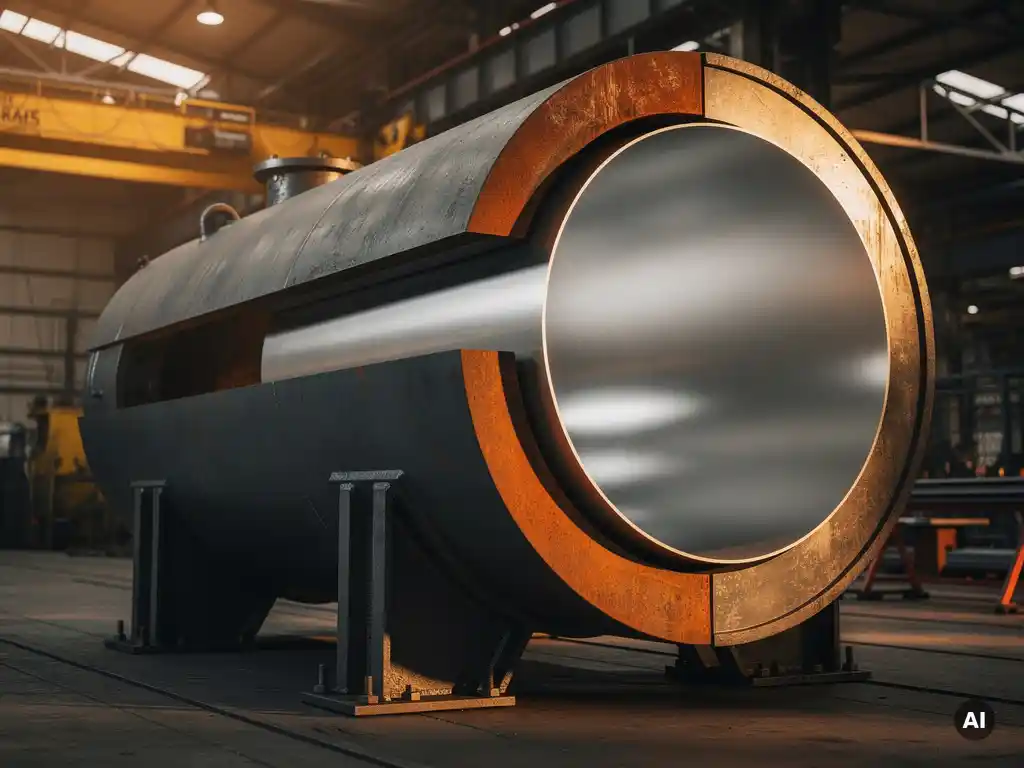
A solid pressure vessel is constructed entirely from a single material throughout its full wall thickness, while a clad pressure vessel combines a structural base material with a bonded corrosion-resistant inner layer. The choice between the two comes down to the operating environment: when the process fluid is highly corrosive but the required wall thickness makes a full solid alloy construction impractical or uneconomical, cladding offers a technically sound and cost-effective alternative. The sections below address the most important questions engineers and procurement teams encounter when specifying one construction type over the other.
What makes clad construction different from solid construction?
In a solid pressure vessel, the entire wall is made from one homogeneous material, typically carbon steel for standard applications or a corrosion-resistant alloy when the process demands it. In clad construction, a thinner corrosion-resistant layer is metallurgically or mechanically bonded to the inside face of a carbon steel or low-alloy structural shell. The structural shell carries the mechanical load; the cladding handles the corrosive environment.
This separation of functions is the defining characteristic of clad pressure vessel construction. The base material is selected for its mechanical properties and weldability at the required wall thickness. The cladding material is selected purely for its resistance to the specific process fluid, temperature, and chemistry involved.
Cladding can be applied through several methods, including explosion bonding, roll bonding, or weld overlay. Each method produces a different bond quality and is suited to different material combinations and vessel geometries. The result, when properly executed, is a composite wall that behaves as an integrated structure under pressure loading.
When should a clad pressure vessel be specified instead of a solid one?
A clad pressure vessel should be specified when the process fluid requires corrosion resistance that only an expensive alloy can provide, but the required structural wall thickness makes fabricating the entire vessel from that alloy impractical, prohibitively expensive, or technically difficult to weld at scale.
The most common triggers for specifying clad construction include:
- High-corrosivity process fluids such as concentrated acids, chloride-containing streams, or aggressive solvents
- Large vessel diameters or wall thicknesses where a full solid alloy construction would be extremely costly
- Operating conditions where standard carbon steel cannot survive but a thin alloy layer provides adequate protection
- Long design lifetimes where corrosion allowance on carbon steel alone would demand impractical wall thicknesses
- Projects where the total installed cost of a clad vessel is substantially lower than an equivalent solid alloy vessel
When wall thickness requirements are modest and the alloy is readily weldable in the required dimensions, a solid construction may remain competitive. The decision is always a function of material cost, fabrication complexity, and the severity of the operating environment.
What materials are commonly used for the cladding layer?
The cladding layer in a corrosion-resistant pressure vessel is selected based on the specific chemical environment, temperature range, and any regulatory or process requirements. The most commonly specified cladding materials include stainless steels such as 316L and duplex grades, as well as higher-performance alloys for more aggressive conditions.
For highly demanding environments, cladding materials extend into the specialty alloy range:
- Titanium – excellent resistance to oxidising acids and chloride environments
- Zirconium – used where resistance to hydrochloric and sulphuric acids is required
- Tantalum – specified for extremely aggressive acid service
- Hastelloy and Inconel grades – for high-temperature corrosive environments and mixed chemical exposure
- Nickel alloys – for caustic or reducing environments
The base material is most commonly carbon steel or low-alloy steel, chosen for its structural strength, availability in large plate thicknesses, and established weldability. The combination of base and cladding material must be metallurgically compatible, and the bonding method must produce a reliable interface that remains intact under thermal cycling and mechanical loading throughout the vessel’s service life.
How does cladding affect pressure vessel design and code compliance?
Cladding affects both the mechanical design and the code compliance process of a pressure vessel. Under codes such as ASME VIII or the European Pressure Equipment Directive, only the base material is typically credited for structural wall thickness calculations. The cladding layer is treated as a corrosion barrier rather than a load-bearing element, which means the structural shell must be designed to carry the full pressure load independently.
This has direct consequences for the design process. The minimum required wall thickness is calculated based on the base material’s allowable stress. If the cladding is to be credited in any way, specific code provisions and material qualifications must be met and documented.
Weld joint design in clad vessels is considerably more complex than in solid vessels. Transitions between clad and unclad sections, nozzle attachments, and internal weld seams all require detailed engineering to ensure that the corrosion barrier remains continuous and that the bond integrity is maintained at every joint. Non-destructive examination requirements are also more extensive, covering both the bond interface and the weld zones in both materials.
What are the quality risks in clad pressure vessel fabrication?
The primary quality risks in clad pressure vessel fabrication centre on bond integrity, weld quality at material transitions, and the continuity of the corrosion barrier. If the bond between the cladding and base material is incomplete or degrades during fabrication, the vessel may develop localised corrosion behind the cladding layer that is extremely difficult to detect and repair in service.
Welding at the interface between clad and base material introduces the risk of dilution, where the weld pool draws in base material chemistry and reduces the corrosion resistance of the weld zone. Controlling dilution requires precise welding procedures, qualified welders, and in many cases the use of matching or over-alloyed filler materials.
Additional fabrication risks include:
- Delamination of the cladding layer during forming or heat treatment
- Inadequate examination of bond quality at plate edges and weld preparations
- Incorrect sequencing of weld passes leading to contamination of the alloy layer
- Insufficient post-weld inspection of the cladding surface for defects or discontinuities
These risks make fabrication experience and rigorous quality control essential. A clad vessel manufactured without deep familiarity with the specific material combination and bonding method carries a significantly higher risk of in-service failure than one produced by a fabricator with a proven track record in clad construction.
Is a solid alloy vessel ever the better choice over a clad one?
Yes. A solid alloy pressure vessel is the better choice when wall thickness requirements are low enough that the full alloy construction remains economically competitive, or when the specific alloy is difficult to bond reliably to a carbon steel base. In some cases, the fabrication complexity and inspection burden of a clad vessel can outweigh the material cost savings.
Solid construction is also preferred when the process involves extremely high temperatures or pressures where the mechanical behaviour of a composite wall introduces uncertainty, or when the geometry of the vessel makes continuous cladding coverage difficult to achieve and verify. For smaller vessels, the cost differential between solid and clad construction may be marginal, and solid construction simplifies both fabrication and inspection.
The decision is never automatic. It requires a structured comparison of material costs, fabrication complexity, code compliance implications, inspection requirements, and the consequences of any in-service failure. In practice, the most technically demanding projects benefit from involving an experienced fabricator in the material selection discussion before the specification is fixed.
How Coek supports clad and solid pressure vessel projects
Coek Engineering has more than 30 years of experience in clad pressure vessel construction, working with material combinations that include carbon steel bases clad with titanium, zirconium, tantalum, Hastelloy, Inconel, and stainless steel grades. For each project, Coek translates customer process requirements into mechanically sound and manufacturable equipment, covering both solid and clad construction across a wide range of dimensions and operating conditions.
Key capabilities relevant to clad and solid vessel projects include:
- In-house mechanical engineering to evaluate and specify construction type based on process conditions
- Advanced materials expertise across a wide range of corrosion-resistant alloys
- Large-scale manufacturing for vessels up to 10 metres in diameter and approximately 1,000 tons
- Compliance with ASME, PED, and ISO 9001 requirements for both construction types
- Rigorous fabrication and inspection procedures for clad bond integrity and weld quality
If you are evaluating construction options for a technically demanding vessel, contact Coek Engineering to discuss your process requirements and find the most appropriate fabrication approach for your project.
Frequently Asked Questions
How do I evaluate the total cost difference between a clad and a solid alloy pressure vessel for my project?
A meaningful cost comparison should account for raw material costs, fabrication labour, inspection requirements, lead times, and long-term maintenance. Clad vessels typically offer significant savings on material cost for large or thick-walled vessels, but they carry higher fabrication and inspection costs due to the complexity of the bond interface and weld transitions. The most reliable approach is to request detailed quotations for both construction types from an experienced fabricator who can assess your specific dimensions, material combination, and code requirements — rather than relying on rule-of-thumb estimates.
What inspection methods are used to verify the integrity of the cladding bond before a vessel enters service?
Bond integrity in clad pressure vessels is typically verified using ultrasonic testing (UT), which can detect disbonding, voids, or delamination at the interface between the cladding and base material. Shear wave and phased array UT techniques are commonly applied across the full plate area and at weld zones. Visual inspection and dye penetrant or liquid penetrant testing (PT) are also used on the cladding surface to identify surface-breaking defects. Code requirements such as ASME VIII specify minimum examination coverage, but reputable fabricators typically apply more extensive inspection protocols for safety-critical applications.
Can a clad pressure vessel be repaired in the field if the cladding is damaged during operation?
Field repair of clad pressure vessels is possible but technically demanding. Minor surface damage to the cladding layer can often be addressed through weld overlay repair using qualified procedures and matching or over-alloyed filler materials. However, any repair must restore the full corrosion barrier without introducing dilution from the base material into the repair weld. Repairs should be carried out by welders qualified for the specific alloy combination, and the repaired area must be re-inspected to confirm barrier continuity. For significant bond degradation or large-area disbonding, the vessel may need to be returned to a specialist fabricator.
How does thermal cycling affect the long-term performance of a clad vessel, and what should I look for during inspection intervals?
Repeated thermal cycling creates differential thermal expansion stresses at the bond interface because the cladding and base material typically have different coefficients of thermal expansion. Over time, this can contribute to progressive disbonding, particularly at edges, nozzle attachments, and weld transitions. During scheduled inspection intervals, ultrasonic bond testing should be repeated in areas identified as higher risk — especially around heat-affected zones and any locations where disbonding was previously detected. Tracking bond condition over successive inspections allows early identification of degradation trends before they develop into service failures.
What questions should I ask a fabricator before awarding a clad pressure vessel contract?
Key questions include: What is your documented experience with this specific material combination (base material and cladding alloy)? Which bonding method do you use, and how do you qualify and verify bond quality for this combination? What are your standard NDE procedures for bond integrity and weld zone inspection? Can you provide references or case studies from comparable projects? How do you control dilution at the clad-to-base weld interface, and what filler materials do you use? The answers will reveal whether the fabricator has genuine hands-on expertise or is treating your project as unfamiliar territory — a distinction that directly affects the risk profile of the finished vessel.
Are there material combinations that are not suitable for clad construction, and how do I know if my required alloy can be reliably bonded?
Not all material combinations produce a reliable metallurgical bond. Some alloy pairings are prone to brittle intermetallic formation at the bond interface, particularly when joining dissimilar metals with very different chemistries, such as titanium or tantalum to carbon steel. In these cases, explosion bonding is often the only viable method, and even then, intermediate interlayer materials may be required to achieve a sound bond. The compatibility of your chosen cladding and base material should be confirmed with the fabricator early in the specification process, ideally before the material selection is finalised, to avoid design changes later.
What is weld overlay cladding, and how does it differ from explosion-bonded or roll-bonded clad plate?
Weld overlay cladding applies the corrosion-resistant layer directly onto the base material using a welding process, typically strip cladding or hot-wire TIG, building up the alloy layer pass by pass. It is well suited to nozzles, internal surfaces with complex geometry, and repair applications where pre-clad plate cannot be used. Explosion bonding and roll bonding, by contrast, produce the composite material as a plate before fabrication begins, offering a more uniform and extensively tested bond across large flat surfaces. In practice, many clad vessels use a combination: explosion- or roll-bonded plate for the main shell and weld overlay for nozzles and transition areas where pre-clad plate cannot be formed or fitted.
Related Articles
- What determines the manufacturing cost of a large industrial pressure vessel?
- How do you control dimensional accuracy in large pressure vessel fabrication?
- When does a pressure vessel require thick-wall design?
- What factors determine the design life of an industrial autoclave?
- What causes fatigue cracking in pressure vessels under cyclic loading?