
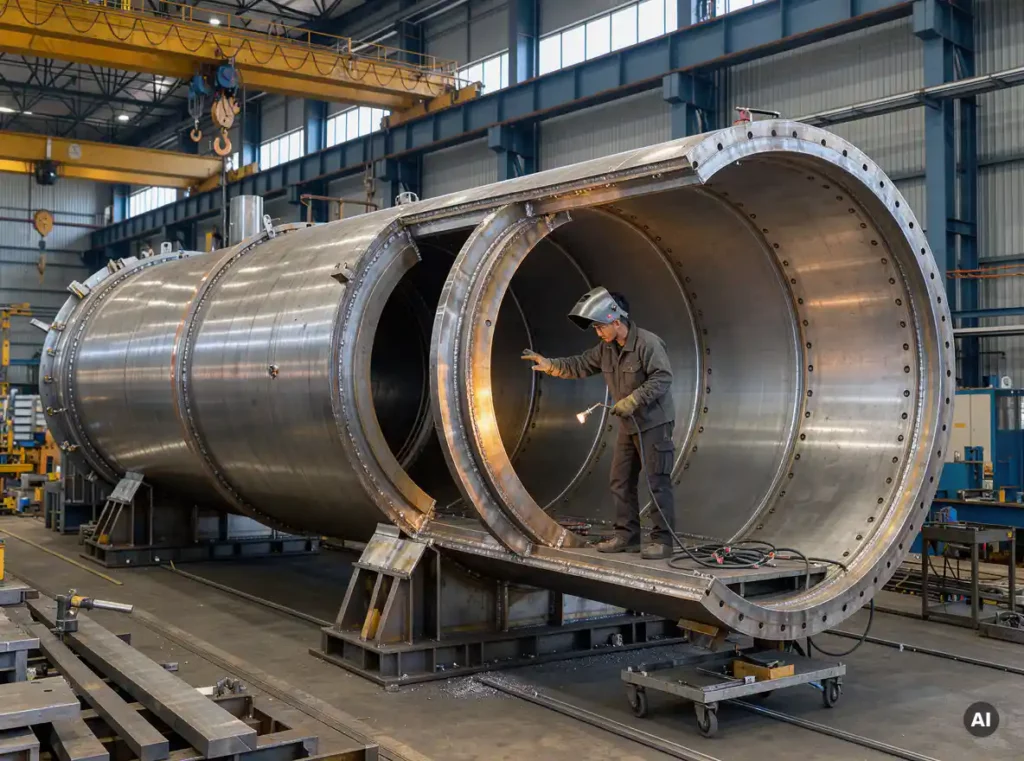
Hydrometallurgical autoclaves are divided into internal compartments so that slurry passes through a series of stages in a controlled sequence, instead of mixing in one open volume. Each compartment acts as a staged reaction zone with its own agitation, residence time and reaction conditions, which improves leaching or oxidation efficiency and reduces short-circuiting of fresh slurry to the discharge.
This staging matters most in horizontal autoclaves used for pressure oxidation and high-pressure acid leaching, where reaction kinetics, heat release and oxygen demand change along the vessel. The sections below explain how slurry moves, why compartments help, how many are needed, how they are built and when a single chamber is enough.
How does slurry move between autoclave compartments?
Slurry moves between autoclave compartments by overflowing over internal dividing walls, called weirs, from one compartment to the next. Feed enters at one end, flows forward in a controlled cascade and exits at the other end, so the slurry passes through every compartment in order.
Each compartment is agitated, which keeps solids suspended and disperses gas such as oxygen into the slurry. The weir height sets the liquid level and the hydraulic path, while the partition geometry limits backflow. The result is a flow pattern that approximates a series of continuously stirred reactors inside one pressure shell.
Flow between compartments is driven by the feed pressure and the level difference across each weir, not by mechanical transfer. This is one reason the weir design and levelling accuracy matter. A small deviation in weir height can shift the slurry level and change residence time in a given compartment.
Why does compartment design improve leaching and oxidation efficiency?
Compartment design improves leaching and oxidation efficiency because it forces slurry through a defined sequence of reaction stages, which narrows the spread of residence times. Fewer particles leave early, so a higher share of the feed receives the full reaction time needed for oxidation or acid leaching.
In a single, well-mixed volume, some fresh feed inevitably reaches the discharge quickly while other material stays much longer. Splitting the vessel into compartments approaches plug-flow behaviour, which is generally more efficient for reactions that slow down as the reactant is consumed.
Staging also helps the process in practical ways:
- Temperature management: exothermic oxidation reactions can be managed zone by zone, with cooling or heating applied where needed.
- Oxygen and gas distribution: oxygen can be injected where demand is highest, rather than sparged uniformly.
- Reagent control: acid and oxygen demand differ along the reaction path, and compartments let operators match supply to demand.
- Agitation intensity: each stage can have an agitator sized for local solids loading and viscosity.
How many compartments does an autoclave need?
The number of compartments depends on the process requirements, mainly residence time, reaction kinetics, slurry throughput and the desired approach to plug flow. There is no universal figure. Process licensors or technology owners define the compartment count, and the mechanical design then has to deliver it reliably.
More compartments generally give a narrower residence time distribution, but every extra stage adds partitions, agitators, shaft seals and fabrication effort. The right number is therefore a balance between process benefit and mechanical complexity.
Typical factors that drive the decision include:
- The required conversion level of the target mineral or sulphide.
- Total residence time at operating temperature and pressure.
- Heat release per stage and the cooling or heating strategy.
- Slurry density, solids content and settling behaviour.
- Maximum practical vessel length and diameter for fabrication and transport.
Because the process side belongs to the technology owner, equipment engineers work from a specified compartment arrangement and focus on making it mechanically sound, accessible for maintenance and manufacturable at scale.
What are the internal compartments made of and how are they built?
Internal compartments are built from partition walls and weirs fabricated in corrosion-resistant material compatible with the slurry, typically titanium or a titanium-clad construction in acidic oxidative service. They are welded or fitted inside a pressure shell that is itself protected by a lining.
The shell of a hydrometallurgical autoclave is commonly carbon steel for strength, with a protective layer against the aggressive slurry. This can be a titanium lining or cladding, often combined with an acid-resistant brick lining. The internals, including partitions, weirs and agitator-related components, must resist the same chemistry plus erosion from solids.
Several design points deserve attention:
- Material selection: titanium grades such as Grade 17 have been used as lining material in autoclaves, and detailing is often adapted to limit erosion in high-velocity zones.
- Weir and partition geometry: sharp edges, flow impingement points and turbulent zones are common erosion sites and benefit from careful detailing.
- Structural support: partitions must carry hydraulic loads and accommodate thermal movement without cracking the lining or cladding.
- Agitator integration: each compartment needs shaft penetrations, seals and nozzles that remain leak tight under pressure and temperature.
For related equipment options, see the overview of industrial autoclave design for demanding corrosive service.
What fabrication challenges do compartmented autoclaves create?
Compartmented autoclaves create fabrication challenges because they combine very large, heavy pressure shells with precise internal geometry and demanding corrosion-resistant materials. Dimensional accuracy, weld quality in titanium or clad layers and the fit of internal partitions all have to be controlled across a vessel that can weigh several hundred tons.
The main difficulties usually fall into a few areas:
- Scale and weight: large horizontal vessels require heavy handling, rotation and transport planning, as well as shop capacity for thick-walled shells.
- Clad and lined construction: bonding, welding and inspecting the corrosion-resistant layer without damaging it require specialised procedures.
- Titanium welding: titanium needs clean, inert-shielded welding conditions, and contamination can compromise the corrosion resistance.
- Internal tolerances: weirs and partitions must be positioned accurately so that levels and flow paths match the process design.
- Access and inspection: internal work in a confined vessel must be planned so that welds and linings can be examined and tested.
- Transport: overall dimensions often dictate logistics, which in turn influences how the vessel is split and assembled.
Early alignment between process requirements and fabrication practicality tends to prevent costly redesign. Considering manufacturability during mechanical design, for example in how partitions are supported and welded, reduces risk later in the build.
When is a single-chamber vessel enough instead of compartments?
A single-chamber vessel is enough when the reaction is fast, the slurry is easy to keep mixed and a broad residence time distribution does not hurt conversion. In those cases, a well-agitated single volume or a simple series of separate vessels can meet the process goal without internal partitions.
Single chambers can make sense under conditions such as these:
- Reaction kinetics are quick, so short-circuiting has little effect on overall conversion.
- Throughput is modest and residence time requirements are low.
- The process does not involve strong exotherms that need staged temperature control.
- Separate vessels in series are preferred for maintenance flexibility.
Compartments become more attractive as the process gets slower, more exothermic or more sensitive to unreacted breakthrough. Choosing between a compartmented autoclave, a single chamber or multiple vessels is ultimately a process and economic decision made by the technology owner, with mechanical feasibility confirmed by the equipment designer.
How Coek helps with autoclave design and fabrication
Coek translates customer, EPC and technology-owner process requirements into mechanically sound and manufacturable autoclaves. Coek does not perform process engineering. Instead, it focuses on turning a specified compartment layout and operating conditions into reliable pressure equipment.
- Fabrication of large titanium-clad autoclaves, with references approaching 1,000 tons.
- Experience with titanium, zirconium, tantalum, Hastelloy and clad construction in corrosive service.
- In-house mechanical engineering to align internal partitions, weirs and agitator interfaces with fabrication efficiency.
- Design in line with international codes, including ASME and PED, backed by ISO 9001 certification.
- Large-scale manufacturing at Geel and Genk for equipment up to 10 metres in diameter and 100 metres in length.
If you are planning a compartmented autoclave and want a manufacturing perspective early in the project, contact the Coek team to discuss your requirements.
Frequently Asked Questions
How do I get started specifying a compartmented autoclave for a new project?
Start by obtaining the process basis from your technology owner or licensor: compartment count, residence time, operating temperature and pressure, slurry density, and oxygen and acid demand per stage. Then involve a fabricator early to review vessel size, material selection (such as titanium cladding or lining), partition support and transport limits. Early manufacturability feedback helps avoid redesign once the process design is frozen.
What happens if a weir is set at the wrong height?
An incorrect weir height changes the slurry level in that compartment, which alters its working volume and residence time and can upset the hydraulic balance across the vessel. Too low a weir may promote short-circuiting and reduce conversion, while too high a weir can reduce vapour space or cause carry-over problems. Precise fabrication tolerances and a levelling check during installation help ensure the as-built geometry matches the process design.
How can erosion of internal partitions and weirs be minimised?
Erosion is best addressed at the design stage by rounding sharp edges, avoiding direct flow impingement on partitions and limiting velocities in constrictions. Using suitable corrosion- and erosion-resistant materials, such as titanium grades, and detailing high-wear zones with extra thickness or protection also helps. Regular internal inspections during shutdowns allow wear patterns to be tracked and repairs planned.
How are the corrosion-resistant lining and internals inspected during fabrication?
Fabricators typically combine visual examination with non-destructive testing methods such as dye penetrant checks and leak testing of welds in the clad or lined layer. Titanium welding is also controlled through inert-gas shielding and cleanliness checks, since contamination can reduce corrosion resistance. Inspection access should be planned early so internal welds and partitions can be examined before the vessel is closed.
Can an existing autoclave be modified to add or change compartments?
In some cases, yes, but it depends on the shell and lining condition, available internal space, agitator and nozzle locations, and whether the pressure vessel code allows the modifications. Any change to partitions or weirs also shifts residence time and flow paths, so the process owner should confirm the impact first. A mechanical review of the existing vessel is needed to judge whether the modification is practical and safe.
What are the most common mistakes when designing a multi-compartment autoclave?
Common mistakes include choosing too many compartments without weighing the added seals, agitators and fabrication effort, and neglecting access for maintenance and inspection. Others are underestimating thermal movement of partitions, ignoring erosion hot spots, and not checking transport limits until late in the project. Aligning process, mechanical and fabrication teams early reduces these risks.
Is it better to use one compartmented autoclave or several vessels in series?
A single compartmented vessel is more compact and keeps everything under one pressure shell, but a failure or maintenance event can take the whole unit offline. Several vessels in series offer more maintenance flexibility and can be easier to transport and fabricate, at the cost of more piping, footprint and transfer equipment. The choice is usually made by the technology owner based on process, economics and site constraints, with mechanical feasibility confirmed by the equipment designer.
Related Articles
- How does high-pressure acid leaching use autoclaves in nickel and cobalt processing?
- What is a shell-and-tube heat exchanger and how does it work?
- What are the biggest fabrication challenges for thick-walled pressure vessels?
- What's another name for autoclave?
- How do you select the right pressure vessel for your process?