
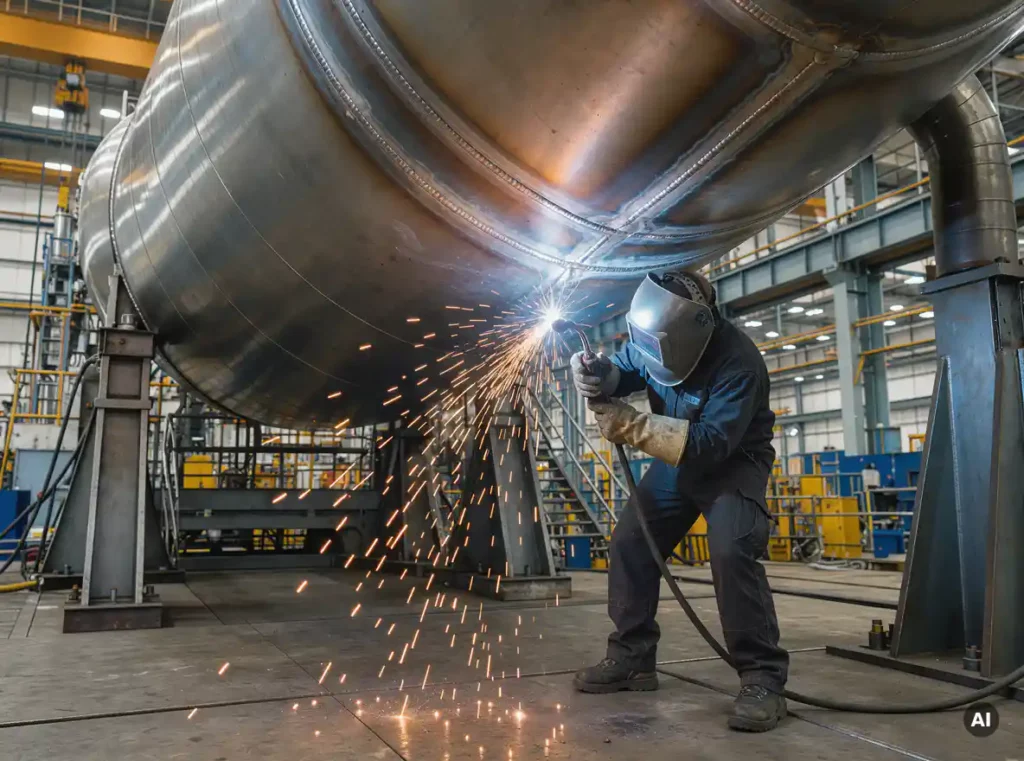
PTA oxidation reactors are demanding to manufacture because they combine extreme corrosion resistance requirements, reactive metals that are difficult to weld, very large diameters and heavy wall thicknesses in a single piece of equipment. Every one of these factors tightens tolerances and leaves little room for fabrication error.
The aggressive acetic acid and bromide environment inside a purified terephthalic acid (PTA) plant rules out ordinary steel, so fabricators must work with titanium or zirconium and control every weld, bond and dimension. The sections below answer the most common questions about PTA reactor fabrication in turn.
Which materials are used to build PTA oxidation reactors?
PTA oxidation reactors are built from titanium, either as solid plate or as a titanium-clad construction on a carbon steel base. Zirconium and tantalum are alternatives for the most aggressive conditions. The choice depends on corrosion severity, operating temperature, pressure and the cost of the full vessel.
The oxidation step in a PTA plant exposes the vessel to hot acetic acid, bromides and oxygen. Few alloys survive that combination without rapid corrosion. Titanium forms a stable oxide layer that protects it, which is why it became the standard material for this duty.
Solid titanium is technically the simplest option, but at a diameter close to 10 metres it becomes very expensive. A clad design solves this. Carbon steel carries the pressure load, while a thin titanium layer faces the process fluid. This split keeps the cost manageable without giving up corrosion protection.
Typical material choices include:
- Titanium Grade 1 or Grade 2: common as the corrosion-resistant cladding layer.
- Zirconium: used where conditions exceed what titanium tolerates.
- Carbon steel: the structural backing in clad designs.
- Titanium Grade 9 tubes: used in associated high-temperature heat exchange equipment.
Why is welding titanium and zirconium so difficult?
Titanium and zirconium are difficult to weld because they absorb oxygen, nitrogen and hydrogen at high temperature, which makes the weld brittle and reduces corrosion resistance. Welders must shield the molten pool, the cooling weld and the back side from air at all times.
Ordinary shielding gas around the arc is not enough. Reactive metals stay vulnerable until they cool well below the temperature where they react with air. Fabricators therefore use trailing shields, backing gas and, in some cases, controlled-atmosphere enclosures.
Cleanliness is just as critical. Oil, dust, fingerprints or iron contamination from ordinary steel tooling can ruin a weld that looks perfect on the surface. Dedicated work areas, separate tools and strict handling procedures are standard practice for reactive metal fabrication.
Weld colour often serves as a first visual check. A bright silver or light straw tint indicates good shielding, while blue, grey or white discolouration signals contamination and typically means the weld must be removed and redone.
How are clad PTA reactors constructed?
Clad PTA reactors are built by bonding a thin titanium layer to a thick carbon steel base plate, usually through explosion cladding, and then forming and welding these clad plates into shells and heads. The titanium surface is then restored across every weld seam to keep the inner lining continuous.
The construction follows a clear sequence:
- Explosion-clad plates are produced, creating a metallurgical bond between titanium and steel.
- The plates are inspected for bond quality, typically with ultrasonic testing.
- Plates are rolled into shell courses and formed into heads without damaging the cladding.
- The carbon steel backing is welded first.
- The titanium layer is restored over the weld seam with strip or cover welds.
- Final inspection and testing confirm the integrity of both layers.
The weakest point of any clad vessel is the transition at seams, nozzles and attachments. Titanium cannot be welded directly to carbon steel, so every joint demands a carefully planned design. A leak in the titanium layer can allow process fluid to reach the steel behind it, so seam quality is a central concern.
What makes thick walls and large dimensions a fabrication challenge?
Thick walls and diameters approaching 10 metres make fabrication difficult because the plates are heavy, forming forces are high, weld volumes are large and dimensional accuracy is harder to hold. Handling, rolling, welding and transporting such a vessel all require specialised equipment and careful planning.
A thick carbon steel shell needs powerful rolling machines and well-controlled welding procedures. Large weld volumes increase distortion and residual stress, so preheat, interpass temperature and heat treatment all need attention. Because the cladding must stay intact through forming and heat treatment, the process window narrows further.
Roundness and alignment become critical at this scale. Even small deviations across a 10-metre shell can complicate the fit of internals, nozzles and mating sections on site. Large PTA equipment also raises logistical questions, such as workshop crane capacity, assembly space and the route from the workshop to the construction site.
Which codes and inspections apply to PTA reactor fabrication?
PTA reactors are typically designed and fabricated to recognised pressure equipment codes, most commonly ASME Section VIII or the European Pressure Equipment Directive (PED) with harmonised standards. The applicable code depends on project location and customer specification, and it governs design, materials, welding and testing.
Beyond the main code, the project specification usually adds further requirements. Common inspection and testing steps include:
- Material certification and positive material identification.
- Weld procedure and welder qualification for each material.
- Radiographic or ultrasonic examination of welds.
- Ultrasonic bond inspection of clad plate.
- Dimensional checks against tight tolerances.
- Hydrostatic pressure testing of the finished vessel.
Third-party inspection is common on projects of this size. A documented inspection and test plan agreed upfront prevents disputes later and keeps every stakeholder aligned on hold points and acceptance criteria.
How do reactor internals and integrated scope affect manufacturing?
Reactor internals and integrated scope increase manufacturing complexity because every component must fit the vessel precisely and work together mechanically. Agitators, drive systems, seals, lubrication systems and instrumentation add interfaces, tolerances and testing steps beyond the pressure shell itself.
Internals made from titanium or other reactive metals face the same welding and cleanliness demands as the shell. Agitator shafts and impellers need accurate balancing and alignment, since vibration can damage seals and bearings over time.
Integrated scope has a practical advantage. When one manufacturer handles the vessel and its mechanical systems, interface problems are caught in the workshop rather than during site installation. Early coordination between shell design and internals also helps avoid late changes that disrupt the fabrication schedule.
What should buyers check when selecting a PTA reactor manufacturer?
Buyers should verify proven experience with titanium- or zirconium-clad equipment of comparable size, relevant PED and ASME certification, in-house engineering capability, workshop capacity for the required dimensions and weight, and a transparent quality system. References for similar equipment are the strongest indicator of real capability.
A practical checklist includes:
- Documented references for clad or reactive metal vessels of similar scale.
- Welding procedures qualified specifically for titanium or zirconium.
- Lifting, rolling and assembly capacity matching the vessel dimensions.
- Mechanical engineering support, including finite element analysis where needed.
- A clear approach to inspection, documentation and traceability.
- Experience with integrated scope if internals are included.
Visit the workshop if possible. Cleanliness, material segregation and handling discipline are easy to judge in person and say a lot about how a manufacturer treats reactive metals.
How Coek helps with PTA oxidation reactor manufacturing
Coek Engineering manufactures custom reactors and other pressure equipment for demanding applications, with long experience in titanium- and zirconium-clad construction. Coek translates customer process requirements into mechanically sound, manufacturable equipment. Coek does not perform process engineering. Capabilities relevant to PTA oxidation reactors include:
- Fabrication of titanium-clad reactors with diameters close to 10 metres.
- Workshop capacity for equipment up to 100 metres in length and approximately 1,000 tons.
- Advanced materials expertise covering titanium, zirconium, tantalum, Hastelloy and Inconel.
- In-house mechanical engineering to design for manufacturability.
- Integrated scope, including agitators, drive systems, seals, lubrication and instrumentation.
- Certification to ISO 9001, PED and ASME.
If you are planning a PTA reactor or another critical pressure vessel, contact the Coek team to discuss your specification and fabrication requirements.
Frequently Asked Questions
How do I get started with specifying a PTA oxidation reactor for fabrication?
Start by compiling a clear process data sheet from your process licensor, covering design pressure and temperature, medium composition (acetic acid, bromides, oxygen), corrosion allowance and overall dimensions. Then share it with shortlisted fabricators early so they can review manufacturability, material choice (solid vs. clad titanium) and transport constraints before the design is frozen. Involving the manufacturer at the specification stage helps avoid costly changes once plates are ordered.
What is the most common cause of weld rejection on titanium or zirconium equipment?
Contamination from air or foreign material is the leading cause. Inadequate shielding gas coverage, a trailing shield that is too short, or iron pickup from steel tools and grinding discs will show up as discoloured, brittle welds. Dedicated tools, clean gloves, segregated work areas and a quick visual colour check after each pass dramatically reduce rework.
What happens if there is a defect or leak in the titanium cladding layer?
A breach in the titanium lining can let hot acetic acid and bromides reach the carbon steel behind it, where they cause rapid corrosion and can compromise the pressure boundary. For this reason, seam and cover welds are typically examined carefully, often with methods such as dye penetrant testing and leak testing of the weld seams. Many designs also include telltale or leak-detection provisions so that small breaches are found before they cause serious damage.
How can I reduce the risk of delays when fabricating a very large reactor?
Lock down the design early, confirm material availability (titanium-clad plate often has long lead times) and agree on an inspection and test plan with hold points before fabrication starts. Also verify that the workshop’s crane capacity, rolling equipment and assembly space match the vessel size, and plan the transport route well in advance. Regular progress reviews and third-party inspection at key milestones help catch issues before they affect the schedule.
Should I choose a solid titanium reactor or a titanium-clad one?
For large-diameter reactors, clad construction is usually the more economical choice because carbon steel carries the pressure load and only a thin titanium layer contacts the process fluid. Solid titanium may make sense for smaller components or where clad joints would be difficult to design or inspect. Ask your manufacturer for a cost and risk comparison based on your actual diameter, wall thickness and operating conditions.
What documentation should I expect to receive with a finished PTA reactor?
Expect a complete manufacturing data book including material certificates and traceability records, weld maps, welding procedure and welder qualifications, NDT reports (radiographic, ultrasonic and bond inspection), dimensional reports, and the hydrostatic test certificate. Depending on the code, you will also receive conformity declarations such as PED or ASME documentation. Agreeing on the documentation scope in the purchase order prevents gaps at handover.
Can internals such as agitators be added or modified after the reactor shell is built?
Modifications are possible but often costly and risky, especially in titanium-clad vessels where any new weld or nozzle penetrates the lining and must be restored carefully. It is far better to finalise agitator, drive, seal and instrumentation requirements during the design phase so that nozzles, supports and tolerances are built in from the start. If a later change is unavoidable, have the fabricator assess its effect on the cladding and any required re-inspection or testing.
Related Articles
- What makes high-pressure MEG reactors mechanically demanding?
- Why must a mining autoclave be engineered together with its downstream pressure letdown system?
- Why can brine treatment processes require reactors made from exotic metals?
- When should an industrial company consider replacing rather than repairing a pressure vessel?
- What factors determine the design life of an industrial autoclave?