
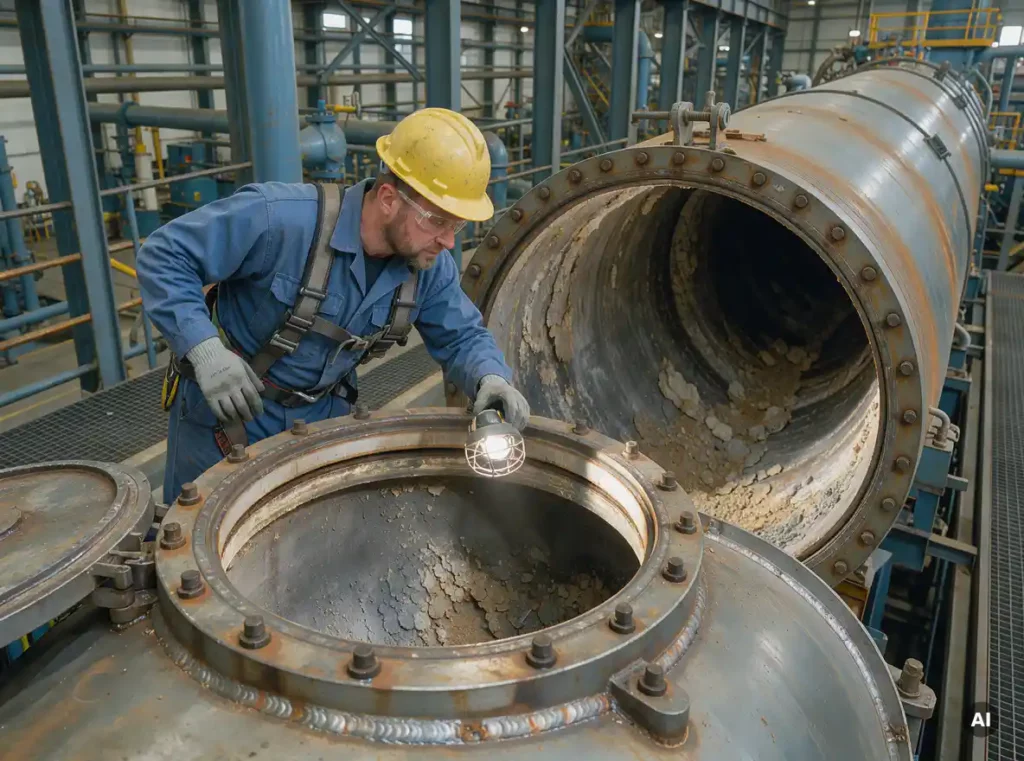
Slurry settling becomes a problem during a mining autoclave shutdown because agitation stops and suspended solids fall out of the slurry under gravity. Dense particles pack into compacted beds in the compartments, which block flow, bury agitator impellers and can overload equipment at restart.
The severity depends on particle density, slurry viscosity, how long the autoclave sits idle and how quickly it cools. The sections below explain what happens to the slurry, what makes it worse, and how to prevent and clear it.
What happens to slurry inside an autoclave once agitation stops?
Once agitation stops, suspended solids begin to fall out of the slurry immediately. Heavier particles drop first and form a dense sediment layer on the bottom of each compartment, while finer particles settle more slowly. Without agitator energy, nothing keeps the bed loose or mobile.
In a pressure oxidation or leaching autoclave, the slurry is typically a mix of ground ore or concentrate, acid and dissolved reaction products. Some of those products precipitate as the chemistry changes. When the slurry sits still and cools, the settled bed can consolidate, and in some cases scale or precipitates bind the particles together.
The bottom of each compartment is the most exposed zone. Solids accumulate around the lower agitator blades, in corners and along the base of baffles or compartment weirs. A bed that was fully fluidised during operation can become a dense, cohesive mass within hours, depending on the slurry properties.
Which shutdown conditions make slurry settling worse?
Several shutdown conditions make settling worse: a long idle time, rapid cooling, high solids content, coarse or dense particles, and a slurry that remains in the vessel instead of being drained. Planned maintenance stops are usually easier to control than sudden trips.
The most common aggravating factors are:
- Unplanned trips: a power loss or process upset stops the agitators without any chance to dilute or flush the slurry first.
- Extended downtime: the longer the slurry sits, the more compact and cohesive the bed becomes.
- Falling temperature: cooling raises slurry viscosity and can trigger precipitation or scale formation that cements particles together.
- High solids content: a thicker slurry has less liquid to carry particles and packs more tightly once settled.
- Coarse or heavy particles: these fall quickly and form a dense layer that is hard to re-suspend.
- Slurry left in the lower compartments: the last compartments often hold the thickest material.
An unplanned stop is generally the worst case, because the operating team has no opportunity to reduce solids loading before agitation is lost.
What operational problems does settled slurry cause during restart?
Settled slurry causes high agitator torque, blocked transfer lines and compartment overflow pipes, uneven solids distribution and possible mechanical damage at restart. Starting an agitator against a packed bed can overload the drive, so restart has to be treated as a controlled operation.
The main restart problems are:
- Agitator overload: impellers partly buried in a compacted bed meet very high resistance. The drive can trip on torque, or the shaft and impeller can suffer stress they were not designed for.
- Blocked flow paths: settled solids can plug discharge nozzles, slurry transfer lines and compartment openings, which stops the autoclave from passing material through.
- Uneven loading: solids that are re-suspended suddenly can create temporary local spikes in density and flow.
- Accelerated wear: forcing a restart against solids increases erosion and abrasion on internals, lining and agitator parts.
- Extended restart time: clearing a bed manually or by repeated start attempts can delay return to production for days.
For vessels with a corrosion-resistant lining, such as titanium, mechanical impact and abrasion from solids also matter. Erosion is a known issue in the field, so protecting internals during restart is part of protecting the lining.
How can settling be minimised during an autoclave shutdown?
Settling is best minimised by reducing solids loading before shutdown, draining or displacing the slurry where possible, and keeping the vessel contents mobile for as long as the process allows. A planned shutdown sequence is far more effective than reacting after agitation has stopped.
Practical measures include:
- Thin the slurry: reduce the feed solids content ahead of a planned stop so the contents hold less dense material.
- Flush with water or process liquor: displace thick slurry from the compartments before it settles.
- Drain early: remove slurry through the discharge route while it is still fluid, rather than letting it sit.
- Keep agitators running as long as safely possible: maintain suspension while the autoclave is being emptied or cooled.
- Control cooling: avoid sharp temperature drops that increase viscosity or drive precipitation.
- Define a documented shutdown procedure: agree on the sequence of feed stop, flushing, draining and agitator stop in advance, and train the operating crew on it.
For short, planned stops, partial flushing and dilution can be enough. For longer maintenance outages, complete draining and rinsing is usually the safer approach to pressure oxidation autoclave maintenance.
How should settled solids be cleared before restarting?
Settled solids should be cleared in stages before restart: first assess the bed, then remove or loosen it using flushing, controlled draining or mechanical removal, and only then restart the agitator at reduced load. Forcing an agitator to start against a packed bed is the most common mistake.
A careful clearing sequence usually follows these steps:
- Isolate and depressurise safely: follow confined space and pressure vessel entry rules before any inspection or manual work.
- Assess the bed: establish how much has settled and in which compartments before choosing a method.
- Loosen by flushing: introduce water or liquor through available nozzles to break up and mobilise the bed.
- Drain the loosened slurry: use the slurry draining route to remove material as it is freed, without overloading the discharge line.
- Remove stubborn deposits mechanically: where the bed has consolidated, manual or mechanical removal may be needed during an internal inspection.
- Inspect internals: check agitators, baffles, weirs and lining for damage or remaining buildup.
- Restart agitators gradually: bring them up in a controlled way and watch torque and current for signs of remaining obstruction.
Never rely on repeated start attempts to clear the bed. Each failed attempt adds stress to the shaft, gearbox and impellers.
How does autoclave design influence settling risk during shutdowns?
Autoclave design strongly influences settling risk through compartment geometry, drain and nozzle placement, agitator layout and the internal details that decide where solids can collect. A design that anticipates shutdown makes draining easier and leaves fewer dead zones where solids pack.
Several design features matter for autoclave design for shutdown:
- Drain and flush nozzle positions: low-point nozzles let operators empty compartments and flush beds from the places where solids collect.
- Compartment and baffle layout: sharp corners and flat floors create dead zones, while shaping that supports flow reduces buildup.
- Agitator arrangement: impeller height, diameter and number affect how well the bottom of a compartment is swept and how easily the agitator can restart.
- Access for inspection and cleaning: adequate manways and access routes make it practical to check and clear compartments during an outage.
- Wear protection: lining details, impingement protection and material selection help the vessel withstand erosion from solids during operation and restart.
These details are set early, while the mechanical design is being developed from the customer’s process requirements. It is far easier to include drain points, access and wear protection at the design stage than to retrofit them to a finished vessel.
How Coek helps with autoclave shutdown and slurry settling
Coek designs and manufactures custom industrial autoclaves for demanding high-pressure, high-temperature and corrosive duties, with references approaching 1,000 tons. Process requirements come from the customer, EPC contractor or technology owner, and Coek translates them into mechanically sound, manufacturable equipment. Where relevant to settling and shutdown, Coek can provide support with:
- Mechanical engineering of nozzle positions, drain points and internal access
- Titanium and clad construction suited to corrosive, erosive slurry service
- Design details developed over time to address erosion issues commonly seen in the field
- Integrated equipment scope, where appropriate, including agitators, drive systems and seals
- Heavy, thick-walled and large-diameter fabrication handled in-house
If you are planning a new autoclave or reviewing an existing design for shutdown resilience, contact our team to discuss your requirements.
Frequently Asked Questions
How long can slurry sit in an autoclave before it becomes a serious settling problem?
There is no single time limit, because it depends on particle density, solids content, viscosity and how fast the vessel cools. In some slurries a cohesive bed can form within hours, especially after an unplanned trip. As a rule, plan to flush or drain any shutdown expected to last longer than a short hold, and use your own slurry’s settling behaviour, ideally tested in the lab, to set a site-specific threshold.
What should the operating crew do first if the agitators trip unexpectedly?
Stop the feed immediately, then follow your documented trip procedure. If the autoclave can still be flushed or drained safely, begin displacing thick slurry from the compartments, starting with the ones holding the densest material. Do not attempt repeated agitator restarts. Instead, assess the bed first, since each failed attempt can overstress the shaft, gearbox and impellers.
How can I tell if an agitator is starting against a packed bed?
Warning signs include abnormally high motor current or torque, a drive that trips on overload, and unusual vibration or noise when the agitator tries to turn. If you see any of these, stop and do not retry. Treat it as a sign that solids need to be loosened by flushing, draining or mechanical removal before another start. Gradual start-up with close monitoring of torque and current helps you detect remaining obstruction early.
What should I check first when starting to build or review a shutdown procedure?
Begin by mapping the sequence for both planned and unplanned stops: feed stop, slurry thinning, flushing, draining, controlled cooling and agitator stop. Then confirm that the equipment supports it, including low-point drain and flush nozzles, available flush water or liquor, and discharge capacity. Finally, write it down, train the crew, and review it after every real shutdown so it reflects actual slurry behaviour.
Does flushing with water always solve the settling problem?
Not always. Flushing works well while the slurry is still fluid, or to loosen a moderately settled bed, but it may not break up a bed that has consolidated or been cemented by precipitates or scale. In those cases, mechanical removal during an internal inspection may be needed. Also make sure the discharge line can handle the loosened slurry, or you risk blocking it.
Can settling during shutdown damage the autoclave lining or internals?
Yes, indirectly. Forced restarts against solids increase erosion and abrasion on agitator parts, baffles and lining, and sudden re-suspension can create high local flow and density. For vessels with a titanium or other corrosion-resistant lining, inspect internals after clearing the bed and before restart. Look for damage, thinning or remaining buildup that could accelerate wear.
Can an existing autoclave be modified to reduce settling risk during shutdown?
Often, to some extent. Common improvements include adding or relocating flush and drain nozzles, improving access for inspection and cleaning, and adding wear protection in erosion-prone areas. Changes to compartment geometry or agitator layout are harder on a finished vessel, so it is best to have an engineering review of your existing design before deciding what is practical.
Related Articles
- What are the differences between laboratory autoclaves and industrial autoclaves?
- How does operating pressure influence pressure vessel head geometry selection?
- How do you verify the integrity of a clad layer in a pressure vessel after fabrication?
- What causes corrosion in pressure vessels and how can it be prevented?
- How do you qualify a new material for use in a pressure vessel design?