
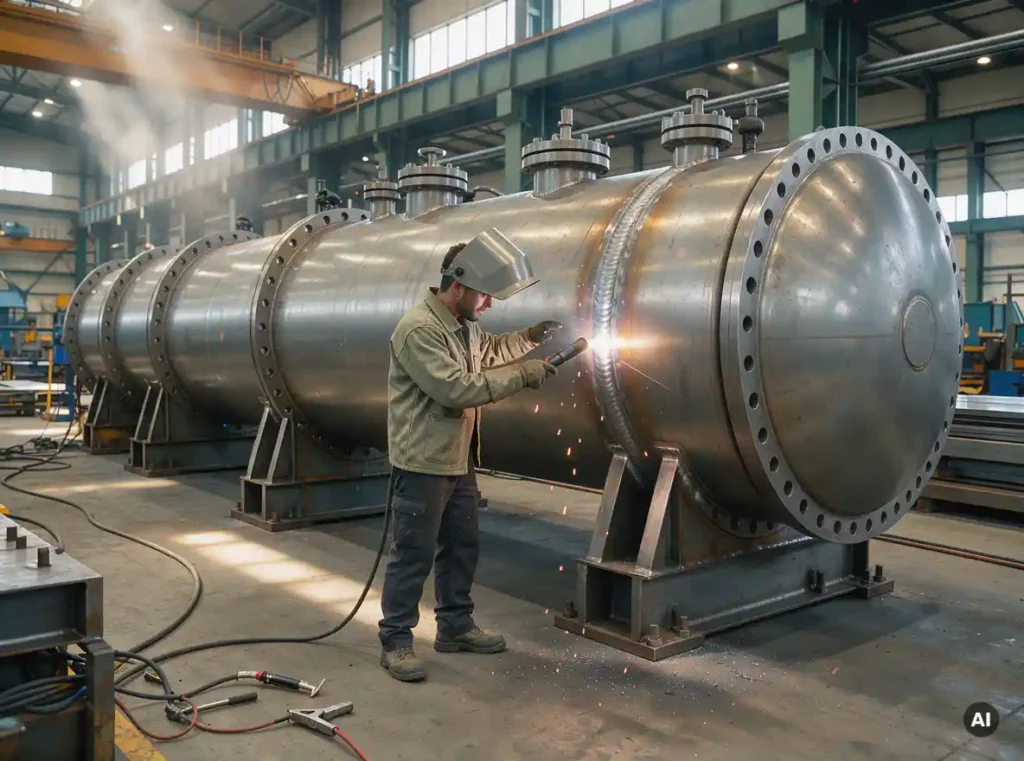
High-pressure acid leaching (HPAL) uses large autoclaves to dissolve nickel and cobalt from laterite ore in hot, pressurized sulfuric acid slurry. The autoclave holds the slurry at roughly 245 to 270 °C and several tens of bar, long enough for metals to dissolve while iron precipitates out of solution.
Because the slurry is extremely corrosive and abrasive, the autoclave is the most critical and demanding piece of equipment in an HPAL plant. The sections below cover operating conditions, materials, clad construction, internal design, size, standards and what to look for in a fabricator.
What operating conditions does an HPAL autoclave withstand?
An HPAL autoclave withstands hot sulfuric acid slurry at temperatures typically between 245 and 270 °C and pressures high enough to keep the liquid phase stable, often around 40 to 55 bar. These conditions are combined with chlorides, abrasive solids and continuous operation.
The combination matters more than any single number. Acid alone is manageable with the right material, and pressure alone is a standard design task. Together with temperature, chloride content and a slurry full of fine ore particles, they create an environment where corrosion and erosion attack the vessel at the same time.
Typical operating factors include:
- Sulfuric acid at high temperature, which drives metal dissolution
- Elevated pressure, which keeps the slurry liquid and supplies reaction conditions
- Solids content from ground laterite ore, which causes erosion
- Variable chloride levels, depending on process water quality
- Continuous duty with long intervals between planned shutdowns
Exact design conditions always come from the technology owner or EPC contractor. Each project defines its own temperature, pressure, corrosion allowance and design life.
Which materials are used inside HPAL autoclaves?
Titanium is the standard corrosion-resistant lining material inside HPAL autoclaves, because it forms a stable protective oxide layer in hot acidic slurry. The pressure-bearing shell is carbon steel, and titanium covers every surface that touches the process medium.
Titanium suits this duty for a clear reason. Stainless steels and many nickel alloys lose resistance in hot, acidic, chloride-bearing slurry, while titanium holds up well across the conditions an HPAL circuit presents. Where a lining must tolerate even harsher local conditions, other reactive metals such as zirconium or tantalum may be considered for specific components, though titanium remains the reference choice for the main vessel surfaces.
Internal parts follow the same logic. Agitator shafts, impellers, baffles, nozzles and internal piping contact the same slurry, so they are also made of corrosion-resistant materials. Material selection for each component depends on its exposure, whether that is static immersion, high-velocity flow or mechanical wear.
Why are HPAL autoclaves built as clad vessels?
HPAL autoclaves are built as clad vessels because a clad design combines the strength of a carbon steel shell with the corrosion resistance of titanium at a fraction of the cost of a solid titanium vessel. Titanium handles the acid, while carbon steel carries the pressure.
A solid titanium autoclave of this size would be prohibitively expensive and would also be harder to fabricate and support. A thick carbon steel shell with a thin titanium inner layer gives the required mechanical strength and wall thickness at a sensible cost.
How is the titanium layer attached to the steel?
Titanium cladding is commonly bonded to carbon steel by explosion cladding, where a controlled detonation drives the titanium plate onto the steel base and creates a metallurgical bond. The clad plate is then rolled, formed and welded into shells and heads. Titanium welding requires careful inert gas shielding and strict cleanliness to avoid contamination.
What are the main fabrication challenges of clad construction?
Clad equipment needs weld procedures for both the steel backing and the titanium layer, plus a method of sealing the weld seams so that no steel is exposed to the process. Bond integrity, weld quality and dimensional accuracy all need verification, because defects in the lining can lead to corrosion behind the clad layer.
How are HPAL autoclave compartments and internals designed?
HPAL autoclaves are typically horizontal, multi-compartment vessels divided by internal partitions, with agitators in each compartment. The slurry flows from one compartment to the next, which improves mixing and gives a controlled residence time for the leaching reactions.
Designing the internals is as demanding as building the shell. The main elements are:
- Compartment partitions or weirs that direct slurry flow through the vessel and limit short-circuiting
- Agitators with shafts, impellers and drive systems that keep solids suspended and promote reaction
- Mechanical seals and lubrication systems that maintain pressure integrity where the shaft passes through the vessel
- Nozzles for slurry, steam and acid positioned to support efficient mixing and heat input
- Instrumentation connections for temperature, pressure and level monitoring
The process layout is defined by the technology owner. The mechanical task is to turn that layout into internals that can be fabricated accurately, installed inside a large vessel and withstand years of abrasive, corrosive service.
How large and heavy can HPAL autoclaves get?
HPAL autoclaves are among the largest pressure vessels built for process industries. Individual units can reach many meters in diameter and tens of meters in length, with finished weights that can approach 1,000 tons. Capacity targets for a plant drive the size of each unit.
Size creates practical constraints well beyond the design calculation. Thick-walled shells, heavy forgings and large clad plates all require specialized rolling, welding and handling equipment. Dimensional tolerances become harder to hold as diameter and length grow, yet alignment of nozzles, partitions and agitator openings stays critical.
Logistics also shape the design. Fabrication close to a port or navigable waterway often simplifies transport of oversized vessels, and some designs are planned as multiple shipping sections or modules. Early coordination between the designer, fabricator and transport planner avoids costly redesign later.
What standards and quality controls apply to HPAL autoclaves?
HPAL autoclaves are designed and built to recognized pressure equipment codes, most commonly ASME or the European Pressure Equipment Directive (PED), with quality management systems such as ISO 9001 supporting fabrication. The project specification defines which code applies.
Quality control covers the full manufacturing chain. Typical activities include:
- Material traceability and certification for steel and titanium
- Qualified welding procedures and welders for both base and clad materials
- Non-destructive examination of welds, such as radiographic, ultrasonic and penetrant testing
- Bond testing of the clad layer
- Dimensional inspection of the shell, nozzles and internals
- Hydrostatic pressure testing before delivery
Third-party inspection is common on projects of this scale, and inspection hold points are agreed in advance with the owner, EPC contractor and inspection body.
What should buyers look for in an autoclave fabricator?
Buyers should look for a fabricator with proven experience in clad and titanium construction, the physical capacity to handle very large and heavy vessels, in-house mechanical engineering, and recognized certifications. Documented experience matters more than any claim of general capability.
A practical checklist includes:
- References for comparable clad or exotic-material pressure equipment
- Workshop capacity for the required diameter, length and weight
- Qualified titanium welding and clad fabrication procedures
- Mechanical engineering that can review and improve manufacturability
- Ability to supply integrated scope, such as agitators, drives and seals
- Transparent quality documentation and inspection planning
- Access to transport routes for oversized equipment
An early technical dialogue is often the best test. A capable fabricator asks detailed questions about operating conditions, tolerances and interfaces before quoting, because those details determine whether the equipment can be built reliably.
How Coek helps with HPAL autoclave fabrication
Coek manufactures custom industrial autoclaves for demanding, corrosive, high-pressure applications, with references approaching 1,000 tons. Starting from your process requirements, Coek translates them into mechanically sound equipment that can be fabricated efficiently and reliably.
- Fabrication of large, heavy and thick-walled vessels at facilities in Geel and Genk, up to approximately 10 m in diameter and 100 m in length
- Over 30 years of experience with clad construction and with titanium, zirconium, tantalum and other demanding materials
- In-house mechanical engineering focused on manufacturability and fabrication efficiency
- Integrated scope where appropriate, including agitators, drive systems, seals, lubrication systems and instrumentation
- ISO 9001, PED and ASME certifications
Explore the full range of industrial autoclaves from Coek, or contact the engineering team to discuss your project requirements.
Frequently Asked Questions
How do I get started when specifying an HPAL autoclave for a new project?
Start by collecting the process data from the technology owner or EPC contractor: design temperature and pressure, slurry composition, chloride levels, solids content, corrosion allowance and required design life. Then engage a fabricator early, ideally during the basic or front-end engineering phase, so they can review manufacturability, shipping limits and material availability before the specification is frozen. Early dialogue on tolerances, interfaces and inspection requirements reduces the risk of redesign and schedule delays later.
What are the most common causes of failure or premature wear in HPAL autoclaves?
The most common problems are defects in the titanium lining, such as weld flaws or incomplete seam sealing, which allow acid to reach the carbon steel behind the clad layer. Erosion at high-velocity areas like nozzles, agitator zones and compartment partitions is another frequent issue, as are agitator seal problems. Rigorous weld qualification, bond testing, and good internal design to limit high-velocity flow help prevent these failures.
How often does an HPAL autoclave need to be inspected, and what does inspection involve?
Inspection intervals are set by the plant operator based on the design life, observed wear rates and planned shutdown schedule, so there is no single universal interval. During shutdowns, inspectors typically check the titanium lining for cracks, erosion and bulging, examine weld seams, and measure the thickness of wear-prone internals such as agitator parts and partitions. Keeping a baseline record from the original fabrication inspection makes it easier to track degradation over time.
Can a damaged titanium lining be repaired, or does the whole vessel need replacing?
Localized damage to a titanium lining can often be repaired by removing the affected area and welding in a new titanium patch using qualified procedures and strict inert gas shielding. Repairs require clean conditions and careful verification, since contamination can make titanium welds brittle. Extensive damage or corrosion behind the clad layer may require larger-scale re-lining, which is why fabricator experience with titanium and clad repair is valuable.
What should I consider when transporting and installing a very large autoclave?
Check the route from the workshop to the site early, including port access, waterways, road clearances and lifting capacity at the destination. For very large units, designers sometimes split the vessel into shipping sections or modules that are joined on site, which affects weld procedures and field inspection planning. Fabricating near a port or navigable waterway can greatly simplify moving vessels approaching 1,000 tons.
Is it better to buy the autoclave and its agitators and seals from one supplier or separately?
Using one supplier for the vessel and its internals, such as agitators, drives, mechanical seals and lubrication systems, simplifies interface management and responsibility, especially where shaft penetrations must maintain pressure integrity. Separate sourcing can work if the interfaces are clearly defined and the suppliers coordinate closely on tolerances and nozzle positions. Whichever route you choose, confirm who is accountable for the combined performance of the vessel and its internals.
Which pressure vessel code should I choose, ASME or PED?
The choice usually follows the project specification, the location of the plant and the requirements of the owner or financing parties. ASME is common on projects following North American practice, while PED applies for equipment placed on the European market, and many fabricators hold both certifications. Confirm the required code with the EPC contractor at the start, since it affects design calculations, material certification, testing and inspection documentation.
Related Articles
- Why are some hydrometallurgical autoclaves divided into internal compartments?
- What equipment challenges arise when scaling up PEF production?
- How do you choose between a fixed tube sheet, U-tube and floating head heat exchanger?
- What are the three types of reactors?
- How does post-weld heat treatment affect pressure vessel mechanical properties?