
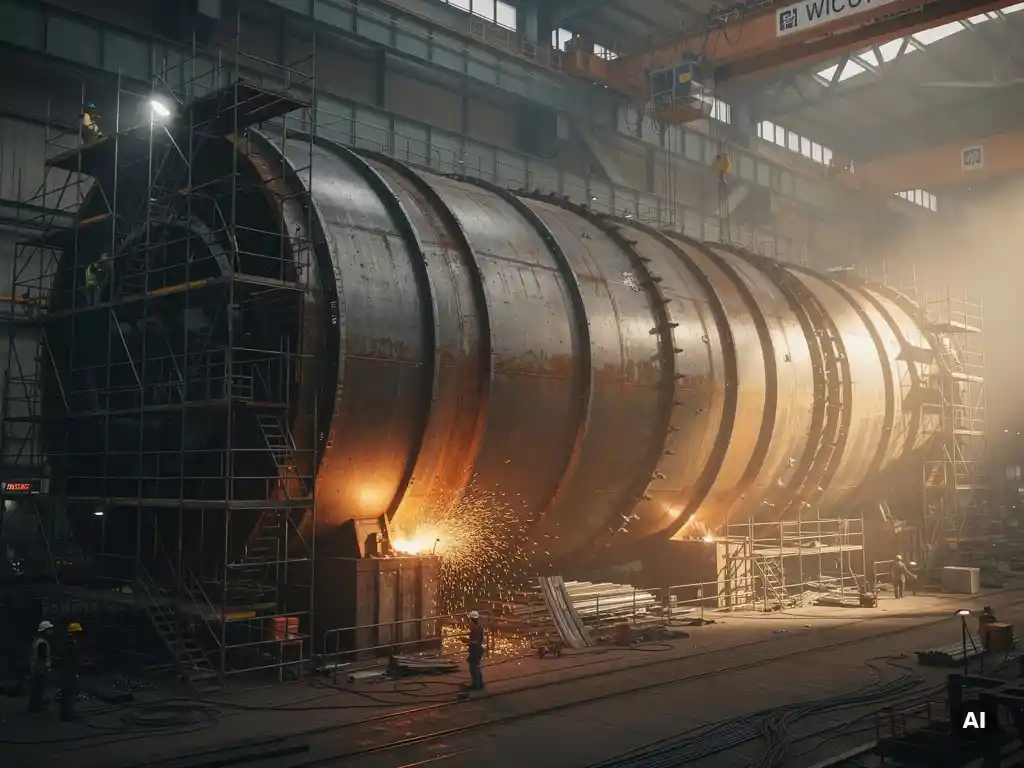
Manufacturing a custom pressure vessel typically takes between 6 and 24 months from contract award to final delivery, depending on the complexity of the equipment, the materials involved, and the regulatory requirements that apply. For straightforward carbon steel vessels with standard dimensions, lead times can fall toward the lower end of that range. For large, thick-walled, or exotic-material equipment, timelines of 18 months or more are common. The sections below break down each phase of the production process and explain the factors that compress or extend the overall schedule.
What factors determine how long a pressure vessel takes to build?
The total lead time for a custom pressure vessel is driven by four interconnected variables: engineering complexity, material availability, fabrication scope, and the inspection and certification requirements attached to the project. No single factor operates in isolation: a vessel that is large but made from standard carbon steel may actually be faster to deliver than a smaller vessel built from an exotic alloy with a demanding inspection plan.
The most influential factors include:
- Equipment size and weight: Larger vessels require more fabrication hours, more complex handling, and often more extensive heat treatment cycles.
- Wall thickness: Thick-walled construction demands slower welding procedures, more preheat, and additional non-destructive examination.
- Material type: Exotic alloys such as titanium, zirconium, Hastelloy, or Inconel have longer procurement cycles and require specialised welding procedures and qualified personnel.
- Clad construction: Explosion-clad or weld-overlaid vessels introduce additional process steps, including cladding verification and bond testing.
- Applicable code and certification: ASME, PED, or other code requirements define mandatory inspection hold points that structure the entire fabrication sequence.
- Internal complexity: Vessels with complex internals, such as agitators, baffles, nozzle clusters, or lining systems, add engineering and fabrication time.
Understanding which of these factors apply to a specific project is the starting point for any realistic schedule discussion.
How long does the engineering and design phase typically take?
The engineering and design phase for a custom pressure vessel typically takes between 4 and 16 weeks, depending on the complexity of the equipment and the completeness of the process data provided by the client. Simple vessels with well-defined process conditions can be designed quickly. Vessels requiring finite element analysis, fatigue calculations, or custom nozzle arrangements take considerably longer.
During this phase, the assigned project engineer works from the customer’s process requirements and translates them into a mechanically sound, manufacturable design. This includes pressure and temperature calculations to the applicable code (ASME, AD Merkblätter, or other standards) as well as supplementary analyses such as FEA, thermal analysis, or vibration analysis where the project demands it.
Procurement of long-lead materials typically begins in parallel with detailed design, not after it. Waiting for a fully approved drawing package before ordering plate or forgings is one of the most common causes of avoidable schedule slippage. The engineering phase therefore has a direct knock-on effect on the entire downstream schedule, and any delays in receiving complete and stable process data from the client will extend it proportionally.
Why do exotic materials and clad construction extend lead times?
Exotic materials and clad construction extend lead times for two compounding reasons: longer material procurement cycles and more complex, slower fabrication procedures. A vessel in carbon steel can often be started within weeks of contract award. The same vessel in solid titanium or with a zirconium-clad inner layer may require months of material lead time before a single weld is made.
On the procurement side, materials such as titanium, zirconium, tantalum, Hastelloy, and Inconel are produced in smaller volumes than standard alloy steels. Mill lead times for plate, forgings, and fittings in these materials are routinely 12 to 20 weeks or longer, and availability can fluctuate with global demand.
On the fabrication side, exotic materials require qualified welding procedures specific to the material, controlled environments to avoid contamination, and specialised non-destructive examination methods. Clad construction adds further steps: the bond between the base material and the corrosion-resistant layer must be verified, and any defects in the cladding must be addressed before the vessel progresses. Each of these steps is a mandatory hold point, not an optional quality check.
For projects involving custom pressure vessels in advanced materials, it is realistic to add 3 to 6 months to the base fabrication schedule compared with a comparable carbon steel construction.
What does the fabrication and inspection sequence look like?
The fabrication of a custom pressure vessel follows a structured sequence in which each step must be completed and verified before the next can begin. This sequential logic, driven by code requirements and quality management obligations, is one of the primary reasons that pressure vessel manufacturing cannot simply be accelerated by adding more labour.
A typical fabrication sequence proceeds as follows:
- Material receipt and incoming inspection: All materials are verified against mill certificates and the applicable material specification before fabrication begins.
- Cutting, forming, and rolling: Shell plates and heads are cut to shape and formed to the required geometry, with dimensional checks at each stage.
- Fit-up and welding: Shell sections, nozzles, and attachments are assembled and welded according to qualified welding procedure specifications.
- Non-destructive examination (NDE): Radiographic, ultrasonic, magnetic particle, or dye penetrant testing is performed at mandatory hold points defined by the applicable code.
- Post-weld heat treatment (PWHT): Where required by code or material specification, the vessel is heat-treated in a controlled furnace environment to relieve residual stresses.
- Final assembly and dimensional inspection: Internals, nozzle flanges, and external attachments are fitted and verified against the approved drawing package.
- Pressure testing: A hydrostatic or pneumatic pressure test is witnessed by a third party to confirm structural integrity.
- Surface treatment and preparation for shipment: Internal and external surface treatment is applied, and the vessel is prepared for transport.
Third-party inspection at mandatory hold points adds calendar time to the sequence, since inspectors must be available and scheduled in advance. For projects under ASME or PED certification, these hold points are non-negotiable.
How does equipment size affect the overall production schedule?
Equipment size affects the production schedule in direct and indirect ways. Larger vessels require more raw material, more welding passes, longer heat treatment cycles, and more extensive dimensional verification. A vessel approaching 1,000 tons in weight cannot be fabricated on the same timeline as a vessel weighing 50 tons, regardless of how efficiently the shop floor is organised.
Beyond the fabrication hours themselves, large equipment creates logistical constraints that affect scheduling. Very large vessels, particularly those with diameters approaching 10 metres or lengths exceeding 50 metres, may need to be fabricated in sections and assembled progressively in the shop. Internal access for welding and inspection becomes more complex as dimensions increase. Furnace capacity for post-weld heat treatment must be matched to the vessel’s dimensions, which limits which facilities can handle the work at all.
Transport planning also begins during the fabrication phase for the largest equipment. Abnormal load permits, route surveys, and coordination with port or rail authorities can add weeks to the overall project timeline and must be factored into the delivery schedule from the outset.
When should procurement and manufacturing be started to meet a project deadline?
For most custom pressure vessels, procurement of long-lead materials should begin immediately after contract award, ideally within the first two to four weeks. Waiting for a fully approved design package before placing material orders is a common mistake that can add months to the delivery date without any corresponding benefit to quality.
A practical approach is to identify the longest-lead items during the early engineering phase and issue purchase orders based on preliminary material specifications. These orders can be refined as the design is finalised, provided the supplier relationship and commercial terms allow for it.
Working backwards from a required delivery date, project teams should account for:
- Engineering and design: 4 to 16 weeks
- Material procurement: 8 to 24 weeks depending on material type
- Fabrication and inspection: 12 to 40 weeks depending on complexity and size
- Surface treatment, documentation, and shipment preparation: 2 to 6 weeks
- Transport to site: variable, but potentially 4 to 12 weeks for international shipments of large equipment
Adding these phases together makes clear why early engagement with a fabricator, well before the engineering package is complete, is essential for projects with firm commissioning dates.
What can shorten or extend a pressure vessel’s delivery time?
Several controllable and uncontrollable factors influence whether a vessel is delivered on schedule, ahead of it, or late. Understanding these factors allows project teams to make informed decisions during the planning phase rather than reacting to problems during fabrication.
Factors that can shorten delivery time include early and complete provision of process data, parallel engineering and procurement, a well-defined and stable scope, and selecting a fabricator with the required materials and equipment immediately available. A fabricator with existing qualified welding procedures for the required material and a current inspection plan framework can enter the design phase faster than one starting from scratch.
Factors that commonly extend delivery time include scope changes after contract award, late or incomplete client data, material availability issues, weld repairs identified during NDE that require re-examination, third-party inspection scheduling delays, and changes to the applicable code or certification requirements mid-project. Each of these introduces rework, waiting time, or additional hold points that compound across the schedule.
For highly complex or first-of-a-kind equipment, building schedule contingency into the project plan from the outset is not a sign of poor planning; it is a sign of realistic project management.
How Coek supports your pressure vessel project schedule
At Coek Engineering, we work with EPC contractors, technology owners, and industrial end users on custom pressure equipment where standard fabrication approaches are not sufficient. Our in-house mechanical engineering team can engage early in the project cycle, before the design is finalised, to help translate process requirements into a manufacturable equipment specification and a realistic production schedule.
Key aspects of how we support schedule-critical projects:
- Early engineering engagement to identify long-lead items and initiate procurement in parallel with design
- In-house expertise in exotic and clad materials, reducing the risk of delays caused by unfamiliar fabrication procedures
- Two production facilities in Geel and Genk with combined shop floor capacity exceeding 35,000 square metres, capable of handling equipment up to 1,000 tons
- Established qualified welding procedures for demanding materials including titanium, zirconium, Hastelloy, and Inconel
- Compliance with ASME, PED, and other international standards, with an integrated inspection plan that structures the fabrication sequence from day one
If you are planning a project involving complex or large-scale pressure vessel fabrication and need a realistic assessment of lead times and manufacturing scope, contact our team to discuss your requirements directly.
Frequently Asked Questions
How early should we involve a pressure vessel fabricator in our project planning?
Ideally, you should engage a fabricator during the pre-FEED or early FEED stage, well before your engineering package is complete. Early involvement allows the fabricator to flag material availability risks, identify long-lead items, and align the fabrication schedule with your project’s commissioning date from the outset. Waiting until the design is fully approved before approaching a fabricator is one of the most common and costly scheduling mistakes on capital projects.
What information do I need to provide to get an accurate lead time estimate?
At a minimum, a fabricator needs your process conditions (design pressure, design temperature, and fluid service), the applicable code or standard, a preliminary material specification, and an indication of vessel size and weight. The more complete and stable this data is at the time of enquiry, the more accurate the lead time estimate will be. Incomplete or frequently changing process data is one of the leading causes of schedule slippage during the engineering phase.
Can scope changes after contract award really add months to the delivery date?
Yes, and the impact is often larger than clients expect. A scope change that seems minor on paper — such as adding a nozzle cluster, changing a material specification, or modifying internal geometry — can invalidate completed drawings, trigger re-ordering of materials, and introduce new NDE hold points. If the change occurs after fabrication has started, it may also require cutting and re-welding completed sections, which adds both labour and mandatory re-inspection time. Freezing the scope as early as possible is one of the most effective schedule risk mitigation strategies available.
What is post-weld heat treatment (PWHT), and how much time does it add to the schedule?
Post-weld heat treatment is a controlled thermal process in which the completed or partially completed vessel is heated to a specified temperature, held for a defined period, and then cooled at a controlled rate to relieve residual welding stresses and improve material toughness. Depending on vessel size and wall thickness, a single PWHT cycle can take anywhere from 24 hours to several days, including heating, soaking, and cooling periods. For very large or thick-walled vessels, multiple PWHT cycles may be required, and furnace availability must be scheduled in advance, which can add additional calendar time beyond the treatment itself.
Is it possible to expedite a pressure vessel order, and what are the trade-offs?
Expediting is possible in some cases, but the options are more limited than in general manufacturing because many steps in pressure vessel fabrication are governed by code-mandated hold points that cannot be bypassed or compressed. What can be accelerated includes overlapping engineering and procurement, prioritising the vessel on the shop floor, pre-qualifying welding procedures in advance, and pre-scheduling third-party inspectors. However, expediting typically comes at a cost premium, and there is a practical floor below which the timeline cannot be reduced without compromising quality or code compliance.
How do third-party inspectors affect the fabrication schedule, and how is this managed?
Third-party inspectors must be present at mandatory hold points defined by the applicable code — such as ASME or PED — before fabrication can progress to the next stage. If an inspector is unavailable on the required date, work must pause until they can attend, which can introduce waiting periods of several days to several weeks depending on inspector workload and project location. Experienced fabricators manage this risk by scheduling inspectors well in advance and maintaining close coordination with the notified body or authorised inspection agency throughout the project.
What happens if a weld defect is found during non-destructive examination?
If NDE reveals a weld defect, the affected area must be excavated, repaired, and re-examined before the vessel can progress. Depending on the severity and location of the defect, this can add anywhere from a few days to several weeks to the schedule, particularly if the repair requires re-qualification of the welding procedure or triggers additional examination of surrounding welds. This is one of the reasons that experienced fabricators invest heavily in welding quality controls and procedure qualification upfront — preventing defects is significantly less disruptive to the schedule than repairing them after the fact.
Related Articles
- Why do some industrial processes require custom-built pressure vessels?
- What are the biggest fabrication challenges for thick-walled pressure vessels?
- What are the main types of industrial autoclaves used in manufacturing?
- What is autoclave manufacturing?
- What is the difference between a jacketed reactor and a shell-and-tube heat exchanger?