
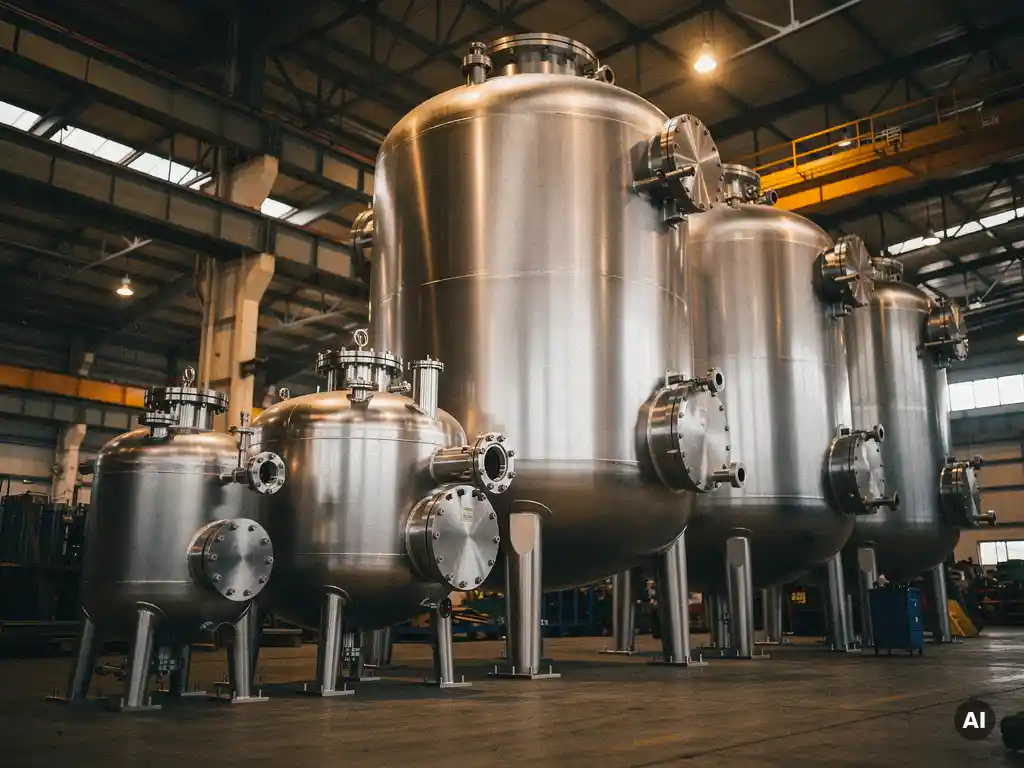
Industrial autoclaves are available across a wide range of sizes, from compact laboratory units of less than one metre in diameter to large-scale industrial vessels exceeding 10 metres in diameter and stretching over 50 metres in length. The right autoclave size depends entirely on the process requirements, operating conditions, and the production volumes involved. The sections below address the most common questions buyers and engineers raise when specifying autoclave dimensions.
How large can industrial autoclaves actually be built?
Industrial autoclaves can be built to very substantial dimensions. In demanding industrial applications, vessels exceeding 5 metres in diameter and 30 to 50 metres in length are not uncommon, and in exceptional cases, autoclave dimensions can approach 10 metres in diameter with weights nearing 1,000 tonnes. The upper limit is set by the fabricator’s manufacturing infrastructure, not by any fixed industry standard.
Large autoclave dimensions are driven by process throughput, batch size, and the physical scale of the materials being processed. Some high-pressure composite curing applications, for example, require autoclaves long enough to accommodate entire aerospace structures. In chemical and hydrometallurgical processes, reactor volume requirements can push vessel sizes into ranges that only a small number of manufacturers worldwide can produce.
The practical ceiling for autoclave size is determined by the combination of available workshop capacity, lifting and handling equipment, the feasibility of transport to site, and the ability to maintain dimensional tolerances across very large weldments. Manufacturers with large-scale fabrication facilities can produce equipment that smaller workshops simply cannot accommodate.
What are the standard autoclave size categories?
Industrial autoclaves do not follow a single universal sizing standard, but they are broadly grouped by application scale. Laboratory and pilot-scale autoclaves typically range from a few litres to a few hundred litres in volume. Industrial autoclaves for batch processing commonly fall between 1 and 5 metres in diameter. Large-scale or heavy industrial autoclaves exceed 5 metres in diameter and can reach lengths of 30 metres or more.
These categories reflect differences not just in size but in engineering complexity:
- Small-scale autoclaves (under 1 m diameter): Used in laboratory, research, and pilot applications. Often standardised and available from catalogue.
- Mid-range autoclaves (1 to 3 m diameter): Suited to batch chemical processes, material testing, and moderate-volume production. May be partially standardised.
- Large industrial autoclaves (3 to 6 m diameter): Require custom engineering and fabrication. Common in composite curing, hydrometallurgy, and specialty chemical production.
- Heavy-duty large autoclaves (above 6 m diameter): Represent the upper tier of industrial capability. Fully custom-built, often with advanced materials and integrated mechanical systems.
The distinction between categories matters because it determines whether a buyer is looking at a product purchase or a full engineering and fabrication project.
What factors determine the right autoclave size for a process?
The right autoclave size is determined by production volume, batch dimensions, operating pressure, temperature requirements, and the physical size of the items or materials being processed. These process parameters, not general preference, drive the dimensional specification. Getting the sizing wrong in either direction creates either production bottlenecks or unnecessarily costly and oversized equipment.
Key factors that engineers and procurement teams evaluate include:
- Batch volume or throughput: The quantity of product per cycle directly determines the minimum internal volume required.
- Physical dimensions of the load: In composite curing or large-part processing, the autoclave interior must accommodate the full geometry of the component being treated.
- Operating pressure and temperature: Higher pressures and temperatures increase wall thickness requirements, which in turn affect the structural weight and overall external dimensions.
- Process chemistry: Corrosive environments may require corrosion-resistant linings or cladding, which adds to the internal and external envelope.
- Future capacity requirements: Where production is expected to scale, some margin is often built into the initial specification.
The autoclave specification process typically begins with the technology owner or process licensor defining the process conditions, and the mechanical engineer then translates those conditions into a manufacturable vessel design.
How does autoclave size affect wall thickness and material choice?
As autoclave diameter increases, wall thickness increases proportionally to maintain structural integrity under the same operating pressure. This relationship is governed by pressure vessel design codes such as ASME or PED. Larger vessels operating at high pressure can require wall thicknesses of 100 millimetres or more, which significantly affects material selection, welding procedures, and fabrication time.
Material choice is also influenced by the combination of size and operating environment. Carbon steel is the baseline material for many large autoclaves, but where the process involves corrosive media, high temperatures, or contamination sensitivity, the material specification becomes more demanding. Options include:
- Stainless steel for moderate corrosion resistance
- Clad construction combining a carbon steel shell with a corrosion-resistant inner layer, such as titanium, zirconium, or nickel alloys
- Solid exotic alloys such as Hastelloy or Inconel for the most aggressive chemical environments
Clad construction is particularly relevant for large autoclaves because it allows the structural strength of a thick carbon steel shell to be combined with a corrosion-resistant surface, avoiding the cost and weight of a fully solid exotic alloy vessel. The choice between solid and clad construction is one of the more consequential decisions in large autoclave design.
What size autoclave can be transported and installed on site?
Transport limitations are one of the most practical constraints on autoclave size. Road transport typically limits vessel diameter to around 5 to 6 metres, depending on the country, route, and available permits. Beyond this, vessels may need to be transported by barge or rail, or in some cases assembled and welded on site. Weight limits on roads and bridges add a further constraint for very heavy equipment.
For very large autoclaves, site assembly is sometimes the only viable option. This requires the fabricator to design the vessel in sections, with field welding carried out under controlled conditions at the installation location. Site assembly introduces additional quality assurance requirements and logistical complexity, but it is a well-established approach for equipment that exceeds transport limits.
Early coordination between the equipment engineer, the transport specialist, and the site installation team is essential. Dimensions that appear feasible in the workshop may require special permits, road closures, or route modifications when transported over long distances or through congested areas.
When does autoclave size require custom engineering rather than a standard build?
Custom engineering is required when the autoclave exceeds the dimensional range of catalogue or semi-standard equipment, when operating conditions involve elevated pressure, extreme temperature, or corrosive media, or when the process demands specific internal configurations. In practice, most industrial autoclaves above approximately 2 metres in diameter and operating at significant pressure are custom-built projects rather than product purchases.
Custom engineering becomes essential in several specific situations: when the vessel requires clad construction or advanced alloy materials; when internal components such as agitators, heating systems, or closure mechanisms must be integrated; when dimensional tolerances are unusually tight; or when the equipment is first of a kind for a particular process. In these cases, the fabricator must not only manufacture the vessel but also resolve engineering challenges that have no established precedent.
The distinction between a standard build and a custom engineering project affects how buyers should approach sourcing. A custom project requires a fabrication partner with in-house mechanical engineering capability, not just manufacturing capacity, so that process requirements can be correctly translated into a mechanically sound and manufacturable design.
How Coek supports large and custom autoclave projects
Coek Engineering designs and manufactures industrial autoclaves for demanding applications where standard equipment is not sufficient. For projects involving large dimensions, high pressures, advanced materials, or integrated mechanical systems, Coek provides:
- Manufacturing capability up to approximately 10 metres in diameter and close to 1,000 tonnes in weight
- In-house mechanical engineering to translate process requirements into manufacturable equipment
- Extensive experience with clad construction, including carbon steel combined with titanium, zirconium, Hastelloy, and other corrosion-resistant materials
- Compliance with international standards including ASME, PED, and ISO 9001
- Capability to integrate related mechanical systems where the scope extends beyond the vessel itself
If you are specifying a large or technically complex autoclave and want to discuss whether your requirements fall within Coek’s manufacturing scope, contact the Coek team directly to start the conversation.
Frequently Asked Questions
How long does it typically take to engineer and fabricate a large custom autoclave?
Lead times for large custom autoclaves vary significantly depending on vessel size, material specification, and the complexity of integrated systems, but projects involving vessels above 3 metres in diameter commonly require 12 to 24 months from order to delivery. The longest phases are typically detailed engineering, procurement of specialist materials such as clad plate or exotic alloys, and the welding and post-weld heat treatment of thick-walled sections. Buyers should factor these timelines into project schedules well before issuing enquiries, as late engagement with fabricators is one of the most common causes of project delays.
What information do I need to provide when requesting a quote for an industrial autoclave?
At minimum, a fabricator will need the internal design pressure and temperature, the internal diameter and length, the process media and any corrosion or contamination requirements, the applicable pressure vessel code (such as ASME or PED), and the physical dimensions of the largest item to be processed if applicable. The more completely a buyer can define the process conditions and load geometry upfront, the more accurate and comparable the quotes received will be. For complex projects, an initial technical discussion with the fabricator before issuing a formal enquiry is often the most efficient way to avoid misaligned proposals.
Can an existing autoclave be enlarged or upgraded rather than replaced?
In most cases, increasing the internal volume of an existing autoclave is not practically or economically viable, as the pressure-retaining shell is a structural element that cannot simply be extended without full re-engineering and re-certification of the vessel. However, upgrades to internal systems — such as heating elements, agitators, closure mechanisms, or instrumentation — are often feasible and can meaningfully extend the useful life or improve the performance of an existing vessel. If production requirements have grown beyond the capacity of an existing autoclave, the more common solution is to commission a new vessel sized to the updated requirements, sometimes operating in parallel with the original unit.
What are the most common mistakes made when specifying autoclave dimensions?
The most frequent mistake is specifying internal volume based on current production volumes without accounting for loading efficiency — in practice, the usable internal volume is always less than the nominal vessel volume once fixtures, spacing requirements, and internal components are accounted for. A second common error is underestimating how wall thickness grows with pressure and diameter, leading to surprises in overall weight and footprint when the detailed design is completed. Buyers who engage a fabricator with in-house engineering capability early in the specification process can avoid both issues before they affect budget or schedule.
How are very large autoclaves tested and certified before commissioning?
Large autoclaves are subject to mandatory inspection and testing under the applicable pressure vessel code, which typically includes non-destructive examination of welds, a hydrostatic pressure test at a multiple of the design pressure, and third-party inspection by a notified body or authorised inspection authority. For vessels manufactured in sections and assembled on site, the testing programme must be adapted to cover field welds with the same rigour as shop welds, which requires careful planning and coordination with the inspection authority. The certification documentation produced through this process — including material traceability records, weld maps, and test reports — forms part of the vessel’s permanent technical file.
Are there energy efficiency considerations specific to larger autoclave sizes?
Yes — larger autoclaves have a more favourable surface-area-to-volume ratio than smaller units, which can reduce heat loss per unit of processed material, but the absolute energy demand for heating a large vessel to operating temperature and pressure is substantial and should be factored into utility planning. Insulation specification, heat recovery systems, and the efficiency of the heating medium (whether steam, hot oil, or electric) all have a proportionally larger impact at industrial scale than in smaller units. Buyers specifying large autoclaves for energy-intensive processes should request that the fabricator model the thermal performance of the vessel as part of the engineering scope.
What ongoing maintenance requirements should I plan for with a large industrial autoclave?
Large autoclaves require periodic inspection of pressure-retaining components, closure seals and door mechanisms, internal surfaces (particularly in corrosive service), and any integrated mechanical systems such as agitators or rotating seals. Most pressure vessel codes mandate formal in-service inspection at defined intervals, and inspection findings must be documented and assessed against fitness-for-service criteria. Planning for maintenance access — including man-ways, internal scaffolding provisions, and isolation arrangements — should begin at the design stage, as retrofitting access provisions to a completed vessel is costly and sometimes impossible.
Related Articles
- What materials are used in shell-and-tube heat exchanger manufacturing?
- What is an autoclave and how does it work in industrial processes?
- How do you control dimensional accuracy in large pressure vessel fabrication?
- What materials are used to manufacture pressure vessels?
- How do you manage thermal expansion in large high-temperature reactor vessels?