
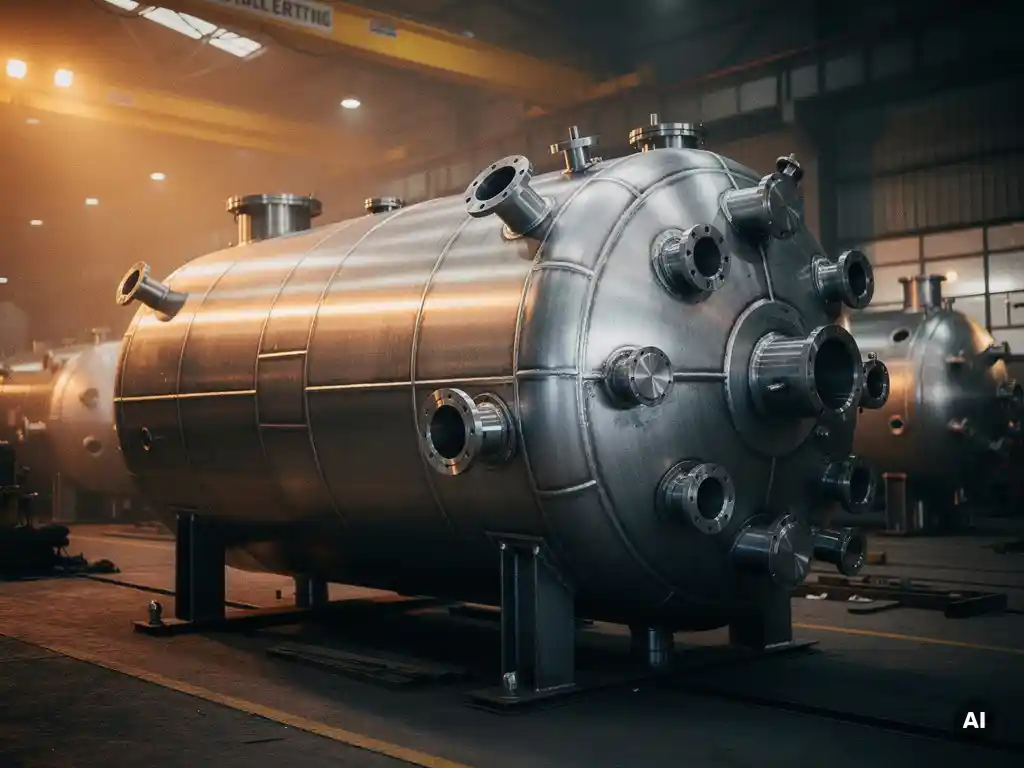
The three main types of reactors used in industrial and chemical processes are batch reactors, continuous stirred-tank reactors (CSTRs), and plug flow reactors (PFRs). Each operates on a fundamentally different principle for how reactants are introduced, mixed, and converted into products. The choice between them depends on factors such as reaction kinetics, required throughput, operating conditions, and the physical properties of the process streams. The sections below explore each reactor type in depth and address the practical considerations that influence reactor selection for demanding industrial applications.
What are the main differences between batch, CSTR, and plug flow reactors?
The core difference between batch, CSTR, and plug flow reactors lies in how material moves through the system and how reaction conditions change over time. A batch reactor processes a fixed charge of material in a closed vessel. A CSTR operates continuously with well-mixed contents at a uniform composition. A plug flow reactor also operates continuously but maintains a concentration gradient along its length, with no back-mixing between fluid elements.
These distinctions have direct consequences for conversion efficiency, residence time distribution, and the ability to control reaction selectivity. Batch reactors offer flexibility but require downtime between cycles. CSTRs provide steady-state operation and are easy to control, but their uniform composition means the reactor always operates at the lowest reactant concentration, which can limit conversion rates. Plug flow reactors achieve higher conversions per unit volume for many reaction types because reactants encounter progressively changing conditions along the reactor length.
What is a batch reactor used for in industrial processes?
A batch reactor is used for processes where flexibility, small production volumes, or complex multi-step chemistry make continuous operation impractical. The entire charge of reactants is loaded, the reaction proceeds under controlled conditions, and the contents are then discharged before the next cycle begins. This makes batch reactors well suited to specialty chemicals, pharmaceuticals, polymers, and any process requiring frequent product changeovers.
In industrial practice, batch reactors are often the preferred choice when:
- Production volumes are too low to justify continuous equipment
- The same vessel must handle multiple different products or formulations
- Reaction times are long and difficult to manage in a continuous-flow system
- Precise control over temperature profiles or reagent addition sequences is required
- The process involves solids, slurries, or highly viscous materials that are difficult to pump continuously
Batch reactors frequently include agitators, internal coils or jackets for temperature control, and nozzles for controlled reagent addition. When operating at elevated pressures or temperatures, they are classified as pressure vessels and must comply with applicable design codes and standards.
How does a continuous stirred-tank reactor (CSTR) work?
A continuous stirred-tank reactor works by continuously feeding reactants into a well-agitated vessel while simultaneously withdrawing product at the same volumetric rate, maintaining a constant liquid level and steady-state composition throughout the vessel. Because the contents are thoroughly mixed, the concentration inside the CSTR is essentially identical to the concentration in the outlet stream.
This uniform composition is the defining characteristic of CSTR operation. It simplifies process control and makes the reactor easy to model mathematically, which is valuable during process design and scale-up. However, operating at the outlet concentration throughout the entire vessel means that the driving force for reaction is at its lowest possible value, which generally requires a larger reactor volume compared to a plug flow reactor achieving the same conversion.
CSTRs are widely used in continuous polymerization, fermentation, wastewater treatment, and liquid-phase chemical synthesis. They are particularly effective for reactions that benefit from dilution of reactants or where temperature uniformity is critical to avoiding hot spots and unwanted side reactions.
What makes plug flow reactors different from other continuous reactors?
Plug flow reactors differ from CSTRs because fluid elements move through the reactor in an ordered sequence with no back-mixing, meaning each element of fluid experiences a progressively changing concentration and conversion as it travels from inlet to outlet. The concentration gradient along the reactor length is the defining feature that separates PFRs from CSTRs.
This ordered flow pattern means the reaction always proceeds at the highest possible reactant concentration near the inlet, giving plug flow reactors a kinetic advantage for reactions where rate increases with concentration. As a result, PFRs typically achieve higher conversions per unit volume than a single CSTR operating under the same conditions.
In practice, plug flow behavior is approximated by tubular reactors, fixed-bed reactors packed with catalyst, and certain column-type vessels. The geometry is well suited to gas-phase reactions, catalytic processes, and high-throughput continuous production. For reactions requiring precise residence time control and high selectivity, the plug flow configuration is often the preferred choice among industrial reactor types.
Which reactor type is best for high-pressure or corrosive applications?
No single reactor type is inherently superior for high-pressure or corrosive applications. The suitability depends on the process chemistry and operating conditions. However, the mechanical design of the reactor vessel has a greater influence on performance and safety in demanding environments than the flow configuration alone. Thick-walled construction, advanced materials selection, and clad fabrication techniques are often the decisive engineering factors.
For corrosive media, the inner surface of the reactor must resist chemical attack without compromising structural integrity. This is frequently addressed through clad construction, where a carbon steel shell provides structural strength and a corrosion-resistant inner layer of materials such as titanium, zirconium, Hastelloy, or Inconel provides chemical resistance. Solid construction in these advanced alloys is also used where wall thickness requirements or process conditions demand it.
High-pressure applications require careful attention to wall thickness calculations, nozzle reinforcement, weld quality, and post-weld heat treatment. Both batch and continuous reactor configurations can be engineered for severe pressure and temperature conditions, provided the vessel is designed and fabricated to the appropriate international standards such as PED or ASME.
How do reactor size and scale affect the choice of reactor type?
Reactor size and scale influence the choice of reactor type because each configuration responds differently to the challenges of large-scale fabrication and operation. As production scale increases, continuous reactors such as CSTRs and PFRs generally become more economically efficient than batch systems, since they eliminate the downtime associated with loading, reaction, and discharge cycles. At very large scales, the mechanical complexity of agitating a large batch vessel also increases significantly.
For very large or heavy reactor vessels, fabrication capability becomes a critical constraint. Dimensions, wall thickness, nozzle configurations, and internal requirements must all be achievable within the manufacturing tolerances required by the process. Reactors approaching or exceeding several hundred tons, or requiring diameters beyond what standard fabricators can handle, need a manufacturer with verified large-scale capabilities.
Scale also affects heat management. Large reactors can develop temperature gradients that are difficult to control through jacket heating or cooling alone, making internal coil systems or multi-zone configurations necessary. These internal requirements add mechanical complexity and must be integrated into the vessel design from the earliest engineering stages.
How Coek helps with industrial reactor design and fabrication
Coek Engineering translates demanding process specifications into mechanically sound, manufacturable reactor vessels for applications where standard fabrication is insufficient. Whether the requirement involves a large batch reactor, a continuous reactor vessel, or a fully integrated equipment scope, Coek’s capabilities are specifically oriented toward technically complex and critical projects.
- Custom reactor vessels in carbon steel, stainless steel, and advanced alloys including titanium, zirconium, Hastelloy, and Inconel
- Clad construction combining structural carbon steel with corrosion-resistant inner layers
- Large-scale manufacturing up to approximately 10 metres in diameter and 1,000 tons in weight
- Thick-walled and high-pressure vessel design compliant with PED and ASME standards
- Integrated reactor scopes including agitators, drive systems, seals, and instrumentation where required
- In-house mechanical engineering to support the transition from process requirements to fabrication-ready designs
If your project involves a reactor vessel with demanding pressure, temperature, corrosion, or dimensional requirements, contact Coek Engineering to discuss your specifications with our technical team.
Frequently Asked Questions
How do I know whether to use a single CSTR or multiple CSTRs in series for my process?
A single CSTR is often sufficient for processes where moderate conversion is acceptable or where dilution of reactants is actually beneficial, such as in certain polymerization or fermentation applications. However, when higher conversion is needed without switching to a PFR, arranging multiple CSTRs in series is a practical solution — each additional stage progressively shifts the operating concentration closer to plug flow behavior, improving overall conversion efficiency. The optimal number of stages is typically determined through reactor design calculations comparing capital cost against the conversion gains achieved with each additional vessel.
What are the most common mistakes engineers make when selecting a reactor type early in process design?
One of the most frequent mistakes is selecting a reactor type based on familiarity or convention rather than on the actual reaction kinetics and process requirements. For example, defaulting to a batch reactor for a process that could run continuously at scale often results in unnecessary downtime and higher operating costs as production volumes grow. Another common error is underestimating the impact of heat management at scale — a reactor configuration that performs well in a lab setting can develop serious temperature control challenges when translated to an industrial vessel, particularly if internal coil systems or multi-zone heating are not incorporated into the design from the outset.
Can a reactor vessel be designed to switch between batch and continuous operation?
In principle, yes — some reactor vessels are engineered with the flexibility to operate in both batch and semi-batch modes, and certain designs can be adapted for continuous feed with overflow withdrawal. However, true dual-mode operation involves significant mechanical and process control complexity, and the compromises made to accommodate both modes often mean the vessel is not fully optimized for either. If operational flexibility is a genuine process requirement, it is worth discussing this explicitly during the engineering phase so that the vessel geometry, agitation system, nozzle layout, and instrumentation are all designed with that flexibility in mind rather than retrofitted later.
What material selection considerations are most critical for reactors handling aggressive solvents or acidic media?
The starting point is always a thorough corrosion assessment that maps the specific chemical species, concentrations, temperatures, and pressures the reactor will encounter throughout its full operating cycle — including cleaning, startup, and upset conditions, not just steady-state operation. From there, material selection typically comes down to a trade-off between corrosion resistance, mechanical strength, weldability, and cost, with options ranging from stainless steel grades for moderately aggressive media to titanium, zirconium, or high-nickel alloys such as Hastelloy or Inconel for more severe environments. Clad construction — combining a structural carbon steel shell with a corrosion-resistant inner layer — is frequently the most cost-effective solution for large vessels where fabricating the entire wall from an advanced alloy would be prohibitively expensive.
How does residence time distribution (RTD) affect reactor performance in practice, and should I always aim for ideal plug flow or perfect mixing?
Residence time distribution describes how long different fluid elements actually spend inside the reactor, and deviations from ideal behavior — such as channeling, dead zones, or back-mixing — can significantly reduce conversion efficiency and product selectivity compared to what design calculations predict. Neither ideal plug flow nor perfect mixing is universally preferable; the optimal RTD depends entirely on your reaction kinetics and selectivity requirements. For reactions where selectivity toward a desired intermediate product is critical, plug flow behavior is generally preferred because it limits over-reaction; for reactions that benefit from dilution or where runaway risk must be managed, well-mixed conditions may actually be the safer and more effective choice.
What should I prepare before approaching a reactor fabricator with a new project?
At a minimum, you should be able to provide the key process parameters — operating temperature and pressure ranges, fluid compositions and their corrosive properties, required vessel volume or throughput, and any known constraints on dimensions or weight. It is also helpful to have clarity on applicable design standards (such as PED or ASME), any internal requirements such as agitators, coils, or baffles, and the project timeline including any phased delivery requirements. The more completely you can describe the process duty and the mechanical boundary conditions upfront, the more efficiently a fabricator’s engineering team can assess feasibility, identify potential design challenges, and provide a meaningful technical and commercial response.
How are fixed-bed catalytic reactors related to plug flow reactors, and what are the key design challenges specific to them?
Fixed-bed catalytic reactors are a practical implementation of the plug flow concept, where the catalyst is packed into the reactor tube or vessel and the process fluid flows through the bed in an ordered, largely back-mixing-free manner. The key design challenges specific to fixed beds include managing pressure drop across the catalyst bed, distributing flow uniformly across the cross-section to avoid channeling, and controlling the heat released or absorbed by the reaction — particularly for highly exothermic reactions where hot spots can deactivate the catalyst or drive unwanted side reactions. Reactor geometry, catalyst particle size and shape, bed depth, and the design of inlet distributors and outlet collectors all play a significant role in determining whether the reactor achieves its intended performance in practice.
Related Articles
- What determines the manufacturing cost of a large industrial pressure vessel?
- What are the installation challenges for heavy pressure vessels on offshore platforms?
- How does post-weld heat treatment affect pressure vessel mechanical properties?
- What are the design challenges of a large autoclave for composite manufacturing?
- What is a pressure vessel and how does it work?