
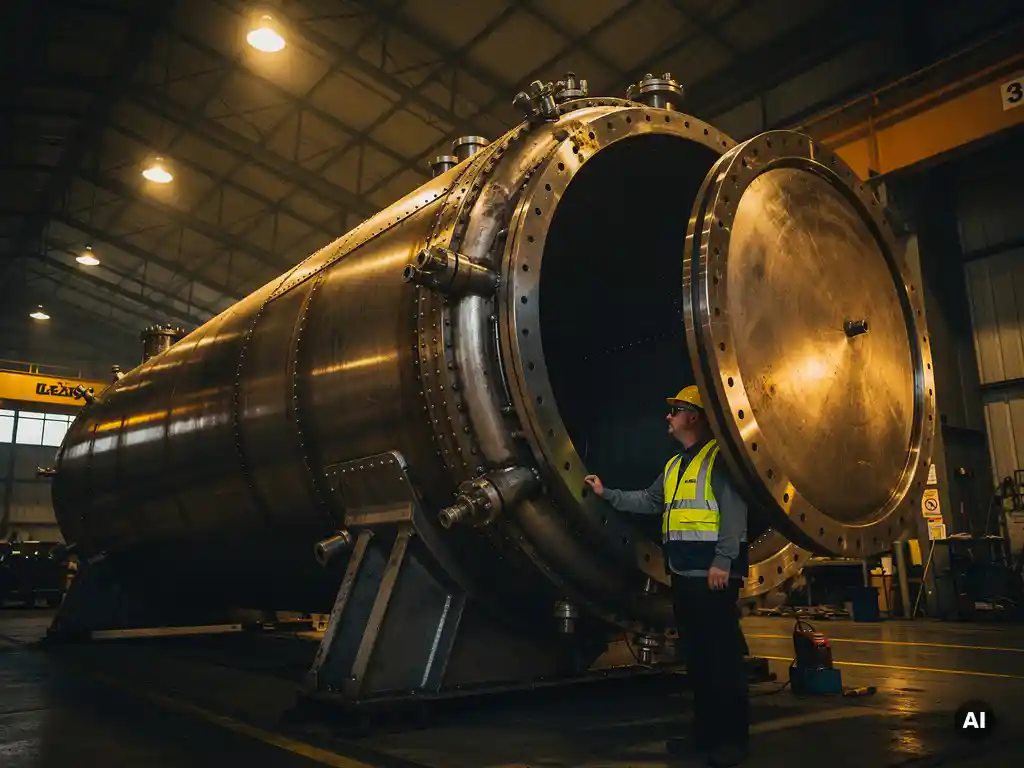
An industrial autoclave is a sealed pressure vessel that uses elevated temperature and pressure, typically with steam or another pressurised medium, to carry out chemical reactions, sterilisation, curing, or other demanding industrial processes. The autoclave generates and maintains a controlled internal environment that cannot be replicated at atmospheric conditions. The sections below unpack how autoclaves work, where they are used, how they differ from standard pressure vessels, and what drives their engineering requirements.
How does an industrial autoclave generate and control pressure?
An industrial autoclave generates pressure by introducing a pressurised medium, most commonly steam, nitrogen, or a process-specific gas, into a sealed vessel. As temperature rises inside the chamber, pressure builds to a defined operating level. Precision control systems, including pressure regulators, safety relief valves, and temperature sensors, maintain stable conditions throughout the process cycle.
The vessel is sealed with a robust closure system, often a quick-opening door or bolted flange, designed to withstand the full operating pressure without leakage. Inside, the process medium transfers heat and pressure uniformly to the contents. Once the cycle is complete, controlled depressurisation returns the vessel to safe conditions before the closure is opened.
In high-pressure autoclave applications, operating pressures can reach several hundred bar, requiring extremely thick walls and precise engineering of every structural element. The control philosophy, including ramp rates, hold times, and depressurisation sequences, is typically defined by the process owner and translated into mechanical and instrumentation requirements during equipment engineering.
What industries use industrial autoclaves?
Industrial autoclaves are used across a wide range of sectors where high-pressure, high-temperature, or chemically aggressive process conditions are required. The common denominator is not the industry itself, but the need for a controlled, sealed, and pressurised environment to drive a specific process outcome.
Sectors that regularly rely on high-pressure autoclaves include:
- Chemical processing: for reactions that require elevated pressure or temperature to proceed efficiently or selectively
- Composite and aerospace manufacturing: for curing fibre-reinforced materials under precisely controlled pressure and heat cycles
- Hydrometallurgy and mining: for pressure oxidation and leaching of ores, often in highly corrosive acidic environments
- Pharmaceutical and biotechnology: for sterilisation and autoclave-based synthesis processes
- Rubber and polymer processing: for vulcanisation and curing of elastomeric products
- Food processing: for retort sterilisation of packaged products at elevated temperature and pressure
- Wood treatment: for pressure impregnation of timber with preservatives
In many of these applications, the autoclave is a critical piece of equipment where failure or unplanned downtime carries significant operational and safety consequences. This makes design quality, material selection, and fabrication precision especially important.
What’s the difference between an autoclave and a pressure vessel?
An autoclave is a type of pressure vessel, but not all pressure vessels are autoclaves. The key distinction lies in function and design intent. A pressure vessel is the broader category, referring to any closed container designed to hold fluids or gases at a pressure significantly above atmospheric pressure. An autoclave is a specific subtype designed to process contents under controlled pressure and temperature conditions, typically with a means of loading, sealing, cycling, and unloading.
Practically, autoclaves tend to have more complex closure systems, such as quick-opening doors or interlocked hatches, because they are opened and closed repeatedly during operation. Standard pressure vessels, such as storage bullets or process columns, are often welded shut or have flanged connections that are not designed for frequent access.
Autoclaves also typically include more integrated process control features, including heating and cooling systems, pressure regulation, and cycle management, while a generic pressure vessel may simply store or transport a pressurised medium. The engineering of an autoclave therefore spans both the pressure-containing structure and the operational cycle requirements.
What materials are industrial autoclaves made from?
The material selection for an industrial autoclave depends primarily on the operating pressure, temperature, and the chemical nature of the process medium. Carbon steel is the baseline material for many applications, but demanding environments, particularly those involving acids, halogens, or highly oxidising conditions, require corrosion-resistant alloys or clad construction.
Common materials used in autoclave fabrication include:
- Carbon steel: suitable for non-corrosive applications at moderate temperatures and pressures
- Stainless steel: used where moderate corrosion resistance and hygiene requirements apply
- Titanium: selected for highly corrosive environments, including oxidising acids and chloride-rich media
- Zirconium: used in extremely aggressive chemical environments, particularly in the chemical processing industry
- Hastelloy and Inconel: high-performance nickel alloys for elevated temperature and corrosion resistance
- Clad construction: a carbon steel shell with a corrosion-resistant inner layer, combining structural strength with chemical resistance at a practical cost
Clad construction is particularly relevant for large autoclaves, where using a solid exotic alloy throughout would be prohibitively expensive and structurally unnecessary. The cladding, whether applied by roll bonding, weld overlay, or explosion bonding, provides the required corrosion protection while the structural load is carried by the carbon steel base material.
How large can an industrial autoclave be?
Industrial autoclaves vary enormously in size depending on the application. Small laboratory or pharmaceutical autoclaves may have internal volumes of just a few litres. At the other end of the scale, large industrial autoclaves used in hydrometallurgy, composite manufacturing, or chemical processing can reach several metres in diameter and tens of metres in length, with weights approaching or exceeding several hundred tons.
The physical size of an autoclave is constrained by the manufacturing capabilities of the fabricator, transport logistics, and the structural requirements imposed by operating pressure. Thick-walled autoclaves designed for very high pressures become significantly heavier as diameter increases, because wall thickness must scale with both pressure and diameter. This creates genuine engineering and fabrication complexity at large scales.
Fabricating autoclaves of this size requires specialised equipment, including large rolling and welding facilities, heavy lifting capacity, and the ability to perform precise dimensional checks on very large structures. Not all pressure equipment manufacturers are equipped for this scale of work.
What are the key design and engineering requirements for an autoclave?
Designing an industrial autoclave requires balancing pressure containment, thermal performance, operational accessibility, and long-term reliability. The starting point is always the process specification, which defines operating pressure, temperature, cycle profile, and the chemical environment. These parameters drive every subsequent engineering decision.
Critical design considerations include wall thickness calculations based on operating pressure and material properties, nozzle and closure design, thermal expansion management, and weld joint configuration. Autoclaves subject to repeated pressurisation and depressurisation cycles must also be assessed for fatigue, since cyclic loading can progressively weaken a structure that would otherwise be adequate for static pressure.
Closure design deserves particular attention. Quick-opening closures must be engineered to prevent accidental opening under pressure while remaining practical to operate in an industrial environment. Interlocks and safety systems are integral to the design, not afterthoughts.
International standards such as the European Pressure Equipment Directive (PED) and ASME codes govern the design, fabrication, inspection, and testing of autoclaves. Compliance with these standards is not optional in most jurisdictions and provides a structured framework for demonstrating equipment integrity throughout its operational life. Industrial autoclave engineering must therefore integrate both the mechanical design and the applicable regulatory requirements from the earliest project stage.
How Coek supports demanding autoclave projects
Coek Engineering manufactures custom industrial autoclaves for technically complex and critical applications, including large-scale, thick-walled, and corrosion-resistant designs that require advanced materials or clad construction. Coek’s approach is to translate customer process requirements into mechanically sound, manufacturable equipment that meets the applicable international standards.
Key capabilities relevant to autoclave projects include:
- Manufacturing capacity for autoclaves up to approximately 10 metres in diameter and approaching 1,000 tons
- Extensive experience with demanding materials including titanium, zirconium, Hastelloy, Inconel, and clad constructions
- In-house mechanical engineering to convert process specifications into fabrication-ready designs
- Compliance with PED, ASME, and ISO 9001 quality standards
- Capability to integrate broader mechanical scope, including closures, internals, and associated systems
If your project involves an autoclave that falls outside what standard fabricators can deliver, contact Coek Engineering to discuss your technical requirements.
Frequently Asked Questions
How do I know whether my application requires a standard pressure vessel or a custom-engineered autoclave?
The key indicator is operational complexity. If your process requires repeated loading and unloading cycles, precise control of temperature and pressure ramp rates, or exposure to chemically aggressive media, you almost certainly need a purpose-engineered autoclave rather than a generic pressure vessel. A detailed process specification, covering operating pressure, temperature profile, cycle frequency, and chemical environment, is the starting point for any meaningful engineering assessment. Engaging a specialist fabricator early in the project allows these parameters to be translated into a technically sound equipment design before costly assumptions are locked in.
What is the typical lead time for manufacturing a large industrial autoclave?
Lead times for large industrial autoclaves vary significantly depending on size, material specification, and fabricator workload, but projects involving thick-walled vessels in exotic alloys or clad construction commonly require 12 to 24 months from order to delivery. The longest lead items are typically the raw materials themselves, particularly large-diameter plate in titanium, zirconium, or nickel alloys, which are produced in limited quantities globally. Early engagement with your fabricator and locking in a material procurement strategy as soon as the specification is confirmed can meaningfully reduce overall project schedule risk.
How does cyclic pressure loading affect the long-term integrity of an autoclave, and how is this managed?
Every pressurisation and depressurisation cycle introduces fatigue loading into the vessel structure, particularly at stress concentration points such as nozzle junctions, weld toes, and closure interfaces. Over time, cumulative cyclic loading can initiate and propagate cracks even in a vessel that is adequately designed for static pressure. This is managed at the design stage through fatigue analysis in accordance with applicable codes such as ASME VIII Division 2 or EN 13445, appropriate weld joint classification, and post-weld heat treatment where required. In service, periodic inspection, including non-destructive examination of high-stress zones, is essential to detecting any developing discontinuities before they become critical.
What are the most common mistakes made when specifying an industrial autoclave?
The most frequent and costly mistake is providing an incomplete or overly conservative process specification. Underspecifying the chemical environment, for example by failing to account for trace contaminants or process upsets, can result in premature corrosion failure. Overspecifying pressure or temperature margins without engineering justification drives up wall thickness, weight, and cost unnecessarily. A second common error is treating the closure system as a secondary concern rather than a primary engineering challenge; quick-opening closures on high-pressure autoclaves require careful mechanical and safety interlock design that must be integrated from the outset, not retrofitted.
Can an existing autoclave be modified or re-rated to handle higher pressures or different process conditions?
In principle, yes, but re-rating an autoclave is a formal engineering exercise that must be treated with the same rigour as a new design. It requires a full review of the original design calculations, material certifications, weld records, and inspection history, followed by revised pressure calculations to confirm structural adequacy under the new conditions. If the original documentation is incomplete, which is common for older vessels, additional non-destructive examination and material testing may be required to establish a reliable baseline. Any re-rating must be documented, verified by a competent authority, and reflected in updated pressure equipment documentation in accordance with the applicable regulatory framework.
What role does surface finish and internal lining play in autoclave performance?
Internal surface condition is critical in applications where product purity, corrosion resistance, or cleanability are process requirements. In pharmaceutical and food-grade autoclaves, smooth internal finishes and hygienic weld profiles prevent product contamination and facilitate cleaning. In chemically aggressive environments such as hydrometallurgy, the internal surface, whether a weld overlay, roll-bonded cladding, or solid alloy, must be free of defects that could act as initiation sites for localised corrosion. Specifying and verifying the required internal surface finish and lining integrity, including inspection of weld seams in clad zones, should be an explicit part of the fabrication quality plan.
Which international standards and certifications should I look for when selecting an autoclave manufacturer?
The most widely recognised frameworks are ASME Section VIII (Divisions 1 and 2) for pressure vessel design and fabrication, which is mandatory or commonly accepted across North America and many international projects, and the European Pressure Equipment Directive (PED 2014/68/EU), which governs equipment placed on the market within the European Economic Area. ISO 9001 certification indicates a documented and audited quality management system, which is relevant to fabrication consistency and traceability. For specific materials or process environments, additional standards such as NACE corrosion guidelines or industry-specific codes may apply. A competent manufacturer should be able to demonstrate active certification, provide documentation of third-party inspections, and have experience working with notified bodies or authorised inspection authorities.
Related Articles
- What materials are used in shell-and-tube heat exchanger manufacturing?
- What is the difference between a solid and a clad pressure vessel?
- What is a high pressure autoclave reactor?
- How do you prevent stress corrosion cracking in pressure vessel materials?
- What causes corrosion in pressure vessels and how can it be prevented?