
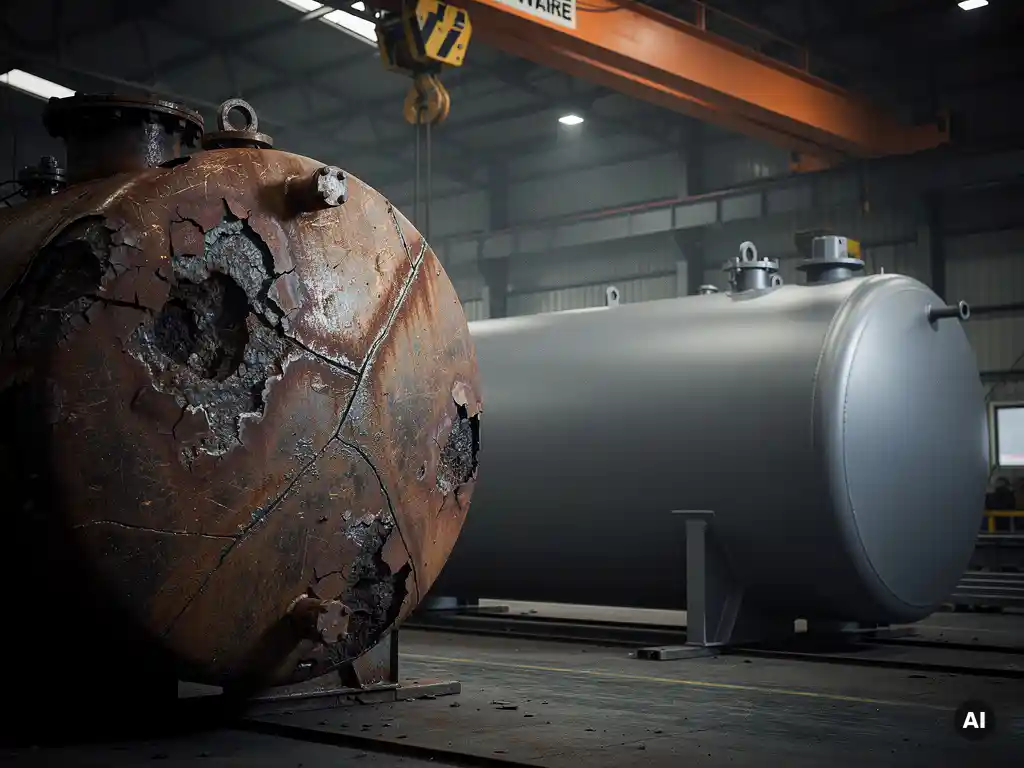
An industrial company should consider replacing a pressure vessel when the cost, risk, or technical limitations of repair outweigh the long-term value of continued operation. This decision point typically arrives when structural degradation is extensive, when repeated repairs no longer restore reliable integrity, or when the vessel no longer meets current regulatory or process requirements. The sections below unpack each dimension of this decision in detail.
What are the main signs that a pressure vessel has reached the end of its service life?
A pressure vessel has likely reached the end of its service life when inspection findings reveal degradation that cannot be reliably arrested or reversed through repair. The most definitive indicators are widespread corrosion or erosion beyond acceptable thickness limits, crack propagation in critical weld zones, creep deformation in high-temperature service, or repeated failure at the same location despite previous remediation.
Beyond these structural signals, operational history matters equally. A vessel that has accumulated a large number of pressure cycles approaching its design fatigue limit, or one that has experienced a significant overpressure or thermal shock event, may have exhausted a substantial portion of its remaining design life even if visible damage appears limited.
- Wall thickness reduced below the calculated minimum required by the original design code
- Extensive pitting corrosion across a large surface area rather than isolated spots
- Weld cracking that recurs after repair, indicating underlying metallurgical incompatibility or stress concentration
- Deformation or distortion of nozzles, flanges, or shell sections beyond tolerance
- Lining or cladding failure exposing base material to a corrosive medium it was never designed to handle
Any single finding from this list warrants a formal engineering assessment. Multiple findings appearing simultaneously are a strong signal that end-of-service-life replacement planning should begin immediately.
How do engineers assess whether a pressure vessel is worth repairing?
Engineers assess the repair-or-replace question by combining quantitative inspection data with a structured fitness-for-service evaluation. The starting point is a detailed inspection report covering wall thickness measurements, weld condition, corrosion mapping, and any non-destructive examination findings. This data is then compared against the vessel’s original design calculations and the applicable pressure equipment standard.
Fitness-for-service methodologies, such as those described in API 579-1/ASME FFS-1, provide a structured framework for evaluating whether a vessel with known flaws or degradation can continue to operate safely and under what conditions. The assessment considers remaining strength, crack stability, remaining corrosion allowance, and the projected rate of future degradation.
A repair is generally considered viable when the degradation is localised, the root cause is understood and controllable, the repair method is technically proven for the material and geometry involved, and the repaired vessel can be expected to deliver a meaningful additional service life. When any of these conditions cannot be met, the engineering case for replacement strengthens considerably.
What factors make pressure vessel repair impractical or unsafe?
Pressure vessel repair becomes impractical or unsafe when the material, geometry, or extent of damage makes it impossible to restore the vessel to a reliably verifiable condition. Several specific factors push a vessel into the replacement category.
Material condition is frequently the deciding factor. Vessels fabricated from materials that have become brittle through hydrogen embrittlement, stress corrosion cracking, or prolonged high-temperature exposure may not respond predictably to welding repair. Introducing heat-affected zones into already compromised base material can create new failure risks that are difficult to inspect or quantify.
Geometric complexity also constrains repair options. Nozzle reinforcement zones, thick-to-thin transitions, and clad interfaces all present challenges for weld repair that require highly specific procedures and post-weld heat treatment. If the vessel geometry does not permit access for qualified inspection after repair, the repair itself cannot be verified to the standard required by the applicable code.
Finally, when corrosion or erosion damage is distributed across a large proportion of the vessel surface rather than concentrated in a defined zone, repair becomes a process of patching an increasingly compromised structure rather than restoring it. At this point, the engineering risk profile of continued repair typically exceeds that of planned replacement.
When does replacing a pressure vessel deliver better long-term value than repeated repairs?
Replacing a pressure vessel delivers better long-term value when the cumulative cost and operational disruption of repeated repairs exceed the investment in a new vessel, or when each successive repair delivers a shorter interval before the next intervention is required. This crossover point is reached sooner than many operators expect.
A new vessel also offers the opportunity to incorporate design improvements that reflect current process requirements, updated material specifications, or revised operating conditions that may have evolved since the original equipment was specified. A repaired vessel, by contrast, remains constrained by its original design envelope.
From a risk management perspective, a new vessel manufactured to current standards and inspected under a full quality assurance regime provides a level of documented integrity that a heavily repaired vessel cannot match. For applications where equipment failure carries significant safety, environmental, or production consequences, this difference in documented reliability has real value that extends beyond the capital cost comparison.
Operators running vessels in demanding service conditions, including high pressures, elevated temperatures, or corrosive media, typically find that the economics of replacement improve further because the consequences of an unplanned failure in these environments are disproportionately severe.
What standards and regulations govern the decision to repair or replace?
The decision to repair or replace a pressure vessel is governed by a combination of design codes, inspection standards, and national or regional regulatory frameworks. The applicable standards depend on the vessel’s original certification, its operating jurisdiction, and the nature of the degradation identified.
In European practice, the Pressure Equipment Directive (PED) and its successor regulations set the conformity framework for pressure equipment placed in service. Repairs that materially alter the vessel’s design or operating parameters may trigger a reassessment of conformity, effectively requiring the repaired vessel to be re-evaluated as if it were new equipment.
In North American practice, the ASME Boiler and Pressure Vessel Code, particularly Section VIII, governs original fabrication. Post-construction inspection and repair are addressed by standards such as API 510, which provides specific guidance on inspection intervals, fitness-for-service assessment, and the conditions under which a vessel should be taken out of service.
Regardless of the specific standard, the regulatory logic is consistent: a vessel that cannot be returned to a condition that meets its original design intent, or that cannot be inspected to verify the quality of a repair, should not remain in service. Regulatory requirements therefore set a hard boundary below which engineering judgment alone cannot authorise continued operation.
How does the operating environment affect the repair-or-replace decision?
The operating environment is one of the most significant variables in the repair-or-replace decision because it determines both the rate at which a vessel degrades and the technical difficulty of performing reliable repairs. Vessels operating in aggressive environments reach decision points earlier and with fewer viable repair options than those in benign service.
Corrosive media present particular challenges. A vessel handling strong acids, halogens, or other aggressive process fluids may rely on a corrosion-resistant lining or clad layer to protect the structural base material. Once that protective layer is breached, the repair must restore both the corrosion barrier and the structural integrity simultaneously. This is technically demanding work, and in some material combinations, it is not reliably achievable through field repair.
High-temperature and high-pressure service compounds the difficulty further. Elevated temperatures accelerate creep and oxidation, reduce the effectiveness of weld repairs, and may require post-weld heat treatment that is impractical to perform on an installed vessel. High cyclic pressure loading reduces the remaining fatigue life of a vessel that has already accumulated significant service history.
When the operating environment is severe and the vessel’s remaining corrosion allowance or fatigue life is limited, the window in which repair remains a technically sound option is narrow. Recognising this window and acting within it, rather than deferring the decision, is a key discipline in responsible pressure equipment management.
How Coek supports the pressure vessel replacement decision
When inspection findings or operational history point toward replacement rather than repair, the quality and specification of the replacement vessel become the central engineering challenge. Coek Engineering designs and manufactures custom pressure vessels for applications where standard or commodity equipment is not adequate.
Relevant capabilities for replacement projects include:
- In-house mechanical engineering to translate updated process requirements into a manufacturable vessel design
- Advanced materials expertise, including titanium, zirconium, Hastelloy, Inconel, and clad constructions combining carbon steel with corrosion-resistant inner layers
- Large-scale manufacturing capacity for vessels up to 10 metres in diameter and approximately 1,000 tons
- Compliance with PED, ASME, and ISO 9001 quality frameworks
- Experience with thick-walled, high-pressure, and dimensionally demanding equipment where fabrication precision is critical
If your organisation is evaluating whether a current vessel has reached the end of its serviceable life, or if a replacement project is already in scope, contact Coek Engineering to discuss your technical requirements with our engineering team. For applications involving large-scale, high-pressure, or corrosive service conditions, you can also review our industrial autoclave capabilities as a reference point for the complexity of equipment we routinely manufacture.
Frequently Asked Questions
How long does a typical pressure vessel replacement project take from decision to commissioning?
The timeline for a pressure vessel replacement depends heavily on vessel complexity, material availability, and the required certification scope, but most custom replacement projects range from several months to over a year from engineering kickoff to site commissioning. Vessels requiring exotic materials such as titanium, zirconium, or Hastelloy, or those with large diameters and thick walls, tend to have longer lead times due to material procurement and fabrication complexity. Starting the replacement process as early as inspection findings permit — rather than waiting for a vessel to reach a critical condition — gives operators the scheduling flexibility to avoid forced shutdowns or emergency procurement.
Can a replacement vessel be designed to handle updated or more demanding process conditions than the original?
Yes, and this is one of the most significant advantages of replacement over repair. A new vessel can be engineered from the ground up to reflect current process conditions, including higher operating pressures or temperatures, changes in process chemistry, or revised flow rates that have evolved since the original vessel was specified. This is particularly valuable when a plant has been debottlenecked or upgraded since the original equipment was installed, as a repaired vessel remains constrained by its original design envelope and cannot be easily recertified for substantially different conditions.
What information should we gather before approaching a manufacturer about a replacement vessel?
The more complete your technical brief, the more accurate and useful the manufacturer’s response will be. At a minimum, you should compile the current vessel’s design documentation (including original drawings, material certifications, and design code), the updated process conditions if they have changed, inspection reports highlighting the degradation that is driving the replacement decision, and any site constraints such as dimensional limits, nozzle orientation requirements, or transport access restrictions. If the original documentation is incomplete — which is common for older vessels — a reputable manufacturer can work with you to reconstruct the necessary design basis, but this adds time to the front-end engineering phase.
What are the most common mistakes operators make when managing aging pressure vessels?
The most consequential mistake is deferring formal fitness-for-service assessments in response to budget pressure or production scheduling constraints, which allows degradation to progress past the point where repair remains a viable option and compresses the time available for planned replacement. A second common error is treating repeated repairs at the same location as a maintenance routine rather than a signal of an underlying design, material, or process incompatibility that repair alone cannot resolve. Finally, operators sometimes underestimate how significantly the operating environment has shifted since original commissioning — changes in process chemistry, cycling frequency, or temperature that have accumulated gradually can have a material impact on remaining vessel life.
Is it possible to use non-destructive examination (NDE) alone to determine whether a vessel needs replacing?
NDE is an essential input to the decision, but it cannot make the determination on its own. Techniques such as ultrasonic thickness measurement, phased array UT, radiographic testing, and acoustic emission monitoring can characterise the nature, location, and extent of degradation with considerable precision, but the significance of those findings must be interpreted within a formal fitness-for-service framework that accounts for design margins, operating loads, and projected degradation rates. An NDE report that identifies a flaw tells you what is there; a fitness-for-service assessment tells you what it means for continued safe operation and whether repair or replacement is the appropriate response.
How does the choice of replacement vessel material affect long-term maintenance requirements?
Material selection for a replacement vessel is one of the most consequential decisions in the project, because it directly determines the vessel’s resistance to the specific degradation mechanisms present in your service environment and therefore the frequency and cost of future inspection and maintenance. Upgrading to a more corrosion-resistant alloy or a clad construction with a corrosion-resistant inner layer can significantly extend inspection intervals and reduce the likelihood of reaching another replacement decision prematurely. Conversely, specifying a material that is marginally adequate for the service conditions to reduce upfront cost often results in accelerated degradation and a shorter-than-expected service life, making the apparent saving illusory over the asset’s lifetime.
What role does documentation play in managing pressure vessel replacement projects, and what should be retained after commissioning?
Comprehensive documentation is the foundation of safe pressure vessel management throughout the asset’s life, and its importance is often underestimated until records are needed for an inspection, an insurance assessment, or a regulatory audit. After commissioning a replacement vessel, operators should retain the full manufacturing data record — including material test certificates, weld procedure qualifications, welder qualification records, NDE reports, hydrostatic test records, and the final code stamp documentation. This package becomes the baseline against which all future inspection findings are compared, and its completeness directly affects the quality of fitness-for-service assessments that may be required later in the vessel’s service life.
Related Articles
- How do pressure, temperature and corrosion affect process column material selection?
- What is an autoclave and how does it work in industrial processes?
- When does a pressure vessel require thick-wall design?
- What is the role of a pressure vessel manufacturer in an EPC project?
- What is a large capacity autoclave?