
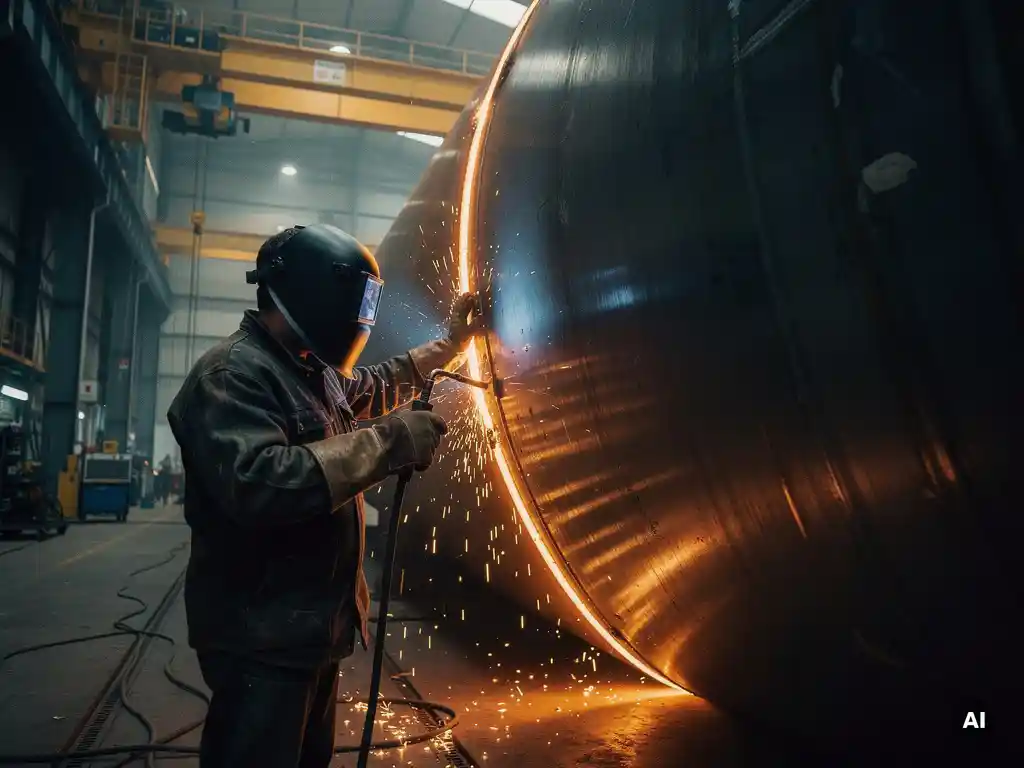
Thick-walled pressure vessels are significantly harder to fabricate than standard vessels because every increase in wall thickness amplifies the technical demands placed on welding, heat treatment, material handling and dimensional control. The thicker the wall, the greater the risk of weld defects, residual stress, distortion and material degradation during fabrication. This article addresses the most critical questions engineers and procurement teams ask when specifying or sourcing heavy-wall pressure vessel manufacturing.
Why does wall thickness make pressure vessel fabrication so much harder?
Greater wall thickness increases fabrication difficulty because it concentrates heat unevenly during welding, creates steeper thermal gradients through the vessel wall, and demands far more precise control over every stage of the manufacturing process. Thicker sections require more weld passes, longer heat treatment cycles and more rigorous inspection to achieve the same quality level as thinner-walled equipment.
In practical terms, a vessel with a wall thickness of 100 mm or more behaves very differently under welding heat than one with a 20 mm wall. The inner and outer surfaces heat and cool at different rates, generating residual stresses that can compromise structural integrity if not properly managed. Material volume also increases substantially, raising the weight and complexity of handling during fit-up, rolling and assembly.
For manufacturers, this means that standard fabrication procedures designed for conventional vessels are often insufficient. Thick-walled pressure vessel fabrication demands qualified welding procedures, specialised preheating, controlled interpass temperatures and post-weld heat treatment tailored to the specific material and wall thickness combination.
What are the most common welding problems in thick-walled vessels?
The most common welding problems in thick-walled pressure vessel fabrication are hydrogen-induced cracking, lamellar tearing, incomplete fusion between weld passes, and high residual stress accumulation. These defects are more likely in heavy-wall sections because the thermal mass of the material makes it harder to maintain consistent heat input across the entire weld joint.
Hydrogen-induced cracking, sometimes called cold cracking, occurs when hydrogen absorbed during welding becomes trapped in the heat-affected zone as the joint cools. In thick sections, the faster cooling rate in the weld area increases susceptibility. Controlling preheat temperature, using low-hydrogen consumables and maintaining proper interpass temperatures are the primary countermeasures.
Lamellar tearing is a concern when through-thickness tensile stresses act on rolled plate with low through-thickness ductility. This is particularly relevant in heavy-wall vessels where large weld joints apply significant stress perpendicular to the plate surface. Material selection and joint design both play a role in reducing this risk.
Incomplete fusion between passes is a volumetric defect that becomes harder to avoid as the number of weld passes increases. Thick walls may require dozens of passes per joint, and each one must achieve proper fusion with the previous layer. This demands highly skilled welders and rigorous interpass inspection.
How does post-weld heat treatment work for thick-walled pressure vessels?
Post-weld heat treatment, or PWHT, involves heating the fabricated vessel to a controlled temperature, holding it at that temperature for a defined period, and then cooling it in a controlled manner. The primary purpose is to relieve residual stresses introduced during welding and to reduce the risk of stress corrosion cracking, hydrogen embrittlement and brittle fracture in service.
For thick-walled vessels, PWHT is almost always mandatory rather than optional. The required soak temperature and hold time are determined by the material specification and wall thickness, as defined by applicable codes such as ASME VIII or EN 13445. Thicker walls require longer hold times to ensure the entire cross-section reaches and maintains the target temperature uniformly.
Heating and cooling rates must be carefully controlled to avoid introducing new thermal stresses during the treatment itself. Large or geometrically complex vessels present additional challenges because temperature uniformity across the entire vessel is difficult to achieve. Manufacturers typically use thermocouples at multiple locations to monitor and record temperature profiles throughout the cycle.
In some cases, local PWHT is performed on specific weld joints rather than the full vessel, but this approach requires careful engineering to ensure it does not create unacceptable stress concentrations at the boundary of the treated zone.
What materials are typically used in thick-walled pressure vessel construction?
Thick-walled pressure vessels are most commonly constructed from carbon steel, low-alloy steel and stainless steel, with the specific grade selected based on operating pressure, temperature and the chemical nature of the process fluid. For corrosive or high-purity applications, advanced alloys and clad constructions are widely used to combine structural strength with corrosion resistance.
Common material categories include:
- Carbon and low-alloy steels such as SA-516, SA-387 and similar grades, used where high strength and good weldability are the primary requirements
- Austenitic stainless steels for moderate corrosion resistance and cryogenic applications
- Nickel alloys such as Inconel and Hastelloy for high-temperature or highly corrosive service
- Titanium and zirconium for aggressive chemical environments where standard alloys are inadequate
- Clad plate, combining a structural carbon steel base with a corrosion-resistant inner layer of stainless steel, titanium, zirconium or other alloys
Clad construction is particularly relevant for thick-walled vessels because it allows the structural wall to be designed for mechanical performance while the cladding addresses corrosion. This approach is often more cost-effective than fabricating the entire vessel from an expensive alloy, and it is well established in demanding chemical and petrochemical applications.
How do manufacturers control distortion and dimensional tolerances in thick-walled vessels?
Controlling distortion and maintaining dimensional tolerances in thick-walled pressure vessel manufacturing requires a combination of engineered weld sequencing, controlled heat input, fixturing and in-process measurement. Because heavy-wall sections carry more thermal mass, the distortion forces generated by welding are substantial and must be actively managed throughout fabrication.
Weld sequencing is one of the most effective tools available. By planning the order in which joints are completed, fabricators can balance the shrinkage forces on each side of a joint and prevent cumulative distortion from building up across the vessel. This requires experience and planning before fabrication begins, not reactive correction after the fact.
Preheat and controlled interpass temperature management also contribute to dimensional stability by reducing the temperature differential between the weld zone and the surrounding material. Excessive temperature gradients are a primary driver of distortion in thick sections.
After welding and PWHT, dimensional verification is carried out using precision measurement equipment. For large vessels, this may include laser measurement systems to verify roundness, straightness and nozzle orientation to the tolerances specified in the design. Where tight tolerances are required for internal components such as trays, agitators or drive systems, dimensional control during fabrication is critical to ensuring correct fit and function during assembly and installation.
Which industry standards govern the fabrication of thick-walled pressure vessels?
The fabrication of thick-walled pressure vessels is governed primarily by ASME Boiler and Pressure Vessel Code Section VIII (Divisions 1, 2 and 3), the European Pressure Equipment Directive (PED) implemented through harmonised standards such as EN 13445, and various national codes depending on the country of installation. The applicable standard is typically specified by the end user, EPC contractor or the regulatory authority in the country where the vessel will operate.
ASME VIII Division 2 and Division 3 are specifically relevant for thick-walled and high-pressure vessels. Division 2 allows higher allowable stresses through more rigorous design and inspection requirements, while Division 3 applies to vessels operating at very high pressures, typically above 700 bar, and imposes the most demanding fabrication and testing requirements of the three divisions.
Beyond the primary design code, additional standards govern specific aspects of fabrication. Welding procedure qualification follows ASME IX or EN ISO 15614, depending on the applicable code. Non-destructive examination methods are specified in ASME V or equivalent EN standards. Material procurement follows ASME II material specifications or EN material standards.
For vessels destined for European markets, CE marking under the PED is required for most pressure equipment above defined pressure-volume thresholds. Manufacturers must hold the appropriate quality system approvals and, in many cases, involve a notified body in the design review and inspection process.
When should a project specify a specialist fabricator for thick-walled vessels?
A project should specify a specialist fabricator for thick-walled pressure vessels whenever the wall thickness, operating conditions, materials or dimensional requirements exceed what general-purpose fabricators can reliably deliver. The threshold is not defined by a single number but by the combination of technical demands that the vessel places on every stage of the manufacturing process.
Situations that consistently call for specialist fabrication capability include:
- Wall thickness above approximately 80 to 100 mm, where standard welding procedures and heat treatment equipment are no longer adequate
- Advanced or exotic materials such as titanium, zirconium, Hastelloy or clad constructions requiring specific welding expertise and material handling procedures
- Very large vessel dimensions that exceed the capacity of standard fabrication shops in terms of rolling, lifting, heat treatment furnace size or transport logistics
- Tight dimensional tolerances required by internal components, rotating equipment or precision process requirements
- First-of-a-kind or highly customised designs where the fabricator must contribute manufacturing engineering input alongside the mechanical design
- Integrated equipment scope where the vessel must be supplied with agitators, drive systems, seals or other mechanical components as a coordinated package
Selecting an underqualified fabricator for a technically demanding vessel is one of the highest-risk decisions a project team can make. The consequences of fabrication defects in thick-walled, high-pressure equipment are severe, and rework or replacement at a late project stage is extremely costly. Specifying a fabricator with demonstrated capability in heavy-wall pressure vessel manufacturing from the outset is the most effective way to manage that risk.
How Coek helps with thick-walled pressure vessel fabrication
Coek Engineering specialises in the fabrication of custom, complex and critical pressure equipment, with particular strength in projects where wall thickness, dimensions, materials or integrated scope create challenges that commodity fabricators cannot reliably address. Key capabilities include:
- Manufacturing of thick-walled vessels, reactors and industrial autoclaves in demanding materials including titanium, zirconium, Hastelloy, Inconel and clad constructions
- More than 30 years of experience with clad equipment combining structural carbon steel with corrosion-resistant inner layers
- Large-scale manufacturing facilities in Geel and Genk capable of handling equipment up to 10 metres in diameter, 100 metres in length and approximately 1,000 tons
- In-house mechanical engineering to translate process requirements into manufacturable equipment designs
- Compliance with ASME, PED and ISO 9001 standards, with involvement of notified bodies where required
- Integrated equipment scope capability, combining the vessel with agitators, drive systems, seals and instrumentation where the project requires it
If your project involves thick-walled pressure vessels with demanding specifications, contact Coek Engineering to discuss your requirements with our technical team.
Frequently Asked Questions
How do I know if my project requires ASME VIII Division 2 or Division 3, rather than Division 1?
The choice between ASME VIII divisions depends primarily on operating pressure and the level of design rigour your project demands. Division 2 is typically appropriate for high-pressure vessels where higher allowable stresses can reduce wall thickness and material costs, provided you accept more stringent design analysis and inspection requirements. Division 3 applies when operating pressures exceed approximately 700 bar, imposing the most demanding fabrication, testing and documentation requirements. Your mechanical engineer or the fabricator’s engineering team should evaluate the operating envelope and advise on the most appropriate division during the early design stage.
What non-destructive examination (NDE) methods are most effective for inspecting thick-walled pressure vessel welds?
Phased array ultrasonic testing (PAUT) and time-of-flight diffraction (TOFD) are the most effective NDE methods for thick-walled welds because they can detect volumetric and planar defects deep within the weld cross-section with far greater sensitivity than conventional radiography. Radiographic testing (RT) becomes increasingly difficult and less reliable as wall thickness increases due to the high radiation exposure required and reduced image contrast. Most codes permit or require a combination of methods — for example, PAUT for volumetric inspection and magnetic particle testing (MT) or dye penetrant testing (PT) for surface-breaking defects — and the specific NDE scope should be agreed with the notified body or inspection authority at the design stage.
Can thick-walled pressure vessels be repaired in the field if a defect is found during or after commissioning?
Field repair of thick-walled pressure vessels is technically possible but significantly more complex than shop repair, and in many cases it is not a viable option. Replicating the controlled preheat, interpass temperature management and post-weld heat treatment conditions of a fabrication shop in the field is extremely difficult, and the risk of introducing new defects or residual stresses during repair is high. If a defect is discovered post-commissioning, the preferred approach is to assess its fitness for service using a recognised methodology such as API 579 before committing to repair, and any repair procedure must be engineered and qualified to the same standard as the original fabrication. This is another reason why getting fabrication quality right the first time is so critical for heavy-wall equipment.
How does clad plate welding differ from solid plate welding in thick-walled vessel fabrication?
Welding clad plate requires a carefully sequenced procedure that addresses both the structural backing layer and the corrosion-resistant cladding separately, using compatible filler materials for each. The structural weld is typically completed first using consumables matched to the base carbon or low-alloy steel, and the cladding is then restored using a transition layer followed by the appropriate cladding alloy filler — for example, titanium, zirconium or stainless steel. Mixing the wrong consumables or sequencing can result in dilution of the cladding layer, compromising its corrosion resistance. Fabricators working with clad constructions must hold qualified welding procedures specifically for the clad combination in question, and the restored cladding is typically verified by ferrite testing, corrosion testing or chemical analysis depending on the alloy system.
What should procurement teams ask a fabricator to demonstrate before awarding a thick-walled vessel contract?
Before awarding a contract for a thick-walled pressure vessel, procurement teams should ask the fabricator to provide evidence of previously fabricated vessels of comparable wall thickness, material and dimensional complexity — including relevant code stamps, material traceability records and NDE reports. You should also verify that the fabricator holds current welding procedure qualifications (WPQs) and welder performance qualifications (WPQs) for the specific material and joint configurations your vessel requires, not just generic approvals. Confirming that the fabricator’s heat treatment furnace is large enough to accommodate your vessel for a full-vessel PWHT cycle is equally important, as undersized equipment often forces compromises. Finally, ask about the fabricator’s in-house engineering capability: a specialist who can review and contribute to the design is far better positioned to flag manufacturability issues early than one who simply executes drawings.
How does wall thickness affect lead times for pressure vessel fabrication?
Wall thickness has a compounding effect on lead time because it increases the duration of almost every fabrication stage. Plate procurement for heavy-wall sections often involves longer mill lead times, particularly for speciality grades or clad material. Welding takes significantly longer due to the higher number of passes required, and PWHT hold times scale directly with wall thickness. NDE is also more time-intensive for thick sections due to the additional inspection methods and coverage required. For very thick-walled vessels in demanding materials, total fabrication lead times of 18 to 36 months are not uncommon, which makes early engagement with a qualified fabricator — ideally during the FEED or detailed engineering phase — essential to protecting the project schedule.
Is it possible to reduce wall thickness through design optimisation without compromising pressure ratings?
Yes — moving from ASME VIII Division 1 to Division 2 is one of the most common ways to reduce required wall thickness while maintaining the same pressure rating, because Division 2 permits higher allowable stresses backed by more rigorous design-by-analysis methods. Advanced finite element analysis (FEA) can also identify areas where conservative code formulae over-specify wall thickness, allowing targeted optimisation. However, any reduction in wall thickness must be assessed holistically: thinner walls may reduce material and welding costs but can introduce sensitivity to corrosion allowance consumption over the vessel’s service life, particularly in aggressive process environments. The trade-off between upfront fabrication cost and long-term integrity should always be evaluated with input from both the mechanical designer and the fabricator.
Related Articles
- What is a process column and how does it work in industrial applications?
- Who buys used autoclaves?
- What are the most common pressure vessel failures and their causes?
- How does nozzle placement affect reactor vessel mechanical performance?
- What is the role of a pressure vessel manufacturer in an EPC project?