
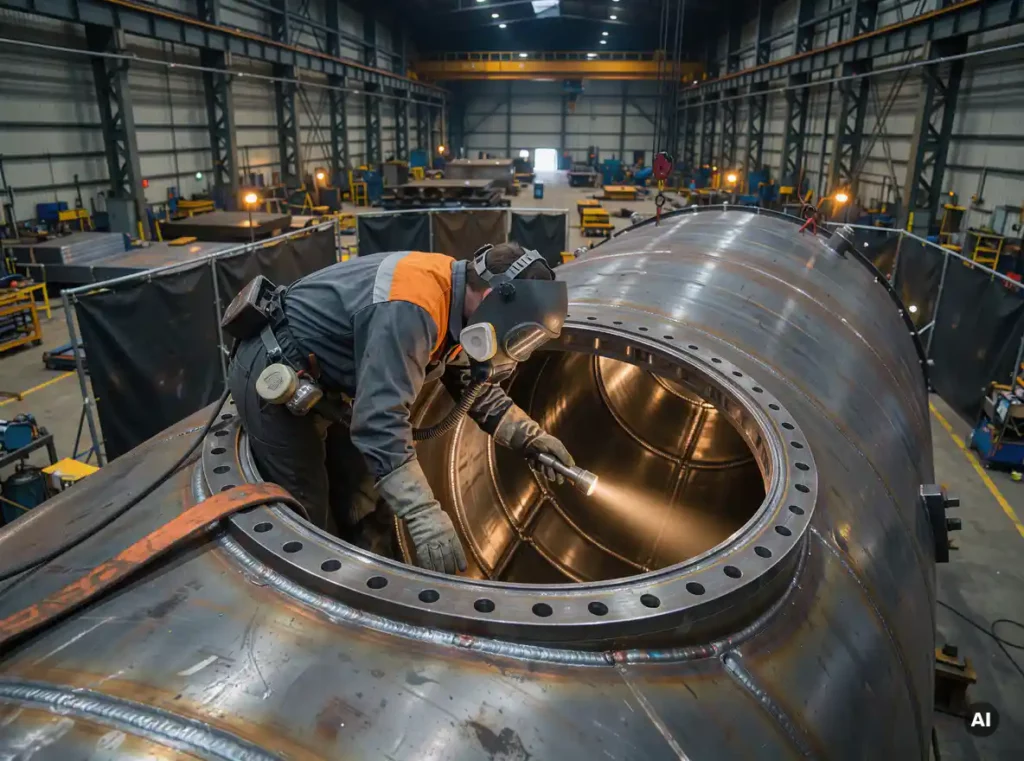
Inspection access matters because reactor internals can block the lines of sight, probe paths and working space that inspectors and maintenance crews need to examine welds, cladding and wall surfaces. If access is planned late, internals may hide critical zones, forcing costly redesign or leaving areas permanently uninspectable.
Access decisions affect safety, code compliance and downtime for the entire life of the vessel. The questions below cover what internals block, how to size openings, whether to remove or fix internals, what the codes expect, and when to lock the design.
Which inspection points do reactor internals typically block?
Reactor internals most often block access to shell and head welds, nozzle attachment welds, the vessel wall behind coils or baffles, and the weld seams that attach the internals themselves. Anything that sits between an inspector and the surface can hide corrosion, cracking or cladding defects.
Typical obstructions include:
- Dense internal piping, distributors and spargers that cover large wall areas
- Cooling or heating coils placed close to the shell
- Trays, baffles and support rings that interrupt visual lines of sight
- Agitator shafts, impellers and draft tubes in the central volume
- Internal supports welded directly to the pressure boundary
The weld attaching an internal to the shell deserves special attention. It is both a potential defect site and a spot where crevices can trap process media. If an inspector cannot reach it with a camera, probe or hand tool, it effectively falls outside the inspection plan.
How large should manways and access openings be?
Manways should be large enough for a person wearing protective equipment to enter and exit, and for tools, probes and removable parts to pass through. Many projects treat roughly 450 to 600 mm as the working range for circular manways, but process requirements, safety rules and internals layout should set the final size.
Size alone is not the whole story. Location matters just as much. A generous manway is of little use if a tray support or distributor sits directly behind it. Consider these factors:
- Entry path: Check that the route inside the vessel stays clear after internals are installed.
- Rescue access: Confined space rules often require that an incapacitated worker can be removed quickly.
- Equipment passage: Inspection crawlers, cleaning tools and replacement parts need a clear route.
- Multiple openings: Tall or long vessels usually need more than one access point to reach every zone.
- Nozzle and platform interaction: External piping and platforms should never block the opening.
For very large reactors, a manway at each level or section is often more practical than a single opening at the bottom. Designers should confirm access with a 3D model or layout review rather than relying on drawings alone.
Should reactor internals be removable or fixed?
Internals should be removable when they sit in areas that need periodic inspection, cleaning or replacement, and fixed when they are structural, rarely serviced and do not hide critical surfaces. The right choice balances inspection needs against the added cost and leak paths that removable designs bring.
Removable internals, such as trays in sections, bolted distributors or lift-out coil bundles, give direct access to the wall and welds. They suit processes with fouling, erosion or aggressive media. The trade-offs are more flanges, more gaskets and tighter fit-up tolerances.
Fixed internals reduce potential leak points and can be stronger, but they depend on the manway layout and on inspection methods that work around them. Welded-in internals also make later repair harder.
A hybrid approach often works best. Keep structural elements fixed, make wear items and anything near critical welds removable, and design the sections so they fit through the available openings. Removal paths should be checked during design, not discovered during the first shutdown.
What do PED and ASME require for internal inspectability?
Both the Pressure Equipment Directive (PED) and ASME Section VIII expect that pressure equipment can be inspected in service where this is needed for safety. They do not prescribe one fixed opening size for every vessel, so the designer must show that the chosen openings and internal layout allow adequate examination.
Under PED, the essential safety requirements address provisions for examination, which include suitable openings for internal access where required. ASME Section VIII sets rules for inspection openings, including when manholes or handholes are needed based on vessel size and service conditions. Local regulations, user specifications and the notified body or authorized inspector may add further expectations.
In practice, the following steps keep a project on track:
- Confirm which code and which edition apply to the vessel and its jurisdiction.
- Check the inspection opening rules for the vessel diameter, service and corrosion allowance.
- Identify which examination methods the in-service plan will use, such as visual, ultrasonic or dye-penetrant testing.
- Verify that internals do not prevent those methods from reaching the required areas.
- Document the access basis in the design file for the inspecting authority to review.
Customer specifications are frequently stricter than the codes, so always compare both.
How does clad or exotic-alloy construction change access needs?
Clad and exotic-alloy construction raises the importance of inspection access because the corrosion-resistant layer is the part that protects the vessel, and defects in it can be hard to detect from outside. Inspectors often need direct visual and surface access to the inner layer, its welds and its transitions.
Several factors increase access needs:
- Overlay and strip-lined welds: Seam welds in the cladding must be examined for continuity and surface quality.
- Nozzle and manway cladding: Transitions where the liner meets a nozzle or opening are common points of concern.
- Material sensitivity: Titanium, zirconium and similar materials need clean handling, so access routes should limit contamination and mechanical damage.
- Repair difficulty: Repairing a damaged liner is demanding, so early detection has real value.
Internals made from these materials add another layer of planning. Welding them directly to the clad surface can compromise the barrier, so many designs use supports that avoid disturbing the liner. Those details need to be settled with the inspection plan in mind.
When should inspection access be locked into the design?
Inspection access should be locked into the design during the early mechanical engineering phase, before the internals layout, nozzle orientation and fabrication sequence are frozen. Changing openings after detailed design usually means rework on the shell, the internals and the inspection plan at the same time.
A practical approach is to review access at set milestones: when the process requirements are translated into a mechanical concept, when internals are laid out in 3D, and before fabrication drawings are released. At each point, ask whether every critical weld and surface can be reached, and whether the removal path for each major internal is clear.
Fabrication also matters. Some internals must be installed in a specific sequence, and large vessels may be built in sections. If access is not considered together with the build plan, an internal may end up trapped inside a closed shell with no way out. Involving the fabricator early prevents this kind of problem.
How does inspection access affect lifecycle maintenance and downtime?
Good inspection access shortens shutdowns, reduces the risk of unplanned outages and lowers the cost of maintaining a reactor over its service life. Poor access forces teams to remove more equipment, extend turnarounds or accept blind spots that raise the chance of a failure going unnoticed.
The effects show up in several ways:
- Inspectors finish faster when they can reach surfaces directly.
- Cleaning and repair crews can work in parallel instead of in sequence.
- Replacement of worn internals is planned rather than improvised.
- Inspection results are more reliable, which supports sound decisions about continued operation.
For critical process equipment, a longer turnaround often costs far more than the extra design effort needed to improve access. Thinking about the full lifecycle during design is one of the most effective ways to protect uptime.
How Coek helps with reactor inspection access
Coek designs and manufactures custom reactors and pressure equipment where inspection access is considered together with mechanical design and fabrication. Process requirements come from the customer, EPC contractor or technology owner, and our engineers translate them into mechanically sound, manufacturable equipment.
Our support typically includes:
- Mechanical design reviews of manway placement, internals layout and removal paths
- Design to ASME, PED and other international codes, with inspection plan set-up handled by a dedicated project engineer
- Experience with clad and exotic-alloy construction, including titanium, zirconium, tantalum and Hastelloy
- Quality control that includes ultrasonic, dye-penetrant and magnetic particle examination
- Integrated scopes that can cover agitators, drive systems, seals and instrumentation
If you are planning a reactor and want inspection access resolved before the design is fixed, contact our team to discuss your requirements.
Frequently Asked Questions
How do I start planning inspection access on a new reactor project?
Begin by listing every critical weld, cladding seam and wall zone that the in-service inspection plan must reach, then map each one against the proposed internals layout. Share that list with the process licensor, the fabricator and the inspecting authority during the early mechanical concept phase. A simple access matrix (zone, inspection method, access route, removable internal in the way) makes gaps obvious before the 3D model is frozen.
What can I do if an existing reactor has internals that block critical welds?
Start by reviewing as-built drawings and past inspection reports to identify exactly which areas are uninspectable. Options include adding a new nozzle or manway, converting selected internals to sectional or bolted designs during the next turnaround, or using alternative methods such as remote crawlers, borescopes, or external ultrasonic and phased-array techniques. Any modification should be agreed with the authorized inspector and documented in the vessel file.
Can remote inspection tools replace larger manways and removable internals?
Remote tools such as crawlers, drones, borescopes and phased-array probes can reduce the need for human entry, but they still need a clear path through an opening and line of sight or probe access to the surface. They work best as a complement to good physical access, not a substitute. Always confirm the tool dimensions and reach against the actual opening size and internals clearances during design.
What are the most common mistakes when designing for inspectability?
Frequent mistakes include placing manways directly behind trays or distributors, welding internals to the shell without a way to examine those welds, and forgetting that external platforms or piping can block an opening. Another is sizing sections of removable internals larger than the manway they must pass through. A 3D layout review with fabrication and maintenance input catches most of these issues early.
How should I document inspection access for the authorized inspector or notified body?
Include an access basis in the design file that states the applicable code and edition, the inspection openings provided, the examination methods planned, and how internals allow those methods to reach required areas. Supporting items such as 3D screenshots, removal-path sketches and the inspection plan make review faster. Documenting customer specification requirements alongside the code requirements also avoids disputes later.
How do I protect clad or titanium and zirconium surfaces during inspection entry?
Define clean-entry procedures in advance: use dedicated, non-contaminating footwear and tools, protect the liner with soft mats or padding on access routes, and avoid contact with carbon steel or iron-bearing materials. Keep the access path free of sharp edges and limit the number of people entering. These rules should be written into the inspection and maintenance procedures so that crews follow them every turnaround.
How many manways does a tall or multi-section reactor typically need?
There is no fixed number, since it depends on the vessel height, the code rules for inspection openings, the internals layout and rescue requirements. As a practical rule, add an opening wherever a section of the vessel cannot be reached and exited safely from another opening, often at each major level or between bed and tray sections. Confirm the final count with a layout review and the confined-space rules that apply at the site.