
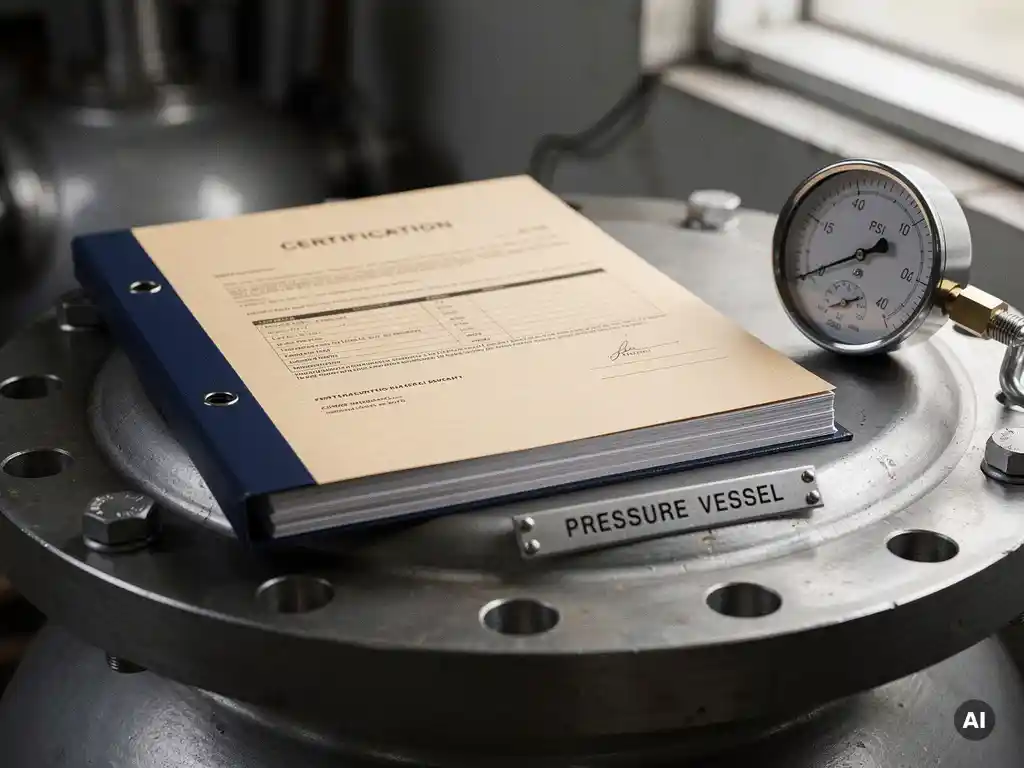
When delivering certified pressure equipment, the required documentation typically includes a Declaration of Conformity, a Manufacturer’s Data Report, material test certificates, welding records, non-destructive examination reports, pressure test records, and an inspection certificate issued or countersigned by a notified body where applicable. The exact package depends on the applicable regulatory framework, the equipment category, and the destination country. The sections below address each of these dimensions in detail.
Which regulatory frameworks govern pressure equipment documentation?
The regulatory framework that governs pressure equipment documentation is determined primarily by the country or region where the equipment will be installed and operated. The most widely referenced frameworks are the European Pressure Equipment Directive (PED 2014/68/EU), the American ASME Boiler and Pressure Vessel Code (BPVC), and regional standards such as AD Merkblätter in Germany and IBR in India.
Each framework defines its own documentation requirements, conformity assessment procedures, and acceptable inspection methods. The PED, for instance, classifies equipment into categories based on fluid type, pressure, and volume, and assigns a specific conformity assessment module to each category. ASME operates through a stamp-based system, where manufacturers hold authorisation to apply stamps such as the U-stamp or U2-stamp, each backed by a defined documentation trail.
For equipment destined for multiple markets or with unconfirmed end destinations, it is common practice to design and document to more than one standard simultaneously. This is particularly relevant for serial production items or equipment supplied through EPC contractors whose projects span multiple jurisdictions.
What documents must accompany a pressure vessel at delivery?
A pressure vessel at delivery must be accompanied by a complete documentation package that demonstrates regulatory compliance, material integrity, fabrication quality, and safe operating conditions. The core documents required at handover are:
- Declaration of Conformity (DoC): the manufacturer’s formal statement that the equipment meets the requirements of the applicable directive or standard
- Manufacturer’s Data Report (MDR) or Inspection Certificate: a structured record of the vessel’s design, materials, fabrication, and test results, countersigned by the inspection authority
- Material Test Certificates (MTCs): mill certificates for all pressure-bearing materials, confirming chemical composition and mechanical properties
- Welding Procedure Specifications (WPS) and Procedure Qualification Records (PQR): documentation that all welding was performed to qualified procedures
- Welder Qualification Records: confirmation that each welder was certified for the procedures applied
- Non-Destructive Examination (NDE) reports: results of radiography, ultrasonic testing, dye-penetrant or magnetic particle inspection as required by the applicable code
- Pressure test report: a signed record of the hydrostatic or pneumatic test, including test pressure, duration, and result
- Inspection and test plan (ITP): the agreed plan showing which activities were witnessed, reviewed, or held by the inspection authority
- Nameplate data sheet: confirming the data stamped on the vessel corresponds to the approved design
For custom pressure vessels destined for demanding operating environments, the documentation package often extends further to include heat treatment records, dimensional inspection reports, and coating or lining inspection records.
How does the equipment category affect documentation scope?
The equipment category directly determines which conformity assessment module applies and, therefore, how extensive the documentation package must be. Under the PED, higher-category equipment requires more rigorous third-party involvement and a broader set of certified records than lower-category equipment.
Category I equipment, which covers the lowest-risk applications, can be self-certified by the manufacturer under Module A, meaning the documentation is largely internal. As equipment moves into Categories II, III, and IV, the required modules involve increasing levels of notified body participation, from design examination through to full quality assurance system approval.
For Category IV equipment, which includes large-bore, high-pressure vessels handling hazardous fluids, the documentation package must demonstrate that every critical step, from design approval to final inspection, was independently verified. This significantly increases the volume and formality of records required at handover.
Under ASME, the distinction operates differently: the U-stamp covers unfired pressure vessels, the U2-stamp covers high-pressure vessels, and the UM-stamp covers miniature vessels. Each stamp type carries its own Manufacturer’s Data Report form and documentation obligations. Manufacturers who hold multiple stamps, as Coek Engineering does with ASME U and U2 authorisation, can cover a broad range of equipment categories within a single quality system.
What role does the notified body play in the documentation package?
A notified body is an independent third-party organisation designated by a national authority to assess conformity with the PED or similar directives. Its role in the documentation package is to review, witness, and countersign specific records, providing independent assurance that the equipment meets the required standard.
Depending on the conformity assessment module, the notified body may be involved at the design stage (reviewing and approving design calculations), during fabrication (witnessing critical operations such as welding or heat treatment), and at final inspection (witnessing the pressure test and issuing or countersigning the inspection certificate).
The notified body’s countersignature on the Manufacturer’s Data Report or equivalent certificate is what transforms an internally produced document into a third-party verified record. Without this, equipment in higher PED categories cannot legally be placed on the European market.
For ASME-stamped equipment, the equivalent role is performed by an Authorised Inspection Agency (AIA). The Authorised Inspector (AI) employed by the AIA witnesses fabrication milestones, reviews documentation, and countersigns the Manufacturer’s Data Report before the ASME stamp can be applied.
How are material traceability records structured for exotic alloys?
Material traceability records for exotic alloys must establish an unbroken chain of identity from the raw material mill certificate through to the finished component, ensuring that no substitution or mix-up occurred at any stage of fabrication. This is particularly critical for alloys such as titanium, zirconium, Hastelloy, and Inconel, where material identity directly affects corrosion performance and mechanical integrity.
A robust traceability system for exotic alloys typically operates as follows:
- Receipt and verification: incoming material is checked against the mill certificate for heat number, chemical composition, and mechanical properties before being accepted into stock
- Marking and segregation: each piece of material is marked with its heat number and physically segregated from other materials to prevent cross-contamination
- Cut piece tracking: when material is cut into components, each piece retains its heat number marking or is assigned a traceable component identifier linked back to the original certificate
- Positive Material Identification (PMI): for critical exotic alloys, PMI testing using X-ray fluorescence or optical emission spectroscopy confirms material identity at key fabrication stages
- Record consolidation: all heat numbers referenced in the completed vessel are listed in the final documentation package, with each linked to its corresponding mill certificate
For clad equipment, where a carbon steel base is combined with a corrosion-resistant inner layer, separate traceability records are maintained for both the base material and the cladding material, including the explosion bonding or weld overlay qualification records that govern the bond interface.
What happens if documentation is incomplete at handover?
Incomplete documentation at handover creates immediate regulatory, contractual, and operational consequences. Equipment that arrives without a complete documentation package cannot be legally placed into service in most jurisdictions, and the project timeline suffers while missing records are resolved.
From a regulatory standpoint, pressure equipment without a valid Declaration of Conformity and inspection certificate cannot be commissioned under the PED. Under ASME, equipment without a countersigned Manufacturer’s Data Report cannot carry the ASME stamp and may be rejected by the end user’s inspection authority.
Contractually, most EPC and end-user purchase orders specify that the documentation package is part of the deliverable. Incomplete handover documentation can trigger non-conformance reports, cause final payment to be withheld, or require the manufacturer to return to site to complete witnessing activities that should have been closed during fabrication.
Operationally, missing traceability records create problems throughout the equipment’s service life. Insurance assessments, statutory re-inspections, and fitness-for-service evaluations all rely on the original documentation. Equipment with gaps in its record history is harder to maintain and may face restrictions during future re-rating or repair activities.
The most effective safeguard is a well-structured inspection and test plan agreed before fabrication begins, with documentation hold points built in at each critical stage rather than assembled retrospectively at the end of the project.
How should pressure equipment documentation be managed long-term?
Pressure equipment documentation should be managed as a permanent technical record that follows the equipment throughout its service life. The documentation package delivered at handover is not an administrative formality but the foundation for every future inspection, repair, modification, and fitness-for-service assessment the equipment will undergo.
Effective long-term management involves three core practices. First, the original documentation package should be stored in a format that remains accessible and legible over decades, whether in a controlled physical archive, a structured digital document management system, or both. Second, any changes made to the equipment after delivery, such as nozzle modifications, re-ratings, or repairs, must be documented and linked to the original package so that the record remains a complete and accurate reflection of the equipment’s current condition. Third, statutory re-inspection records, pressure test renewals, and inspection authority findings should be added to the file at each inspection interval.
Regulatory bodies and insurance underwriters typically require that original documentation can be produced on request at any point during the equipment’s operational life. For long-life assets such as large reactor vessels or autoclaves, this means managing records over periods of 20, 30, or even 40 years.
End users and asset owners are encouraged to establish a document control procedure specifically for pressure equipment records, separate from general project archives, to ensure that these technically critical files are not lost during organisational changes, system migrations, or site transfers.
How Coek Engineering supports compliant pressure equipment documentation
At Coek Engineering, documentation is treated as an integral part of the manufacturing process, not a final step. For every project, a dedicated project engineer coordinates the full documentation package alongside fabrication, ensuring that records are complete, traceable, and aligned with the applicable regulatory framework before delivery.
- Design and fabrication performed in accordance with ASME, PED, AD Merkblätter, TEMA, and regional standards including IBR (India), KGS (Korea), and ML (China)
- Full material traceability from mill certificate to finished component, including PMI for exotic alloys such as titanium, zirconium, Hastelloy, and Inconel
- In-house quality management supported by independent external inspection agencies and recognised notified bodies
- NDE capabilities including phased array ultrasonic examination and TOFD, with full reporting integrated into the documentation package
- Certifications including ISO 9001, ASME U, U2 and UM stamps, National Board, PED modules D, H, and H1, and multiple regional certificates
Whether you are sourcing a single critical vessel or a broader equipment scope, Coek’s engineering and quality teams ensure that the documentation delivered at handover meets your project’s regulatory, contractual, and operational requirements. Contact Coek Engineering to discuss your project requirements.
Frequently Asked Questions
Can a manufacturer self-certify pressure equipment documentation, or is third-party involvement always required?
It depends on the equipment category and applicable framework. Under the PED, Category I equipment can be self-certified by the manufacturer under Module A, meaning no notified body involvement is required. However, for Categories II through IV, third-party participation becomes mandatory to varying degrees — ranging from design examination to full quality assurance system approval. Under ASME, an Authorised Inspector from an Authorised Inspection Agency must always countersign the Manufacturer’s Data Report before the stamp can be applied, regardless of vessel size or pressure class.
What is the most common documentation mistake manufacturers make during pressure vessel fabrication?
The most common mistake is treating documentation as a retrospective exercise — assembling records only at the end of the project rather than capturing them progressively during fabrication. This approach frequently results in missing witness signatures, undated test records, or traceability gaps that are difficult or impossible to close after the fact. The most reliable safeguard is an agreed Inspection and Test Plan (ITP) established before fabrication begins, with defined hold and witness points at each critical stage to ensure records are captured in real time.
How do documentation requirements differ when supplying pressure equipment to multiple countries simultaneously?
When equipment is destined for multiple markets or jurisdictions, the documentation package must satisfy the most stringent requirements of all applicable frameworks simultaneously. In practice, this means identifying the overlapping requirements of each standard — for example, PED and ASME — and designing the documentation trail to satisfy both from the outset. Material certificates, NDE reports, and pressure test records are generally acceptable across frameworks, but conformity assessment modules, stamp authorisations, and notified body involvement must each be addressed separately for each target market.
How long must pressure equipment documentation be retained, and who is responsible for keeping it?
Under the PED, manufacturers are required to retain the technical documentation for at least 10 years after the equipment is placed on the market. However, from an operational standpoint, the full documentation package should be maintained for the entire service life of the equipment, which for large industrial vessels can span 30 to 40 years. Responsibility is shared: the manufacturer must retain design and fabrication records, while the end user or asset owner is responsible for maintaining the handover package, adding re-inspection records, and ensuring the file remains accessible throughout the equipment’s operational life.
What is Positive Material Identification (PMI), and when is it required in the documentation package?
Positive Material Identification (PMI) is a non-destructive testing method — typically using X-ray fluorescence (XRF) or optical emission spectroscopy (OES) — that verifies the elemental composition of a material against its mill certificate. It is required when material mix-up would pose a serious safety or corrosion risk, which is almost always the case with exotic alloys such as titanium, Inconel, Hastelloy, and zirconium. PMI results are documented and included in the final traceability package, providing independent confirmation that the correct material was used at each critical location in the finished vessel.
Can pressure equipment documentation be issued and stored digitally, or must it be provided in hard copy?
Most regulatory frameworks, including the PED and ASME, permit documentation to be issued and stored in digital format, provided the records are controlled, tamper-evident, and reliably accessible over the long term. In practice, a hybrid approach is common: digital document management systems are used for day-to-day access and long-term storage, while wet-signed originals or certified copies are retained for key certificates such as the Declaration of Conformity and the Manufacturer’s Data Report. End users should ensure their document control procedure accounts for system migrations and organisational changes that could otherwise result in records becoming inaccessible over a multi-decade asset life.
What steps should a buyer take when receiving a pressure vessel documentation package to verify it is complete and correct?
Upon receipt, the buyer should verify the package against the agreed documentation requirements listed in the purchase order or ITP, checking that every specified document is present and that each carries the required signatures and countersignatures. Key checks include confirming that all heat numbers on material certificates match those referenced in the Manufacturer’s Data Report, that NDE reports cover the scope required by the applicable code, and that the pressure test record is signed by both the manufacturer and the inspection authority. Any discrepancies should be raised as formal non-conformances before final payment is released, as resolving documentation gaps after handover becomes significantly more difficult and costly.
Related Articles
- What determines the manufacturing cost of a large industrial pressure vessel?
- What international standards apply to pressure vessel design and certification?
- What's another name for autoclave?
- When does a pressure vessel require thick-wall design?
- What causes corrosion in pressure vessels and how can it be prevented?